
Logo

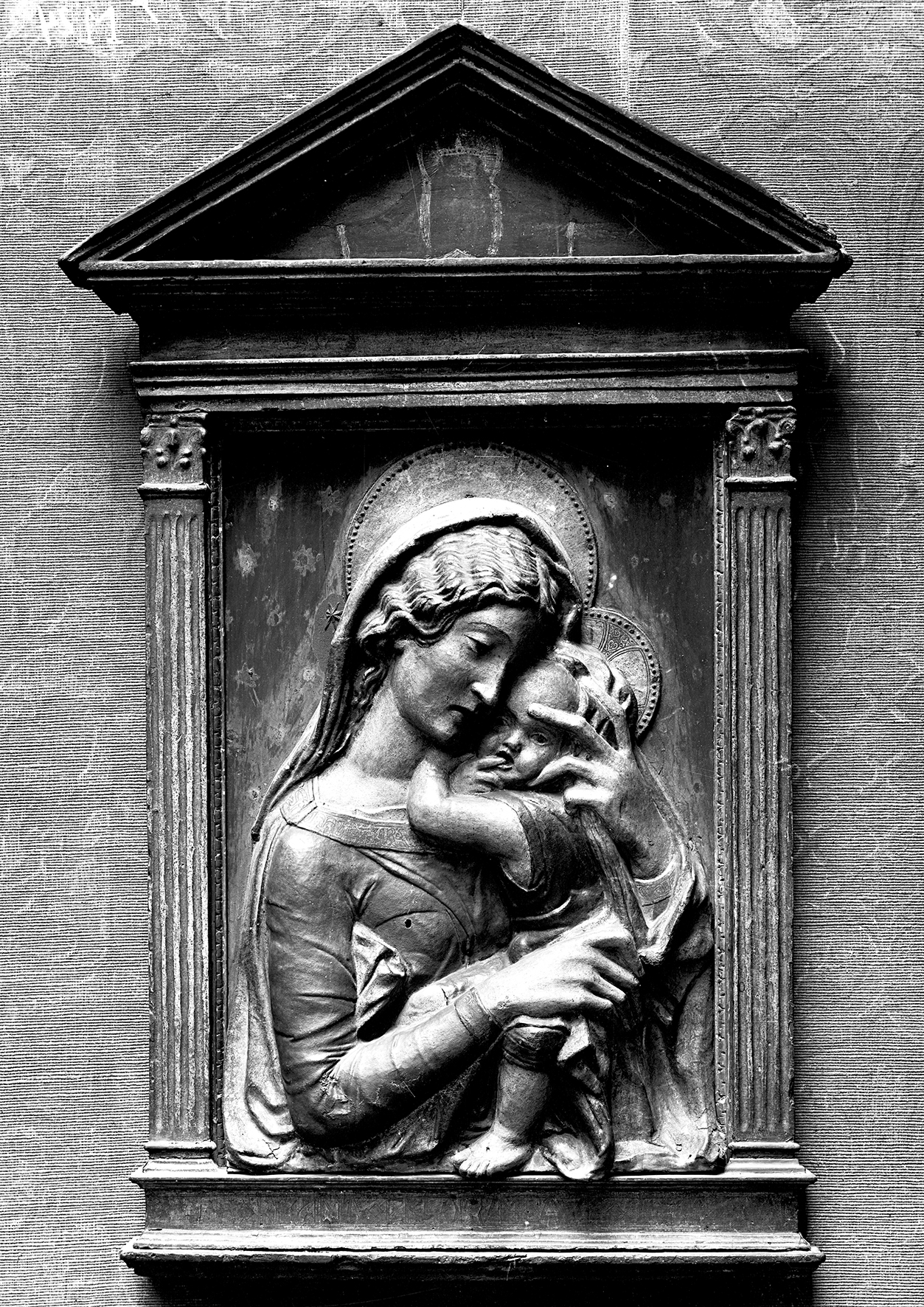
Madonna von Verona / Virgin and Child (called the Verona Madonna)

Ident. Nr.: M 24

ObjID: obj:1063458

Eigentum des Kaiser Friedrich Museumsvereins
Details (expert)

Creator/Entity
nach: Donatello (um 1386-1466)
Date(s)
Datierung: 1446/1455
Material / Technique
Dimensions
Höhe x Breite: 83 x 56 cm

Object Description

After Donatello

Virgin and Child (called the Verona Madonna)
ca. 1450

Papier-mâché
83 x 56 cm
In the pediment of the frame, a representation of God the Father, in a style close to Paolo Uccello or Andrea di Giusto.

Berlin, Staatliche Museen zu Berlin, Skulpturensammlung, Inv. SKS M 24.
Formerly Kaiser-Friedrich-Museum, lost since May 1945.

Provenance
Florence (1900); Berlin, Skulpturensammlung/Altes Museum (1900-1904); Berlin, Skulpturensammlung/Kaiser-Friedrich-Museum (1904-1939); Berlin, storage (1939-1945); whereabouts unknown (1945-present).

Acquisition
Bought in Florence in 1900, anonymous gift.

Other Versions
• Berlin, Staatliche Museen, Skulpturensammlung, Inv. SKS M 254. Bode-Museum, storage. Terracotta, 73.8 x 53 cm.
• Florence, Museo Nazionale del Bargello, Inv. Sc. 363. Terracotta, 76 x 53 cm.
• Krefeld, Kaiser-Wilhelm-Museum, Inv. 202/1901. Painted stucco, 95 x 65 cm.
• London, Victoria and Albert Museum, Inv. A1-1932. Stucco, h: 95.3 cm.
• Lugano, Rohoncz Castle.
• New York, Metropolitan Museum of Art, Inv. 12.78. Painted terracotta, 73.7 x 52.1 cm.
• Paris, Musée du Louvre, Inv. RF 589. Papier-mâché, 95 x 57 cm.
• Verona, via delle Fogge, façade. Stucco.
• Formerly Berlin, Königliche Museen. Sold in 1900.
• Formerly Vienna, Castiglioni collection.

Comment
This type of Virgin and Child is known as the Verona Madonna, after a composition in stucco that is still visible today in a street tabernacle on the Via delle Fogge in Verona. The composition is known in various versions (see Radcliffe 1992) and has almost always been connected to Donatello: the close but sad relationship between the mother and her Child; the plasticity of the two arms of Mary, subtly foreshortened; her hairdo; the position of the Child, held tightly and free at the same time, and twisting in several directions – all this has its origin in the art of Donatello. In the master’s oeuvre, the Verona Madonna can be directly compared with the Louvre Madonna (Inv. RF 353) and the Madonna with Cherubs in the Bode-Museum (Inv. SKS 54), which points towards a creation in the 1440s. A painting once attributed to Andrea Mantegna formerly in the Goodbody Collection in Invergarry and in the T. E. Nelson collection in Manchester seems a direct echo of this composition (see Ronald Lightbown, Mantegna, Oxford, Phaidon and Christie’s, 1986, p. 480 cat. 173, pl. 203); it is a good indication that the original work may have been created during Donatello’s stay in Padua (1443-1454). The Virgin and Child in a similar pose in a trompe-l’oeil lunette in one of the reliefs of the Santo Altarpiece by Donatello (the Miracle of the Speaking Infant) gives weight to this hypothesis.
The Berlin Museums have had a difficult history with images of the Verona Madonna type. A first version of the work (in which the figures had haloes) was bought in Venice in 1884 (Bode and Tschudi 1888), but sold in 1900 when the present relief was acquired thanks to the recently created Kaiser Friedrich-Museums-Verein. The deaccession of the first relief may reflect doubts about its authenticity, as no other piece in the Donatellesque collection in Berlin had such a fate (the works sold during the Nazi-era represent a special case; see Inv. SKS 2930). The present relief was lost in the Friedrichshain fires in May 1945 – a loss that is all the more regrettable as this version in papier-mâché was said to be the closest one to the original by Donatello (see Gentilini 1985; Payre 1989). In 1967, the Kaiser Friedrich-Museums-Verein bought for the West Berlin collection another version of the relief (Inv SKS 254). In 1986, thermoluminescence indicated that this later acquisition was fired during the 19th or the 20th century (archives of the Bode-Museum); the possibility of a forgery may be confirmed by the somewhat too geometrical aspect of the reverse (Bodo Buczinsky, oral communication, August 2015).


Literature
Bode 1900
Wilhelm Bode, “Erwerbungen im Jahre 1899/1900”, Kaiser Friedrich-Museums-Verein zu Berlin. Bericht für das Geschäftsjahr 1899-1900, Berlin, Büxenstein, 1900, p. 12: Donatello, Paduan period.
Marquand 1913
Allan Marquand, “Some Works by Donatello in America”, Art in America, I, n°4, October 1913, p. 221: said to come from Venice (confusion with the former version in the Berlin Museums, Inv. SKS 62).
Schottmüller 1913
Frida Schottmüller, Die italienischen und spanischen Bildwerke der Renaissance und des Barocks in Marmor, Ton, Holz und Stuck, Berlin, Georg Reimer, 1913, pp. 18-19 cat. 37: the original by Donatello does not exist anymore; other versions notably in the Via delle Fogge, Verona; in the Museo Nazionale del Bargello, Florence; in the Beckerath collection, Berlin.
Bode 1922
Wilhelm von Bode, Die Italienische Plastik, 7th ed., Berlin and Leipzig, Vereinigung wissenschaftlicher Verleger and De Gruyter, 1922, p. 78 fig. 39: Donatello.
Maclagan and Longhurst 1932
Eric Maclagan and Margaret H. Longhurst, Catalogue of Italian Sculpture, London, Victoria and Albert Museum, 1932, p. 23.
Schottmüller 1933
Frida Schottmüller, Die italienischen und spanischen Bildwerke der Renaissance und des Barock. Erster Band. Die Bildwerke in Stein, Holz, Ton und Wachs, Zweite Auflage, Berlin and Leipzig, Walter de Gruyter & Co., 1933, p. 11: workshop of Donatello, ca. 1445; existed as an unpainted version in the Kaiser-Friedrich-Museum that was sold after this acquisition; p. 12: same master as Inv. SKS 2634.
Feulner 1941
Adolf Feulner (ed.), Stiftung Sammlung Rohoncz. III. Teil. Plastik und Kunsthandwerk, Lugano, n. ed., 1941, p. 14.
Goldscheider 1941
L. Goldscheider, Donatello, Paris, Phaidon, 1947, p. 39 fig. 114: after Donatello.
“Verzeichnis…” 1953
“Verzeichnis der im Flakturm Friedrichshain verlorengangenen Bildwerke der Skulpturen-Abteilung”, Berliner Museen, new series, III, n°1-2, 1953, p. 12: burnt between 5 and 10 May 1945.
Pope-Hennessy 1964
John Pope-Hennessy, Catalogue of Italian Sculpture in the Victoria and Albert Museum, London, Her Majesty’s Stationary Office, 1964, I, p. 85: after Donatello.
Berliner Museen 1968
Berliner Museen, new series, XVIII, n°1, 1968, pp. 36, 38: about the new acquisition in 1967 of Inv. SKS M 254, replacing the Inv. SKS M 24, lost in 1945.
Kaiser-Friedrich-Museums-Verein Berlin… 1972
Kaiser-Friedrich-Museums-Verein Berlin. Erwerbungen 1897-1972, n. pl., Adolph Fürst & Sohn, 1972, p. 34 cat. 24: Donatello.
McNeal Caplow 1977
Harriet McNeal Caplow, Michelozzo, New York and London, Garland Publishing, 1977, I, pp. 483-485; II, fig. 186: after a prototype by Michelozzo and not by Donatello.
Gentilini 1985
Giancarlo Gentilini in Paola Barocchi et al. (eds.), Omaggio a Donatello. 1386-1986. Donatello e la storia del Museo, exh. cat. (Florence, Museo Nazionale del Bargello, 19 December 1985-30 May 1986), Florence, SPES, 1985, pp. 432-434: with the Krefeld version, the closest version to the lost original by Donatello.
Neri Lusanna 1986
Enrica Neri Lusanna, “Stefano Bardini e la collezione di sculture”, in eadem and Lucia Faedo (eds.), Il museo Bardini a Firenze. Volume secondo: le sculture, Milan, Electa, 1986, p. 24 and 31: Bardini provenance.
Krahn and Lessmann 1987
Volker Krahn and Johanna Lessmann, Italienische Renaissancekunst im Kaiser Wilhelm Museum Krefeld, Krefeld, Krefeld Kunstmuseen, 1987, p. 26.
Payre 1989
Marie-Noëlle Payre, La Madone de Vérone, MA Thesis (IFROA, Sculpture Section, 2nd part), 1989: this version and the one in the Musée du Louvre, Paris are the most ancient ones.
Radcliffe 1992
Anthony Radcliffe in idem, Malcom Baker and Michael Maek-Gérard, The Thyssen-Bornemisza Collection. Renaissance and Later Sculpture with Works of Art in Bronze, London, Sotheby’s Publications, 1992, pp. 48-53.
Elsig 1997
Frédéric Elsig in Mauro Natale and Claude Ritschard (eds.), L’art d’imiter. Images de la Renaissance italienne au Musée d’art et d’histoire, exh. cat. (Geneva, Musée d’art et d’histoire, 14 March-28 September 1997), Geneva, Musée d’art et d’histoire, 1997, p. 127: Paduan workshop of Donatello; does not mention Inv. KFM 254.
Keller 1997
Peter Keller, “Katalog der Bildwerke (Skulptur) und des Kunstgewerbes des Kaiser-Friedrich-Museums-Vereins”, in 100 Jahre Mäzenatentum. Die Kunstwerke des Kaiser-Friedrich-Museums-Vereins Berlin, Berlin, Kaiser-Friedrich-Museums-Verein, 1997, p. 228: workshop of Donatello.
Jolly 1998
Anna Jolly, Madonnas by Donatello and his Circle, Frankfurt am Main et al., Peter Lang, 1998, p. 122 cat. 28. 1: after Donatello, later 1440s.
Lambacher 2006
Lothar Lambacher (ed.), Staatliche Museen zu Berlin. Dokumentation der Verluste. Skulpturensammlung. Band VII. Skulpturen. Möbel, Berlin, Staatliche Museen zu Berlin-Preußischer Kulturbesitz, 2006, p. 137: last documented in the vault of the Neue Reichsmünze, Berlin on 7 April 1945, crate n°750 KFM.
Vaccari 2006
Maria Grazia Vaccari in Vittorio Sgarbi (ed.), La scultura al tempo di Andrea Mantegna tra classicismo e naturalismo, exh. cat. (Mantua, Castello di San Giorgio, 16 September 2006-14 January 2007), Milan, Electa, 2006, p. 62: related to the version in the Museo Nazionale del Bargello, Florence (Inv. 363), exhibited as by Donatello.
Bormand 2008
Marc Bormand, Donatello. La Vierge et l’Enfant. Deux reliefs en terre cuite, Paris, Musée du Louvre et Somogy, 2008, p. 19: related to the version in the Musée du Louvre, also in papier-mâché.
Gentilini 2008
Giancarlo Gentilini, “La cartapesta nel Rinascimento toscano”, in Raffaele Casciaro (ed.), La scultura in cartapesta. Sansovino, Bernini e i Maestri leccesi tra tecnica e artificio, exh. cat. (Milan, Museo diocesano, 15 January-30 March 2008; Lecce, Museo provinciale “Sigismondo Castromediano”, 18 April-15 June 2008), Cinisello Balsamo, Silvana, 2008, p. 32: related to the version in the Musée du Louvre, also in papier-mâché.

Neville Rowley (24 May 2016)

Last updated: 30.07.2026

Contact

Institution:

Skulpturensammlung und Museum für Byzantinische Kunst

Additional items from the collections

Bildnis Baron Otto Hermann Vietinghoff-Scheel

Bildnis Baron Otto Hermann Vietinghoff-Scheel

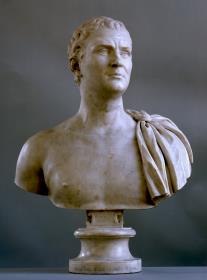
Über einem knappen Schulterausschnitt erhebt sich der leicht nacht rechts gewendete Kopf des ca. 55-jährigen Barons Otto Hermann von Vietinghoff-Scheel. Er trägt unter dem Rock eine Weste mit einem darüber diagonal verlaufenden Ordensband, weiter ein über die Brust reichendes Halstuch, das so genannte Jabot, mit dem der vordere Ausschnitt der Weste verdeckt wird. Sein Haar ist nach der im 18. Jahrhundert in Mode gekommenen Zopftracht mit Seitenlocken frisiert, die dem wohlgenährten Gesicht eine natürliche Würde verleiht.Der 1722 in Riga geborene Baron von Vietinghoff gehörte dem deutschbaltischen Uradel an und zählte zu den bedeutendsten Persönlichkeiten Livlands. Neben seinen Aufgaben als livländischer Gouvernementsregierungsrat in Riga, später Geheimrat und Senator, sowie am Hof von St. Petersburg, wo er im Dienste Katharina der Großen stand, machte er sich vor allem durch sein kulturelles, der Aufklärung verpflichtetes Engagement einen Namen. Sein immenser Reichtum erlaubte es ihm, die Kirche in Marienburg errichten zu lassen und ein großes Haus zu führen, im dem er die "Gesellschaft der Muße" gründete und ein Liebhaber-Theater einrichtete, deren Direktor er lange Zeit war. Darüber hinaus unterhielt er ein Orchester mit hervorragenden Musikern. Seine breitgefächerte Bildung und Kunstkenntnisse wie auch seinen ausgeprägten, in verschiedenen zeitgenössischen Quellen gerühmten Geschmack erwarb er durch zahlreiche ausgedehnte Reisen durch Frankreich und Italien. Unter seinem Einfluß erlebte seine Heimatstadt Riga einen kulturellen Aufschwung.Auf einer seiner zahlreichen Reisen in die französische Hauptstadt suchte der Baron - vermutlich 1777 - auch die Werkstatt von Jean-Antoine Houdon auf, um sich von dem erst 36-Jährigen, aber schon im Zenit seines Ruhmes stehenden Billdhauer porträtieren zu lassen. Houdon, der sculpteur der französischen Aufklärung, hatte sich vor allem durch seine Büsten der philosophes, der Pariser Intellektuellen wie u. A. Denis Diderot (1771) hervorgetan.Die zunächst in Gips ausgeführte Büste des Baron von Vietinghoff wurde im Pariser Salon von 1777 - wohl nur kurze Zeit nach ihrer Entstehung - mit 25 weiteren Werken Houdons ausgestellt, wie das livret unter der Nr. 238 vermerkt: "Portrait de M. le Baron de Vietinghoff (buste platre)". Diese frühe Fassung, von der noch weitere, nicht datierte Gipsrepliken existieren, dürfte als Modell für das hier gezeigte Marmorporträt von 1791 gedient haben, den es zeigt zweifellos den Mittfünfziger und nicht den 69-Jährigen, am Ende seines Lebens stehenden Baron. Houdon erfaßte in diesem Porträt nicht nur den selbstbewußten Staatsmann, dessen energisches Durchsetzungsvermögen uns in der Profilansicht besonders hervortritt, sondern auch den aufmerksamen lebensbejahenden Menschen, charkterisiert durch die leicht geöffneten Lippen und vor allem seinen offenen Blick, der einen Eindruck von jener Aktivität vermitttelt, mit der er durch sein wohltätiges Handeln einen kulturellen Wandel in seiner Heimatstadt herbeiführte. Houdon hat mit dieser Büste den Ruhm und die Verdienste des Barons auf eindrucksvolle Weise der Nachwelt überliefert.Hans-Ulrich Kessler

Heiliger Michael

Heiliger Michael

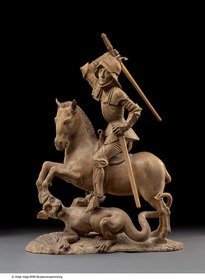
Auf einer flachen, unregelmäßig polygonalen Plinthe steht der Erzengel Michael aufrecht, fast säulenhaft gerade und stößt eine nur in ihrer mittleren Partie noch ursprüngliche Lanze in das Maul des samt Hals vollständig erneuerten Drachenkopfs. Während das linke Standbein mitsamt dem Fuß gänzlich unter dem Gewand verschwindet, ist das rechte Bein leicht nach außen gestellt, sodass sich das Knie durch den Stoff drückt. Somit wird der Tritt des rechten Fußes (Zehen erneuert) auf den Schwanz des Drachen betont, dessen Spitze sich um den Engel windet und in dessen Rücken wieder emporrankt. Abgesehen von diesen knappen Berührungen sind Erzengel und Drachen weitgehend separiert komponiert, Spannung durch Interaktion oder gar Dramatik fehlt. Zu unterlegen und geradezu wehrlos ist der relativ kleine Drachen mit kurzen Vogelkrallen und verkümmerten Flügeln mit schneckenartig eingerollten Spitzen. Das wird auch mit dem originalen Kopf kaum anders gewesen sein – zumal der breitschultrige Michael mit seinen ursprünglich höher und weiter ausgespannten Flügeln noch imposanter und kraftvoller gewirkt hat als mit den schematisch geraden und viel zu bescheidenen heutigen Flügeln des ausgehenden 19. Jahrhunderts. Hinzu kommt die ehemals längere Lanze.Ruhig und überlegen wirken auch die Handgriffe, die der Erzengel zum tödlichen Stoß benötigt: Der Kraft ausübende rechte Arm ist knapp angewinkelt, der linke locker nach unten gelegt, um die Richtung des Stoßes zu lenken. Das Haupt ist nach rechts gewandt, der Lanze folgend, und leicht gesenkt. Gegenläufig zur Stoßrichtung sind die Falten des langen Mantels arrangiert, der von der rechten Schulter über den Körper gezogen und unter dem linken Arm eingeklemmt ist, sodass von dort aus strahlenförmige Bahnen nach links verlaufen. Im linken Halbprofil wirkt die Figur massig und wenig strukturiert, von rechts sind unbewegte und kleinteilige Faltenkaskaden hinter dem Drachen zu sehen. Auffällig sind die voluminöse Mantelschließe in Form eines Kleeblattkreuzes auf der Brust und die Schnürung des Wamses unmittelbar darunter. Die Schließe ist nicht waagerecht, sondern scheint durch Haltung und Lanzenstich des Engels verrutscht – eine der wenigen Andeutungen von Anstrengung.(Auszug aus: Tobias Kunz, Bildwerke nördlich der Alpen und im Alpenraum 1380 bis 1440. Kritischer Bestandskatalog der Berliner Skulpturensammlung, Petersberg, Michael Imhof Verlag 2019)

Madonna mit Kind mit zwei Cherubinen

Madonna mit Kind mit zwei Cherubinen

Dieses äußerst fein gearbeitete Relief wurde von einem Künstler ausgeführt, der mit Donatello eng zusammenarbeitete und die Marmordekorationen für den Hof des Medici-Palastes in Florenz ausgeführt hat. Das Relief war wahrscheinlich über der Augenhöhe angebracht: Christus schaut nach unten und segnet mit seiner rechten Hand den fiktiven Betrachter dieser Szene. Der Cherub auf der rechten Seite ist eine moderne Ergänzung.Erworben 1842This extremely refined relief was made by a close collaborator of Donatello, who was also the author of the marble courtyard decorations for the Medici Palace in Florence. The relief was probably placed above eye level: Christ is looking downward, blessing with his right hand the fictive viewer of this scene. The cherub on the right side is a modern addition.--Follower of DonatelloMadonna and Child with two Cherubsca. 1440-60Marble44 x 32.5 x 8.5 cmBerlin, Staatliche Museen, Skulpturensammlung, Inv. SKS 57.Bode-Museum, storage.ProvenanceFlorence (before 1842); Berlin, Skulpturensammlung/Altes Museum (1842-1904); Berlin, Skulpturensammlung/Kaiser-Friedrich-Museum (1904-1939); Berlin, storage (1939-1945); Merkers, storage (1945); Wiesbaden, Central Collecting Point (1945-1956); West Berlin, Skulpturensammlung/Museum Dahlem (1956-1997); Berlin, storage (1997-2006); Berlin, Skulpturensammlung/Bode-Museum (since 2006).AcquisitionBought in Florence in 1842.ExhibitionsBotticelli. Bildnis, Mythos, Andacht, Frankfurt am Main, Städel Museum, 13 November 2009-28 February 2010.From Renaissance to Rococo. Four Centuries of European Drawing, Painting and Sculpture, Tokyo, The National Museum of Western Art, 13 June-17 September 2012 and Kyushu, Kyushu National Museum, 9 October-12 December 2012, cat. 1.BibliographyTieck 1844Frédéric Tieck, Musées Royaux. Notice des sculptures antiques, Berlin, Moeser and Kühn, 1844, p. 61 cat. 688a: school of Sansovino.Kunstblatt, 1846Kunstblatt, 1846, p. 245. (reference to be checked)Bode 1884Wilhelm Bode, “Die italienischen Skulpturen der Renaissance in den Königlichen Museen zu Berlin. III”, Jahrbuch der Königlich preußischen Kunstsammlungen, V, 1884, pp. 33-34: school of Donatello; same sculptor of the Lombardi monument in the Medici chapel of Santa Croce, Florence.Bode 1887Wilhelm Bode, Italienische Bildhauer der Renaissance. Studien zur Geschichte der italienischen Plastik und Malerei auf Grund der Bildwerke und Gemälde in den Königl. Museen zu Berlin, Berlin, W. Speemann, 1887, pp. 36-38: school of Donatello.Tschudi 1887Hugo von Tschudi, Donatello e la critica moderna, Turin et al., Fratelli Bocca, 1887 (1st ed.: Rivista storica Italiana, IV, n° 2, 1887), p. 33.Bode and Tschudi 1888Wilhelm Bode and Hugo von Tschudi, Beschreibung der Bildwerke der christlichen Epoche, Berlin, W. Spemann, 1888, p. 17 cat 44, pl. IV: school of Donatello, probably a pupil from Padua; same hand of the Lombardi relief in the Medici chapel in Santa Croce, Florence; of a Virgin and Child with five Angels in the Victoria and Albert Museum, London (Inv. 7624-1861); of a relief in the Jacquemart-André collection (Inv. 1810) and in the Bardini collection (stucco); of a round plaquette in the Musée du Louvre, Paris, and in the Hainauer collection, Berlin now in the Bode-Museum, see Inv. SKS 2847.Semrau 1891Max Semrau, Donatellos Kanzeln in S. Lorenzo. Ein Beitrag zur Geschichte der italienieschen Plastik im XV. Jahrhundert, Breslau, Schottlaender, 1891, p. 87 note 2: Giovanni da Pisa.Bode 1902Wilhelm Bode, Florentiner Bildhauer der Renaissance, Berlin, Bruno Cassirer, 1902, pp. 106, 107 fig. 107: follower of Donatello, close to the Judith in the Palazzo Vecchio, Florence, and to the pulpits of San Lorenzo, Florence.Meyer 1903Alfred Gotthold Meyer, Donatello, Bielefeld and Leipzig, Delhagen and Klafing, 1903, p. 118: Donatello.Schubring 1907Paul Schubring, Donatello. Des Meisters Werke in 277 Abbildungen, Stuttgart and Leipzig, Deutsche Verlags-Anstalt, 1907, pp. 157,162: school of Donatello.Venturi 1908Adolfo Venturi, Storia dell’arte italiana. VI. La scultura del Quattrocento, Milan, Ulrico Hoepli, 1908, pp. 455, 459 fig. 301: school of Donatello.Schottmüller 1913Frida Schottmüller, Die italienischen und spanischen Bildwerke der Renaissance und des Barocks in Marmor, Ton, Holz und Stuck, Berlin, Georg Reimer, 1913, p. 17 cat. 34: a section of the background on the right has been replaced in plaster in modern time; ancient frame, but not from the same period as the relief; characteristic of the studio of Donatello ca. 1435; related to two works mentioned by Schubring 1907, pp. 162, 166.Bode 1921Wilhelm Bode, Florentiner Bildhauer der Renaissance, Berlin, Bruno Cassirer, 1921, p. 101 fig. 56: workshop of Donatello.Wulff 1922Oskar Wulff, Donatello, Leipzig, E. A. Seemann, 1922, p. 14, fig. 31: pupil of Donatello.Schottmüller 1933Frida Schottmüller, Die italienischen und spanischen Bildwerke der Renaissance und des Barock. Erster Band. Die Bildwerke in Stein, Holz, Ton und Wachs, Zweite Auflage, Berlin and Leipzig, Walter de Gruyter & Co., 1933, p. 13: workshop of Donatello, ca. 1435; after a composition by Donatello; close to a Virgin and Child in a private collection, Paris, and to the Madona del Perdono in the Museo dell’Opera metropolitana, Siena.Nicco Fasola 1956Giusta Nicco Fasola, “Bassorilievi donatelleschi nel museo Calvet”, Critica d’arte, III (new series), n° 18, 1956, p. 559 and fig. 292: workshop of Donatello.Neri Lusanna 1986Enrica Neri Lusanna in eadem and Lucia Faedo (eds.), Il museo Bardini a Firenze. Volume secondo: le sculture, Milan, Electa, 1986, p. 254: perhaps the same pupil of Donatello as the author of the Madonna dei Cordai in the Museo Bardini, Florence.Gentilini 1993Giancarlo Gentilini in Luciano Bellosi (ed.), Francesco di Giorgio e il Rinascimento a Siena 1450-1500, exh. cat. (Siena, Chiesa di Sant’Agostino, 25 April-31 July 1993), Milan, Electa, 1993, p. 177 fig. 2, p. 181: collaborator of Donatello, author of one part of the Madonna del Perdono, of the tondi of the courtyard of the Medici palace, Florence, of the Madonna Lombardi in the Medici Chapel of Santa Croce, Florence, and the Madonna and Child with Angels in the Victoria and Albert Museum (deriving from Inv. SKS M 88); possibly Andrea dell’Aquila.Jolly 1998Anna Jolly, Madonnas by Donatello and his Circle, Frankfurt am Main et al., Peter Lang, 1998, p. 156: Paduan follower of Donatello, late 15th century; motif of the base similar to the plaquette of the Madonna with Candelabra in the National Gallery of Art, Washington DC.Katalog der Originalabgüsse… 2000Katalog der Originalabgüsse. Heft 6. Christliche Epochen. Spätantike. Byzanz. Italien. Freiplastik. Reliefs. Bronzestatuetten, Berlin, Staatliche Museen zu Berlin, 2000, cat. 2655: workshop of Donatello.Eclercy 2009Bastian Eclercy in Andreas Schumacher (ed.), Botticelli. Bildnis. Mythos. Andacht, exh. cat. (Frankfurt am Main, Städel Museum, 13 November 2009-28 February 2010), Frankfurt am Main, Städel Museum, 2009, pp. 266-267 cat. 44: workshop of Donatello; the closed eyes of the Child are a premonition of his death; spatial ambiguity of the left hand and the veil of the Virgin.Weppelmann 2012Stefan Weppelmann in From Renaissance to Rococo. Four Centuries of European Drawing, Painting and Sculpture, exh. cat. (Tokyo, The National Museum of Western Art, 13 June-17 September 2012 and Kyushu, Kyushu National Museum, 9 October-12 December 2012), Tokyo, National Museum of Western Art, 2012, pp. 46-47 cat. 1: workshop of Donatello, ca. 1460.CommentThe Virgin is holding her baby by the chest, with her eyes raised to heaven – indicating her awareness of Jesus’ future death on the Cross. He is seated on his mother’s thighs; he caresses with his left hand the wrist of the Virgin, while blessing with his right hand a beholder who was probably intended to view the work from below (the lowered eyelids of the Christ Child are not a sign of sleep, as argued by Eclercy 2009). The figures are set in an ornamented base, finely carved with heads of putti and decorative, palm-trees motifs; the background is also decorated with two cherubs (the right one is a modern addition after the one on the left, which is very abraded, as is the case with the Virgin’s right hand, and Christ’s nose and legs). Jesus is wrapped in swaddling clothes, but his legs and left shoulder are left naked.The relief was bought for the Berlin Museums by Gustav Waagen in 1842. First attributed to the school of Sansovino – a most implausible judgement – it was connected to the school of Donatello by Bode 1884, an attribution that is still valid today. The relationship with the works of Donatello is indeed very strong; from the pose of the Virgin, reminiscent of a composition present in Berlin, in a terracotta and a plaquette (see Inv. SKS 56 and Inv. SKS 1028), to her complicated headdress (similar to the Virgin and Child in the Musée du Louvre, Paris, Inv. RF 353; but also to Holophernes in the Judith and Holophernes in the Palazzo Vecchio, Florence) or to the Blessing Christ (see for instance the Virgin and Child with four Cherubs in Berlin, Inv. SKS 54). However, the handling of the marble has always prevented critics from seeing an original work by Donatello, whose conception of space is always more mastered and whose handling of the faces less caricatural.The work has been most often compared to the relief known as the Madonna del Perdono, now in the Museo dell’Opera metropolitana in Siena but coming from the Sienese Cathedral: besides the composition, there are close similarities between the reliefs, such as the posture of the right arm of the Virgin, the background with cherubs or the intended view from below. If the Madonna del Perdono is accepted as an autograph work by Donatello, some parts of the relief have probably been carved by an assistant. This is why art historians have sometimes thought that this assistant may be the autor of the Berlin Madonna (see especially Gentilini 1993). Bode and Tschudi 1888 had also suggested a common paternity with a Virgin and Child in the Lombardi monument in the sacristy of Santa Croce, Florence and with a Virgin and Child with five Angels in the Victoria and Albert Museum (inv. 7624-1861). Gentilini 1993 added to this group the tondi of the courtyard of the Medici palace in Florence, and the decoration of the organ tribune of the church of San Lorenzo, Florence (oral communication); he suggested that their author might have been Andrea dell’Aquila, who was a pupil of Donatello between 1435 and 1443.Neville Rowley (18 February 2016)

Würfelkapitell mit Palmetten- und Blattornament

Würfelkapitell mit Palmetten- und Blattornament

Das Kapitell ist aus der Grundform des Würfels entwickelt und an allen vier Seiten ausgearbeitet. An den vier Schildflächen erscheinen leicht alternierende vegetabile Ornamente im flachen Relief. Es stammt aus dem Benediktinerkloster auf dem Huy, ein in fränkischer Zeit militärisch genutzter Höhenrücken im nördlichen Harzvorland. Von Beginn an stand das Kloster unter dem Schutz der Halberstädter Bischöfe, Burchard I. hatte neben der Marienkapelle auch eine Pfalz errichtet. Die Klosterchronik des 12. Jahrhunderts erwähnt die Fertigstellung des „monasteriums“ noch in der Regierungszeit Abt Alfrieds. Der Kreuzgang, der noch stehende, zweigeschossig gewölbte Bau an der Westseite des Südflügels und möglicherweise auch Gebäude östlich der Kirche können erst nach 1150 fertiggestellt worden sein. Dieser späteren Phase gehört wohl auch das Kapitell an. Im südlichen Abschnitt des Ostflügels hat es noch einen Zweistützenraum mit den bekannten Basen gegeben, in dem dieses Kapitell aufgestellt gewesen sein könnte. Die Bildhauer, die im dritten Viertel des 12. Jahrhunderts zum Ausbau der Huysburger Klausurgebäude herangezogen wurden, haben unter Verwendung des in Sachsen seit dem 11. Jahrhundert üblichen Würfelkapitells, aber auch der korinthischen Ordnung, vor allem durch die ausgeprägte Dreidimensionalität der Formen neue Maßstäbe in der Region gesetzt. Das ornamentale Kapitell ist eng mit der Bauskulptur des nördlichen Harzvorlandes verbunden und man kann davon ausgehen, dass die meisten der auf der Huysburg tätigen Bildhauer in sächsischen Werkstätten ausgebildet wurden und wohl auch an verschiedenen Baustellen der Region tätig waren.(Auszug aus: Tobias Kunz, Bildwerke nördlich der Alpen. 1050 bis 1380. Kritischer Bestandskatalog der Berliner Skulpturensammlung, Petersberg, Michael Imhof Verlag 2014)