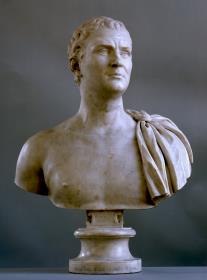

Bildnis eines Soldaten (vermutlich Ludovico III. Gonzaga) / Portrait of a Soldier (Presumed Portrait of Ludovico III Gonzaga)
Ident. Nr.: 52
ObjID: obj:1890962

Credit: Staatliche Museen zu Berlin, Skulpturensammlung und Museum für Byzantinische Kunst / Antje Voigt CC BY-SA 4.0
Details (expert)
- Creator/Entity
- Date(s)
- Datierung: ca. 1450-1453
- Geographical references
- Material / Technique
- Bronze
- Dimensions
- Höhe x Breite: 37 x 29 cm (Höhe: 55,5 cm mit Marmorsockel)Gewicht: 29 kg (mit Sockel)
- Permalink
- https://id.smb.museum/object/1890962
Object Description
English catalogue entry
Attributed to Nicolò Baroncelli and Domenico di Paris
Nicolò di Giovanni Baroncelli, called Nicolò del Cavallo
Active in Padua, 1434-Ferrara, 1453
Domenico di Paris
Active in Ferrara during the second half of the 15th century
Portrait of a Soldier
(Presumed Portrait of Ludovico III Gonzaga)
ca. 1450-1453?
Bronze
Height: 56 cm
Berlin, Staatliche Museen, Skulpturensammlung, Inv. SKS 52.
Bode-Museum, on view.
Provenance
Paris, Frédéric Spitzer (1876); Berlin, Skulpturensammlung/Altes Museum (1876-1896); Berlin, Skulpturensammlung/Neues Museum (1896-1904); Berlin, Skulpturensammlung/Kaiser-Friedrich-Museum (1904-1939); Berlin, storage (1939-1945); Merkers, storage (1945); Wiesbaden, Central Collecting Point (1945-1956); West Berlin, Skulpturensammlung/Museum Dahlem (1956-1997); Berlin, storage (1997-2006); Berlin, Skulpturensammlung/Bode-Museum (since 2006).
Acquisition
Bought for 3,000 Marks in 1876 in Paris from the Spitzer collection (inventory book in the Bode-Museum).
Other versions
• Paris, Musée Jacquemart-André, Inv. 1937. Bronze, height: 36 cm. Bought on 11 November 1888 from Stefano Bardini in Florence for 35,000 lire.
• Formerly Berlin, Königliche Museen, Skulpturensammlung, Inv. SKS 172. Bronze, height: 27.5 cm. Lost since May 1945.
• Formerly St Petersburg, Stroganoff collection. Bronze.
Exhibitions
Splendours of the Gonzaga, London, Victoria and Albert Museum, 4 November 1981-31 January 1982, cat. 28.
Giulio Romano, Mantua, Palazzo Te and Palazzo Ducale, 1 September-12 November 1989.
Bibliography
Wilhelm Bode, Italienische Portraitskulpturen des XV. Jahrhunderts in den Königlichen Museen zu Berlin, n. pl. Berlin, n. d. 1883, p. 8 (reproduced): Donatello; portrait of an unknown man; three other portraits in bronze are listed as by Donatello: this one, another in Berlin (see Inv. SKS 172), the equestrian monument of the Gattamelata in Padua and the so-called bust of the latter’s son in the Museo Nazionale del Bargello, Florence.
Hermann Grimm, “Italienische Porträtbüste des Quattrocento”, Preussische Jahrbücher, 51, 1883, p. 407: identifies the bust with Ludovico III Gonzaga through a comparison with medals by Pisanello and Pietro da Fano. (reference to be checked)
Wilhelm Bode, “Die italienischen Skulpturen der Renaissance in den Königlichen Museen zu Berlin. III”, Jahrbuch der Königlich preußischen Kunstsammlungen, V, 1884, pp. 29-30: style of Donatello, portrait of a commander.
August Schmarsow, Donatello. Eine Studie über den Entwicklungsgang des Künstlers und die Reihenfolge seiner Werke, Breslau, Vereins für Geschichte der bildenden Künste, 1886, p. 42: Donatello; portrait of the King of Naples Alfonso V of Aragon; made in 1448 before the stay in Padua which began earlier; the second bust in Berlin (Inv. SKS 172) is by Bertoldo di Giovanni.
Wilhelm Bode, Italienische Bildhauer der Renaissance. Studien zur Geschichte der italienischen Plastik und Malerei auf Grund der Bildwerke und Gemälde in den Königl. Museen zu Berlin, Berlin, W. Speemann, 1887, pp. 14, 31-32, 222-223, 252, 260.
Esposizione Donatelliana nel R. Museo Nazionale in Firenze, exh. cat. (Florence, Museo nazionale del Bargello, 1887), Florence, Tipografia dei Fratelli Bencini, 1887, p. 8 n° 51: Donatello, portrait of a warrior, plaster cast in the exhibition made after the bronze in the Berlin Museums.
Hans Semper, Donatellos Leben und Werke, Innsbruck, Wagnerischen Universitäts-Buchhandlung, 1887, p. 82: both portraits in Berlin (Inv. SKS 52; Inv. SKS 172) are unfinished portraits for the equestrian monument ordered by Alfonso of Aragon in Naples, and left uncompleted because of technical problems.
Hugo von Tschudi, Donatello e la critica moderna, Turin et al., Fratelli Bocca, 1887 (1st ed.: Rivista storica Italiana, IV, n° 2, 1887), pp. 24-25: Donatello, but not a portrait of Alfonso V of Aragon; close to the works of Donatello in the church of Sant’Antonio, Padua.
Wilhelm Bode and Hugo von Tschudi, Königliche Museen zu Berlin. Beschreibung der Bildwerke der Christlichen Epoche, Berlin, W. Spemann, 1888, p. 16 cat. 40, pl. III: Donatello, possible portrait of Ludovico Gonzaga.
Wilhelm Bode, “Ludovico III Gonzaga, Markgraf von Mantua, in Bronzebüsten und Medaillen”, Jahrbuch der königlich Preußischen Kunstsammlungen, X, 1889, pp. 49-55: Donatello, portrait of Ludovico Gonzaga; publishes a similar bronze bust in the Musée Jacquemart-André, Paris.
August Schmarsow, review of Bode and Tschudi 1888, Repertorium für Kunstwissenschaft, XII, 1889, p. 206: Nicolò Baroncelli, close to the Sts Maurelius and George flanking the Crucifixion in the Cathedral of Ferrara; even if the sitter was Ludovico Gonzaga, the style is too different from the Gattamelata to be by Donatello.
Max Semrau, Donatellos Kanzeln in S. Lorenzo. Ein Beitrag zur Geschichte der italienischen Plastik im XV. Jahrhunderts, Breslau, Schlesischen Buchdruckerei, 1891, p. 95 note: Nicolò Baroncelli, similar to the Crucifixion in the Cathedral of Ferrara.
Wilhelm Bode, “Aus der Abteilung Italienischer Bronzen”, Pan, IV, 1896, 4, pp. 250-256: Donatello.
Paul Kristeller, Andrea Mantegna, London, Longmans, Green and Co., 1901, p. 181: Donatello, portrait of Ludovico Gonzaga.
Lord Balcarres, Donatello, London and New York, Duckworth & Co. and Charles Scribner’s Sons, 1903, pp. 127-128: the Jacquemart-André version is “perhaps the less ugly of the two”. Used to be known as a portrait of Alfonso of Naples or of Giovanni Tornabuoni. Left unfinished, flaws in modeling; by an assistant of Donatello, or a mistake by the master; p. 128-129: the other bust in Berlin (Inv. SKS 172) is quite superb, it is a portrait of Giovanni Antonio, the son of the Gattamelata, ca. 1455.
Alfred Gotthold Meyer, Donatello, Bielefeld and Leipzig, Delhagen and Klafing, 1903, p. 93.
Frida Schottmüller, Donatello. Ein Beitrag zum Verständnis seiner künstlerischen Tat, Munich, F. Bruckmann, 1904, p. 105 note 1, p. 128.
Paul Schubring, Donatello. Des Meisters Werke in 277 Abbildungen, Stuttgart and Leipzig, Deutsche Verlags-Anstalt, 1907, p. 126, 197: Donatello, ca. 1451-1453; the bust in the Jacquemart-André collection is also by Donatello.
G. De Nicola, “Baroncelli, Nicolò di Giovanni”, in Ulrich Thieme and Felix Becker, Allgemeines Lexikon der bildenden Künstler von der Antike bis zur Gegenwart, Leipzig, Wilhelm Engelmann, 1908, II, p. 517: attributed to Baroncelli, but of too high quality to be by him.
Alfred Gotthold Meyer, Donatello, Bielefeld and Leipzig, Delhagen and Klafing, 19082, p. 94: Donatello (as is the Jacquemart-André bust), unidentified soldier.
Adolfo Venturi, Storia dell’arte italiana. VI. La scultura del Quattrocento, Milan, Ulrico Hoepli, 1908, p. 194: probably by Nicolò Baroncelli.
Émile Bertaux, Donatello, Paris, Plon, 1910, p. 170 note 1: not Donatello; attributed by Louis Courajod to Nicola Baroncelli.
Maud Cruttwell, Donatello, London, Methuen, 1911, p. 121: “feeble copy” of the bust in the Jacquemart-André collection; possibly by Domenico sic Baroncelli.
Émile Bertaux, “Musée Jacquemart-André. L’art italien”, Revue de l’art ancien et moderne, 196, 1913, pp. 417-418. (reference to be checked)
Seymour De Ricci, “Institut de France. Musée Jacquemart-André. Les objets d’art”, Les Arts, 153, Septembre 1914, p. 6: Donatello?
Fritz Goldschmidt, Die italienischen Bronzen der Renaissance und der Barock. Erster Teil: Büsten, Statuetten und Gebrauchsgegenstände, Berlin, Georg Reimer, 1914, p. 1 cat. 1, pl. 1: Donatello, portrait of Ludovico III Gonzaga, 1450-1451.
Georges Lafenestre, Paul Durrieu, André Michel and Léon Deshairs, Le Musée Jacquemart-André, Paris, Gazette des Beaux-Arts and Librairie G. van Oest, 1914, p. 88: the Jacquemart-André version is far better than the Berlin one; perhaps Donatello; Louis Courajod attributed it to Baroncelli.
Wilhelm Bode, Die Italienische Plastik, 7th ed., Berlin and Leipzig, Vereinigung wissenschaftlicher Verleger and De Gruyter, 1922, p. 76 fig. 38: Donatello, portrait of Ludovico III Gonzaga.
Frida Schottmüller, Italienische Bildnisbüsten, Berlin, Julius Bard, 1923, pp. 7, 12: Donatello, portrait of Ludovico III Gonzaga, ca. 1450. Reproduction in frontispiece.
Wilhelm von Bode, “A Newly Discovered Bas-Relief by Donatello”, The Burlington Magazine, XLVI, n° 264, March 1925, p. 114: Donatello.
Institut de France, Musée Jacquemart André, Paris, 1926: by Niccolò Baroncelli according to Adolfo Venturi. (reference to be checked)
Wilhelm von Bode, Die Italienischen Bildwerke der Renaissance und der Barock. II. Bronzestattuettten, Berlin, Walter de Gruyter & Co., 1930, p. 1, cat. 1: Donatello, portrait of Ludovico III Gonzaga, 1450-1451 (1930a).
Wilhelm von Bode, Mein Leben, Berlin, Reckendorf, 1930 now in: Thomas W. Gaehtgens and Barbara Paul eds., Berlin, Nicolai, 1997, I, pp. 131-132; II, p. 138: Bode bought the work for the Berlin Museums from the collection of Frédéric Spitzer in Paris as a modern piece of decoration for 3,500 francs, as the work was believed by Spitzer to date from the 19th century (1930b).
Arduino Colasanti, Donatello, Rome, Valori Plastici, n. d., pl. CCXL; French trans., Paris, Crès, 1931, pl. CCXLIX: workshop of Donatello.
Museo dei calchi in gesso, 1933, p. 19 cat. 557.
G. Nicomedi, Bronzi minori del Rinascimento italiano, Milan, 1933, p. 41: Donatello? (reference to be checked)
E. F. Bange, Italienische Skulpturen im Kaiser Friedrich Museum, Berlin, Staatliche Museen in Berlin, 1933, pl. 22: Donatello, portrait of Ludovico III Gonzaga.
Filippo Rossi, Museo dei calchi in gesso. Catalogo delle opere esistenti, Florence, Mealli e Stianti, 1933, p. 19 cat. 557: Donatello, portrait of Ludovico III Gonzaga.
E. F. Bange, Die Italienischen Bildwerke im Kaiser-Friedrich-Museum, Berlin, Verlag für Kunstwissenschaft, 1934, pp. 22-23: Donatello, portrait of Ludovico III Gonzaga.
Hans Kauffmann, Donatello. Eine Einführung in sein Bilden und Denken, Berlin, Grotesche Verlagsbuchandlung, 1935, pp. 138-139, 237-238: Donatello; the bust in the Musée Jacquemart-André being a copy by Giovanni sic Baroncelli.
E. F. Bange, “Piero de’ Medici”, Jahrbuch der Preussischen Kunstsammlungen, LIX, 1938, pp. 85-88: Donatello, portrait of Piero di Cosimo de’ Medici, just before 1466; the bust in the Musée Jacquemart-André being a copy from the late 16th century.
Rezio Buscaroli, L’arte di Donatello, Florence, Monsalvato, 1942, p. 148 cat. 84: possibly Donatello.
L. Goldscheider, Donatello, Paris, Phaidon, 1947, pp. 31-32: after Donatello, as are the other version in Berlin (Inv. SKS 172) and the bust in the Musée Jacquemart-André.
Istituto statale d’arte di Firenze. Catalogo dei calchi in gesso, Florence, Corradino Mori, 1955-1956, p. 50 cat. 866, pl. LIII: the plaster cast of the work is valued at 5,000 Italian lire.
H. W. Janson, The Sculpture of Donatello, Princeton, Princeton University Press, 1957, II, p. 141 note 2: so-called Ludovico Gonzaga bust, not by Donatello.
Kurt Badt, “Drei plastische Arbeiten von Leone Battista Alberti”, Mitteilungen des Kunsthistorischen Institutes in Florenz, VIII, n° 2, September 1958, pp. 84-87: Leon Battista Alberti, as he was a dilettante sculptor; impossibly by Donatello, as when the latter is documented in Mantua in 1451 Ludovico Gonzaga was aged 39 and the sitter looks much older.
Luigi Grassi (ed.), Tutta la scultura di Donatello, Milan, Rizzoli, 1958, p. 104: from a lost prototype by Donatello, by the school of the artist (as is the bust in the Musée Jacquemart-André).
Peter Metz, Europäische Bildwerke von der Spätantike bis zum Rokoko aus den Beständen der Skulpturen-Abteilung der Ehem. Staatliche Museen Berlin-Dahlem, exh. cat. (Essen, Villa Hügel, 4 June-31 September 1957), Munich, Prestel, n. d. post 1958, p. 49 cat. 239, pl. 39: Donatello (but Alberti has been recently proposed), portrait of Ludovico Gonzaga.
Peter Metz, “Das neue Skulpturenmuseum in Dahlem”, Jahrbuch der Stiftung preußischer Kulturbesitz, III, 1964-1965, p. 109: Donatello; on view in the Berlin-Dahlem Museums.
John Pope-Hennessy, The Portrait in the Renaissance, New York, Bollingen, 1966, p. 86: possibly Alberti, portrait of Ludovico Gonzaga.
Peter Metz, Bildwerke der christlichen Epochen von der Spätantike bis zum Klassizismus aus den Beständen der Skulpturenabteilung der Staatliche Museen, Stiftung Preußischer Kulturbesitz, Berlin-Dahlem, Munich, Prestel, 1966, p. 89 cat. 499, pl. 77: Donatello, portrait of Ludovico Gonzaga.
Marilyn Aronberg Lavin, “Piero della Francesca’s Flagellation: the Triumph of Christian Glory”, The Art Bulletin, L, n° 4, December 1968, pp. 334-335, figs. 23, 26, 28: anonymous artist, portrait of Ludovico Gonzaga, ca. 1450. Same person as the figure standing on the far right of Piero della Francesca’s Flagellation of Christ in the Galleria Nazionale delle Marche, Urbino.
Franco Russoli, Scultura italiana. 3. Il Rinascimento, Milan, Electa, 1967, p. 18: attributed to Donatello (as the Jacquemart-André bust). (reference to be checked)
Marilyn Aronberg Lavin, Piero della Francesca: The Flagellation, London, Allen Lane The Penguin Press, 1972, pp. 54-57, figs. 26, 29, 31: anonymous, portrait of Ludovico Gonzaga, ca. 1450. Identical to the far right figure in the Flagellation of Christ by Piero della Francesca in the Galleria Nazionale delle Marche, Urbino.
Bernhard Degenhardt, “Ludovico II. Gonzaga in einer Miniatur Pisanellos”, Pantheon, XXX, 1972, p. 208 note 10.
Françoise de La Moureyre-Gavoty, Inventaire des collections publiques françaises. 19. Institut de France. Paris – Musée Jacquemart-André, Paris, Édition des Musées Nationaux, 1975, cat. 44: Florentine school, attributed to Alberti; not the same mould used for the works in Berlin and in the Musée Jacquemart-André; as the Berlin model is some ten years younger, it can be dated 1463 (when Alberti is documented in Ferrara), while the Musée Jacquemart-André bust dates 1470 (when Alberti returns to the city).
Jane Schuyler, Florentine Busts: Sculpted Portraiture in the Fifteenth Century, Ph.D. (Columbia University, 1972), New York and London, Garland Publishing, 1976, pp. 101-103: Alberti, self-portrait, 1470s.
Ulrich Middeldorf, “On the Dilettante Sculptor”, Apollo, CVII, 1978, pp. 310-322 now in idem, Raccolta di scritti, that is Collected Writings. III. 1974-1979, Florence, SPES, 1981, p. 184: attributed to Alberti.
Catalogo della Gipsoteca, Florence, 1979, p. 61 cat. 866.
Anthony F. Radcliffe in David Chambers and Jane Martineau (eds.), Splendours of the Gonzaga, exh. cat. (London, Victoria and Albert Museum, 4 November 1981-31 January 1982), Cinisello Balsamo, Amilcare Pizzi, 1981, pp. 117-118 cat. 28: attributed to Alberti; portrait of Ludovico III Gonzaga; the Berlin and Jacquemart-André busts represent two different persons.
Karla Langedijk, The Portraits of the Medici. 15th-18th Centuries, Florence, SPES, 1983, II, p. 1339 cat. 22: rejects the identification with Piero de’ Medici made by Bange 1938.
Hannelore Sachs, Donatello, East Berlin, Henschelverlag, 1984, chap. 7.
Luisa Bernardini in eadem, Annarita Caputo Calloud and Mila Mastrorocco (eds.), Omaggio a Donatello. Donatello e il primo Rinascimento nei calchi della Gipsoteca, exh. cat. (Florence, Istituto Statale d’Arte, 19 December 1985-30 May 1986), Florence, SPES, 1985, p. 62 cat. 40: the plaster cast in the Gipsoteca, Florence, was given by the Berlin Museums in 1887, then transferred to the Opificio delle Pietre Dure and finally to the Gipsoteca in 1932.
Anthony F. Radcliffe in Italian Renaissance Sculpture in the Time of Donatello, exh. cat. (Detroit, The Detroit Institute of Arts, 23 October 1985-5 January 1986), Detroit, The Detroit Institute of Arts, 1985, pp. 166-167.
Anthony F. Radcliffe in Alan Phipps Darr and Giorgio Bonsanti (eds.), Donatello e i suoi, exh. cat. (Florence, Forte del Belvedere, 15 June-7 September 1986), Detroit and Florence, The Detroit Institute of Arts, La Casa Usher and Arnaldo Mondadori Editore, 1986, p. 216: the Jacquemart-André version is attributed to Alberti, said superior to the Berlin version and closer to the documented portraits of Ludovico. So the Berlin version is probably another sitter than Ludovico.
Rodolfo Signorini, “’Riverenzia all’antiquità’ in Mantova prima di Giulio Romano”, in Giulio Romano, exh. cat. (Mantua, Palazzo Te and Palazzo Ducale, 1 September-12 November 1989), Milan, Electa, 1989, pp. 309-310: portrait of Ludovico Gonzaga.
Eugenio Battisti, Piero della Francesca, Marisa Dalai Emiliani ed., Milan, Electa, 1992, II, p. 390 note 404: contests the identification of the bust with Ludovico Gonzaga, and then the interpretation by Aronberg Lavin 1968 of Piero della Francesca’s Flagellation.
N. Buhl, “Baroncelli, Nicolò di Giovanni”, in Saur Allgemeines Künstlerlexikon, Munich and Leipzig, Saur, 7, 1993, p. 128: attributed to Baroncelli.
Joseph Rykwert, in idem and Anne Engel (eds.), Leon Battista Alberti, exh. cat. (Mantua, Palazzo Te, 10 September-11 December 1994), Milan, Electa, 1994, p. 549 cat. 145: attributed to Alberti.
Katalog der Originalabgüsse. Heft 6. Christliche Epochen. Spätantike. Byzanz. Italien. Freiplastik. Reliefs. Bronzestatuetten, Berlin, Staatliche Museen zu Berlin, 2000, cat. 2435: Donatello?, ca. 1450.
Marilyn Aronberg Lavin, Piero della Francesca, London, Phaidon Press, 2002, pp. 109-111, fig. 75: attributed to Donatello, portrait of Ludovico Gonzaga, ca. 1450. Same person as the figure standing on the far right of Piero della Francesca’s Flagellation of Christ in the Galleria Nazionale delle Marche, Urbino.
Davide Gasparotto in Filippo Trevisani (ed.), Andrea Mantegna e i Gonzaga. Rinascimento nel Castello di San Giorgio, exh. cat. (Mantua, Castello di San Giorgio, 16 September 2006-14 January 2007), Milan, Electa, 2006, pp. 126-127: the Jacquemart-André bust is attributed to Leon Battista Alberti, ca. 1470; it is clearly superior to the Berlin bust, which is close to the profile of the Camera Picta by Mantegna (1470-74) representing Ludovico.
Nicolas Sainte Fare Garnot in Rodolfo Signorini and Daniela Sogliani (eds.), A casa di Andrea Mantegna. Cultura artistica a Mantova nel Quattrocento, exh. cat. (Mantua, Casa del Mantegna, 26 February-4 June 2006), Cinisello Balsamo, Silvana, 2006, p. 378: the Jacquemart-André bust is not by Donatello but by a workshop active in Mantua, maybe after a drawing by Alberti.
Volker Krahn, “Pastiche or Fake? A ‘Donatello’ by Medardo Rosso“, Apollo, CLXIX, June 2009, p. 43 note 1: put in storage in the Museum Dahlem because suspected to be a fake.
Curatorial Archives in the Bode-Museum, Berlin
• Letter of John Pope-Hennessy to Claus Zoege von Manteuffel, 5 February 1963: “I was myself by no means convinced of the Alberti attribution”.
• Correspondence between Ursula Schlegel (Sculpture Collection, Staatliche Museen, West Berlin) and Françoise Gavoty (Musée Jacquemart-André, Paris). 4 letters between 6 February and 21 March 1967. On 10 March 1967, Gavoty says to reject the attribution to Donatello and the identification with Ludovico Gonzaga, while Schlegel (21 March 1967) rejects the attribution but accepts the identification of the sitter.
• Analysis of the bronze (17 October 1991).
• Correspondance between Michael Knuth (Sculpture Collection, Staatliche Museen zu Berlin) and Filippo Trevisani. Six emails between 21 October 2005 and 6 January 2006. On the latter email, Knuth asserts that the work was not given in loan because it was suspected to be a fake.
• Correspondance between Michael Knuth (Sculpture Collection, Staatliche Museen zu Berlin) and Davide Gasparotto. Three emails between 13-18 April 2006: Knuth (18 April) possibily gives the bust to Sperandio; his colleague Volker Krahn is said to consider the bust as a 19th century forgery.
Comment
This work was bought by Wilhelm Bode in Paris in 1876 in rather unusual circumstances. When the famous banker Adolphe de Rothschild announced himself at the apartment of the art dealer and collector Frédéric Spitzer in rue de Rivoli, the latter did not want to introduce the young Bode, who was also visiting. The art historian had to wait in a room filled with various things, including this bronze head, thought to be a 19th-century cast. A few days later, Bode sent someone to buy secretly on behalf of the Berlin Museums the bust as a “modern piece of decoration”, for the modest amount of 3,500 francs (this is at least what is related in Bode 1930b; a price of 3,000 Deutsche Mark is recorded in the inventory book in the Bode-Museum). Bode had immediately valued the high quality of the piece, and its similarity to another bust from the Berlin collection given by Friedrich Wilhelm IV in 1868 (see Inv. SKS 172): he ascribed both to Donatello first hesitantly, then more firmly. Some flaws visible in the present bust were explained by its having been left unchiseled (Bode 1883; Bode 1884). Another similar bust was noticed by Bode in Count Serguei Stroganoff’s collection in St Petersburg (Bode 1884, p. 29 note 2). A few years later, Bode would publish a fourth bust, very close to the present one, that had just been acquired though the antiquarian Stefano Bardini by Nélie Jacquemart for her house in Paris (see Bode 1889; it is now in the Musée Jacquemart-André, Paris).
Grimm 1883 identified the sitter of the Berlin bust as Ludovico III Gonzaga (1412-1478), marquis of Mantua from 1444 until his death, thanks to a comparison with medals by Pisanello and Pietro da Fano. In 1451, Donatello was documented in Mantua, where he was asked to carve the Tomb of St Anselm (a work he never completed, even if “some labors have been already started”; see H. W. Janson, The Sculpture of Donatello, Princeton, Princeton University Press, 1957, II, p. 205). Schmarsow 1886 (followed by Semper 1887) preferred to identify the sitter as Alfonso V of Aragon, the King of Naples who ordered from Donatello an equestrian sculpture, also never completed – the Berlin bust was supposed to be part of it. At the exhibition dedicated to Donatello held in Florence in 1887, a cast of the bust was shown as a “Portrait of a warrior” (Esposizione donatelliana 1887). In general, however, the identification with Lodovico Gonzaga became the rule until the present day (the proposition of Bange 1938 to identify the sitter with Piero di Cosimo de’ Medici remained unfollowed). This identification, based only on the profile of the medals and of the representation by Andrea Mantegna in the Camera degli Sposi in the Castle of Mantua, remains speculative (based on the Berlin bust, Aronberg Lavin 1968 has built an even more speculative interpretation of Piero della Francesca’s Flagellation in the Galleria Nazionale delle Marche, Urbino).
The attribution to Donatello proposed by Bode has been much challenged. The name of Nicolò Baroncelli, a Florentine follower of Donatello active in Northern Italy, was made by Schmarsow 1889 and partly followed until the mid-20th century (see below). Badt 1958 attributed the work to Leon Battista Alberti, the great humanist of the Renaissance who was also a “dilettante” sculptor – the unfinished chiseling of the Berlin bust was seen as a mark of the unprofessionalism of Alberti in the field of bronze sculpture. This attribution obtained a great consensus, and the name of Alberti has partly remained in modern literature (Rykwert 1994; Gasparotto 2006), even if the critics constantly hesitated to praise the Berlin or the Paris version (the second Berlin version, Inv. SKS 172, has been missing since 1945; it has not been discussed in recent literature, nor has the bust once in St Petersburg and whose whereabouts are unknown).
If the busts in Berlin and in the Jacquemart-André have always been compared, it is not only due to their physiognomic affinities, but also to their similar armor (even if it was probably added on purpose, as was the case for the second Berlin version). In the Berlin bust, the patina of the face is quite different from the one of the armor, while the hair also appears to have been modeled differently. Many irregularities of the surface are probable signs of ancient restorations; these technical aspects explain why the Bode-Museum has presented until 2016 the work as a 19th-century forgery (see the Curatorial Archives; and Krahn 2009). In any case, a joint presentation and close analysis of the busts in Berlin and Paris appear to be necessary to answer the question (a cast of the second Berlin bust still exists at the Berlin Gipsformerei).
It is certain that the attribution to Alberti should be rejected, as it is based only on the supposition that the sculptor may be a dilettante, and not so much on his existing oeuvre (only a few plaquettes in bronze representing Alberti are tentatively ascribed to him). Although unsatisfactory, Bode’s attribution to Donatello is understandable, in that the bust is reminiscent of the face of the St Louis of Toulouse made by the Florentine sculptor for the High Altar of the church of Sant’Antonio, Padua. Even more than Donatello, the comparison with Nicolò Baroncelli made by Schmarsow 1889 still appears illuminating, as the face of the St Maurelius flanking the Crucifixion in the Cathedral of Ferrara, made by Baroncelli, together with his brother-in-law Domenico di Paris, seems almost superimposable with our sculpture. A pupil of Filippo Brunelleschi, Nicolò Baroncelli worked with Donatello in Padua before he went to Ferrara to cast the bronze horse of the equestrian monument of Duke Niccolò d’Este (also with Domenico di Paris), a monument completed in 1451, when Donatello is documented in Mantua. On the one hand, the formal similarities between the Berlin bust and the St Maurelius by Baroncelli and Domenico di Paris, and, on the other, the resemblance of the sitter with ascertained portraits of Ludovico Gonzaga, give credence to both hypothesis, even if one should remain cautious on the matter.
Neville Rowley (11 February 2016 - last reviewed on 19 February 2016)
Last updated: 29.07.2026
Contact
Institution:
Skulpturensammlung und Museum für Byzantinische Kunst
Email:
sbm@smb.spk-berlin.de