
Madonna der Via di Pietra Piana
Ident. Nr.: 2431
ObjID: obj:862491
Credit: Staatliche Museen zu Berlin, Skulpturensammlung und Museum für Byzantinische Kunst / Antje Voigt CC BY-SA 4.0
Details (expert)
- Involved
- Dating
- Datierung: 1446/1455
- Material / Technique
- Ton und Holz, gefasst
- Dimensions
- Höhe x Breite x Tiefe: 69 x 56 x 19,5 cm (Relief)Höhe x Breite x Tiefe: 155 x 105 x 19,5 cm (Rahmen)Gewicht: ca. 50 kg
- Permalink
- https://id.smb.museum/object/862491
Object Description
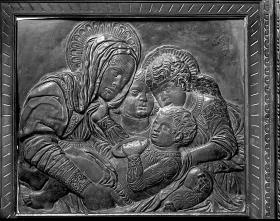
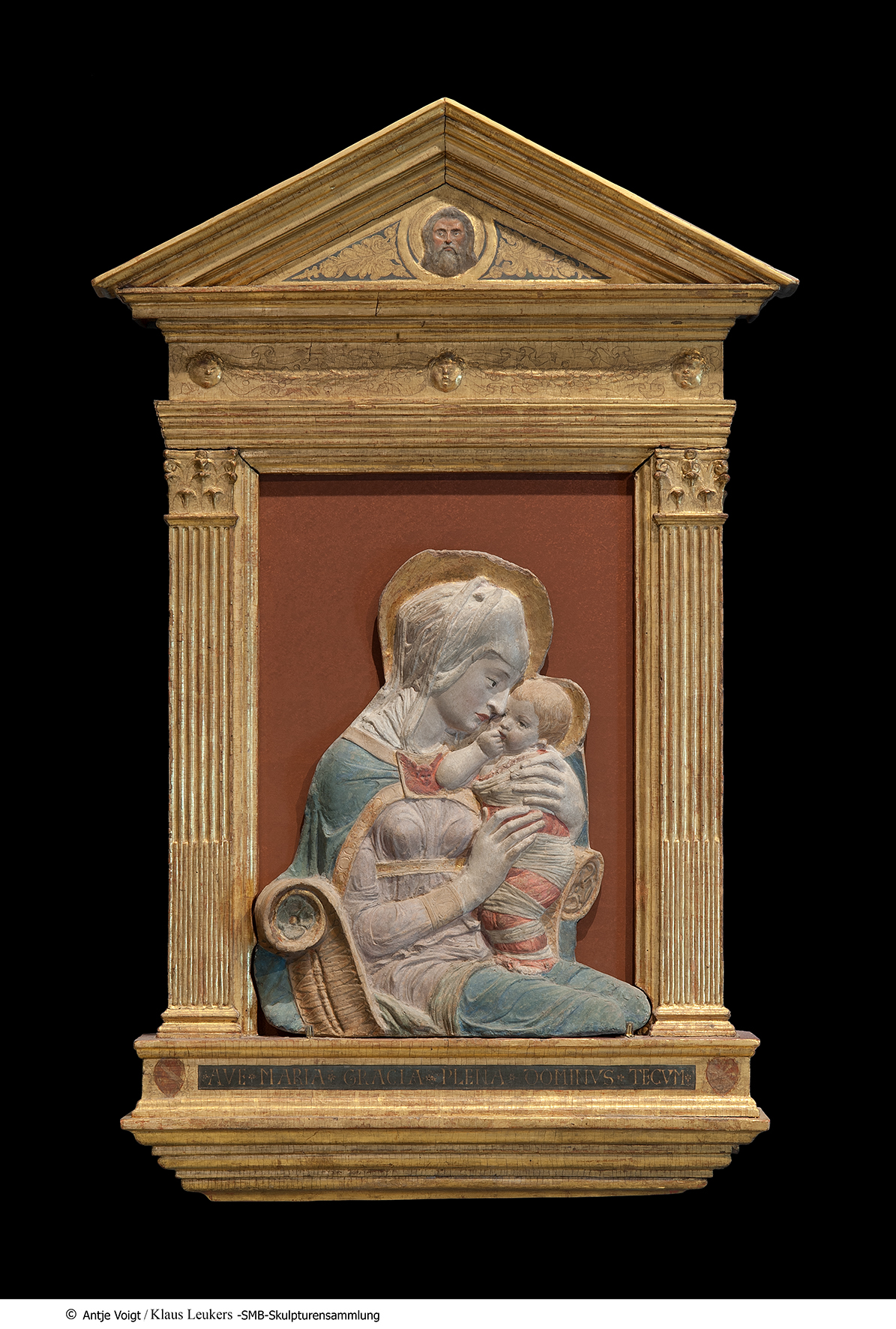
After Donatello?
Virgin and Child (called the Madonna di via Pietrapiana)
Painted and gilt terracotta
69 x 56 cm (without frame)
The frame was not originally with the sculpture; it dates from the mid 15th-century (in the style of Michelozzo according to Schottmüller 1933). Inscription on the base: AVE.MARIA.GRATIA.PLENA.DOMINUS.TECUM.
Berlin, Staatliche Museen, Skulpturensammlung, Inv. SKS 2431.
Bode-Museum, on view.
Provenance
Berlin, Skulpturensammlung/Altes Museum (1899-1904); Berlin, Skulpturensammlung/Kaiser-Friedrich-Museum (1904-1939); Berlin, storage (1939-1945); Soviet Union, secret storage (1945/46-1958); East Berlin, Skulpturensammlung/Bode-Museum (1958-1990); Berlin, Skulpturensammlung/Bode-Museum (1990-present).
Acquisition
Acquired in 1899. Anonymous gift (Prince Liechtenstein?).
Restoration
1995 (photograph of the reverse in the restoration files of the Bode-Museum).
Other Versions
• London, Victoria and Albert Museum, Inv. 7412-1860. Stucco, 84 x 69.5 cm.
• Scandicci, Pieve di San Giuliano a Settimo. Terracotta, 70 x 53 cm.
• Private collection. Formerly Florence, via Pietrapiana. Terracotta, 84 x 68 cm.
• Formerly New York, Dr. Preston P. Satterwhite. Terracotta, 129.5 x 66 cm.
• Formerly Pieve di San Giuliano a Settimo.
• Formerly Vienna, C. Castiglioni (his sale, Vienna, 1930, n°84). Stucco, 112 x 88 cm (with the frame).
Comment
The relief in terracotta is limited to the Virgin and Child, their haloes, and the faldstool of the Madonna, all painted with pastel colors; the background of the relief, and the frame in an antique style, with the frieze decorated with cherubs and garlands and the gable with God the father, did not originally belong with the Madonna. The seated Virgin is holding her son tightly in her hands, pressing his body against hers, while her face approaches his. All wrapped in swaddling clothes, Jesus has gotten his right arm loose from his bandages; he brings his fingers to his mouth. This is an intimate vision of a mother and child, in which the foreshadowing of the death of Christ is only apparent in the somewhat absent air of the Madonna.
Since its acquisition by the Berlin Museums in 1899 (by anonymous gift; an inventory book in the Bode-Museum mentions Prince Liechtenstein), this work has always been connected with Donatello. Typically Donatellesque are indeed the profile of the Virgin (see Inv. SKS 51), her arm parallel to the relief plane (Inv. SKS 59), the Antique-style faldstool on which she sits, the way she is dressed and her tight hold on the Christ Child (see especially the Virgin and Child in the Musée du Louvre; Inv. RF 353). The mantle of the Virgin is held together on her breast by a fibula with a seraph, as is the case with the Virgin of the High Altar of the church of Sant’Antonio, Padua. However, the quality of the Berlin Madonna is too modest to be more than a replica after a prototype by Donatello.
This composition is known in many versions under the name Madonna di via Pietrapiana, from a relief that was long on view in this Florentine street, near Santa Croce (today in a private collection). Long thought to have been a replica after a lost original by Donatello, the latter was proposed after restoration to be an original creation by Donatello (Avery 1985). Some scholars have alternatively attributed the composition to a follower of the artist: Fabriczy 1906 thought of Antonio da Pisa and Venturi 1908 of Francesco del Valente. The question cannot be solved as the oeuvres of these sculptors are still very elusive.
Bibliography
Fabriczy 1906
C. de Fabriczy, “Antonio di Chellino da Pisa”, L’Arte, IX, 1906, p. 444: the Berlin version is a copy after the original in the via Pietrapiana, Florence, by the Paduan follower of Donatello, Antonio di Chellino da Pisa.
Schubring 1907
Paul Schubring, Donatello. Des Meisters Werke in 277 Abbildungen, Stuttgart and Leipzig, Deutsche Verlags-Anstalt, 1907, p. 201: school of Donatello.
Venturi 1908
Adolfo Venturi, Storia dell’arte italiana. VI. La scultura del Quattrocento, Milan, Ulrico Hoepli, 1908, p. 452: the composition may be by Francesco del Valente.
Schottmüller 1913
Frida Schottmüller, Die italienischen und spanischen Bildwerke der Renaissance und des Barocks in Marmor, Ton, Holz und Stuck, Berlin, Georg Reimer, 1913, p. 20 cat. 42: after Donatello; the composition is Florentine and not Paduan (as argued by Fabriczy 1906).
Maclagan and Longhurst 1932
Eric Maclagan and Margaret H. Longhurst, Catalogue of Italian Sculpture, London, Victoria and Albert Museum, 1932, p. 25: workshop of Donatello.
Schottmüller 1933
Frida Schottmüller, Die italienischen und spanischen Bildwerke der Renaissance und des Barock. Erster Band. Die Bildwerke in Stein, Holz, Ton und Wachs, Zweite Auflage, Berlin and Leipzig, Walter de Gruyter & Co., 1933, pp. 13-14: workshop of Donatello.
Middeldorf 1938
Ulrich Middeldorf, review of Schottmüller 1933, Rivista d’arte, XX, 1938 now in: idem, Raccolta di scritti that is Collected Writings. I. 1924-1938, Florence, SPES, 1979-80, p. 379: compared with the standing Virgin and Child in the Morgan Library, New York.
Valentiner 1938
W. R. Valentiner, Catalogue of an Exhibition of Italian Gothic and Early Renaissance Sculpture, exh. cat. (Detroit, The Detroit Institute of Art, 7 January-20 February 1938), Detroit, The Detroit Institute of Art, 1938, cat. 28: related to a work lent in the exhibition by Dr. Preston P. Satterwhite, New York.
Avery 1986a
Charles Avery in Alan Phipps Darr and Giorgio Bonsanti (eds.), Donatello e i suoi, exh. cat. (Florence, Forte del Belvedere, 15 June-7 September 1986), Detroit and Florence, The Detroit Institute of Arts, La Casa Usher and Arnaldo Mondadori Editore, 1986, p. 154: after Donatello, the original is in via Pietrapiana, Florence.
Avery 1986b
Charles Avery, “Donatello’s Madonnas Reconsidered”, Apollo, CXXIV, n°295 (new series), September 1986, pp. 181-182: the version in the via Pietrapiana is by Donatello, ca. 1455-1460.
Poeschke 1986
Joachim Poeschke, review of Darr and Bonsanti 1986, Kunstchronik, XXXIX, n°12, December 1986, p. 506: the version in the via Pietrapiana is not by Donatello.
Pope-Hennessy 1993
John Pope-Hennessy, Donatello Sculptor, New York, London and Paris, Abbeville Press, 1993, p. 344 note 18: the version in the via Pietrapiana is not by Donatello but by an unidentified follower, ca. 1455.
Rosenauer 1993
Artur Rosenauer, Donatello, Milan, Electa, 1993, p. 298: the version in the via Pietrapiana is not by Donatello.
Jolly 1998
Anna Jolly, Madonnas by Donatello and his Circle, Frankfurt am Main et al., Peter Lang, 1998, pp. 136-139 cat. 37.1: after Donatello, early 1460s; differences between the Berlin version and the one in the via Pietrapiana, Florence.
Bormand 2008
Marc Bormand, Donatello. La Vierge et l’Enfant. Deux reliefs en terre cuite, Paris, Musée du Louvre and Somogy, 2008, pp. 16, 49 fig. 25: after Donatello.
Neville Rowley (20 May 2016)
Last updated: 19.03.2026
Contact
Institution:
Skulpturensammlung und Museum für Byzantinische Kunst
Email:
sbm@smb.spk-berlin.de