
Credit: Staatliche Museen zu Berlin, Gemäldegalerie / Christoph Schmidt Public Domain Mark 1.0
Details (expert)
- Creator/Entity
- Date(s)
- Ausführung: um 1335
- Additional titles
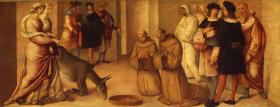
- Collection title: Der heilige Franziskus erweckt ein KindTranslation: Saint Francis Awakens a Child
- Geographical references
- Material / Technique
- Tempera auf Pappelholz
- Dimensions
- Bildmaß: 48,2 x 43 cm mit Rahmen
- Acquisition
- 1828/29 Ankauf von Carl Friedrich von Rumohr in Florenz
- Permalink
- https://id.smb.museum/object/862850
Object Description
Die von Giotto eingeführte neue Wiedergabe von Raum und Emotion war eng verbunden mit einer spirituellen Revolution. Anfang des 13. Jahrhunderts hatte der Heilige Franz von Assisi den Franziskanerorden gegründet, zu dessen Zielen es gehörte, zu Einfachheit und einer Kontemplation über die wirkliche Welt zurückzukehren. Giotto hatte seine wegweisende Karriere mit dem bedeutenden Auftrag begonnen, die Wände der Basilika San Francesco in Assisi auszumalen. Später sollten er und seine Schüler in der Kirche des Franziskanerordens in Florenz, Santa Croce, tätig werden.
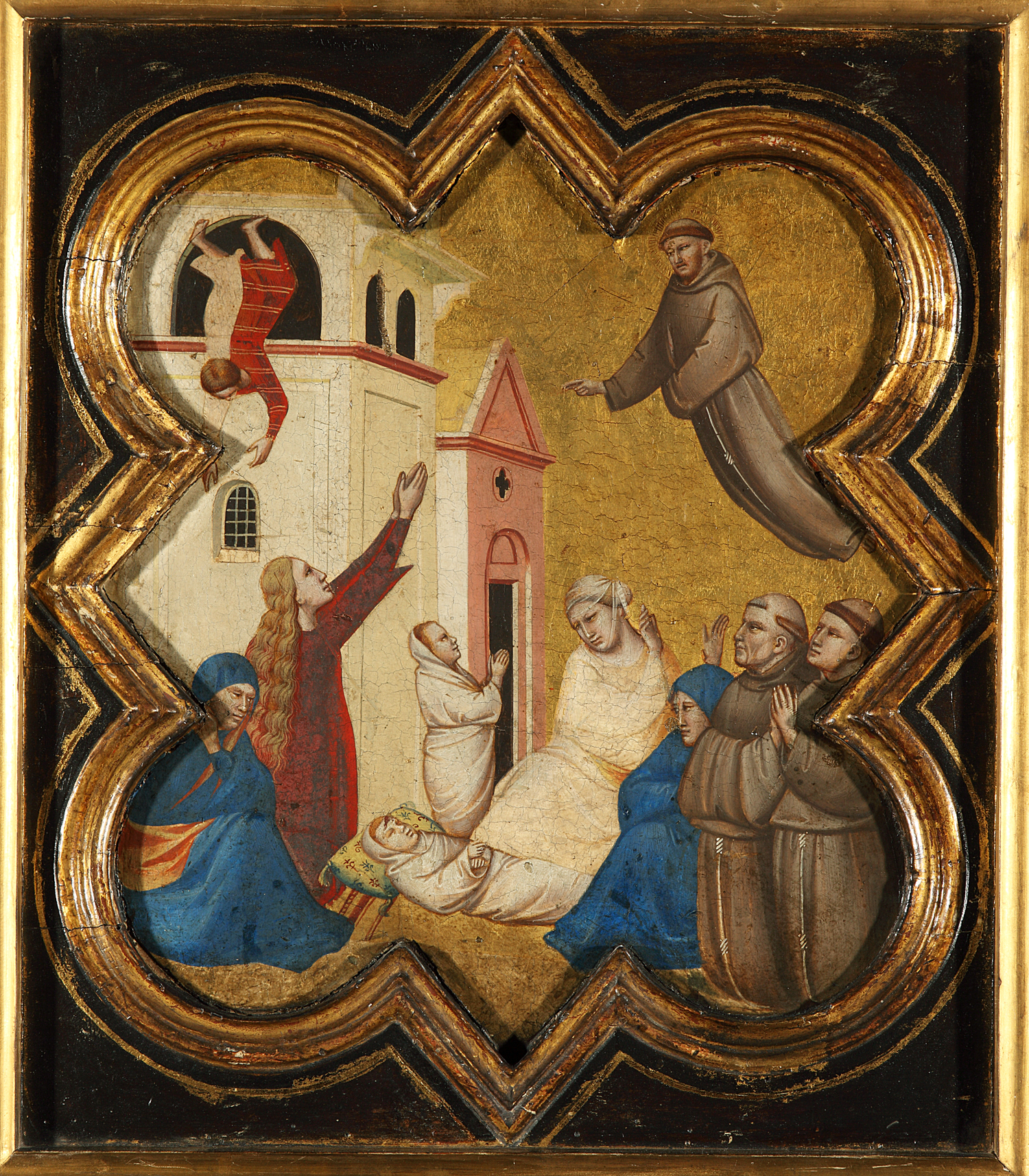
Dieses Tafelbild gehört zu einer Reihe von Szenen aus dem Leben Jesu und des Heiligen Franziskus, die Taddeo Gaddi für die Sakristei von Santa Croce malte. Drei Stationen einer einzigen Geschichte werden gleichzeitig wiedergegeben: der Sturz eines Jungen aus dem Fenster, sein Tod sowie seine Wiederauferstehung dank des wundersamen Eingreifens des Heiligen Franziskus. Wie der Heilige selbst tragen auch die beiden knienden Figuren ganz rechts das Ordensgewand der Franziskaner: Sie waren dabei und werden bezeugen, dass das Wunder tatsächlich geschah.| Prestel-Museumsführer - Gemäldegalerie Berlin, 2017
________________________________________________________________
The new representation of space and emotion introduced by Giotto was intimately related to a spiritual revolution: in the early 13th century, St. Francis of Assisi had founded the order of Franciscans, one of whose objectives was to return to simplicity and to a contemplation of the real world. Giotto had begun his groundbreaking career with the significant commission to decorate the walls of the Basilica of St. Francis in Assisi. Later he would work on the church of the Franciscan order in Florence, named Santa Croce, as did his pupils. This panel is one of a series with scenes of the life of Jesus and of St. Francis made by Taddeo Gaddi for the sacristy of Santa Croce: three moments of a single story are simultaneously shown: the fall of a boy from a window, his death, and his resurrection thanks to the miraculous intervention of St. Francis. Like the saint, the two kneeling figures on the far right are dressed in Franciscan clothing: they are the witnesses who will testify that the miracle really happened.| Prestel Museum Guides - Gemäldegalerie Berlin, 2017
Last updated: 25.06.2026
Contact
Institution:
Gemäldegalerie
Email:
gg@smb.spk-berlin.de