
Logo

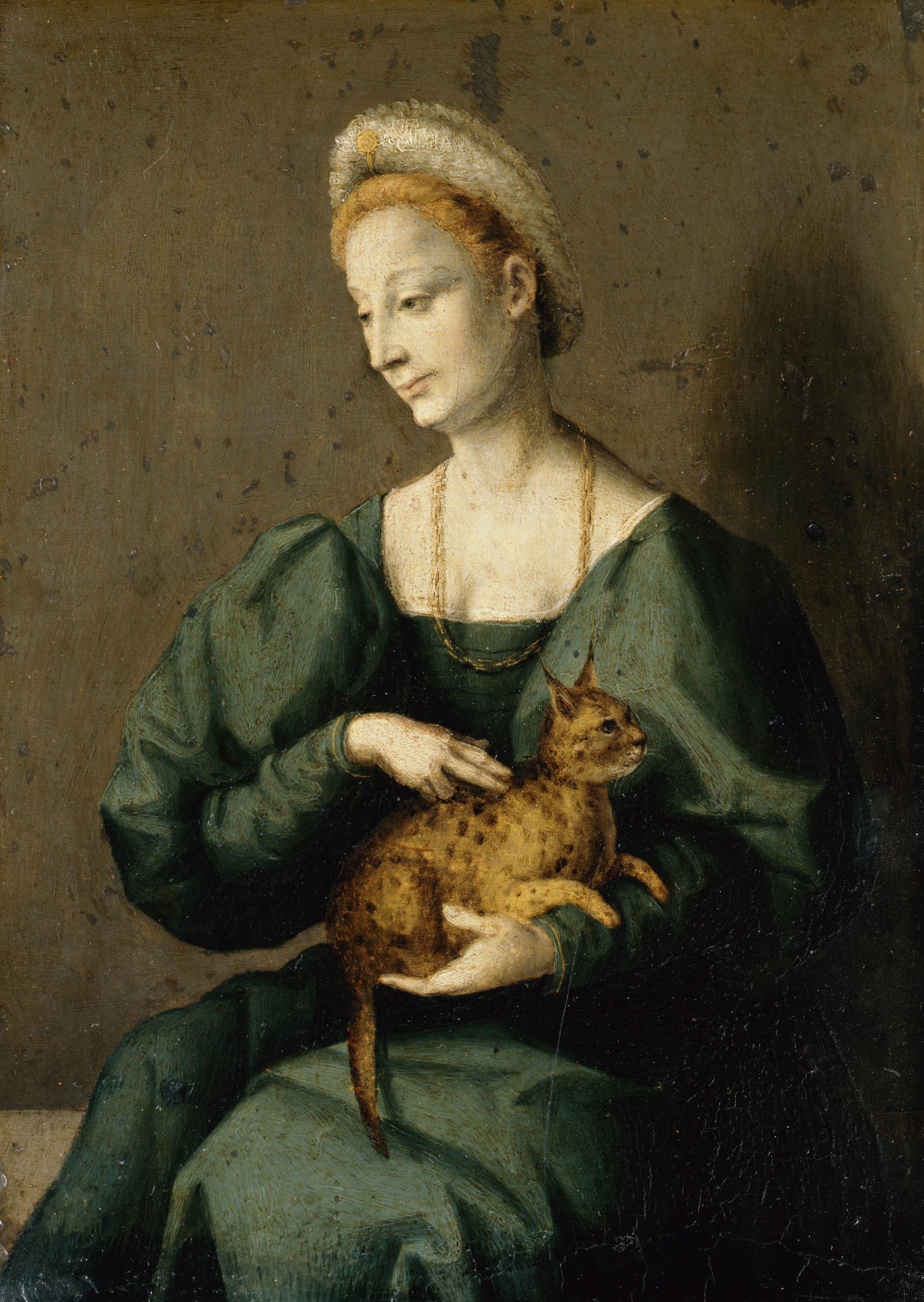
Bildnis einer Frau mit Luchs

Ident. Nr.: 267A

ObjID: obj:863402

Details (expert)

Creator/Entity
Ausführung: Bachiacca (Francesco Ubertini) (1494 - 1557),
Maler*in
Date(s)
Ausführung: 1530
Additional titles
Collection title: Bildnis einer Frau mit Luchs
Translation: Portrait of a Woman with a Lynx
Geographical references
Italien,
Land
Material / Technique
Pappelholz
Dimensions
Bildmaß: 27,1 x 19,8 cm
Acquisition
1896/97 Schenkung von Wilhelm Bode, Berlin

Object Description

Das kleine Format verleiht dem Gemälde Intimität: Versonnen streichelt die Dame den zahmen, jungen Luchs auf ihrem Arm. Seine Darstellung könnte in traditioneller Weise als Symbol für Sehschärfe stehen. In der Renaissance war es an Fürstenhöfen aber auch sehr beliebt, exotische Tiere wie Geparden zu halten. So malte Bacchiacca häufig solche Tiere oder gepunktete Raubkatzenfelle.
____________________________________

The painting’s small size lends it intimacy: lost in thought, the lady strokes the tame, young lynx on her arm. Traditionally, the animal’s depiction could stand as a symbol of sharp vision. In the Renaissance, though, it was also very popular at courts to keep exotic animals such as cheetahs. Bachiacca therefore painted such animals – or the spotted fur of feline predators – frequently.

Last updated: 07.09.2026

Contact

Institution:

Gemäldegalerie

Additional items from the collections

Maria mit dem Kind und singenden Engeln (Raczyński Tondo)

Maria mit dem Kind und singenden Engeln (Raczyński Tondo)

Möglicherweise gehörte das Rundbild den Brüdern von S. Francesco in Florenz. Maria wird als Himmelskönigin mit einer Krone ausgezeichnet, zugleich ist sie mitleidende Mutter des zum Opfer bestimmten Christusknaben. Er greift nach ihrer Brust. Die nährende Maria galt den Theologen als Mutter aller Menschen und als Heilsspenderin. Singende Engel preisen sie, Lilien als Reinheitssymbole in den Händen. Wie man in Antlitz und Gestalt Marias immer auch das Ideal irdischer Frauenschönheit suchte, so kann man in den Engeln die Verkörperung jugendlich-harmonischen Ebenmaßes sehen. Botticelli meisterte das anspruchsvolle Format mit einer durchdachten Bildordnung, die das Rund der Begrenzung aufnimmt: Im Mittelpunkt vielfach kreisender Bewegung thront die Madonna.| Prestel-Museumsführer - Gemäldegalerie Berlin, 2017_______________________________________________________It is possible that this circular picture used to belong to the Brothers of S. Francesco in Florence. Mary is identified as the Queen of Heaven by a crown, but at thesame time she is the mother of the boy Christ, who is marked out for sacrifice. He is reaching for her breast. Theologians saw Mary as the giver of nourishment, asthe mother of all mankind, and of salvation. Singing angels are praising her, with lilies in their hands as symbols of purity. Just as the ideal of earthly female beautywas always sought in the face and form of Mary, in the same way the angels can be seen as embodying youthful harmony. Botticelli mastered this demanding formatwith a calculated pictorial order that takes up the circular border: the Madonna is enthroned at the centre of a multiple encircling movement.| Prestel Museum Guides - Gemäldegalerie Berlin, 2017