
Logo

Venus

Ident. Nr.: 1124

ObjID: obj:863959

Details (expert)

Involved
Ausführung: Sandro Botticelli (1445 - 1510),
Maler*in
Ausführung: Sandro Botticelli Werkstatt,
Maler*in
Dating
Ausführung: um 1490
Additional titles
Collection title: Venus
Translation: Venus
Geographical references
Italien,
Land
Material / Technique
Leinwand
Dimensions
Bildmaß: 158,1 x 68,5 cm

Object Description

Keine andere Bildschöpfung Botticellis ist heute so bekannt wie seine Darstellung der nackten, von goldenem Haar umspielten Liebesgöttin. Erstmals seit der Antike erscheint der weibliche Akt hier allein aufgrund seiner erotischen Anziehungskraft bildwürdig. Dabei handelt es sich keineswegs um die getreue Wiedergabe eines wirklichen Modells, sondern um ein in höchstem Maße stilisiertes Ideal. Die charakteristische Haltung folgt dem antiken Typus einer Venus pudica, die mit beiden
Händen schamhaft ihre Blöße zu verhüllen sucht. Das Berliner Gemälde, dessen Ausführung auf Leinwand für die Entstehungszeit noch eine Ausnahme darstellt, konzentriert sich ausschließlich auf den Körper der Göttin.

Fast lebensgroß und isoliert wie eine Statue steht sie in klassischem Kontrapost auf einem schmalen Sims aus grauem Stein. Der harte Schlagschatten zu ihren Füßen lässt ihre Präsenz greifbar erscheinen. Auf eine genauere räumliche oder inhaltliche Kontextualisierung wird hingegen verzichtet. Undurchdringliches Dunkel hinterfängt die Figur, wobei die homogene schwarze Farbfläche die schön bewegte Kontur des Körpers, das helle Inkarnat und das ornamentale Linienspiel des überlangen Haars umso wirkungsvoller hervortreten lässt. Mit dem Pinsel flüssig aufgetragene Goldfarbe, sogenanntes Muschelgold, verleiht den einzelnen Strähnen einen übernatürlich scheinenden Glanz. Die sinnlichen Reize betonend, lösen sich die Enden straff gebundener Flechten direkt über der Brust und auch die Scham wird durch den Griff in die fließende Haarfülle eher akzentuiert als verhüllt. Im Eigenleben des Haars, das wie von einem Windhauch bewegt scheint, könnte man den letzten Nachhall des Mythos erkennen, aus dessen Kontext die Figur bewusst isoliert wurde. Denn anders als im berühmten vielfigurigen Gemälde der Florentiner Uffizien ist hier nicht die Geburt der Venus das Thema. Während dort die aus dem Meeresschaum geborene Liebesgöttin von Personifikationen der Winde auf einer Muschelschale an die Küste Zyperns getrieben wird, um alsbald verhüllt zu werden, steht sie dem Betrachter hier – gleichsam auch noch ihrer Geschichte entkleidet – unmittelbar und allein gegenüber. Botticelli verzichtet selbst auf Attribute wie sie Lucas Cranach seiner formal ähnlich reduzierten Venus in Gestalt des Amor beigibt.

Schon der Florentiner Kunstschriftsteller Giorgio Vasari berichtet, Botticelli habe für zahlreiche Paläste seiner Heimatstadt Bilder schöner nackter Frauen geschaffen. Von seiner Venus sind neben den genannten Gemälden heute noch zwei weitere Versionen in der Galleria Sabauda in Turin und in einer Schweizer Privatsammlung bekannt. Der damaligen Praxis entsprechend wurde aufgrund der hohen Nachfrage ein erfolgreicher Prototyp durch die Werkstatt wiederholt. Von der hohen Qualität der Berliner Fassung zeugen die subtilen, aber überaus wirkungsvollen Modifikationen in der Figurenanlage. Die Souveränität der Adaption lässt einen besonders hohen Anteil des Meisters an der Ausführung vermuten. Sabine Hoffmann | 200 Meisterwerke der europäischen Malerei - Gemäldegalerie Berlin, 2019
___________________________________

No other image by Botticelli is as well known today as his portrayal of the goddess of love, naked, with her golden hair playing around her. Here, for the first time since antiquity, a female nude seems worthy of depiction for her erotic attractiveness alone. This is by no means a faithful representation of a real-life model, but of a highly stylised ideal. Her characteristic pose follows the ancient type of the Venus pudica, who coyly tries to cover her nakedness with both hands. The Berlin painting, whose execution on canvas still constituted an exception at the time, concentrates solely on the body of the goddess. She stands, almost life-size and isolated like a statue, in classical contrapposto on a narrow ledge of grey stone. The sharp shadow at her feet makes her presence tangible. A more exact context of space or meaning is, on the other hand, omitted. Impenetrable darkness lies behind the figure, and this homogeneous black surface of colour allows the beautifully dynamic contour of the body, the light flesh tone and the ornamental play of lines of the very long hair to stand out with great effect. Golden paint applied in liquid form with the brush, socalled shell gold, confers a supernatural lustre to the individual locks. Emphasising her sensual charms, the ends of tightly woven plaits come open just above her breast, and her pudenda too are highlighted rather than concealed as she grasps her flowing abundance of hair. In the independent motion of the hair, which appears moved as if by a breath of wind, it is possible to discern the last echoes of the myth from whose context the figure was deliberately isolated: in contrast to the famous painting with many figures in the Uffizi in Florence, the subject here is not the birth of Venus. Whereas in The Birth of Venus, the goddess of love, born from the foam of the sea, is driven on to the coast of Cyprus by personifications of the winds, then
to be clothed, here she stands directly and alone before the beholder – as if she had been stripped of her history, too. Botticelli dispenses with attributes such as that bestowed by Lucas Cranach in the shape of Amor on his Venus, which formally is reduced in similar way.

The Florentine art historian Giorgio Vasari reports that Botticelli painted pictures of beautiful naked women for many palazzi in his home city. In addition to the above-mentioned works, two versions of his Venus are known today: in the Galleria Sabauda in Turin and in a Swiss private collection. In accordance with contemporary practice, a successful prototype was repeated by the studio, due to high demand. The subtle but extremely effective modifications to the figure testify to the high quality of the Berlin work. The confident skill of the adaptation suggests that the master himself made a particularly large contribution to the execution. Sabine Hoffmann | 200 Masterpieces of European Painting - Gemäldegalerie Berlin, 2019

Last updated: 20.07.2026

Contact

Institution:

Gemäldegalerie

Additional items from the collections

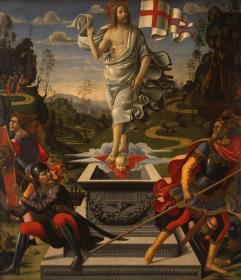
Die Auferstehung Christi

Die Auferstehung Christi

»Nun, da ich die Methoden dieser Kunst zu verstehen beginne, grämt es mich, dass sie mir nicht den Auftrag erteilen, das gesamte Rund der Stadtmauern von Florenz mit Geschichten zu bemalen.« Diese Aussage soll Domenico Ghirlandaio gegenüber seinem Bruder Davide geäußert haben, nachdem er den Chor der Dominikanerkirche S. Maria Novella ausgeschmückt hatte. Die Fresken sind heute nochzu sehen und gehören zu den künstlerischen Höhepunkten eines Florenzbesuchs. Doch Ghirlandaio war nicht nur ein bemerkenswerter Freskant, er ist auch für die Gemälde des Hochaltars verantwortlich, die Anfang des 19. Jahrhunderts veräußert wurden. Die Mitteltafel der Vorderseite, Maria mit dem Kinde und Heiligen, befindet sich heute in der Alten Pinakothek in München; die heute in der Gemäldegalerie in Berlin aufbewahrte Auferstehung nahm die Rückseite des Altarbilds ein, die nur für die Priester sichtbar war. Um die Mitteltafel und an den Seiten waren drei Heiligenpaare angeordnet. Zwei dieser Heiligen befanden sich einst in der Gemäldegalerie und wurden vermutlich im Mai 1945 in den letzten Tagen des Zweiten Weltkriegs zerstört (Abb. links).Die Auferstehung zeigt Jesus Christus am Ostermorgen, wie er dem Grab entsteigt und die vier römischen Soldaten, die es bewachen, in Schrecken versetzt. Ghirlandaio wich hier stark vom Inhalt der Heiligen Schrift ab: Das Grab Christi befand sich in einer Höhle und nicht unter freiem Himmel und keinesfalls wies es die Inschrift INRI auf (Jesus von Nazareth, König der Juden), die oben an seinem Kreuz angebracht gewesen sein soll. Auch der Pelikan, der seine Jungen mit demeigenen Blut nährt, entwickelte sich erst viel später zu einem Symbol Christi. Der Maler wollte hier die Theatralik der Szene betonen: Jesus scheint beinahe von einer unsichtbaren Maschinerie in die Luft gehoben, während die Soldaten ihre Überraschung und Angst zu überspielen suchen. Während des 19. Jahrhunderts erfuhr Ghirlandaio für seinen Sentimentalismus große Bewunderung, wurde von einigen Ästheten genau aus diesem Grund jedoch auch stark kritisiert. Der Landschaft in diesem Gemälde gebührt die gleiche Beachtung wie der bemerkenswerten Szene im Vordergrund. Auf der linken Seite nähern sich die drei Marien, die gleich das leere Grab Christi entdecken werden (ihre Namen variieren je nach Evangelium). Dahinter erkennt man im blauen Dunstschleier eine Stadt imflämischen Stil, mit einer besonderen Nähe zur Malweise des Hugo van der Goes. Am 28. Mai 1483 traf Van der Goes’ Bild für den Hochalter von S.’Egidio in Florenz ein (jetzt in den Uffizien), Domenico Ghirlandaio änderte daraufhin seine Vorstellung von Tafelmalerei.Ghirlandaio vollendete weder das Altarbild für S. Maria Novella, noch war es ihm vergönnt, die Stadtmauern von Florenz zu bemalen, wie er gehofft hatte: 1494 starb er im Alter von 45 Jahren an der Pest. Es hat etwas Bewegendes, stellt man sich vor, dass der Tod den Maler während der Arbeit an dieser Auferstehung ereilte, deren Botschaft die Hoffnung auf ein Leben nach dem Tod enthielt. Giorgio Vasari zufolge wurde dieser Teil des Bildes von Ghirlandaios Brüdern Davide undBenedetto fertiggestellt. Kritiker stimmen jedoch darin überein, dass die Landschaft von einem anderen Künstler stammen muss, in dem man Ghirlandaios Schüler Francesco Granacci sah, der heute als Pseudo Granacci bezeichnet wird. Trotz dessen Mitwirkens kann die Auferstehung als eines der letzten Meisterwerke von Domenico Ghirlandaio gelten. Neville Rowley | 200 Meisterwerke der europäischen Malerei - Gemäldegalerie Berlin, 2019________________________________________“Now that I have begun to understand the methods of this art, it grieves me that they will not commission me to paint the whole circuit of the walls of the city of Florence with stories.” This is what the painter Domenico Ghirlandaio is reputed to have said to his brother Davide, after having finished decorating the choir of the Dominican Church of Santa Maria Novella. The frescoes are still in place and are one of the highlights of any visitor who discovers Florence. But Ghirlandaio was not only a remarkable fresco painter: he was also responsible for the gigantic altarpiece adorning the chapel, dispersed at the beginning of the 19th century. The Virgin and Child in Glory among Saints which occupied the central compartment on the front side is now to be seen in Alte Pinakothek in Munich; as for the present Resurrection now in the Gemäldegalerie in Berlin, it was on the other side of the altarpiece, only visible to priests. Around the central panels and on the lateral sides of the altarpiece, three pairs of saints were displayed; two of these saints, once part of the collection of the Gemäldegalerie, were probably destroyed in May 1945 in the last days of the Second World War (fig. left).The Resurrection shows Jesus-Christ on Easter morning, coming out of his tomb, to the complete astonishment of the four Roman soldiers charged to guard his sepulture. Ghirlandaio freed himself largely from the Holy Scriptures: Christ’s tomb was set in a cave and not in the open air; and it was certainly not inscribed with the acronym “I.N.R.I.” (Jesus Christ King of Nazareth), placed instead on top of his cross, nor with the Pelican who fed his children with his blood, a symbol of Christ adopted much later (it is true that the inscription appears to have been painted over a former one). What mattered for the painter was to accentuate the theatrical character of the scene: Jesus seems to be pulled into the air by some backstage machinery, while the soldiers over-play their surprise and their fear. During the 19th century, Ghirlandaio was greatly admired for his sentimentalism; and also despised by a few aesthetes for this very reason.The landscape of this painting is to be admired on the same level as the ostentatious foreground. On the left side, we see the three Mary who, soon, will discover the empty tomb of Christ (their identities vary according to the gospels). Further on, one distinguishes a city in a blue mist, painted like in a Flemish style, and close in particular to Hugo van der Goes. On 28 May 1483, the high altarpiece of the church of Sant’Egidio, painted by Van der Goes, had arrived in Florence (it is now in the Uffizi); from that moment on, Domenico Ghirlandaio changed his conception of panel painting.Ghirlandaio did not have time to finish the Santa Maria Novella altarpiece, nor to fresco the whole circuit of the walls of Florence, as he had hoped: he died from the plague in 1494, only aged 45. There is something moving about imagining the painter agonizing while trying to complete this Resurrection, whose religious message is to give hope in a life after death. According to Vasari, this part of the altarpiece was completed by the painter’s brothers, Davide and Benedetto; but critics nowagree that the landscape is due to another artist, long confused with the pupil of Ghirlandaio Francesco Granacci and now known as the “Pseudo Granacci”. Despite the latter’s intervention, one can fully consider the Resurrection as one of the last masterpieces by Domenico Ghirlandaio. Neville Rowley | 200 Masterpieces of European Painting - Gemäldegalerie Berlin, 2019