
Logo

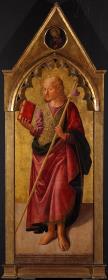
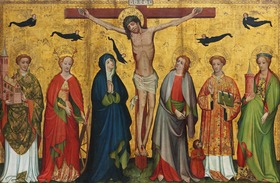
Die Heiligen Matthias und Elisabeth von Ungarn (?)

Ident. Nr.: 1635D

ObjID: obj:864439

Details (expert)

Involved
Ausführung: Ugolino di Nerio (nachweisbar 1317 – 1327),
Maler*in
Dating
Ausführung: um 1325
Additional titles
Collection title: Die Heiligen Matthias und Elisabeth von Ungarn (?)
Translation: Saints Matthias and Elizabeth of Hungary (?)
Geographical references
Italien,
Land
Material / Technique
Pappelholz
Dimensions
Bildmaß: 135 x 56,5 cm

Object Description

SIGNATUR / INSCHRIFT: S.(MATTI)AS & S. (...)

Diese fünf Fragmente gehörten ursprünglich allesamt zum Hochaltar der Franziskanerkirche S. Croce in Florenz. Eine Zeichnung aus dem 18. Jahrhundert (Abb. links) zeigt das Polyptychon, bevor es zerschnitten und in Einzelteilen an Privatsammler verkauft wurde – zu einer Zeit, in der die Kunst des 14. Jahrhunderts als zu »primitiv« galt, um Andachtszwecken zu genügen. Die meisten Fragmente des Polyptychons befinden sich heute in Berlin und in der National Gallery in London. Die – wie auf der Zeichnung zu sehen ist – stark beschädigte zentrale Tafel der Jungfrau mit dem Jesuskind ist bis heute nicht gefunden worden und wurde wahrscheinlich zerstört.

Ugolino di Nerios Stil ist stark der Malweise von Duccio di Buoninsegna geschuldet, dem Gründungsvater der Sienesischen Malerei, der zwischen 1308 und 1311 das Altarbild für den Dom von Siena (die Maestà) malte. Die Darstellung der Figuren ist von der byzantinischen Kunst inspiriert; ihre Züge sind eher kodifiziert als realistisch – Heilige galten als strenge Persönlichkeiten, die gefürchtet und nicht bewundert werden sollten. Die bedeutendsten sind anhand ihrer Attribute leicht
zu erkennen: Johannes der Täufer an den auf einem Spruchband zitierten Worten, die er spricht, als er Christus erkennt (Ecce Agnus Dei … – »Seht das Lamm Gottes …«), der heilige Paulus an dem Schwert, mit dem er geköpft werden wird, der heilige Petrus an den Schlüsseln zum Paradies. Im oberen Bildregister erkennt man als einzige Frau die heilige Klara von Assisi, deren Darstellung ihrer Mitgliedschaft im Franziskanerorden geschuldet ist. Mit allerlei Ablenkungen beschäftigte Engel
und Köpfe von Heiligen oder Seligen füllen den Raum zwischen den Registern. Ihre Identifizierung ist nahezu unmöglich – sie waren nicht dazu gedacht, aus kurzer Entfernung betrachtet zu werden. Die beiden Berliner Bildtafeln mit narrativem Inhalt gehörten früher zum unteren Teil des Altars, der sogenannten Predella. Sie stellen die Geißelung und die Grablegung Christi dar und sind ebenfalls stark von Duccios Maestà inspiriert.

Dieser typisch sienesische, in der byzantinischen Tradition verankerte Stil wirft Fragen auf, denn das Altarbild war nicht nur für das mit Siena rivalisierende Florenz, sondern darüber hinaus für den wichtigsten Altar der größten Franziskanerkirche der Stadt bestimmt. Die Franziskaner waren die Ersten, die Giottos figurative Revolution begrüßten. Dieser hatte schon 1288 damit begonnen, die Oberkirche von S. Francesco in Assisi mit Fresken zu schmücken, und in S. Croce nicht weniger als
vier Kapellen freskiert (die Fresken der Peruzzi-Kapelle und der Bardi-Kapelle sind noch erhalten). Auch Giottos Schülern, von Taddeo Gaddi bis zu Maso di Banco, wurde – wie könnte es anders sein – die gleiche Ehre zuteil. Warum also vergaben die Franziskaner den Auftrag für das Gemälde ihres Hochaltars nun an einen sienesischen Maler, der in Florenz sicherlich als reaktionär galt? Die Frage lässt sich nicht beantworten. Ugolino di Nerio jedenfalls war während seiner gesamten Laufbahn häufig für die Franziskaner tätig.| 200 Meisterstücke der europäischen Malerei - Gemäldegalerie Berlin, 2019
_______________________________________________

These five fragments all originally belonged to the high altar of the Franciscan Basilica of Santa Croce in Florence. A late 18th century drawing (fig. left) shows the polyptych still complete before it was dismantled and sold in pieces to private collectors – at a time when the art of that early period was considered too “primitive” to be used for devotion purpose. Most of the fragments of the polyptych are
now in Berlin and in the National Gallery in London. The Virgin and Child in the centre, which the drawing already shows as very damaged, has unfortunately not been identified yet and was probably destroyed.

The style of Ugolino di Nerio owes much to the founding father of Sienese painting, Duccio, who painted the high altar of the Cathedral of Siena (also known as the Maestà) between 1308 and 1311. The types of figures are inspired by Byzantine art and have features that are more codified than realistic. Saints are considered as severe characters, meant to be feared and not adored. The most important ones are easily recognizable through their attributes: Saint John the Baptist carries a cartel indicating his words when he recognized Christ (“Ecce Agnus Dei …”, Behold the Lamb of God …); Saint Paul carries the sword that beheaded him; Saint Peter the keys of Paradise. In the upper register, one can recognize Saint Clare of Assisi, the only woman represented by virtue of her membership of the Franciscan order. Between the register, one can see distracted angels, and heads of saints or blessed, whose identification is almost impossible – they were not meant to be seen at close range. The two narrative scenes preserved in Berlin were formerly part of the lower part of the altarpiece, or predella. They represent the Flagellation of Christ and his Entombment, and are also much inspired by Duccio’s Maestà.

This style of Byzantine inspiration, typically Sienese, is somewhat difficult to relate to the destination of the altarpiece, not only the rival city of Florence, but in particular the most important altar of the largest Franciscan church in the city. The Franciscans were the first to welcome Giotto’s figurative revolution, which had begun to fresco the upper basilica of Saint Francis at Assisi as early as 1288. In Santa Croce itself, Giotto had frescoed no less than four chapels (two are still preserved, the Peruzzi chapel and the Bardi chapel). Giotto’s students also had this honour, from Taddeo Gaddi to Maso di Banco; this was only logical. Why, then, did the Franciscans call upon a Sienese painter, certainly to be considered reactionary in Florence itself, to paint their high altar? The question remains open. Ultimately, Ugolino would continue to work intensely for the Franciscans throughout his career.| 200 Masterpieces of European Painting - Gemäldegalerie Berlin, 2019

Last updated: 03.07.2026

Contact

Institution:

Gemäldegalerie

Additional items from the collections

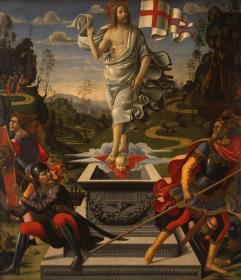
Die Auferstehung Christi

Die Auferstehung Christi

»Nun, da ich die Methoden dieser Kunst zu verstehen beginne, grämt es mich, dass sie mir nicht den Auftrag erteilen, das gesamte Rund der Stadtmauern von Florenz mit Geschichten zu bemalen.« Diese Aussage soll Domenico Ghirlandaio gegenüber seinem Bruder Davide geäußert haben, nachdem er den Chor der Dominikanerkirche S. Maria Novella ausgeschmückt hatte. Die Fresken sind heute nochzu sehen und gehören zu den künstlerischen Höhepunkten eines Florenzbesuchs. Doch Ghirlandaio war nicht nur ein bemerkenswerter Freskant, er ist auch für die Gemälde des Hochaltars verantwortlich, die Anfang des 19. Jahrhunderts veräußert wurden. Die Mitteltafel der Vorderseite, Maria mit dem Kinde und Heiligen, befindet sich heute in der Alten Pinakothek in München; die heute in der Gemäldegalerie in Berlin aufbewahrte Auferstehung nahm die Rückseite des Altarbilds ein, die nur für die Priester sichtbar war. Um die Mitteltafel und an den Seiten waren drei Heiligenpaare angeordnet. Zwei dieser Heiligen befanden sich einst in der Gemäldegalerie und wurden vermutlich im Mai 1945 in den letzten Tagen des Zweiten Weltkriegs zerstört (Abb. links).Die Auferstehung zeigt Jesus Christus am Ostermorgen, wie er dem Grab entsteigt und die vier römischen Soldaten, die es bewachen, in Schrecken versetzt. Ghirlandaio wich hier stark vom Inhalt der Heiligen Schrift ab: Das Grab Christi befand sich in einer Höhle und nicht unter freiem Himmel und keinesfalls wies es die Inschrift INRI auf (Jesus von Nazareth, König der Juden), die oben an seinem Kreuz angebracht gewesen sein soll. Auch der Pelikan, der seine Jungen mit demeigenen Blut nährt, entwickelte sich erst viel später zu einem Symbol Christi. Der Maler wollte hier die Theatralik der Szene betonen: Jesus scheint beinahe von einer unsichtbaren Maschinerie in die Luft gehoben, während die Soldaten ihre Überraschung und Angst zu überspielen suchen. Während des 19. Jahrhunderts erfuhr Ghirlandaio für seinen Sentimentalismus große Bewunderung, wurde von einigen Ästheten genau aus diesem Grund jedoch auch stark kritisiert. Der Landschaft in diesem Gemälde gebührt die gleiche Beachtung wie der bemerkenswerten Szene im Vordergrund. Auf der linken Seite nähern sich die drei Marien, die gleich das leere Grab Christi entdecken werden (ihre Namen variieren je nach Evangelium). Dahinter erkennt man im blauen Dunstschleier eine Stadt imflämischen Stil, mit einer besonderen Nähe zur Malweise des Hugo van der Goes. Am 28. Mai 1483 traf Van der Goes’ Bild für den Hochalter von S.’Egidio in Florenz ein (jetzt in den Uffizien), Domenico Ghirlandaio änderte daraufhin seine Vorstellung von Tafelmalerei.Ghirlandaio vollendete weder das Altarbild für S. Maria Novella, noch war es ihm vergönnt, die Stadtmauern von Florenz zu bemalen, wie er gehofft hatte: 1494 starb er im Alter von 45 Jahren an der Pest. Es hat etwas Bewegendes, stellt man sich vor, dass der Tod den Maler während der Arbeit an dieser Auferstehung ereilte, deren Botschaft die Hoffnung auf ein Leben nach dem Tod enthielt. Giorgio Vasari zufolge wurde dieser Teil des Bildes von Ghirlandaios Brüdern Davide undBenedetto fertiggestellt. Kritiker stimmen jedoch darin überein, dass die Landschaft von einem anderen Künstler stammen muss, in dem man Ghirlandaios Schüler Francesco Granacci sah, der heute als Pseudo Granacci bezeichnet wird. Trotz dessen Mitwirkens kann die Auferstehung als eines der letzten Meisterwerke von Domenico Ghirlandaio gelten. Neville Rowley | 200 Meisterwerke der europäischen Malerei - Gemäldegalerie Berlin, 2019________________________________________“Now that I have begun to understand the methods of this art, it grieves me that they will not commission me to paint the whole circuit of the walls of the city of Florence with stories.” This is what the painter Domenico Ghirlandaio is reputed to have said to his brother Davide, after having finished decorating the choir of the Dominican Church of Santa Maria Novella. The frescoes are still in place and are one of the highlights of any visitor who discovers Florence. But Ghirlandaio was not only a remarkable fresco painter: he was also responsible for the gigantic altarpiece adorning the chapel, dispersed at the beginning of the 19th century. The Virgin and Child in Glory among Saints which occupied the central compartment on the front side is now to be seen in Alte Pinakothek in Munich; as for the present Resurrection now in the Gemäldegalerie in Berlin, it was on the other side of the altarpiece, only visible to priests. Around the central panels and on the lateral sides of the altarpiece, three pairs of saints were displayed; two of these saints, once part of the collection of the Gemäldegalerie, were probably destroyed in May 1945 in the last days of the Second World War (fig. left).The Resurrection shows Jesus-Christ on Easter morning, coming out of his tomb, to the complete astonishment of the four Roman soldiers charged to guard his sepulture. Ghirlandaio freed himself largely from the Holy Scriptures: Christ’s tomb was set in a cave and not in the open air; and it was certainly not inscribed with the acronym “I.N.R.I.” (Jesus Christ King of Nazareth), placed instead on top of his cross, nor with the Pelican who fed his children with his blood, a symbol of Christ adopted much later (it is true that the inscription appears to have been painted over a former one). What mattered for the painter was to accentuate the theatrical character of the scene: Jesus seems to be pulled into the air by some backstage machinery, while the soldiers over-play their surprise and their fear. During the 19th century, Ghirlandaio was greatly admired for his sentimentalism; and also despised by a few aesthetes for this very reason.The landscape of this painting is to be admired on the same level as the ostentatious foreground. On the left side, we see the three Mary who, soon, will discover the empty tomb of Christ (their identities vary according to the gospels). Further on, one distinguishes a city in a blue mist, painted like in a Flemish style, and close in particular to Hugo van der Goes. On 28 May 1483, the high altarpiece of the church of Sant’Egidio, painted by Van der Goes, had arrived in Florence (it is now in the Uffizi); from that moment on, Domenico Ghirlandaio changed his conception of panel painting.Ghirlandaio did not have time to finish the Santa Maria Novella altarpiece, nor to fresco the whole circuit of the walls of Florence, as he had hoped: he died from the plague in 1494, only aged 45. There is something moving about imagining the painter agonizing while trying to complete this Resurrection, whose religious message is to give hope in a life after death. According to Vasari, this part of the altarpiece was completed by the painter’s brothers, Davide and Benedetto; but critics nowagree that the landscape is due to another artist, long confused with the pupil of Ghirlandaio Francesco Granacci and now known as the “Pseudo Granacci”. Despite the latter’s intervention, one can fully consider the Resurrection as one of the last masterpieces by Domenico Ghirlandaio. Neville Rowley | 200 Masterpieces of European Painting - Gemäldegalerie Berlin, 2019