
Logo

Dünenlandschaft im Mondschein

Ident. Nr.: 853B

ObjID: obj:864888

Details (expert)

Involved
Ausführung: Adriaen Brouwer (1603/05 - 1638),
Maler*in
Dating
Ausführung: 1637/38
Additional titles
Collection title: Dünenlandschaft im Mondschein
Translation: Dune Landscape in Moonlight
Geographical references
Flandern,
Region
Material / Technique
Eichenholz
Dimensions
Bildmaß: 25,8 x 34,8 cm

Object Description

Auf der kleinen Bildfläche wird ein schlichter Landschaftsausschnitt eingefangen. Sandige Dünen steigen sanft nach rechts oben an, auf der Höhe stehen zerzauste Laubbäume, unter deren Schirm sich eine armselige, vom Bildrand angeschnittene Kate mit steilem Dach duckt. Links im Mittelgrund ist ein von dichtem Baum- und Strauchwerk umstandenes Bauensemble erkennbar, aus dem ein runder Kirchturm aufragt.
Dazwischen führt der Blick auf das Meer und den Himmel. Der über dem Horizont aufsteigende Vollmond, als gelbe, pastos gemalte Scheibe vor einer dunklen Wolkenschlucht platziert, sendet sein gleißendes Licht über die stille Wasserfläche. Es hellt den Himmel in Fetzen auf und beleuchtet die wellenartigen Dünenkämme. Aus der Ferne nähern sich Segelboote dem Strand. Durch die Einbindung anekdotischer Details wird ein Gefühl menschlich warmer Behaustheit im Natürlichen vermittelt, wobei die Figuren nur flüchtig charakterisiert erscheinen. Allein die Landschaft und das Licht transportieren die Stimmung.
Die Malweise ist locker, die Pinselstriche breit, zuweilen tupfend oder grob streifig, die Farben werden wechselweise dünn und pastos auf den weißen Kreidegrund oder die braune Untermalung aufgetragen. Im Bereich von Himmel und Wasser schimmert der weiße Grund durch, alle anderen Töne wie das Blaugrün der Bäume oder das rötliche Gelb des Dünensandes werden vom Braun der Untermalung vertieft und gebrochen.

Adriaen Brouwer hat in seinem kurzen Leben in nur zwölf Schaffensjahren vor allem mit kleinformatigen Genreszenen aus dem bäuerlichen
Milieu Ruhm und Ansehen erworben. Geboren im flandrischen Oudenaarde, zog es ihn nach Holland. Man schätzte seine malerische Fähigkeit ebenso wie sein Talent, Situationen, Charaktere und Verhaltensweisen treffsicher zu beobachten. Brouwer setzte mit seinen bäuerlichen Szenen die künstlerische Tradition von Malern wie Jan Brueghel, Pieter Brueghel d. J. oder David Vinckeboons fort und bediente ein in seiner Zeit vorherrschendes Interesse der Städter an ländlich-natürlichem Leben. 1631/32 kehrte er aus Holland zurück nach Flandern, wo er 1638 völlig verarmt in der Kunstmetropole Antwerpen verstarb. Hier hatte er die höchste Wertschätzung seines großen Malerkollegen Rubens erlangt, der eine Anzahl von Brouwers Werken erwarb.
Insgesamt sechzehn Arbeiten Brouwers befanden sich in Rubens Kunstsammlung, darunter auch »een Landschap bij Manschijn«, bei dem es sich um das hier beschriebene Bildchen gehandelt haben könnte. Brouwers Ruf als »Bauernmaler« stand so fest, dass man ihn erst spät auch als bedeutenden Landschaftsmaler erkannte. Er hat seine Werke selten signiert und nie datiert. Heute weiß man, dass die wenigen, inzwischen hoch geschätzten Landschaften Brouwers erst in seinen letzten Lebensjahren entstanden sind. Irene Geismeier | 200 Meisterwerke der europäischen Malerei - Gemäldegalerie Berlin, 2019

SIGNATUR / INSCHRIFT: Bez. unten: A B (verbunden)
__________________________________________________________________

The small painting shows a very simple section of a landscape. Sandy dunes gently rise to the right; wind-blown trees stand on the crest. Under the boughs crouches a shabby cottage with a steep roof, cut off by the right edge of the painting. In the left middle ground we see a group of buildings, surrounded by thick bushes and trees; a church spire towers up from the centre. Between the trees and the buildings, the viewer’s gaze is drawn to the sea and the sky. The full moon rising above the horizon, painted as an impasto yellow disk in front of a dark abyss of clouds, sends its bright, gelid light across the surface of the water. It illuminates ragged sections of the sky and reflects off the wave-like crests of the dunes. In the distance, a sailing boat can be seen approaching the shore. The inclusion of anecdotal details creates a sense of a cosy, human shelter in a natural setting, although the figures are only roughly sketched. The mood of the picture is transported solely by the landscape and the light. The style is loose, with wide brushstrokes and the paint applied in splashes or rough stripes. The colours are alternately applied thinly or impasto on a white chalky background or a brown background. The white background shimmers through the sky and the water; all other colours such as the blue-green of trees or the reddish-yellow of the sand of the dunes appear deeper and are broken by the brown background.

In his short life, with only twelve active years, Adriaen Brouwer achieved considerable fame and renown for his small-format genre scenes with peasants or rural settings. Born in Oudenaarde in Flanders, the artist moved to the Dutch Republic. He was highly respected for his artistic skill and his keen observations of situations, characters and behaviour. Brouwer’s paintings of farmers and rural scenes continued the artistic tradition established by painters such as Jan Brueghel, Pieter Brueghel the Younger and David Vinckeboons, and it served the contemporary interest of city dwellers in a natural, rural lifestyle. In 1631/32, he left the Dutch Republic and returned to Flanders, where in 1638 he died in complete poverty in city of Antwerp.

Here, in the capital of the arts, he had attained the very highest respect from his colleague Rubens, who purchased a number of Brouwer’s paintings. There were 16 of Brouwer’s works in Rubens’ art collection, including “een Landschap bij Manschijn”, which could possibly be the painting described here. Brouwer’s reputation as the “peasant painter” was so firm that it was not until very much later that he was recognised as an influential landscape painter. He seldom signed his works and never dated them. We now know that the handful of landscapes that Brouwer painted, which are now greatly acclaimed for their intensity, were produced in his final years. Irene Geismeier | 200 Masterpieces of European Painting - Gemäldegalerie Berlin, 2019

Last updated: 03.07.2026

Contact

Institution:

Gemäldegalerie

Additional items from the collections

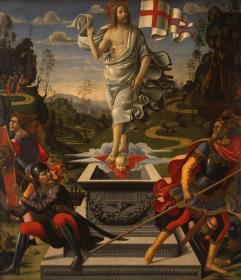
Die Auferstehung Christi

Die Auferstehung Christi

»Nun, da ich die Methoden dieser Kunst zu verstehen beginne, grämt es mich, dass sie mir nicht den Auftrag erteilen, das gesamte Rund der Stadtmauern von Florenz mit Geschichten zu bemalen.« Diese Aussage soll Domenico Ghirlandaio gegenüber seinem Bruder Davide geäußert haben, nachdem er den Chor der Dominikanerkirche S. Maria Novella ausgeschmückt hatte. Die Fresken sind heute nochzu sehen und gehören zu den künstlerischen Höhepunkten eines Florenzbesuchs. Doch Ghirlandaio war nicht nur ein bemerkenswerter Freskant, er ist auch für die Gemälde des Hochaltars verantwortlich, die Anfang des 19. Jahrhunderts veräußert wurden. Die Mitteltafel der Vorderseite, Maria mit dem Kinde und Heiligen, befindet sich heute in der Alten Pinakothek in München; die heute in der Gemäldegalerie in Berlin aufbewahrte Auferstehung nahm die Rückseite des Altarbilds ein, die nur für die Priester sichtbar war. Um die Mitteltafel und an den Seiten waren drei Heiligenpaare angeordnet. Zwei dieser Heiligen befanden sich einst in der Gemäldegalerie und wurden vermutlich im Mai 1945 in den letzten Tagen des Zweiten Weltkriegs zerstört (Abb. links).Die Auferstehung zeigt Jesus Christus am Ostermorgen, wie er dem Grab entsteigt und die vier römischen Soldaten, die es bewachen, in Schrecken versetzt. Ghirlandaio wich hier stark vom Inhalt der Heiligen Schrift ab: Das Grab Christi befand sich in einer Höhle und nicht unter freiem Himmel und keinesfalls wies es die Inschrift INRI auf (Jesus von Nazareth, König der Juden), die oben an seinem Kreuz angebracht gewesen sein soll. Auch der Pelikan, der seine Jungen mit demeigenen Blut nährt, entwickelte sich erst viel später zu einem Symbol Christi. Der Maler wollte hier die Theatralik der Szene betonen: Jesus scheint beinahe von einer unsichtbaren Maschinerie in die Luft gehoben, während die Soldaten ihre Überraschung und Angst zu überspielen suchen. Während des 19. Jahrhunderts erfuhr Ghirlandaio für seinen Sentimentalismus große Bewunderung, wurde von einigen Ästheten genau aus diesem Grund jedoch auch stark kritisiert. Der Landschaft in diesem Gemälde gebührt die gleiche Beachtung wie der bemerkenswerten Szene im Vordergrund. Auf der linken Seite nähern sich die drei Marien, die gleich das leere Grab Christi entdecken werden (ihre Namen variieren je nach Evangelium). Dahinter erkennt man im blauen Dunstschleier eine Stadt imflämischen Stil, mit einer besonderen Nähe zur Malweise des Hugo van der Goes. Am 28. Mai 1483 traf Van der Goes’ Bild für den Hochalter von S.’Egidio in Florenz ein (jetzt in den Uffizien), Domenico Ghirlandaio änderte daraufhin seine Vorstellung von Tafelmalerei.Ghirlandaio vollendete weder das Altarbild für S. Maria Novella, noch war es ihm vergönnt, die Stadtmauern von Florenz zu bemalen, wie er gehofft hatte: 1494 starb er im Alter von 45 Jahren an der Pest. Es hat etwas Bewegendes, stellt man sich vor, dass der Tod den Maler während der Arbeit an dieser Auferstehung ereilte, deren Botschaft die Hoffnung auf ein Leben nach dem Tod enthielt. Giorgio Vasari zufolge wurde dieser Teil des Bildes von Ghirlandaios Brüdern Davide undBenedetto fertiggestellt. Kritiker stimmen jedoch darin überein, dass die Landschaft von einem anderen Künstler stammen muss, in dem man Ghirlandaios Schüler Francesco Granacci sah, der heute als Pseudo Granacci bezeichnet wird. Trotz dessen Mitwirkens kann die Auferstehung als eines der letzten Meisterwerke von Domenico Ghirlandaio gelten. Neville Rowley | 200 Meisterwerke der europäischen Malerei - Gemäldegalerie Berlin, 2019________________________________________“Now that I have begun to understand the methods of this art, it grieves me that they will not commission me to paint the whole circuit of the walls of the city of Florence with stories.” This is what the painter Domenico Ghirlandaio is reputed to have said to his brother Davide, after having finished decorating the choir of the Dominican Church of Santa Maria Novella. The frescoes are still in place and are one of the highlights of any visitor who discovers Florence. But Ghirlandaio was not only a remarkable fresco painter: he was also responsible for the gigantic altarpiece adorning the chapel, dispersed at the beginning of the 19th century. The Virgin and Child in Glory among Saints which occupied the central compartment on the front side is now to be seen in Alte Pinakothek in Munich; as for the present Resurrection now in the Gemäldegalerie in Berlin, it was on the other side of the altarpiece, only visible to priests. Around the central panels and on the lateral sides of the altarpiece, three pairs of saints were displayed; two of these saints, once part of the collection of the Gemäldegalerie, were probably destroyed in May 1945 in the last days of the Second World War (fig. left).The Resurrection shows Jesus-Christ on Easter morning, coming out of his tomb, to the complete astonishment of the four Roman soldiers charged to guard his sepulture. Ghirlandaio freed himself largely from the Holy Scriptures: Christ’s tomb was set in a cave and not in the open air; and it was certainly not inscribed with the acronym “I.N.R.I.” (Jesus Christ King of Nazareth), placed instead on top of his cross, nor with the Pelican who fed his children with his blood, a symbol of Christ adopted much later (it is true that the inscription appears to have been painted over a former one). What mattered for the painter was to accentuate the theatrical character of the scene: Jesus seems to be pulled into the air by some backstage machinery, while the soldiers over-play their surprise and their fear. During the 19th century, Ghirlandaio was greatly admired for his sentimentalism; and also despised by a few aesthetes for this very reason.The landscape of this painting is to be admired on the same level as the ostentatious foreground. On the left side, we see the three Mary who, soon, will discover the empty tomb of Christ (their identities vary according to the gospels). Further on, one distinguishes a city in a blue mist, painted like in a Flemish style, and close in particular to Hugo van der Goes. On 28 May 1483, the high altarpiece of the church of Sant’Egidio, painted by Van der Goes, had arrived in Florence (it is now in the Uffizi); from that moment on, Domenico Ghirlandaio changed his conception of panel painting.Ghirlandaio did not have time to finish the Santa Maria Novella altarpiece, nor to fresco the whole circuit of the walls of Florence, as he had hoped: he died from the plague in 1494, only aged 45. There is something moving about imagining the painter agonizing while trying to complete this Resurrection, whose religious message is to give hope in a life after death. According to Vasari, this part of the altarpiece was completed by the painter’s brothers, Davide and Benedetto; but critics nowagree that the landscape is due to another artist, long confused with the pupil of Ghirlandaio Francesco Granacci and now known as the “Pseudo Granacci”. Despite the latter’s intervention, one can fully consider the Resurrection as one of the last masterpieces by Domenico Ghirlandaio. Neville Rowley | 200 Masterpieces of European Painting - Gemäldegalerie Berlin, 2019