

Credit: Staatliche Museen zu Berlin, Gemäldegalerie / Jörg P. Anders Public Domain Mark 1.0
Details (expert)
- Creator/Entity
- Date(s)
- Ausführung: um 1670
- Systematics/Type
- Additional titles
- Collection title: Landschaft mit der Ansicht von HaarlemTranslation: Landscape with the view of Haarlem
- Geographical references
- Material / Technique
- Leinwand
- Dimensions
- Bildmaß: 54,1 x 66,9 cm
- Acquisition
- 1874 Ankauf mit der Sammlung des Bankiers Barthold Suermondt, Aachen
- Permalink
- https://id.smb.museum/object/865204
Object Description
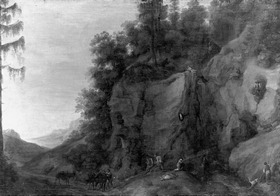
Ruisdael wurde in Haarlem geboren, wo er auch die Lehrzeit und die ersten Jahre seiner Tätigkeit als selbständiger Maler verbrachte. Zum Bildgegenstand hat er seine Vaterstadt jedoch erst wesentlich später erhoben - lange nach seiner Übersiedlung nach Amsterdam. Weitgesehene Ansichten von Haarlem in der Art des hier vorgestellten Bildes zählen zu den Beispielen der zur vollen Reife entwickelten Landschaftskunst des Malers. Sie erweitern das Themenrepertoire in reich variierender Gestaltgebung von etwa 1670 an. Vom erhöhten Standort der Dünen im Nordwesten Haarlems, etwa von Bloemendaal aus, erblickt das Auge in der Ferne die rötlich schimmernden Dächer der Stadt, den mächtigen Bau der Sint Bavo-Kirche, links die Bakenesserkirche, die Sint Jans Kerk und das Klockhuis, rechts das Rathaus, die Nieuwe Kerk und am Rande der Stadt auf den Wällen die vielen Kornmühlen. Auf der flachen Ebene des Landes spiegelt sich im Wechsel von Licht- und Schattenstreifen der bewölkte Himmel, der über niedrigem Horizont hoch hinaufgeführt ist. Im abgegrenzten Bezirk des Vordergrundes liegen auf den Wiesen lange Bahnen von Leinen zum Bleichen ausgebreitet, damals ein vertrautes Bild in der Umgebung Haarlems. Das Bleichen von Leinen sowohl holländischer Machart wie auch deutscher, englischer und skandinavischer Importe gehörte zu den wichtigsten Wirtschaftszweigen der Stadt, wobei den Bleichereien das klare Dünenwasser zu Gute kam. Ruisdael hat in nahezu allen seinen »Haarlempjes«, wie dieser von ihm kreierte und von Jan van Kessel und Jan Vermeer van Haarlem weitergeführte Landschaftstypus von den Zeitgenossen genannt wurde, dem Bleichenmotiv einen besonderen Stellenwert zuerkannt.1813 hatte Goethe in einem Essay »Ruisdael als Dichter« die vollkommene Symbolik in den Werken des Malers bewundert. Das Zusammenwirken von naturnaher Gestaltgebung und inhaltlich-anspruchsvoller Aussage ist in der Tat ein wesentliches Merkmal Ruisdaelschen Schaffens, in dem die holländische Landschaftsmalerei des 17. Jahrhunderts ihren eindrucksvollen Höhepunkt erreicht hat. Jan Kelch | 200 Meisterwerke der europäischen Malerei - Gemäldegalerie Berlin, 2019
Bezeichnet rechts unten: JvRuisdael (JvR verbunden)
_______________________________________________________
Ruisdael was born in Haarlem, where he was an apprentice and spent his first years as a self-employed painter. Yet it was not until much later that he first made his home town the subject of paintings – long after his move to Amsterdam. Views of Haarlem from a distance of the type shown in this picture are examples of Ruisdael’s landscape art in its most mature form.
From about 1670, they extend the repertoire of subjects through a lavish variety of forms. From a raised viewpoint on the dunes to the north-west of Haarlem, approximately from Bloemendaal, the eye glimpses in the distance the roof of the town glowing red, the massive Church of Sint Bavo, on the left the Bakenesser Church, the Sint Jans Kerk and the Klockhuis, to the right the town hall and Nieuwe Kerk, and at the edge of the town numerous grain mills on the town walls. On the flat plain of the countryside, the cloudy sky, raised high over a low horizon, is reflected in alternating strips of light and shade. In the marked-off foreground, great lengths of linen have been spread out to bleach, a familiar sight in the surroundings of Haarlem at that time. Bleaching linen, both of cloth made in Holland and goods imported from Germany, England and Scandinavia, was among the leading economic activities in the town, thanks to the clear water of the dunes. Ruisdael, in almost all of his
“Haarlempjes”, as contemporaries called this kind of landscape, which was created by him and continued by Jan van Kessel and Jan Vermeer van Haarlem, accorded an especially prominent place to the motif of bleaching cloth.
In 1813, Goethe admired the perfect symbolism in the artist’s works in an essay entitled Ruisdael as a Poet. The interaction between forms close to nature and a significant statement is indeed an essential characteristic of Ruisdael’s work, in which 17th-century Dutch landscape painting attained its impressive peak. Jan Kelch | 200 Masterpieces of European Painting - Gemäldegalerie Berlin, 2019
Last updated: 03.07.2026
Contact
Institution:
Gemäldegalerie
Email:
gg@smb.spk-berlin.de