
Logo

Der Tod Mariae

Ident. Nr.: 1884

ObjID: obj:865492

Details (expert)

Involved
Ausführung: Giotto (um 1267 - 1337),
Maler*in
Dating
Ausführung: um 1310
Additional titles
Collection title: Der Tod Mariae
Translation: Death of the Virgin
Geographical references
Italien,
Land
Material / Technique
Pappelholz
Dimensions
Bildmaß: 75,8 x 179,7 cm Giebelform

Object Description

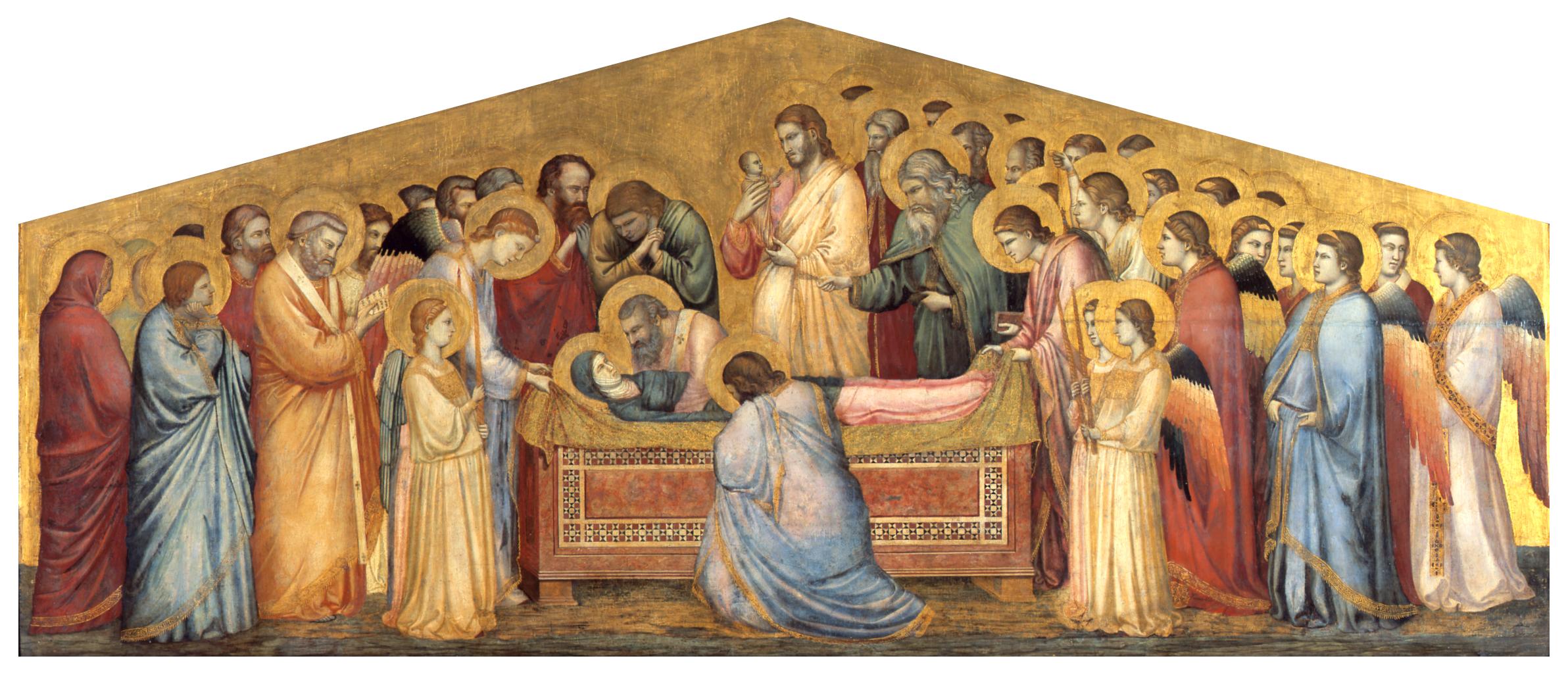
Dargestellt ist die Entschlafung Mariens, ein Bildthema, das sich aus apokryphen Quellenschriften speist, von denen die wichtigste ein mit »Transitus Mariae« überschriebener Text eines anonymen Autors (Pseudo-Meliton) ist, der von Gregor von Tours (538–594) modifiziert wurde. Aufgrund dieser Vorlagen redigierte Jakobus da Voragine seine Version des Geschehens für die Legenda aurea, eine Sammlung mit den Lebensbeschreibungen der Heiligen. In allen Quellen wird zwischen verschiedenen, zeitlich aufeinanderfolgenden Ereignissen unterschieden: Marias Bitte, im Kreise der Apostel, Patriarchen und Engel sterben zu dürfen, ihrer eigentlichen Entschlafung, den Exequien (Trauerfeier), der Grablegung sowie der Auferweckung und Himmelfahrt. Giotto hat mehrere Elemente dieser Ereignisse auf der Berliner Tafel in einer einzigen Darstellung synthetisiert. Das Sujet des Bildes ist hier demnach weniger als »historia« (Bilderzählung) zu bezeichnen, sondern vielmehr als eine ohne zeitliches Kontinuum formulierte Inszenierung des Totenkults, als Darstellung des Rituals gemeinschaftlicher Erinnerung aufzufassen.

Vor diesem Hintergrund nimmt es nicht wunder, dass Giottos Komposition zahlreiche Verweise auf das mittelalterliche Bestattungsritual enthält. Dazu zeigt die Tafel Anwesende verschiedener Kategorien: Neben den Aposteln kommt insbesondere den Engeln eine wichtige Rolle zu. Bei Exequiendarstellungen und in der Grabmalsikonografie treten sie als Liturgen auf und spenden – dem Text der Apokalypse folgend – den Weihrauch. Hier übernimmt ein Engel in der rechten Bildhälfte
diese Aufgabe. Mit vollen Wangen bläst er in ein Rauchfass, um die Glut darin zu entfachen. Zudem sind, am linken Bildrand, Frauen gegenwärtig, die Gefährtinnen Mariens. Sie können gleichzeitig als Verweise auf die zum Trauergeleit gehörenden Frauen im realen Bestattungskult verstanden werden. Neben dem Sarkophag steht ferner beidseitig ein Engelpaar mit speziellen gedrehten Kerzen, die beim Sterbesegen entzündet wurden. Es folgte die Totenklage. Auf der Berliner Tafel vollführen die prominent über dem Haupt Mariens positionierten Apostel Gesten der Trauer. Der Klerus versammelte sich anschließend zur Vigil, die Bußpsalmen wurden gelesen, und der Körper wurde mit Weihwasser besprengt. Wir sehen Petrus auf der linken Seite aus den Psalmen rezitieren, während Andreas, in grüner Gewandung, von rechts das Aspergill mit dem Weihwasser führt. In anschließender Prozession geleitete man den Leichnam unter Gebet und Gesang zu Grabe.

Wenn sich diese Momente des Geschehens auf dem Bild allesamt finden lassen, dann deshalb, weil das Flachgiebeldossale um 1310 auf einem am Lettner befindlichen Seitenaltar des Florentiner Humiliatenkonvents zu Ognissanti aufgestellt war, der explizit der Verrichtung von Totenoffizien und Memorialgottesdiensten zugeeignet war. Unmittelbar vor ihm befanden sich Bodengräber. Das Kultbild war demnach thematisch auf das liturgische Ritual abgestimmt, das sich davor ereignete,
während das Zeremoniell selbst wiederum eine visuelle Überhöhung durch das im Altarbild inszenierte Geschehen erhielt. Mit der Entschlafung Mariens verbindet sich die christliche Hoffnung auf ein Leben nach dem Tod. Das kultische Handeln um Tod und Memoria war für den Humiliatenorden von großer Bedeutung, denn mit dieser seelsorgerischen Tätigkeit waren wichtige Einnahmen verbunden, die den Mönchen durch Anteile am Nachlass Verstorbener zukamen. Als 1296 der innerstädtische Friedhof in Florenz aufgelöst wurde, zählte der außerhalb des Stadtzentrums
gelegene Konvent von Ognissanti für einige Jahre zu den wichtigsten Kirchen für den Bestattungskult, da sich in unmittelbarer Nähe ein großer Friedhof befand, der unbeschränkt ausgedehnt werden konnte. Dieses für die Existenz des Ordens wichtige Bildwerk gaben die Mönche bei dem bedeutenden Florentiner Maler Giotto di Bondone in Auftrag, der es, auf der Höhe seines reifen Schaffens, um 1310 ausführte. Die tiefenräumliche Erscheinung des Geschehens ist durch die Positionierung massiver Figuren und ihre säulenartige Staffelung erwirkt. Bildeinführend kniet einer der Apostel vor dem bildparallel gestellten Sarkophag mit dem darauf ausgestreckten Körper Mariens. Dahinter wird die in hellem Gewand mittig stehende Figur Christi von zwei Aposteln in grüner Toga flankiert. In der rosa- und cremefarbenen Gewandung ist die Gestalt Christi mit den Engelpaaren verbunden, die links und rechts vom Sarkophag stehen: Vorder- und Mittelgrund sind durch derartige Farbklänge kunstvoll miteinander verwoben. Von der mittig vor dem Sarg knienden Figur des Engels entfaltet sich die Handlung hinüber zu den Seiten, hin zum Blau des links stehenden Engels, der seine Hände ringt, und zu jenem auf der rechten Seite, der seine Ellenbogen in seinen Umhang hineindrückt. Es ist auch die prononciert vorgetragene Körperlichkeit, die Giottos Figuren von der vorhergehenden byzantinischen Formensprache abhebt, weshalb der Maler seit frühester historiografischer Tradition als Vater der modernen Malerei gilt.

Im Verlauf seiner bewegten Geschichte hat die Malschicht des Berliner Retabels stark gelitten. Das Flachgiebeldossale wurde im Zuge diverser Umgestaltungen der Ognissanti-Kirche (Entfernung des Lettners und Barockisierung des Raums im 16. Jahrhundert) von seinem Altar entfernt, schließlich veräußert und gelangte im 19. Jahrhundert nach England in die Sammlung des Reverend Walter Davenport Bromley. 1913 wurde es von dem Londoner Kunsthändler Robert Langton Douglas erworben, der es dem Kaiser Friedrich Museumsverein verkaufte. Nachdem dieses wichtige Werk zunächst hinsichtlich der Autorschaft diskutiert wurde, gilt es inzwischen unbestritten als autografes Werk des großen Florentiner Meisters, Farbkomposition und Figurenstil bestätigen dies. Stephan Weppelmann | 200 Meisterwerke der europäischen Malerei - Gemäldegalerie Berlin, 2019
___________________________________________

This work depicts the Dormition of the Virgin Mary, a theme that derives from apocryphal scriptures, of which the most important is the text headed Transitus Mariae by an anonymous author (Pseudo-Meliton), which was altered by Gregory of Tours (538–594). On the basis of these sources Jacobus da Voragine edited his version of the events for the Golden Legend (legenda aurea), a collection of saints’ lives. All sources distinguish various events in a chronological sequence: Mary’s wish to be allowed to die among the apostles, patriarchs and angels, her actual dormition, the funeral, the entombment and her resurrection and ascent into heaven. On the Berlin panel, Giotto made a synthesis of several elements of these events in one single depiction. The subject of the painting in this case should therefore be understood less as a historia (pictorial narrative) than as a representation of the
funeral cult rendered without a chronological continuum, a depiction of the ritual of communal commemoration.


Given this background, it is not surprising that Giotto’s composition contains numerous references to the medieval burial ritual. Moreover, the panel shows the participating figures in different categories: alongside the apostles, an important role is given to the angels in particular. In representations of obsequies and in the iconography of funeral monuments they appear as officiants and – following the text of the Apocalypse – are the givers of incense. Here, an angel in the right-hand part of the picture performs this task. With puffed-out cheeks, he blows into a censer in order to ignite the embers within it. Also present, on the left margin of the scene, are women, Mary’s companions. They can be regarded simultaneously as references to women in the cortège in an actual burial ritual. On each side of the sarcophagus, there also stands a pair of angels with special twisted candles, which were lit for
the blessing of the dead. This was followed by the lament for the deceased. On the Berlin panel, the apostles placed prominently above Mary’s head are performing gestures of mourning. After this, the clergy assembled for the vigil, the Penitential Psalms were read, and the body was sprinkled with holy water. We see Saint Peter on the left reciting from the psalms, while Saint Andrew, clothed in green, carries the aspergillum with the holy water from the right. In the subsequent procession, the body was accompanied to the grave with prayers and song.

That all of these aspects of the funeral scene can be identified on the painting is explained by the fact that this low-gabled dossal was placed on a side altar on the screen in the Florentine Ognissanti monastery of the Umiliati order. The altar was explicitly assigned to the offices of burial and memorial services. Graves in the floor of the church were placed directly in front of it. The painting was thus thematically devoted to the liturgical ritual that took place in front of it, while the ceremony itself was visually enhanced by the events depicted on the altarpiece. The Dormition of the Virgin Mary is associated with Christians’ expectation of life after death. The cult of death and commemoration was of great importance to the Umiliati, as this pastoral activity was linked to a significant income that the monks received through a share of the deceased person’s estate. When the cemetery in the inner city of
Florence was dissolved in 1296, the Ognissanti monastery outside the city centre became one of the leading churches for burials for a period of some years, as a large cemetery that could be extended indefinitely was situated in its immediate vicinity. The commission for this painting, which was of significance for the existence of the Umiliati order, was given by the monks to Giotto di Bondone, a leading Florentine painter, who executed it in about 1310 at the pinnacle of his mature period of work.
The three-dimensional appearance of the scene is created through the positioning of weighty figures and their arrangement like staggered columns. By way of introduction, one of the apostles kneels at the sarcophagus, which is set parallel to the edge of the painting, with the body of Mary stretched out upon it. Behind this, the figure of Christ, standing in the middle with a light-coloured robe, is flanked by two apostles wearing green togas. In its pink and cream-coloured clothing, the form of Christ is linked to the pairs of angels standing to the left and right in front of the sarcophagus: by means of such chromatic harmonies, the foreground and middle ground are skilfully interwoven. From the figure of the angel kneeling in front of the sarcophagus at the centre, the story unfolds to the sides, to the blue of the angel on the left who is wringing his hands and to the angel on the right who is pressing his elbows into his cape. The pronounced rendering of corporeality is one element that distinguishes Giotto’s figures from the Byzantine formal language that preceded him. For this reason, the artist has been regarded since the beginnings of art historical tradition as the father of modern painting.

In the course of its rich history, the paint layer of the Berlin altarpiece has suffered considerably. During various alterations to the Ognissanti church (the removal of the screen and the Baroque remodelling of the interior in the 16th century) it was taken from its altar, was eventually sold, and in the 19th century came to England to the collection of Reverend Walter Davenport Bromley. In 1913,
it was purchased by the London art dealer Robert Langton Douglas, who sold it to the Kaiser Friedrich Museumsverein. Following initial discussions of the authorship of this important work, it is now regarded without dispute as a work by the great Florentine master’s own hand, as the colour composition and the style of the figures confirm. Stephan Weppelmann | 200 Masterpieces of European Painting - Gemäldegalerie Berlin, 2019

Last updated: 15.12.2025

Contact

Institution:

Gemäldegalerie

Additional items from the collections

Die Anbetung der Könige

Die Anbetung der Könige

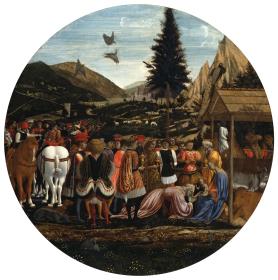
Dieses runde Gemälde (oder Tondo) schildert die Ankunft der Könige aus den damals drei bekannten Kontinenten (Europa, Asien, Afrika), die nach der Geburt Jesu dem Weihnachtsstern gefolgt sind und nun dem Erlöser der Welt ihre Geschenke darbieten. Jesus sitzt im Vordergrund auf dem rechten Knie seiner Mutter Maria, und obwohl er gerade erst geboren wurde, weiß er um seine Bestimmung undsegnet mit der rechten Hand den betagten König, der vor ihm kniet und ihm unterwürfig den Fuß küsst. Dieser hat respektvoll seine Krone abgesetzt und sie seinem direkt hinter ihm stehenden Diener übergeben. Die anderen beiden Könige (die ihre Kronen noch tragen) warten derweil, bis sie mit der Überreichung ihrer Gaben an der Reihe sind. Das Gefolge der drei Könige oder Magi ist beeindruckend: Die Menge derer, die herbeieilt, um den Sohn Gottes zu sehen, erstreckt sich zunächstzur Linken über den Vordergrund und dann zwischen den Hügeln hindurch in die Tiefe bis zu einem weit entfernt gelegenen See. Tatsächlich kann man sich fragen, ob das Interesse des Malers in erster Linie nicht der recht konventionell gestalteten Anbetung, sondern vielmehr der endlosen Prozession galt, die viele Überraschungen birgt (rechts hinter der Hütte, auf der majestätisch ein Pfau thront, sind zum ersten Mal in der italienischen Renaissancemalerei zwei Kamele dargestellt).Diese akribisch ausgeführten Details verweisen auf ein bestimmtes künstlerisches Vorbild: die flämische Malerei und die Gemälde der Van-Eyck-Brüder, die 1432 ihr Meisterwerk, das Polyptychon für die St.-Bavo-Kathedrale in Gent, signierten. Die Frage, wie der Maler der Anbetung von deren bildnerischen Neuerungen erfuhr, trieb die Kunstkritik Ende des 19. und Anfang des 20. Jahrhunderts um. Bei dem Künstler musste es sich definitiv um einen Italiener handeln – die links dargestellten Pferde, insbesondere das weiße Pferd, zeigen das besondere Gefühl des Künstlers für räumliche Verkürzungen. Doch wie erklärt sich der flämische Einschlag? Aufgrund einer Zeichnung, die offenbar denselben Mann, der im Vordergrund des Tondos zu sehen ist, von hinten zeigt, brachten Wilhelm Bode und Hugo von Tschudi (1885) Pisanello ins Spiel, einen der größten Maler der Internationalen Gotik. Der Gehängte im Hintergrund, ein Motiv, das auch in einem von Pisanellos Fresken in S.’Anastasia in Verona vorkommt (wo ebenfalls ein Pferd von hinten zu sehen ist), wurde als versteckte Signatur interpretiert. Erst 1925 wurde Dank Roberto Longhi klar, dass die Anbetung von Domenico Veneziano stammt, wahrscheinlich einem gebürtigen Venezianer, der fast ausschließlich in Florenz arbeitete.Domenico Veneziano war lange Zeit vergessen. Giorgio Vasari widmete ihm in der Erstausgabe seiner Künstlerbiografien Le Vite (1550) kein eigenes Kapitel. Berühmt war Veneziano allenfalls aufgrund seiner Maltechnik: An ihn wurde das Geheimnis der Ölmalerei weitergegeben, und zwar nicht direkt durch die Van-Eyck- Brüder, sondern durch Antonella da Messina. Laut Vasari soll dieses Geheimnis Domenico das Leben gekostet haben, denn ihm zufolge wurde er von seinem Florentiner Rivalen Andrea del Castagno ermordet. Im 19. Jahrhundert stellte sich heraus, dass die ganze Geschichte erfunden war, denn Castagno war vier Jahre vor Domenico Veneziano gestorben. Das Interesse an diesem Künstler wurde wieder geweckt, als sich herausstellte, dass ein Eintrag vom 12. September 1439 ihn als Lehrer des berühmten Malers Piero della Francesca auswies. Und doch bleibt Domenico Veneziano ein Rätsel: Seine bedeutendsten Fresken (zu nennen sind hier insbesondere die zusammen mit Piero della Francesca ausgeführten Werke im Chor der Florentiner Kirche S. Egidio) sind verschwunden, und die erhaltenen Gemälde sehr rar. Es überrascht also kaum, dass es so schwierig war, bei der Zuschreibung des Berliner Tondos Einvernehmen zu erzielen.Schon seit Langem wird über die Frage spekuliert, wer das Gemälde in Auftrag gegeben haben könnte. Einige diskrete Halbsätze oder Worte rufen damalige Losungen ins Gedächtnis: »honia boa in tempor« (alles Gute in der Zeit) auf der Kruppe des weißen Pferds; »tenpo« (Zeit) auf der Kopfbedeckung des Reiters; »ainsi va le monde« (so ist der Lauf der Welt) auf dem Mantel der vor dem Pferd stehenden Person und »grace fai Die« (Gnade durch Gott) auf der Kleidung eines hinter dem knienden König stehenden Dieners. Keiner dieser Texte stimmt mit dem bekannten Motto irgendeiner Familie überein, auch wenn sie auf die Maxime Lorenzo il Magnificos»le tems revient« (die Zeit kehrt wieder) abgestimmt sind. Geschirre und Gürtel sind auf diesem Bild besonders wichtig, nicht nur wegen der Inschriften, die sie tragen: Der Kunsthistoriker Francis Ames-Lewis (1979) interpretierte die Wiederkehr des Sieben-Punkte-Motivs als einen versteckten Verweis auf das Wappen der bedeutendsten Florentiner Familie nach 1434: der Medici.Domenico Veneziano hatte Kontakt zu den Medici, denen er in einem Brief aus dem Jahr 1438 »wundervolle Dinge« zu zeigen versprach. Im Inventarverzeichnis des Palazzo Medici, das nach dem Tod von Lorenzo il Magnifico erstellt wurde, ist ein Tondo einer Anbetung von Pisanello gelistet, doch es könnte sich durchaus umVenezianos Gemälde handeln, denn die Größenangaben stimmen überein. Für die Medici hatte das Thema Anbetung der Könige auch politische Bedeutung, denn ab 1434, als sie die Macht in Florenz übernommen hatten, waren sie verantwortlich für die Organisation des Dreikönigsfests, einer großen Prozession, die jedes Jahr am 6. Januar stattfand. Ein Gemälde zu diesem Thema in Auftrag zu geben, war daher ein klarer Hinweis auf ihre Macht.Hinter dem knienden König sind zwei Figuren mit spezifischeren Gesichtszügen zu erkennen: ein in Schwarz-Weiß gekleideter Falkner, der den Betrachter direkt anblickt und dessen Physiognomie stark an die Porträts von Piero de’ Medici, dem Sohn des Patriarchen Cosimo, erinnert, und zu seiner Linken der Diener, der die Krone des alten Königs hält und Pieros Bruder Giovanni gleicht. Da die Gesichter der beiden Männer offenbar später als der Rest gemalt wurden, ist es nicht ausgeschlossen,dass Domenico Veneziano sie im Nachhinein noch einmal veränderte, um sie in Porträts zu verwandeln. 20 Jahre später, 1459, ließ die Familie Medici die Kapelle ihres Palasts in Florenz mit einem Freskenzyklus schmücken, der ebenfalls die Anreise der Könige thematisiert. Diese Aufgabe vertrauten sie Benozzo Gozzoli an und das Altarbild gaben sie bei Filippo Lippi in Auftrag (es befindet sich heute im Besitz der Gemäldegalerie, Abb. S. 315). Domenico Veneziano kam nicht mehrin Betracht – wahrscheinlich war er zu dieser Zeit krank. Zwei Jahre später starb er in Florenz, in Vergessenheit geraten und aus dem Dunstkreis der Medici herausgefallen, weit weg von seiner Heimat Venedig. Neville Rowley | 200 Meisterwerke der europäischen Malerei - Gemäldegalerie Berlin, 2019SIGNATUR / INSCHRIFT: tenpoHONIA.BO(N)A.IN.TENPOR(E)a(i)nsi va le (monde)grace fai(t) die(u)____________________________________This round painting (called tondo) represents the moment when, after the birth of Jesus Christ, kings from the three known continents (Europe, Asia, Africa), having followed the shepherd’s star, come to offer gifts to the Saviour of mankind. Jesus may be a newborn, sitting in the foreground on the knees of his mother Mary, he is already aware of his destiny and blesses with his right hand the old kneeling king who humbly kisses his foot. The old sovereign respectfully left his crown in the hands of the page just behind him, while the other two kings (still crowned) await their turn to present their offerings. The procession of the kings (sometimes named as The Magi) is impressive: the crowd rushes to see the son of God, and stretches over an exceptional depth, first on the left foreground, then deep along the hills of this landscape leading to a lake. In fact, one may wonder whether the main interest of the painter did not lie so much in the foreground scene of the Adoration of the Magi, all in all standard, but rather in the endless procession which bears many surprises (for the first time in Italian Renaissance painting, two camels are to be seen on the right of the painting, behind a hut surmounted by a majestic peacock).All this pictorial meticulousness, at the end of the 1430s, refers to a precise pictorial model: that of Flanders and the Van Eyck brothers, who signed in 1432 their masterpiece – the polyptych of the cathedral of Saint Bavo in Ghent. How the author of this painting became aware of these pictorial innovations was a question that stirred art criticism in the late 19th and early 20th centuries. The painter was an Italian, that’s for sure – the horses to the left, especially the white one, seem to adapt to the rules of mathematical perspective. As for this taste of Flanders, it was difficult to explain. On the basis of a drawing apparently representing the same man seen from behind in the foreground of the tondo, Wilhelm Bode and Hugo von Tschudi (1885) thought of Pisanello, one of the greatest painters of the International Gothic style; the presence of a hanged man in the far landscape, as in one ofPisanello’s frescoes in Sant’Anastasia in Verona (where a horse seen from behind is also represented), was interpreted as a hidden signature. It was only in 1925, due to Roberto Longhi, that it became clear that the panel was the work of Domenico Veneziano, a painter probably born in Venice but whose career proceeded almost exclusively in Florence.Domenico Veneziano had been for a long time a forgotten painter; in 1550, he did not have his own biography in the Lives of the Artists by Giorgio Vasari. He was only famous from a technical point of view: it is to him that the secret of oil painting would have been transmitted, not directly by the Van Eyck brothers, but through Antonello da Messina. This secret would have costed the life of the painter,who – still according to Vasari – was assassinated by a Florentine rival, Andrea del Castagno. In the 19th century, one realized that this story was only a fable, Andrea having died four years before Domenico. The latter could emerge from oblivion, especially after one discovered that on 12 September 1439, he was documented as the master of a famous painter, Piero della Francesca. Yet Domenico remains an enigma: his most important frescoes have disappeared (especially in the choir of the Florentine church of Sant’Egidio, made together with Piero), while his remaining paintings are very few. It is not surprising, then, that the attribution of the Berlin tondo was so difficult to achieve unanimity.One has long been lost in conjecture as to whom commissioned this painting. A few words discretely written are remindful of mottos of the period: “honia boa in tempor” (all in good time) on the rump of the white horse, to the left; “tenpo” (time) on the rider’s headgear which is beyond; “ainsi va le monde” (thus goes the world) written vertically on the mantle of the character placed before the said horse; finally “grace fai Die” (grace makes God) on the clothing of one of the assistants behind the kneeling king. So many texts which do not correspond to the known motto of any family, even if they are attuned with what would then be the maxim of Lorenzo the Magnificent, “le tems revient” (times comes back). The harnesses and belts are especially important, not only for the written inscriptions they bear: the art historian Francis Ames-Lewis (1979) interpreted the recurrence of the seven-point motif as a hidden reference to the coat of arms of Florence’s most important family after 1434: the Medici.Domenico Veneziano was in contact with the Medici, to whom he promised, in a letter dated from 1438, to show them “wonderful things”. In the inventory of the Medici palace made after the death of Lorenzo the Magnificent, a tondo representing the Adoration of the Magi is listed as being by Pesello, but it could well be the present painting – as the dimensions are coherent. For the Medici, the themeof the Adoration of the Magi was of political importance: since they took power in 1434, they have been responsible for the organization of the “Feast of the Magi”, a massive procession, which took place every year on 6 January at the time of the Candlemas. Asking for a painting of this theme was therefore an obvious reference to their power.Behind the kneeling king, one notices two figures with less generic features than those of their neighbors: the falconer in black and white, who looks at the spectator and closely resembles the portraits of Piero de’ Medici, son of the patriarch Cosimo the Elder; to his left, the page holding the crown of the old king closely resembles his brother Giovanni. As the faces of the two men seem almost repainted afterwards, it is not impossible that Domenico Veneziano changed these facial features in order to transform them into portraits. Two decades later, in 1459, the Medici would decorate the chapel of their Florentine palace with a fresco cycle representing precisely the theme of the Adoration of the Magi; they would give the task to Benozzo Gozzoli, while the main altar would be assigned to Filippo Lippi (it is today in the Gemäldegalerie, fig. p. 315). Domenico Veneziano was no more a possible choice – he was probably ill at the time. Two years later, he would die in oblivion, far from his Venetian homeland and from the splendours of the Medici. Neville Rowley | 200 Masterpieces of European Painting - Gemäldegalerie Berlin, 2019

Die Geburt Christi mit der Anbetung der Hirten

Die Geburt Christi mit der Anbetung der Hirten

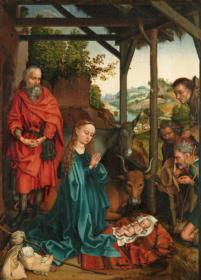
Eine der kraftvollsten Künstlerpersönlichkeiten, zugleich ein zartes, lyrisches Temperament, tritt als Vollender der spätgotischen Malerei in Deutschland in Erscheinung: Martin Schongauer aus Colmar. Seiner Kunst wegen nannten ihn seine Zeitgenossen »Hipsch Martin« oder auch »Martin Schön«, und nach seinem Tod wurde er als »pictorum gloria«, als Ruhm aller Maler, hoch gepriesen. Sein Einfluß auf die deutsche und niederländische Kunst zu Ende des 15. und bis weit ins 16. Jahrhundert hinein ist kaum zu überschätzen. Wir kennen ihn vorwiegend als Graphiker. 116 seiner Stiche sind erhalten geblieben. Sie waren in ganz Europa verbreitet und wirkten noch lange nach seinem Tod anregend auf andere Künstler. Auch Albrecht Dürer zog nach Colmar, um bei Schongauer zu arbeiten. Da dieser inzwischen verstorben war, lernte er ihn nicht mehr kennen. Dennoch ist Dürer wesentlich von der Formtradition der Schongauerwerkstatt geprägt worden. Das malerische Werk Schongauers wurde von den Bilderstürmen und den Zeitläuften weitgehend vernichtet. Nur wenige Gemälde seiner Hand sind auf uns gekommen und geben uns einen Begriff von seiner überragenden malerischen Kunst. Unter diesen ist die um 1480 gemalte Geburt Christi in Berlin eines der reifsten und schönsten. Erzählt wird das Geschehen in der Weihnachtsnacht, die Geburt des Kindes in einer Hütte vor einer Höhle am Wegrand. Der biblische Bericht ist mit legendären Zügen ausgeschmückt, die teils der Bildtradition, teils mystischen Schriften entstammen. Die einzelnen Elemente der Darstellung sind jedoch übersichtlich geordnet und sinnvoll zu einem Ganzen verschmolzen. Das Kind liegt auf einer weißen Windel am Boden. Das Weiß des Tuches, die hellste Farbe im Bild, steht sinnbildlich für den überirdischen Glanz, der nach der Legende von dem Knaben ausging. Das Kind ist das eigentliche Zentrum des Bildes, um das herum sich alles ordnet. Ihm wenden sich alle anderen Figuren in Bewegung oder Blickrichtung anbetend zu. Maria ist ihm am nächsten. Der Saum ihres Mantels, der zum Kind hin fällt, macht die Beziehung augenfällig. Joseph steht weiter weg. Durch den Wanderstab und das Bündel ist auch er mit dem Kind verbunden. Auch die Tiere, die die Heilige Familie begleiten, sind dem Kind zugewandt, der Ochs steht näher, der Esel ferner. Möglicherweise ist dies Ausdruck einer Deutung, die in den beiden Tieren Sinnbilder des Alten und Neuen Testaments erkennt. So erscheint die Familie mit den Tieren in der Hütte geborgen und von einem heiligen Bezirk umgrenzt. Die Hirten, die gekommen sind, den neugeborenen König zu verehren, verharren draußen vor der Hütte. In Nähe oder Ferne zu Christus ist das Verhältnis der einzelnen Gestalten zu ihm klar und anschaulich bestimmt. Der Betrachter des Bildes wohnt dem Ereignis gleichsam in der Hütte selbst bei und wird so in das Geschehen einbezogen. Die Hirten vor dem Stall, ein jüngerer, einer mittleren Alters und ein Greis, machen deutlich, daß alle Lebens alter, Jung und Alt, dem Neugeborenen huldigen. Die Stützen und Balken der Hütte gliedern das Bildfeld, ihre perspektivischen Linien leiten das Auge zugleich in die Tiefe des Raumes, in ein übersonntes, weites Flußtal mit Hirten und Herden. Über dem Dach der Hütte lagert aber noch das Dunkel der Nacht. Nach einer Legende nämlich war die Geburtsnacht vom Stern von Bethlehem erleuchtet und hell wie ein Tag, so daß es Nacht und Tag zugleich war. Legendäres und Symbolisches sind wie selbstverständlich in die Darstellung eingewoben. Der emaillehafte Schmelz der leuchtenden Farben trägt zur Klarheit der Komposition bei. Wilhelm H.Köhler | 200 Meisterwerke der europäischen Malerei – Gemäldegalerie Berlin, 2019____________________________________________________________________________________ The artist regarded as having brought late Gothic painting in Germany to its apogee was Martin Schongauer from Colmar, one of the strongest artistic personalities and at the same time a man with a gentle, lyrical temperament. His contemporaries nicknamed him “Hipsch Martin” (pretty Martin) or sometimes “Martin Schön” (Martin the beautiful) on account of his art; after his death he was venerated as pictorum gloria, the glory of all painters. His influence on German and Netherlandish artin the late 15th and well into the 16th century can scarcely be overestimated. We know him primarily as a graphic artist. 116 of his engravings have been preserved. They were distributed all over Europe and continued to provide inspiration for other artists long after his death. Albrecht Dürer moved to Colmar in order to work with Schongauer, but by the time he arrived Schongauer was already dead, so the two artists never met. Nevertheless, Dürer was influenced in major ways by the formal traditions of Schongauer’s workshop. Most of Schongauer’s painterly oeuvre was destroyed either by the iconoclasts or by the ravages of time. The few paintings that have come down to us give us an idea of his phenomenal painted art. The Nativity in the Berlin collection, dating from around 1475, counts among his most mature and most beautiful works.The painting narrates the events of Christmas night, the birth of the child in a hut before a cave at the side of the road. The Biblical account is embroidered with elements of legend, some taken from the pictorial tradition, others from the writings of the Mystics. The individual elements of the depiction are, however, clearly arranged and merged into a whole in a meaningful way. The child is lying on the ground in white swaddling clothes. The white of the cloth, the lightest colour in the painting, symbolises the celestial splendour that according to legend radiated from the infant. The child forms the centre of the picture; everything else is arranged around him. All the other figures are eithermoving towards him or gazing at him in veneration. Mary is closest. The hem of her coat is falling towards the child, making their relationship obvious. Joseph stands further away, but his staff and bundle connect him with the child. The animals accompanying the Holy Family are likewise turning towards the child, the ox closer, the ass further away.Perhaps this expresses an interpretation whereby the two animals symbolise the Old and New Testaments. Thus, the family and the animals are brought together in the hut’s shelter as if in a sacred enlosure. The shepherds who have come to pay their respects to the newborn king remain outside in front of the hut. The relationship of each of the figures to Christ is clearly illustrated by how close or distant they are. The viewer’s position seems to be inside the hut, too, and thus they are drawn intothe scene. The shepherds in front of the stable, one younger, one middle-aged, the third an old man, demonstrate that people of all ages, young and old, are paying homage to the new born. The supports and beams of the hut structure the pictorial field, their lines of perspective guiding the eye into the depths of the space, a sunny, broad river valley with shepherds and their flocks of sheep. Above the roof of the hut, the darkness of night still reigns. According to a legend, the night when Christ wasborn was light as day, illuminated by the star of Bethlehem, so that it was night and day at the same time. Legends and symbols are woven naturally into the depiction. The enamel-like glaze of the radiant colours adds clarity to the composition. Wilhelm H.Köhler | 200 Masterpieces of European Painting – Gemäldegalerie Berlin, 2019

Die Auferstehung Christi

Die Auferstehung Christi

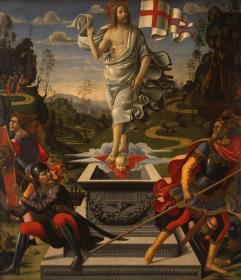
»Nun, da ich die Methoden dieser Kunst zu verstehen beginne, grämt es mich, dass sie mir nicht den Auftrag erteilen, das gesamte Rund der Stadtmauern von Florenz mit Geschichten zu bemalen.« Diese Aussage soll Domenico Ghirlandaio gegenüber seinem Bruder Davide geäußert haben, nachdem er den Chor der Dominikanerkirche S. Maria Novella ausgeschmückt hatte. Die Fresken sind heute nochzu sehen und gehören zu den künstlerischen Höhepunkten eines Florenzbesuchs. Doch Ghirlandaio war nicht nur ein bemerkenswerter Freskant, er ist auch für die Gemälde des Hochaltars verantwortlich, die Anfang des 19. Jahrhunderts veräußert wurden. Die Mitteltafel der Vorderseite, Maria mit dem Kinde und Heiligen, befindet sich heute in der Alten Pinakothek in München; die heute in der Gemäldegalerie in Berlin aufbewahrte Auferstehung nahm die Rückseite des Altarbilds ein, die nur für die Priester sichtbar war. Um die Mitteltafel und an den Seiten waren drei Heiligenpaare angeordnet. Zwei dieser Heiligen befanden sich einst in der Gemäldegalerie und wurden vermutlich im Mai 1945 in den letzten Tagen des Zweiten Weltkriegs zerstört (Abb. links).Die Auferstehung zeigt Jesus Christus am Ostermorgen, wie er dem Grab entsteigt und die vier römischen Soldaten, die es bewachen, in Schrecken versetzt. Ghirlandaio wich hier stark vom Inhalt der Heiligen Schrift ab: Das Grab Christi befand sich in einer Höhle und nicht unter freiem Himmel und keinesfalls wies es die Inschrift INRI auf (Jesus von Nazareth, König der Juden), die oben an seinem Kreuz angebracht gewesen sein soll. Auch der Pelikan, der seine Jungen mit demeigenen Blut nährt, entwickelte sich erst viel später zu einem Symbol Christi. Der Maler wollte hier die Theatralik der Szene betonen: Jesus scheint beinahe von einer unsichtbaren Maschinerie in die Luft gehoben, während die Soldaten ihre Überraschung und Angst zu überspielen suchen. Während des 19. Jahrhunderts erfuhr Ghirlandaio für seinen Sentimentalismus große Bewunderung, wurde von einigen Ästheten genau aus diesem Grund jedoch auch stark kritisiert. Der Landschaft in diesem Gemälde gebührt die gleiche Beachtung wie der bemerkenswerten Szene im Vordergrund. Auf der linken Seite nähern sich die drei Marien, die gleich das leere Grab Christi entdecken werden (ihre Namen variieren je nach Evangelium). Dahinter erkennt man im blauen Dunstschleier eine Stadt imflämischen Stil, mit einer besonderen Nähe zur Malweise des Hugo van der Goes. Am 28. Mai 1483 traf Van der Goes’ Bild für den Hochalter von S.’Egidio in Florenz ein (jetzt in den Uffizien), Domenico Ghirlandaio änderte daraufhin seine Vorstellung von Tafelmalerei.Ghirlandaio vollendete weder das Altarbild für S. Maria Novella, noch war es ihm vergönnt, die Stadtmauern von Florenz zu bemalen, wie er gehofft hatte: 1494 starb er im Alter von 45 Jahren an der Pest. Es hat etwas Bewegendes, stellt man sich vor, dass der Tod den Maler während der Arbeit an dieser Auferstehung ereilte, deren Botschaft die Hoffnung auf ein Leben nach dem Tod enthielt. Giorgio Vasari zufolge wurde dieser Teil des Bildes von Ghirlandaios Brüdern Davide undBenedetto fertiggestellt. Kritiker stimmen jedoch darin überein, dass die Landschaft von einem anderen Künstler stammen muss, in dem man Ghirlandaios Schüler Francesco Granacci sah, der heute als Pseudo Granacci bezeichnet wird. Trotz dessen Mitwirkens kann die Auferstehung als eines der letzten Meisterwerke von Domenico Ghirlandaio gelten. Neville Rowley | 200 Meisterwerke der europäischen Malerei - Gemäldegalerie Berlin, 2019________________________________________“Now that I have begun to understand the methods of this art, it grieves me that they will not commission me to paint the whole circuit of the walls of the city of Florence with stories.” This is what the painter Domenico Ghirlandaio is reputed to have said to his brother Davide, after having finished decorating the choir of the Dominican Church of Santa Maria Novella. The frescoes are still in place and are one of the highlights of any visitor who discovers Florence. But Ghirlandaio was not only a remarkable fresco painter: he was also responsible for the gigantic altarpiece adorning the chapel, dispersed at the beginning of the 19th century. The Virgin and Child in Glory among Saints which occupied the central compartment on the front side is now to be seen in Alte Pinakothek in Munich; as for the present Resurrection now in the Gemäldegalerie in Berlin, it was on the other side of the altarpiece, only visible to priests. Around the central panels and on the lateral sides of the altarpiece, three pairs of saints were displayed; two of these saints, once part of the collection of the Gemäldegalerie, were probably destroyed in May 1945 in the last days of the Second World War (fig. left).The Resurrection shows Jesus-Christ on Easter morning, coming out of his tomb, to the complete astonishment of the four Roman soldiers charged to guard his sepulture. Ghirlandaio freed himself largely from the Holy Scriptures: Christ’s tomb was set in a cave and not in the open air; and it was certainly not inscribed with the acronym “I.N.R.I.” (Jesus Christ King of Nazareth), placed instead on top of his cross, nor with the Pelican who fed his children with his blood, a symbol of Christ adopted much later (it is true that the inscription appears to have been painted over a former one). What mattered for the painter was to accentuate the theatrical character of the scene: Jesus seems to be pulled into the air by some backstage machinery, while the soldiers over-play their surprise and their fear. During the 19th century, Ghirlandaio was greatly admired for his sentimentalism; and also despised by a few aesthetes for this very reason.The landscape of this painting is to be admired on the same level as the ostentatious foreground. On the left side, we see the three Mary who, soon, will discover the empty tomb of Christ (their identities vary according to the gospels). Further on, one distinguishes a city in a blue mist, painted like in a Flemish style, and close in particular to Hugo van der Goes. On 28 May 1483, the high altarpiece of the church of Sant’Egidio, painted by Van der Goes, had arrived in Florence (it is now in the Uffizi); from that moment on, Domenico Ghirlandaio changed his conception of panel painting.Ghirlandaio did not have time to finish the Santa Maria Novella altarpiece, nor to fresco the whole circuit of the walls of Florence, as he had hoped: he died from the plague in 1494, only aged 45. There is something moving about imagining the painter agonizing while trying to complete this Resurrection, whose religious message is to give hope in a life after death. According to Vasari, this part of the altarpiece was completed by the painter’s brothers, Davide and Benedetto; but critics nowagree that the landscape is due to another artist, long confused with the pupil of Ghirlandaio Francesco Granacci and now known as the “Pseudo Granacci”. Despite the latter’s intervention, one can fully consider the Resurrection as one of the last masterpieces by Domenico Ghirlandaio. Neville Rowley | 200 Masterpieces of European Painting - Gemäldegalerie Berlin, 2019