
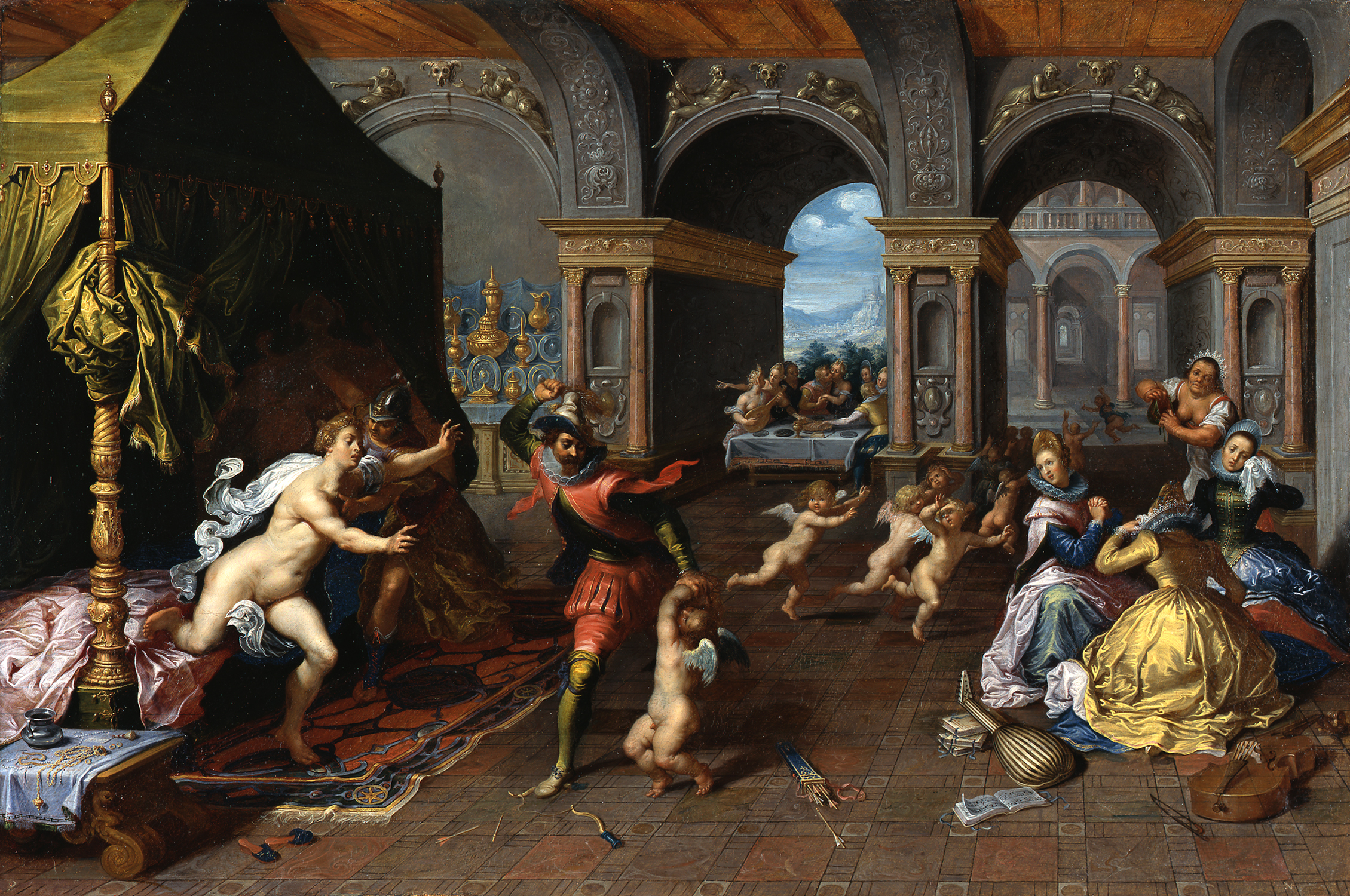
Credit: Staatliche Museen zu Berlin, Gemäldegalerie / Jörg P. Anders Public Domain Mark 1.0
Details (expert)
- Creator/Entity
- Date(s)
- Ausführung: 1632
- Systematics/Type
- Additional titles
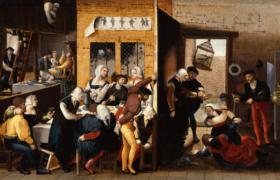
- Collection title: Die Züchtigung AmorsTranslation: The Chastisement of Cupid
- Geographical references
- Material / Technique
- Eichenholz
- Dimensions
- Bildmaß: 56 x 84,1 cm
- Acquisition
- 1829/30 Überweisung aus den Königlich Preußischen Schlössern
- Permalink
- https://id.smb.museum/object/865617
Object Description
In dem reich dekorierten Renaissance-Saal spielt sich ein in der gängigen Amor-Literatur nicht behandeltes, von de Vos mit Verve und farblicher Brillanz gestaltetes Ereignis ab. Ein vornehm gekleideter Herr geißelt den vor Schmach gekrümmten Amor-Knaben vor den Augen von Venus. Diese versucht ihrem Kind zu Hilfe zu eilen, wird aber von einem behelmten Krieger, der Mars sein könnte, gehindert. Erschreckte Damen werfen ihre Musikinstrumente zu Boden. Eine Gruppe von Amoretten flieht angstvoll dem Ausgang zu. Eine ältere Frau weist dem Betrachter hämisch einen leeren Geldbeutel vor und erklärt mit dieser Geste den Groll des den Liebesgott strafenden Kavaliers.| Prestel-Museumsführer - Gemäldegalerie Berlin, 2017
____________________________________________________________________________
De Vos presents an incident that is not usually mentioned in literature about Cupid, with verve and brilliant colour. It takes place in a lavishly decorated Renaissance hall. An elegantly dressed gentleman is whipping the boy Cupid, who is curling up in shame, before the eyes of Venus. She is trying to come to her son’s aid, but is prevented by a helmeted warrior, who could be Mars. Terrified women are throwing their musical instruments on the ground. A group of little cupids is running to find a way out. An older woman is maliciously showing the viewer an empty purse. This is, of course, the reason for the annoyance of the cavalier who is punishing the god of love.| Prestel Museum Guides - Gemäldegalerie Berlin, 2017
Last updated: 15.12.2025
Contact
Institution:
Gemäldegalerie
Email:
gg@smb.spk-berlin.de