
Logo

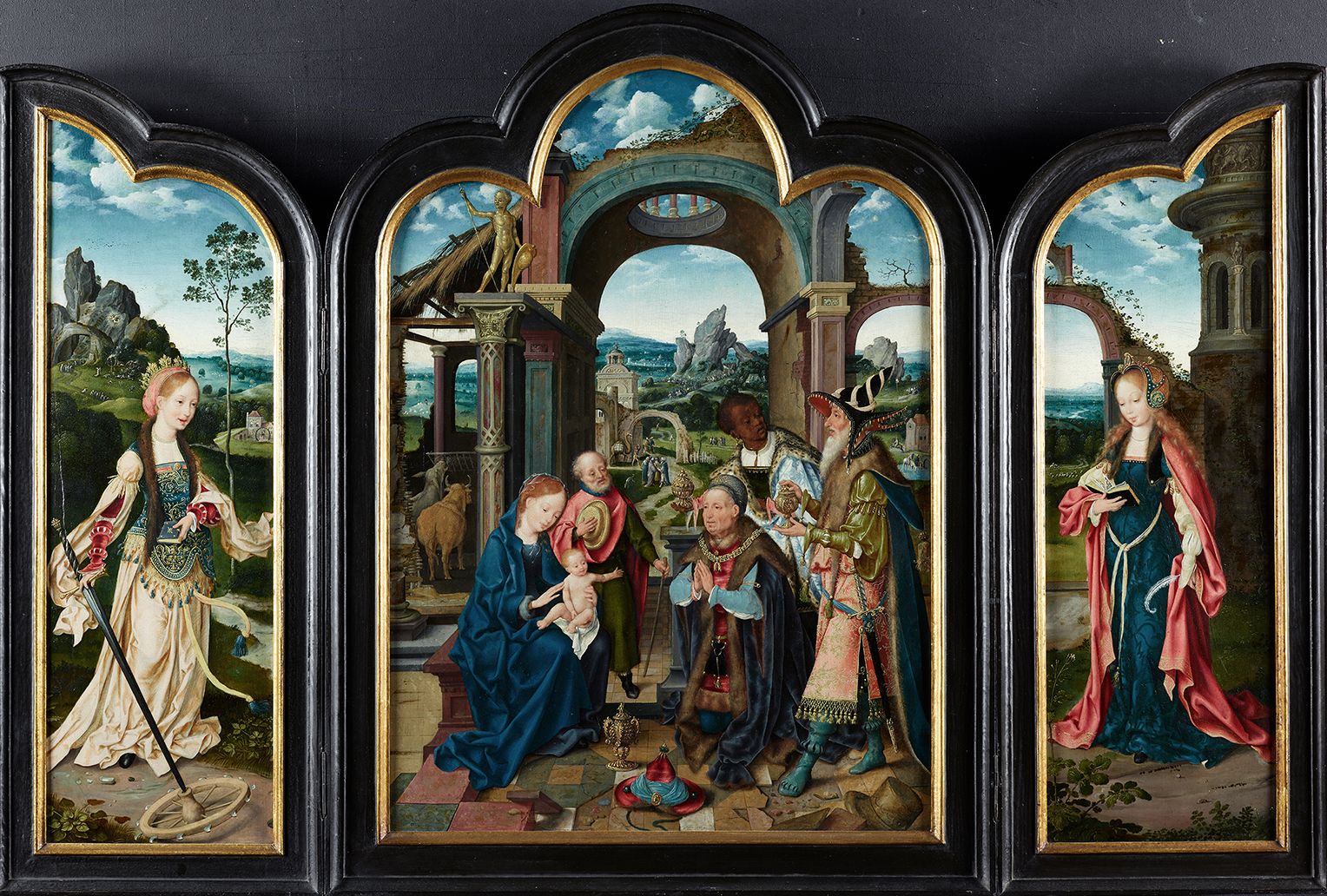
Triptychon mit der Anbetung der Könige

Ident. Nr.: 578

ObjID: obj:865723

Details (expert)

Involved
Ausführung: Joos van Cleve (um 1485 - 1540/41),
Maler*in
Dating
Ausführung: 1520
Additional titles
Collection title: Triptychon mit der Anbetung der Könige
Die heilige Katharina
Die heilige Barbara
Translation: Triptych: The Adoration of the Kings
Geographical references
Material / Technique
Eichenholz
Dimensions
Bildmaß: je Flügel 69 x 22 cm oben bogiger Abschluß
Bildmaß: Mitteltafel 72 x 52 cm

Object Description

Noch im 16. Jahrhundert haben es viele Künstler nicht für notwendig erachtet, ihre Werke zu signieren. So kommt es zu der paradoxen Situation, daß einerseits bedeutende Schaffenskomplexe nur mit einem sogenannten Notnamen versehen werden können, während andererseits zeitgenössische Quellen die Namen zahlreicher vielbeschäftigter Künstler überliefern, die sich heute jedoch nicht mehr mit den einst von ihnen geschaffenen Werken in Verbindung bringen lassen. Früher war auch unser Künstler nur als Meister des Todes Mariae bekannt. Er hatte seinen Notnamen nach zwei Altären dieses Themas in Köln und München erhalten. Mit größter Wahrscheinlichkeit ist er jedoch identisch mit dem in Antwerpener Urkunden genannten »Joos van Cleve alias van der Beke«, der dort 1511 die Freimeisterschaft erworben hatte und 1519 sowie 1525 der Malergilde als Dekan vorstand. Joos van Cleve, der vom Nieder rhein stammte und vermutlich ein Schüler von Jan Joest van Kalkar gewesen ist, hatte in Brügge durch die Kunst Memlings und Gerard Davids die entscheidenden Anregungen empfangen. In Antwerpen setzte er sich mit dem Schaffen von Patenier, Massys und den Antwerpener Manieristen auseinander. Eine Reise nach Italien dürfte ihn mit der Kunst Leonardo da Vincis in Berührung gebracht haben. Joos van Cleves Altarbilder und Porträts waren auch außerhalb der Niederlande bekannt und geschätzt. So arbeitete er eine Zeitlang als Porträtmaler am Hof Franz I. von Frankreich und reiste nach England, um Heinrich VIII. zu malen. Aus der mittleren Schaffenszeit Joos van Cleves stammt das kleine, einst privater Andacht dienende Triptychon mit der Anbetung der Könige. Es zeigt in geschlossenem Zustand, auf den Außenseiten der Flügel, die heiligen Christophorus und Sebastian, die sich in Grisaille gleich steinernen Skulpturen wirkungsvoll von dem rotbraunen Hintergrund der gemalten Nischen abheben. Festlich und in leuchtender Farbgebung erscheint dagegen die Innenseite des Altares. Das Mittelbild und die Flügel verbindet eine weite Landschaft, die sich unter blauem, zum Horizont hin aufgehelltem Himmel über die gesamte Breite des kleinen Altares erstreckt. Das Zentrum beherrscht die hoch aufragende Ruine eines palastartigen Bauwerkes mit Bögen, Säulen und Pfeilern sowie einem vergoldeten Standbild. Im Vordergrund sitzt Maria mit dem Kind auf dem Schoß, das seine Hand nach den Königen ausstreckt, die ihm huldigen und Geschenke darbringen. Kleidung und Aussehen der Könige kennzeichnen ihre Herkunft aus den damals bekannten Weltreichen: Europa, Afrika und Asien. Vor dem Kind kniet der Herrscher des Abendlandes, ausgewiesen durch die Kette des Ordens vom Goldenen Vlies. Im Hintergrund steht Joseph, der den Hut ehrfurchtsvoll in der Hand hält. Der Künstler hat ihn, der Überlieferung folgend, bärtig und mit gelichtetem Haar als ehrwürdigen alten Mann dargestellt. Unter dem Dach des Stalles sind Ochs und Esel zu sehen, die vor der Futterraufe stehen. Ihre Darstellung leitet sich von alttestamentlichen Prophezeihungen her, die auf die Ankunft des Weltenherrschers bezogen wurden. Sie zeigen, daß nicht nur die Menschheit, sondern auch die Kreatur den Erlöser erkannt hat. Unter freiem Himmel, nahe einer Gruppe bizarrer Felsen, ist das Zusammentreffen der Könige mit ihrem Gefolge dargestellt. Die weite Landschaft mit ihren vielfältigen, genau beobachteten Details steht ganz unter dem Eindruck der Panoramalandschaften Joachim Pateniers, mit dem Joos van Cleve verschiedentlich zusammengearbeitet hat. Der rechte Altarflügel zeigt die heilige Barbara mit Buch und Feder in der Hand, ausgewiesen durch ihr Attribut, den Turm, der mächtig hinter ihr aufragt. Ihr gegen über, auf dem linken Flügel, steht die heilige Katharina. Ihre reiche Kleidung und die Krone auf ihrem Haupt weisen auf ihre königliche Herkunft hin. In ihrer rechten Hand hält sie das Schwert, dessen Spitze auf dem mit eisernen Zähnen besetzten Rad ruht. Der Legende nach wurde sie aufs Rad geflochten. Das Marterinstrument wurde jedoch auf ihr Gebet hin durch ein Feuer zerstört, das vom Himmel fiel. Die Heilige wurde schließlich enthauptet und ihr Leib von Engeln auf den Sinai getragen. Joos van Cleve hat die wundersame Begebenheit des brennenden Rades in der Landschaft hinter der Heiligen mit viel Liebe zum Detail und großer Erzählfreude geschildert. Die heiligen Katharina und Barbara gehörten ebenso wie der heilige Christophorus und auch der heilige Sebastian – auf den Außenseiten der Altarflügel – zur Gruppe der Vierzehn Nothelfer, die seit dem Spätmittelalter besondere Verehrung genossen. Rainald Grosshans | 200 Meisterwerke der europäischen Malerei – Gemäldegalerie Berlin, 2019
_____________________________________________________________________________

As late as the 16th century, many artists found it unnecessary to sign their works. As a consequence, we encounter a paradoxical situation: on the one hand, major bodies of work can be assigned only with so-called “notnamen” (a German term meaning contingent or necessity name), while on the other hand, contemporary sources have transmitted the names of numerous highly productive artists which can no longer be related reliably to the works they created. Earlier, the present artist was known
only as the Master of the Death of the Virgin. He received his “notname” for two altarpieces devoted to that theme which are preserved in Cologne and Munich. In all likelihood, however, he is identical with “Joos van Cleve alias van der Beke”, an artist mentioned in Antwerp documents, who acquired his master craftsman status in 1511, and belonged to the painters’ guild as a dean from 1519 until 1525.

Joos van Cleve, who was probably a native of the Lower Rhine, and presumably a student of Jan Joest van Kalkar, received decisive, creative impulses from the art of Memling and Gerard David in Bruges. In Antwerp, he became familiar with the works of artists such as Patinir, Massys, and the Antwerp Mannerists. A journey to Italy may have brought him into contact with the art of Leonardo da Vinci. Joos van Cleve’s altarpieces and portraits were known and prized beyond the Netherlands as well. He worked for a period of time as a portrait painter at the court of François I of France, and travelled to England in order to paint Henry VIII.

This small Triptych with the Adoration of the Magi, originally intended for private devotion, comes from the middle period of Joos van Cleve’s career. When the triptych is closed, the outer sides of the wings show Saints Christopher and Sebastian, painted in grisaille to resemble stone sculptures, and both contrast effectively with the reddish-brown background of the painted niches (fig. left). More festive in comparison and executed in glowing colours are the inner sides of the altarpiece. The central panel and the wings are unified into an expansive landscape that stretches out all the way to the bright sky above the horizon, and extends across the entire breath of the altarpiece. The middle of the composition is dominated by the towering ruins of a palace-style structure with arches, columns, and pilasters, along with a gilded statue. Seated in the foreground is the Virgin with the Christ child on her lap, his hand stretched out towards the Magi, who pay him homage and offer gifts.

The attire and appearance of the Magi indicate their origins from the realms of the world known at that time, i. e. Europe, Africa, and Asia. Kneeling before the child is the king of the Occident, identified by his chain of the Order of the Golden Fleece. Standing in the background, and holding his hat reverentially in his hand, is Joseph. In accordance with tradition, the artist represents him as a venerable old man, bearded and with white hair. Visible under the roof of the stable are an ox and a donkey which stand in front of a feed trough. Their presence is derived from Old Testament prophecies pertaining to the arrival of the Lord of the World. They show that not only humanity, but creatures as well recognise the Redeemer. Set beneath the open sky, not far from a group of bizarre cliffs, is the meeting of the three kings with their entourages. The expansive landscape with its multitude of precisely observed details betrays the impact of the panoramic landscapes of Joachim Patinir, with whom Joos van Cleve worked on various occasions.

Depicted on the right-hand wing with a book in one hand and a feather in the other is Saint Barbara, who is identified by her attribute: the tower, which looms up powerfully behind her. Her counterpart on the left-hand wing is Saint Catherine, whose elaborate clothing and crown allude to her royal origins. In her right hand, she holds a sword, whose tip rests on a wheel set with iron teeth. According
to legend, she was to have been bound to the torture wheel. In response to her prayers, however, this instrument of martyrdom was destroyed by fire which fell from the heavens. Finally, the saint was beheaded and her body carried to Mount Sinai by angels. With much love of detail and great delight in storytelling, Joos van Cleve has depicted the miraculous event of the burning wheel in the landscape
behind the saint. Like Saints Christopher and Sebastian, both shown on the outer wings of the altarpiece, Saints Catherine and Barbara belong to the group of the Fourteen Holy Helpers, who were treated with special reverence beginning in the later Middle Ages. Rainald Grosshans | 200 Masterpieces of European Painting – Gemäldegalerie Berlin, 2019

Last updated: 03.07.2026

Contact

Institution:

Gemäldegalerie

Additional items from the collections

Die Geburt Christi mit der Anbetung der Hirten

Die Geburt Christi mit der Anbetung der Hirten

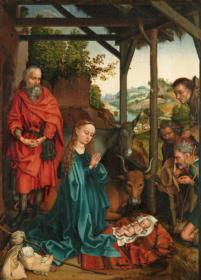
Eine der kraftvollsten Künstlerpersönlichkeiten, zugleich ein zartes, lyrisches Temperament, tritt als Vollender der spätgotischen Malerei in Deutschland in Erscheinung: Martin Schongauer aus Colmar. Seiner Kunst wegen nannten ihn seine Zeitgenossen »Hipsch Martin« oder auch »Martin Schön«, und nach seinem Tod wurde er als »pictorum gloria«, als Ruhm aller Maler, hoch gepriesen. Sein Einfluß auf die deutsche und niederländische Kunst zu Ende des 15. und bis weit ins 16. Jahrhundert hinein ist kaum zu überschätzen. Wir kennen ihn vorwiegend als Graphiker. 116 seiner Stiche sind erhalten geblieben. Sie waren in ganz Europa verbreitet und wirkten noch lange nach seinem Tod anregend auf andere Künstler. Auch Albrecht Dürer zog nach Colmar, um bei Schongauer zu arbeiten. Da dieser inzwischen verstorben war, lernte er ihn nicht mehr kennen. Dennoch ist Dürer wesentlich von der Formtradition der Schongauerwerkstatt geprägt worden. Das malerische Werk Schongauers wurde von den Bilderstürmen und den Zeitläuften weitgehend vernichtet. Nur wenige Gemälde seiner Hand sind auf uns gekommen und geben uns einen Begriff von seiner überragenden malerischen Kunst. Unter diesen ist die um 1480 gemalte Geburt Christi in Berlin eines der reifsten und schönsten. Erzählt wird das Geschehen in der Weihnachtsnacht, die Geburt des Kindes in einer Hütte vor einer Höhle am Wegrand. Der biblische Bericht ist mit legendären Zügen ausgeschmückt, die teils der Bildtradition, teils mystischen Schriften entstammen. Die einzelnen Elemente der Darstellung sind jedoch übersichtlich geordnet und sinnvoll zu einem Ganzen verschmolzen. Das Kind liegt auf einer weißen Windel am Boden. Das Weiß des Tuches, die hellste Farbe im Bild, steht sinnbildlich für den überirdischen Glanz, der nach der Legende von dem Knaben ausging. Das Kind ist das eigentliche Zentrum des Bildes, um das herum sich alles ordnet. Ihm wenden sich alle anderen Figuren in Bewegung oder Blickrichtung anbetend zu. Maria ist ihm am nächsten. Der Saum ihres Mantels, der zum Kind hin fällt, macht die Beziehung augenfällig. Joseph steht weiter weg. Durch den Wanderstab und das Bündel ist auch er mit dem Kind verbunden. Auch die Tiere, die die Heilige Familie begleiten, sind dem Kind zugewandt, der Ochs steht näher, der Esel ferner. Möglicherweise ist dies Ausdruck einer Deutung, die in den beiden Tieren Sinnbilder des Alten und Neuen Testaments erkennt. So erscheint die Familie mit den Tieren in der Hütte geborgen und von einem heiligen Bezirk umgrenzt. Die Hirten, die gekommen sind, den neugeborenen König zu verehren, verharren draußen vor der Hütte. In Nähe oder Ferne zu Christus ist das Verhältnis der einzelnen Gestalten zu ihm klar und anschaulich bestimmt. Der Betrachter des Bildes wohnt dem Ereignis gleichsam in der Hütte selbst bei und wird so in das Geschehen einbezogen. Die Hirten vor dem Stall, ein jüngerer, einer mittleren Alters und ein Greis, machen deutlich, daß alle Lebens alter, Jung und Alt, dem Neugeborenen huldigen. Die Stützen und Balken der Hütte gliedern das Bildfeld, ihre perspektivischen Linien leiten das Auge zugleich in die Tiefe des Raumes, in ein übersonntes, weites Flußtal mit Hirten und Herden. Über dem Dach der Hütte lagert aber noch das Dunkel der Nacht. Nach einer Legende nämlich war die Geburtsnacht vom Stern von Bethlehem erleuchtet und hell wie ein Tag, so daß es Nacht und Tag zugleich war. Legendäres und Symbolisches sind wie selbstverständlich in die Darstellung eingewoben. Der emaillehafte Schmelz der leuchtenden Farben trägt zur Klarheit der Komposition bei. Wilhelm H.Köhler | 200 Meisterwerke der europäischen Malerei – Gemäldegalerie Berlin, 2019____________________________________________________________________________________ The artist regarded as having brought late Gothic painting in Germany to its apogee was Martin Schongauer from Colmar, one of the strongest artistic personalities and at the same time a man with a gentle, lyrical temperament. His contemporaries nicknamed him “Hipsch Martin” (pretty Martin) or sometimes “Martin Schön” (Martin the beautiful) on account of his art; after his death he was venerated as pictorum gloria, the glory of all painters. His influence on German and Netherlandish artin the late 15th and well into the 16th century can scarcely be overestimated. We know him primarily as a graphic artist. 116 of his engravings have been preserved. They were distributed all over Europe and continued to provide inspiration for other artists long after his death. Albrecht Dürer moved to Colmar in order to work with Schongauer, but by the time he arrived Schongauer was already dead, so the two artists never met. Nevertheless, Dürer was influenced in major ways by the formal traditions of Schongauer’s workshop. Most of Schongauer’s painterly oeuvre was destroyed either by the iconoclasts or by the ravages of time. The few paintings that have come down to us give us an idea of his phenomenal painted art. The Nativity in the Berlin collection, dating from around 1475, counts among his most mature and most beautiful works.The painting narrates the events of Christmas night, the birth of the child in a hut before a cave at the side of the road. The Biblical account is embroidered with elements of legend, some taken from the pictorial tradition, others from the writings of the Mystics. The individual elements of the depiction are, however, clearly arranged and merged into a whole in a meaningful way. The child is lying on the ground in white swaddling clothes. The white of the cloth, the lightest colour in the painting, symbolises the celestial splendour that according to legend radiated from the infant. The child forms the centre of the picture; everything else is arranged around him. All the other figures are eithermoving towards him or gazing at him in veneration. Mary is closest. The hem of her coat is falling towards the child, making their relationship obvious. Joseph stands further away, but his staff and bundle connect him with the child. The animals accompanying the Holy Family are likewise turning towards the child, the ox closer, the ass further away.Perhaps this expresses an interpretation whereby the two animals symbolise the Old and New Testaments. Thus, the family and the animals are brought together in the hut’s shelter as if in a sacred enlosure. The shepherds who have come to pay their respects to the newborn king remain outside in front of the hut. The relationship of each of the figures to Christ is clearly illustrated by how close or distant they are. The viewer’s position seems to be inside the hut, too, and thus they are drawn intothe scene. The shepherds in front of the stable, one younger, one middle-aged, the third an old man, demonstrate that people of all ages, young and old, are paying homage to the new born. The supports and beams of the hut structure the pictorial field, their lines of perspective guiding the eye into the depths of the space, a sunny, broad river valley with shepherds and their flocks of sheep. Above the roof of the hut, the darkness of night still reigns. According to a legend, the night when Christ wasborn was light as day, illuminated by the star of Bethlehem, so that it was night and day at the same time. Legends and symbols are woven naturally into the depiction. The enamel-like glaze of the radiant colours adds clarity to the composition. Wilhelm H.Köhler | 200 Masterpieces of European Painting – Gemäldegalerie Berlin, 2019

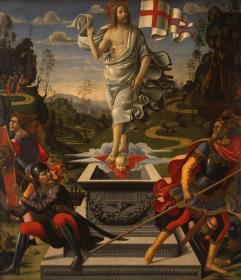
Die Auferstehung Christi

Die Auferstehung Christi

»Nun, da ich die Methoden dieser Kunst zu verstehen beginne, grämt es mich, dass sie mir nicht den Auftrag erteilen, das gesamte Rund der Stadtmauern von Florenz mit Geschichten zu bemalen.« Diese Aussage soll Domenico Ghirlandaio gegenüber seinem Bruder Davide geäußert haben, nachdem er den Chor der Dominikanerkirche S. Maria Novella ausgeschmückt hatte. Die Fresken sind heute nochzu sehen und gehören zu den künstlerischen Höhepunkten eines Florenzbesuchs. Doch Ghirlandaio war nicht nur ein bemerkenswerter Freskant, er ist auch für die Gemälde des Hochaltars verantwortlich, die Anfang des 19. Jahrhunderts veräußert wurden. Die Mitteltafel der Vorderseite, Maria mit dem Kinde und Heiligen, befindet sich heute in der Alten Pinakothek in München; die heute in der Gemäldegalerie in Berlin aufbewahrte Auferstehung nahm die Rückseite des Altarbilds ein, die nur für die Priester sichtbar war. Um die Mitteltafel und an den Seiten waren drei Heiligenpaare angeordnet. Zwei dieser Heiligen befanden sich einst in der Gemäldegalerie und wurden vermutlich im Mai 1945 in den letzten Tagen des Zweiten Weltkriegs zerstört (Abb. links).Die Auferstehung zeigt Jesus Christus am Ostermorgen, wie er dem Grab entsteigt und die vier römischen Soldaten, die es bewachen, in Schrecken versetzt. Ghirlandaio wich hier stark vom Inhalt der Heiligen Schrift ab: Das Grab Christi befand sich in einer Höhle und nicht unter freiem Himmel und keinesfalls wies es die Inschrift INRI auf (Jesus von Nazareth, König der Juden), die oben an seinem Kreuz angebracht gewesen sein soll. Auch der Pelikan, der seine Jungen mit demeigenen Blut nährt, entwickelte sich erst viel später zu einem Symbol Christi. Der Maler wollte hier die Theatralik der Szene betonen: Jesus scheint beinahe von einer unsichtbaren Maschinerie in die Luft gehoben, während die Soldaten ihre Überraschung und Angst zu überspielen suchen. Während des 19. Jahrhunderts erfuhr Ghirlandaio für seinen Sentimentalismus große Bewunderung, wurde von einigen Ästheten genau aus diesem Grund jedoch auch stark kritisiert. Der Landschaft in diesem Gemälde gebührt die gleiche Beachtung wie der bemerkenswerten Szene im Vordergrund. Auf der linken Seite nähern sich die drei Marien, die gleich das leere Grab Christi entdecken werden (ihre Namen variieren je nach Evangelium). Dahinter erkennt man im blauen Dunstschleier eine Stadt imflämischen Stil, mit einer besonderen Nähe zur Malweise des Hugo van der Goes. Am 28. Mai 1483 traf Van der Goes’ Bild für den Hochalter von S.’Egidio in Florenz ein (jetzt in den Uffizien), Domenico Ghirlandaio änderte daraufhin seine Vorstellung von Tafelmalerei.Ghirlandaio vollendete weder das Altarbild für S. Maria Novella, noch war es ihm vergönnt, die Stadtmauern von Florenz zu bemalen, wie er gehofft hatte: 1494 starb er im Alter von 45 Jahren an der Pest. Es hat etwas Bewegendes, stellt man sich vor, dass der Tod den Maler während der Arbeit an dieser Auferstehung ereilte, deren Botschaft die Hoffnung auf ein Leben nach dem Tod enthielt. Giorgio Vasari zufolge wurde dieser Teil des Bildes von Ghirlandaios Brüdern Davide undBenedetto fertiggestellt. Kritiker stimmen jedoch darin überein, dass die Landschaft von einem anderen Künstler stammen muss, in dem man Ghirlandaios Schüler Francesco Granacci sah, der heute als Pseudo Granacci bezeichnet wird. Trotz dessen Mitwirkens kann die Auferstehung als eines der letzten Meisterwerke von Domenico Ghirlandaio gelten. Neville Rowley | 200 Meisterwerke der europäischen Malerei - Gemäldegalerie Berlin, 2019________________________________________“Now that I have begun to understand the methods of this art, it grieves me that they will not commission me to paint the whole circuit of the walls of the city of Florence with stories.” This is what the painter Domenico Ghirlandaio is reputed to have said to his brother Davide, after having finished decorating the choir of the Dominican Church of Santa Maria Novella. The frescoes are still in place and are one of the highlights of any visitor who discovers Florence. But Ghirlandaio was not only a remarkable fresco painter: he was also responsible for the gigantic altarpiece adorning the chapel, dispersed at the beginning of the 19th century. The Virgin and Child in Glory among Saints which occupied the central compartment on the front side is now to be seen in Alte Pinakothek in Munich; as for the present Resurrection now in the Gemäldegalerie in Berlin, it was on the other side of the altarpiece, only visible to priests. Around the central panels and on the lateral sides of the altarpiece, three pairs of saints were displayed; two of these saints, once part of the collection of the Gemäldegalerie, were probably destroyed in May 1945 in the last days of the Second World War (fig. left).The Resurrection shows Jesus-Christ on Easter morning, coming out of his tomb, to the complete astonishment of the four Roman soldiers charged to guard his sepulture. Ghirlandaio freed himself largely from the Holy Scriptures: Christ’s tomb was set in a cave and not in the open air; and it was certainly not inscribed with the acronym “I.N.R.I.” (Jesus Christ King of Nazareth), placed instead on top of his cross, nor with the Pelican who fed his children with his blood, a symbol of Christ adopted much later (it is true that the inscription appears to have been painted over a former one). What mattered for the painter was to accentuate the theatrical character of the scene: Jesus seems to be pulled into the air by some backstage machinery, while the soldiers over-play their surprise and their fear. During the 19th century, Ghirlandaio was greatly admired for his sentimentalism; and also despised by a few aesthetes for this very reason.The landscape of this painting is to be admired on the same level as the ostentatious foreground. On the left side, we see the three Mary who, soon, will discover the empty tomb of Christ (their identities vary according to the gospels). Further on, one distinguishes a city in a blue mist, painted like in a Flemish style, and close in particular to Hugo van der Goes. On 28 May 1483, the high altarpiece of the church of Sant’Egidio, painted by Van der Goes, had arrived in Florence (it is now in the Uffizi); from that moment on, Domenico Ghirlandaio changed his conception of panel painting.Ghirlandaio did not have time to finish the Santa Maria Novella altarpiece, nor to fresco the whole circuit of the walls of Florence, as he had hoped: he died from the plague in 1494, only aged 45. There is something moving about imagining the painter agonizing while trying to complete this Resurrection, whose religious message is to give hope in a life after death. According to Vasari, this part of the altarpiece was completed by the painter’s brothers, Davide and Benedetto; but critics nowagree that the landscape is due to another artist, long confused with the pupil of Ghirlandaio Francesco Granacci and now known as the “Pseudo Granacci”. Despite the latter’s intervention, one can fully consider the Resurrection as one of the last masterpieces by Domenico Ghirlandaio. Neville Rowley | 200 Masterpieces of European Painting - Gemäldegalerie Berlin, 2019