Logo

Der Campo di Rialto

Ident. Nr.: Streit.5

ObjID: obj:867299

Credit: Leihgabe der Streitschen Stiftung

Details (expert)

Creator/Entity
Ausführung: Giovanni Antonio Canal (1697-1768),
Maler*in
Sigismund Streit (1687 - 1775),
Auftraggeber*in
Date(s)
Ausführung: 1758/62
Systematics/Type
Additional titles
Collection title: Der Campo di Rialto
Translation: The Campo di Rialto
Geographical references
Herstellungsort: Italien,
Land
Material / Technique
Leinwand
Dimensions
Bildmaß: 119,3 x 186,6 cm
Acquisition
Seit 1964 Leihgabe der Streitschen Stiftung, Berlin

Object Description

Die Ansicht des Campo di Rialto, des ehemaligen Hauptmarktplatzes und Hauptgeschäftszentrums von Venedig (Sitz der Staatsbank im Portico del Banco Giro), malte Canaletto in seinen letzten Lebensjahren, zwischen 1758 und 1763, nach der Rückkehr aus England, wo er mit kurzen Unterbrechungen von 1746 bis 1755 gewirkt hatte. Das Bild entstand im Auftrag des aus Berlin stammenden, seit Jahrzehnten in Venedig tätigen Kaufmanns Sigismund Streit (1687-1775), zusammen mit einem Gegenstück, einer Ansicht des Canal Grande in Venedig mit dem Palazzo Foscari, dem Wohnsitz Streits, in dem er auch sein Büro hatte. Streit vergab diesen Auftrag im Zusammenhang mit einer großzügigen Schenkung von Kunstwerken, seiner Bibliothek und Barvermögen, die er seiner alten Berliner Schule, dem Gymnasium zum Grauen Kloster, zugedacht hatte. Mit den beiden Bildern wollte er die Stätten seines privaten Lebens und seines beruflichen Wirkens (Campo di Rialto) für die Nachwelt festhalten. Dazu kamen noch zwei Darstellungen venezianischer Volksfeste in Form von Veduten: das Fest der Vigilia di S. Marta bei der Kirche S. Marta, an den Zattere, am Giudeccakanal, und das Fest der Vigilia di S. Pietro bei S. Pietro di Castello; die beiden Bilder haben die gleichen Maße wie die zuvor genannten. Vielleicht sollten sie den Anfang eines Zyklus von venezianischen Festdarstellungen bilden (Kat.Nrn. Streit.7-12), den Streit dann aber von einem anderen Künstler malen ließ. Beide Festdarstellungen Canalettos sind Nachtbilder. Sie bilden ein Paar und wirken wie Gegenstücke zu den beiden »Tageslichtbildern«, dem Canal Grande und dem Campo di Rialto.
Sigismund Streit war schon 1709 nach Venedig gekommen und konnte sich 1715 dort als Kaufmann selbständig machen. 1739, mit 52 Jahren, ließ er sich von Amigoni, der gerade aus England zurückgekehrt war, malen und erwarb von ihm insgesamt zehn Bilder mit biblischen und mythologischen Szenen, wohl noch ohne den Gedanken an eine Stiftung. Er war aber nie Kunstsammler im eigentlichen Sinne. 1750 gab er sein Geschäft auf und zog sich zunächst für acht Monate jährlich, seit 1754 dann ganz nach Padua zurück. Er war Junggeselle, und da er sich mit seinem Neffen, der eine Zeitlang bei ihm gearbeitet hatte, überworfen hatte, reifte in ihm der Gedanke, sein Vermögen in eine Stiftung für seine Berliner Schule einzubringen, mit der er seit 1751 deswegen in brieflichem Kontakt stand. Im Hinblick auf die Stiftung ließ er zunächst um 1751/52 von Nogari vier Allegorien mit moralisch-pädagogischen Bezügen malen, die wahrscheinlich für den Bibliothekssaal der Schule bestimmt waren. Nach 1758 folgten die vier Bilder Canalettos, die 1763 nach Berlin versandt wurden.
Der Campo di S. Giacomo di Rialto, das Hauptgeschäfts- und Bankenzentrum, lag nicht weit von Streits Wohn- und Geschäftshaus, dem Palazzo Foscari, entfernt, wenn auch auf der anderen Kanalseite. Canaletto hatte in früheren Jahren den Campo di Rialto zweimal in umgekehrter Richtung gemalt, mit Blick auf die Fassade von S. Giacometto (Dresden, Staatl. Kunstsammlungen; Ottawa, National Gallery of Canada), niemals zuvor aber die weniger reizvolle Ansicht mit dem Blick auf die nüchternen Fassaden der von Antonio Abbondi 1520 bis 1522 errichteten Fabbriche Vecchie di Rialto, die den Platz an zwei Seiten begrenzen und Sitz von Handels-, Schiffahrts- und Ernährungsbehörden waren. Die Wahl dieser Ansicht ging offensichtlich auf den Wunsch Streits zurück, der den rückwärtigen Porticato del Banco Giro dargestellt sehen wollte, wo die Staatsgirobank ihren Sitz hatte. Ihre Beamten sitzen an Pulten. Im rückwärtigen Gäßchen sitzen Notare an ihren Schaltern, auch die Versicherungsagenten hatten in der Nähe Büros. Kaufleute gehen im Gespräch auf und ab. Streit erwähnt in seiner Beschreibung besonders die Juden mit ihren roten Mützen und die Armenier in langen Gewändern und spitzen Hüten. Am mittleren Pfeiler des Porticato sieht man den »gobbo di Rialto«, eine von Pietro da Salò 1541 geschaffene Skulptur, über deren Rücken eine kleine Treppe auf die »Colonna del bando« führt, von der ein »comandador« Verlautbarungen verlas. Fremden Kaufleuten wurde erlaubt, sich hier zu versammeln.
Links im Bild erscheint die »Ruga degli orefici«, benannt nach den Goldschmieden, die im Sottoportico ihre Läden hatten, im Hintergrund der Campanile von S. Giovanni Elemosinario. Vor den Läden sieht man Verkaufsstände mit Fleisch, Gemüse, Obst und Keramik. Im Vordergrund und am rechten Porticato werden Haushaltswaren, Möbel, Gemälde und andere Kunstgegenstände angeboten. Die weitwinklige Perspektive läßt den Platz sehr viel größer und monumentaler erscheinen, als er in Wirklichkeit ist. Die Pflasterung mit dem mäanderartigen weißen Muster, wie es noch heute besteht, scheint im Jahre 1758 vorgenommen worden zu sein, womit ein Terminus post quem für Canalettos Bild gegeben ist. Die Monumentalität des Raumes, die kühle trockene Klarheit der Atmosphäre, die penible Exaktheit in der Wiedergabe der Architektur, die kalligraphische Pinselschrift, die Farbigkeit mit der Bevorzugung von sandigen Beiges, Brauns und rötlichen Tönen und die Vorliebe für das genrehafte Ausspinnen der Details sind Charakteristika für Canalettos Spätstil. Erich Schleier | 200 Meisterwerke der europäischen Malerei - Gemäldegalerie Berlin, 2019
__________________________________________

Canaletto created this view of the Campo di Rialto, the former main market square and commercial centre of Venice (with the seat of the state-owned bank located in the Portico del Banco Giro), in his final years, between 1758 and 1763, and following his return from England, where he had worked with brief interruptions from 1746 until 1755. The painting was executed on a commission from the merchant Sigismund Streit (1687–1775), a native of Berlin, who had been active in Venice for several decades, together with a pendant, a view of the Canal Grande in Venice with the Palazzo Foscari, Streit’s residence, where he also maintained his office. Streit awarded the commission in conjunction with a generous donation of artworks, his library, and monetary assets intended for his old Berlin school, the “Gymnasium zum Grauen Kloster”. Through these two pictures, he wanted to preserve the places of his private life and professional activity (Campo di Rialto) for posterity. There were also two depictions of Venetian folk festivals in the form of vedute: the Festival of Vigilia di Santa Marta at the Church of Santa Marta on the Zattere on the Giudecca Canal, and the Festival of Vigilia di San Pietro at San Pietro di Castello; both have the same dimensions as the above-mentioned works. Perhaps they were intended as the inception of the cycle of depictions of Venetian festivals (Cat. no. Streit.7-12) which Streit, however, had painted instead by another artist. Both of Canaletto’s festival scenes are night pictures. They form a pair, and function as counterparts to the two “daylight pictures”, the Canal Grande and the Campo di Rialto.
Sigismund Streit arrived in Venice in 1709, becoming an independent merchant in 1715. In 1739, when he was 52, he had himself portrayed by Amigoni, who had just returned from England, acquiring altogether ten pictures from Amigoni depicting biblical or mythological scenes, probably still without any thought of an endowment. He was however never an art collector in the genuine sense. In 1750, he gave up his business and moved to Padua, initially for eight months annually, then permanently in 1754. He was a bachelor, and having fallen out with his nephew, who had worked for him for a time, he began to develop the idea of converting his estate into an endowment for his Berlin school, with which he maintained a correspondence beginning in 1751. It was with an eye toward this endowment that he began by having Nogari execute four allegories conveying moral and pedagogical messages in 1751/52, probably intended for the school’s library hall. Following in 1758 were the four pictures by Canaletto, which were sent to Berlin in 1763.
The Campo di San Giacomo di Rialto, the main commercial and banking centre, was not far distant from Streit’s residence and business premises, albeit on the opposite side of the canal. In earlier years, Canaletto had depicted the Campo di Rialto twice from the opposite direction, with a view of the façade of San Giacometto (Dresden, Staatliche Kunstsammlungen; Ottawa, National Gallery of Canada), but had never painted the less attractive view with the sober façades of the Fabbriche Vecchie di Rialto, erected by Antonio Abbondi in 1520–22, which delimits the square on two sides, and served as the headquarters of the agencies responsible for commerce, shipping, and foodstuffs. Evidently, the choice of this view is attributable to the wishes of Streit, who wanted to see a depiction of the rearward Porticato del Banco Giro, where the state clearing bank had its headquarters. The banks officials are seen seated at desks. Seated at their counters in the rearward alley are notaries, and insurance agents had offices nearby. Merchants walk back and forth, engaged in conversation. In his description, Streit mentioned in particular the Jews, with their red caps, and the Armenians, attired in long robes with pointed hats. Visible alongside the central pillar of the Porticato is the Gobbo di Rialto (Hunchback of the Rialto), a sculpture created by Pietro da Salò in 1541, whose back supports a small staircase on the Colonna del bando, from which a “comandador” would read proclamations. Foreign merchants were allowed to assemble here.
Visible on the left is the Ruga degli orefici, named for the goldsmiths who had their shops in the sottoportico, and in the background, the campanile of San Giovanni Elemosinario. Seen in front of the shops are the stalls where meat, vegetables, fruit, and ceramics were sold. Offered in the foreground and in the right-hand side porticato were household goods, furniture, paintings, and other art objects. The wide-angle perspective allows the square to seem far larger and more monumental than it actually is. The paving, with its meandering white pattern, which still exists today, seems to have been undertaken in the year 1758, thereby providing a terminus post quem for Canaletto’s picture. The monumentality of the space, the cool, dry clarity of the atmosphere, the meticulous precision of the architectural rendering, the calligraphic brushwork, the colour scheme, with its preference for sandy beige, brown, and reddish tones, and the fondness for the genre-style elaboration of details are all characteristics of Canaletto’s late style. Erich Schleier | 200 Masterpieces of European Painting - Gemäldegalerie Berlin, 2019

Last updated: 02.09.2026

Contact

Institution:

Gemäldegalerie

Additional items from the collections

Die Apostel Petrus und Johannes, segnend

Die Apostel Petrus und Johannes, segnend

Das Bild stammt von einer beidseitig bemalten Prozessionsfahne, die Vasari für die Compagnia dello Spirito Santo malte. Auf der anderen Seite war das Pfingstwunder dargestellt. Es befindet sich heute in der Bildergalerie, Potsdam Sanssouci. Beide Szenen stehen inhaltlich in unmittelbarem Zusammenhang. Nach der Ausgießung des Heiligen Geistes zu Pfingsten treten Petrus und Johannes gemeinsam auf, um als Jünger Christi dessen Lehre zu verbreiten. Auf den göttlichen Auftrag verweist die Taube des Heiligen Geistes, die über der Szene schwebt. Laut Apostelgeschichte hält Petrus eine wirkungsvolle Predigt und heilt im Beisein von Johannes einen Lahmen (Apg. 3,1-10). Er ist der Stellvertreter Christi auf Erden, ist befähigt, Wunder zu tun und kann darüber hinaus als Repräsentant der Kirche angesehen werden. Mit den Darstellungen auf der Prozessionsfahne, die zu Pfingsten durch die Stadt getragen wurde, verwiesen die Mitglieder der Bruderschaft auf ihre eigene Jüngerschaft und ihre Aufgabe als Verkünder des Evangeliums. Vasari war als Maler und Baumeister in Arezzo, Florenz und Rom tätig. Auf vielen Reisen sammelte er Material für die Lebensbeschreibungen italienischer Künstler, die heute eine der wichtigsten Quellen der Kunstgeschichte sind. | Prestel-Museumsführer - Gemäldegalerie Berlin, 2017__________________________________________________The picture conies from a processional banner painted on both sides that Vasari painted for the Compagnia dello Spirito Santo. The miracle of Pentecost was depicted on the other side. This work is now in the Bildergalerie in Potsdam- Sanssouci. The two scenes are closely linked in terms of content. After the outpouring of the Holy Spirit at Pentecost, Peter and John appeared together to spread Christ’s teaching as his disciples. The pentecostal dove hovering over the scene refers to the divine mission. The account adds that sick people were healed by Peter’s shadow as he passed by (Acts of the Apostles 3, 1-10). He is Christ’s representative on earth, is able to perform miracles and can also be seen as representing the whole church. The members of the Brotherhood were identifying their own discipleship and their mission to proclaim the gospel in the images on the processional banner that was carried through the city at Whitsuntide. Vasari worked as a painter and architect in Arezzo, Florence and Rome. He travelled a great deal, and collected material for accounts of Italian artists’ lives, which are important sources of art history. | Prestel Museum Guides - Gemäldegalerie Berlin, 2017

Thronende Madonna / Glatzer Madonna

Thronende Madonna / Glatzer Madonna

Im Jahre 1902 erwarb das Museum durch den Kaiser-Friedrich-Museums-Verein aus dem Gymnasium zu Glatz, einer Stadt im Grenzbereich zwischen Schlesien und Nordböhmen, ein Hauptwerk der Böhmischen Schule. Die nach ihrer Herkunft Glatzer Madonna benannte Altartafel legt Zeugnis ab für die Blüte der Kunst am Hof Karls IV. zu Prag. Sie zeigt die Gottesmutter mit dem Kind auf einem architektonisch reich gestalteten Thron. Ein Engel setzt ihr eine Krone auf. In der Hand hält sie ein Lilienszepter. Ein Reichsapfel liegt in ihrem Schoß, ein Engel reicht ihr, die Knie beugend, einen weiteren dar. Diese Attribute kennzeichnen Maria als »regina coeli«, als Himmelskönigin. Der Christusknabe in ihrem Schoß hält eine Schriftrolle als einen Hinweis auf die »Schrift«, die nun erfüllt sei. Zwei Engel oben halten ein kostbares Ehrentuch, zwei weitere neigen sich aus Fenstern und schwingen Weihrauchfässer. Ein Engel links weist mit großer Gebärde auf die Gestalt des Stifters am Fuß des Thrones hin. In der vielgliedrigen Gestalt des aus kostbaren Materialien bestehenden Throns soll gleichsam ein himmlisches Gebäude anschaulich werden. Marmor und Edelsteine verschiedener Farbe bestimmen den Eindruck. Auffällig ist daneben die aus Brettern gefügte Rückwand, womit vielleicht Zedernholz gemeint ist, das beim Bau des Salomonischen Tempels Verwendung fand. In zwei tempelartigen Gehäusen oben sieht man zwei Löwen. Sie erinnern, wie auch die Bretter aus Zedernholz, an die Beschreibung des Thrones und Tempels Salomos. Der Sinnbezug auf den Salomonischen Thron deutet den Christusknaben als Neuen Salomo und setzt seine Mutter, in deren Schoß er ruht, dem Salomonischen Thron gleich. Maria wird so auch gekennzeichnet als Sitz der göttlichen Weisheit. Vielfältiger Art sind die in die Darstellung verwobenen symbolischen Anspielungen. Ein Stern über dem Thron im Goldgrund erinnert an den Beinamen Marias: »stella maris«, Maria als der Stern des Meeres. Die uns erhaltene Tafel ist unvollständig. Sie war ursprünglich nach italienischen Vorbildern von kleineren Darstellungen rahmenartig eingefaßt. Eine Schrift des 17. Jahrhunderts berichtet über den damaligen Zustand, wonach als kleine Bilder um die Tafel herum angeordnet waren: die Geburt Christi, die Beschneidung Christi, die Flucht nach Ägypten und Jesus im Tempel, also wohl eine Folge von Szenen aus dem Marienleben (Depictae in parvis imaginibus curae Divae Virginis ut …). Der Stifter am Fuß des Throns ist durch seine Amtszeichen, Pallium und Patriarchalkreuz, als Erzbischof ausgewiesen. Seine bischöflichen Insignien bringt er wie ein Opfer auf den Stufen des Throns dar. Anhand seiner Würdezeichen ist der Stifter der Tafel zu identifizieren. Es ist Ernst von Pardubitz, der erste Erzbischof Prags. Er ging in Glatz zur Schule, studierte in Italien und Paris und wurde 1343 zum Bischof ernannt. 1344 erwirkte er von Papst Clemens VI. in Avignon die Erhebung Prags zum Erzbistum. Prag wurde damit vom Erzbistum Mainz unabhängig und selbständig. Um 1350 gründete der Erzbischof in Glatz ein Augustinerchorherrenstift. In die Kirche dieses Klosters stiftete er möglicherweise unsere Altartafel. Wilhelm H.Köhler | 200 Meisterwerke der europäischen Malerei - Gemäldegalerie Berlin, 2019_____________________________In 1902, with the help of the Kaiser Friedrich Museumsverein, the museum acquired one of the major works of the Bohemian School from the secondary school in Glatz (Kłodzko), a town in the border area between Silesia and Northern Bohemia. The altar panel known as the Virgin of Kłodzko, named after the place where it comes from, testifies to the flourishing of the arts at the Prague court of Charles IV. It shows the Mother of God with the Christ child sitting on a throne of elaborate architecture. An angel is placing a crown on her head. In her hand, she holds a scepter of lilies. An imperial orb lies in her lap, while a kneeling angel holds out a second one to her. These attributes identify Mary as regina coeli, the queen of heaven. The Christ child in her lap is holding a scroll as a reference to the “scriptures” that have now been fulfilled. Two angels at the top of the painting hold a precious cloth of honour; two others are leaning out of the windows swinging censers. An angel on the left is gesturing towards the figure of the patron at the foot of the throne. The throne, made of precious materials, is divided into many sections and as such is intended to represent a celestial edifice. Marble and precious stones in various colours confirm this impression. Noteworthy is its back made of wooden planks, perhaps cedar, the wood used to build Solomon’s Temple. Two lions can be seen intwo temple-like enclosures above the throne. Like the cedar planks, they recall the description of Solomon’s throne and temple. The symbolic reference to the throne suggests that the Christ child is the New Solomon and thus places his mother, in whose lap he lies, on a par with the throne itself. Mary is thus also identified as the seat of divine wisdom. Myriad symbolic allusions are woven into the depiction. A star above the throne in the gold ground recalls Mary’s epithet: stella maris or “star of the sea”.The surviving panel is incomplete. It was originally framed by smaller depictions, a design that followed Italian models. A 17th-century text tells us about the small images that were once placed around the central image: the Nativity, the Circumcision of Christ, the Flight into Egypt and Jesus in the Temple, evidently a series of scenes from the Life of the Virgin: “Depictae in parvis imaginibuscurae Divae Virginis ut […]”. The patron at the foot of the throne is identifiable as an archbishopthrough his official insignia, pallium and patriarchal cross. He lays his bishop’s insignia on the steps of the throne like a sacrifice. The patron of the panel can be identified: it is Ernst of Pardubice, Prague’s first archbishop, who attended school in Glatz (Kłodzko), studied in Italy and Paris and was appointed a bishop in 1343. In 1344, he succeeded in having Prague raised to the status of an archbishopric by Pope Clemens VI in Avignon. Prague thus became independent of the archbishopric of Mainz and an archbishopric in its own right. Around 1350, the archbishop founded an Augustinian canonical seminary in Glatz (Kłodzko). He may have donated this altar panel to the monastery church. Wilhelm H.Köhler | 200 Masterpieces of European Painting - Gemäldegalerie Berlin, 2019

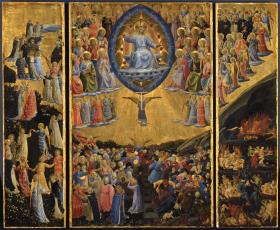
Das jüngste Gericht

Das jüngste Gericht

Auch wenn dieses Gemälde sich heute wie ein Triptychon präsentiert, bildete es ursprünglich ein Ganzes. Wichtiger als die Trennung in eine Mittel- und zwei Seitentafeln ist deshalb die symbolische Teilung des Bildraums in der Mitte. Jesus Christus hält, von Heiligen, Seligen und Engeln als Beisitzern flankiert, das Jüngste Gericht ab, dem jeder Christ voller Hoffnung und Angst entgegensieht. Die Gräber der Toten öffnen sich, wie im unteren Teil des Bildes dargestellt, und die Seele jedes Einzelnen wird gewogen. Wessen Seele unbelastet ist, steigt auf ins Paradies (links),wessen Sünde zu schwer wiegt, fährt zur Hölle (rechts), wo er die schlimmsten Strafen erleidet. Es gibt keine Hoffnung, diesem Schicksal zu entrinnen: Die Frau in dem roten Gewand in der unteren Bildmitte, die sich zwischen die geretteten Seelen zu mogeln versucht hat, wird von einem Engel erbarmungslos zur Gruppe der Verdammten gestoßen.Fra Angelico beschäftigte sich während seiner gesamten künstlerischen Laufbahn mit dem Thema des Jüngsten Gerichts. Der Alltag des observanten Dominikanermönchs, der im Konvent von S. Domenico in Fiesole lebte, bestand aus Beten und Malen. Dieses Gemälde kann als eine direkte Kritik am Verhalten seiner Zeitgenossen interpretiert werden: Es finden sich viele bedeutende Persönlichkeiten unter den Verdammten, sowohl Könige als auch Bischöfe und Geistliche. Doch obwohl Fra Angelico sich einem gewissen Symbolismus verpflichtet fühlte, integrierte er auch die neuen Darstellungstechniken in sein Bild, die Masaccio in den 1420er-Jahren in Florenz eingeführt hatte. Die Gräberreihe in der Mitte ist nach den Gesetzen der Zentralperspektive gemalt und sorgt so für eine überzeugende Raumwirkung. Im oberen Teil des Gemäldes hingegen konterkarieren der Hintergrund aus Blattgold und die intensiven Farben jede Raumillusion. Es ist, als habe Fra Angelico sich gar nicht zwischen Tradition und Moderne, zwischen Gotik und Renaissance, entscheiden wollen.In der Mitte des linken Seitenteils ziehen zwei Gestalten die Aufmerksamkeit des Betrachters auf sich: eine von hinten dargestellte Figur mit Papstkrone und eine Figur in Dominikanertracht mit Kardinalshut. Wahrscheinlich handelt es sich um zwei Zeitgenossen des Künstlers: Papst Eugen IV. und Juan de Torquemada. Beide hielten sich Ende der 1430er-Jahre tatsächlich in Florenz auf und Eugen IV. könnte die Fresken Fra Angelicos im Konvent von St. Marco gesehen haben. Nachdem er nach Rom zurückgekehrt war, bat er den Maler, für ihn im Vatikan zu arbeiten. Kardinal Torquemada kannte Fra Angelico womöglich persönlich. Er leitete später die römische Bruderschaft in S. Maria sopra Minerva, wo Fra Angelico das letzte Jahrzehnt seines Lebens verbrachte, und war wahrscheinlich der Auftraggeber des Jüngsten Gerichts. Obwohl das Werk erstmals in Rom urkundlich erwähnt wurde, ist es möglich, dass es während des päpstlichen Exils in Florenz entstand. Es verlor auch in der Folgezeit nicht an Bedeutung: Viel später, im Jahr 1570, bat der Dominikanerpapst Pius V. den flämischen Künstler Bartholomäus Spranger, eine zeitgenössische Kopie des Gemäldes anzufertigen. Neville Rowley | 200 Meisterwerke der europäischen Malerei - Gemäldegalerie Berlin, 2019________________________________________________________________Even if this painting has today the appearance of a triptych, it was originally a continuous panel. In fact, the most important separation in the image does not take place in the lateral parts of the painting but in its middle, where Jesus-Christ, surrounded by a tribunal of saints, blessed and angels, pronounces what every Christian awaited with hope and anguish, the Last Judgement. On that day, the graves of the dead will open, as seen in the lower part of the painting, and the souls of each one will be weighed. Those who are light enough will be able to go to Paradise, on the left side; souls heavy with sin will be pushed mercilessly to Hell, on the right, in order to suffer the worst punishments. Any hope of escaping this destiny is a vain thing: the woman in red who had tried to slip among the saved souls is pushed without gentleness by an angel on the side of the damned.Throughout his career, Fra Angelico has painted this theme of the Last Judgement with the greatest attention. As a Dominican observant friar, living in the convent of San Domenico in Fiesole, his life was only made of prayer and painting. This work can be seen as a direct criticism of the mores of his contemporaries: one distinguishes many important persons among the damned, whether kings, bishops, or religious. If Fra Angelico’s painting is symbolic, it does not abandon the pictorialinnovations introduced in Florence by Masaccio during the 1420s (fig. p. 297). The central path of the tombs follows the laws of perspective, and allows to build a convincing space. The upper part of the painting seems to deny this interest for space, making great use of gold leaf and intense colours. It is as if Fra Angelico had never wanted to choose between tradition and modernity, between Gothic and Renaissance.In the middle of the left fragment of the picture, two characters attract attention; one is viewed from behind, wearing the papal tiara, the second is in profile, dressed with a Dominican habit and bearing a cardinal’s hat. It is likely that these characters are contemporaries of the artist, Pope Eugene IV and Cardinal Juan de Torquemada. Eugene IV had indeed stayed in Florence in the late 1430s, and had been able to admire the fresco decoration made by Fra Angelico in the convent of San Marco. Once he settled in Rome, he would ask the painter to work for him in the Vatican. Cardinal Torquemada was also present in Florence with Eugenius IV; he may have known Fra Angelico at the time. He would later rule the Roman convent of Santa Maria sopra Minerva, where Fra Angelico spent the last decade of his life, and is likely to be the patron of the painting. Even if the work is documented for the first time in Rome, it is possible that it was painted in Florence, during the stay of the Pontifical Court. Its importance did not diminish with time: as late as 1570, the Dominican Pope Pius V asked the Flemish painter Bartholomeus Spranger to paint a modernised copy of it. Neville Rowley | 200 Masterpieces of European Painting - Gemäldegalerie Berlin, 2019