
Credit: Staatliche Museen zu Berlin, Gemäldegalerie / Jörg P. Anders Public Domain Mark 1.0
Details (expert)
- Creator/Entity
- Date(s)
- Ausführung: 1652
- Systematics/Type
- Additional titles
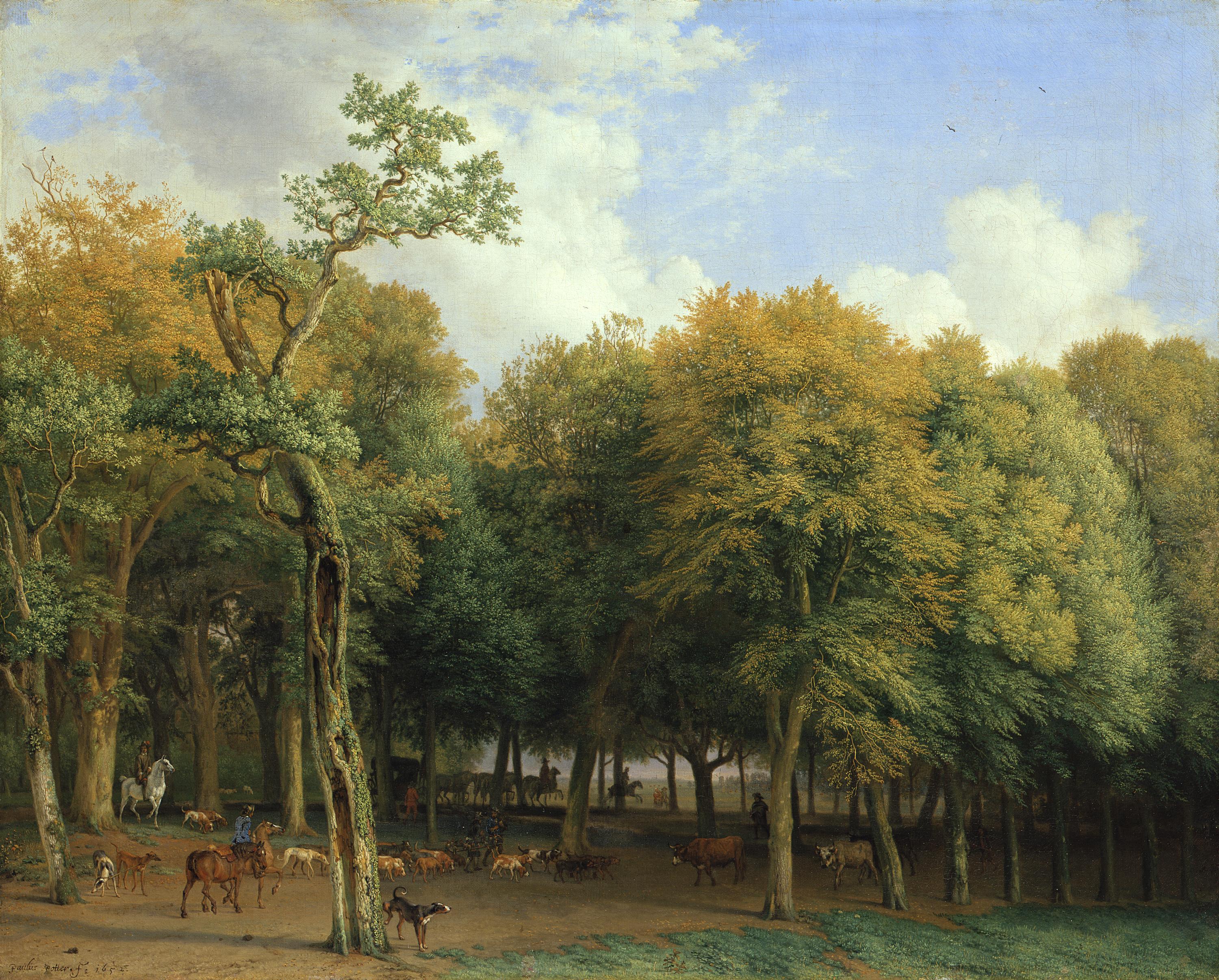
- Collection title: Aufbruch zur JagdTranslation: Departure for the Hunt
- Geographical references
- Material / Technique
- Leinwand
- Dimensions
- Bildmaß: 62,6 x 77,1 cm
- Acquisition
- 1874 Ankauf mit der Sammlung des Bankiers Barthold Suermondt, Aachen
- Permalink
- https://id.smb.museum/object/867397
Object Description
Paulus Potter gehört zu den ersten und berühmtesten niederländischen Malern, die sich auf Tierdarstellungen spezialisierten. Tiere waren nun nicht mehr nur schmückendes Beiwerk in Landschaftsgemälden, sondern nahmen eine zentrale Rolle ein. Hier gibt Potter in leichter Aufsicht eine Jagdgesellschaft wieder. Zwei vornehm gekleidete Reiter – die Jagd war ein Privileg des Adels – und ein Sechsspänner begleiten sie. Auch zwei Falkner und mit roten Hauben bewehrte Vögel sind zu erkennen. Von rechts nähern sich Viehhirten mit ihren Rindern, die von Jagdhunden angekläfft werden. Dargestellt ist der „Koekamp“, eine noch heute identifizierbare und oft gemalte Weide im „Haagse Bosch“, dem Wald bei Den Haag.| Britta Bode
SIGNATUR / INSCHRIFT: Bez. links unten: Paulus Potter• F• 1652
_____________________________________________________________________________
Paulus Potter was one of the first and most famous Dutch artists to specialize in animal portrayals. Now, animals were not a mere decorative accessory in landscapes, but they rather played a central role. Here, Potter depicts a hunting party from a slightly overhead perspective. Two elegantly dressed riders – hunting was a privilege only nobility could enjoy – and a six horse carriage escort them. Two falconers and their falcons, wearing red caps are also to be recognized. From the right livestock herders are approaching with their cows, whom the dogs bark at. Shown here is the “Koekamp”, a still identifiable and often painted meadow in the “Haagse Bosch”, the forest near The Hague.| Britta Bode
Last updated: 03.07.2026
Contact
Institution:
Gemäldegalerie
Email:
gg@smb.spk-berlin.de