
Logo

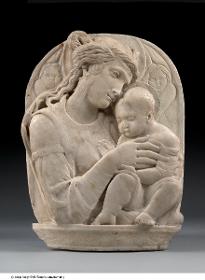
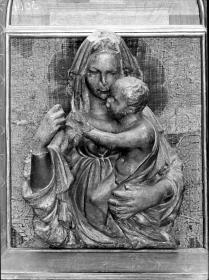
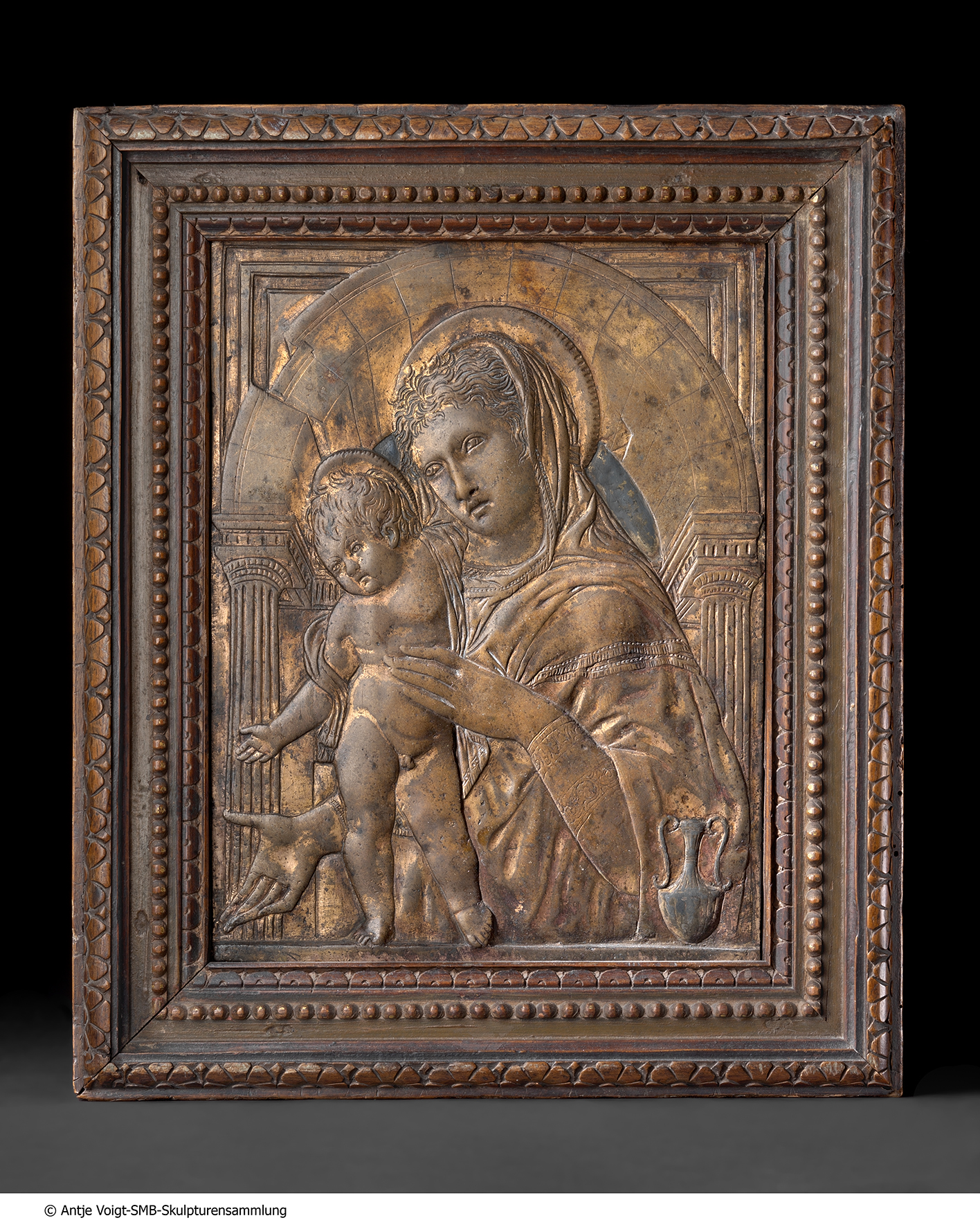
Maria mit Kind in einer Nische / Virgin and Child in a Niche

Ident. Nr.: 3044

ObjID: obj:867946
Details (expert)

Creator/Entity
nach: Donatello (um 1386-1466),
Bildhauer*in
Date(s)
Datierung: 15. Jahrhundert
Material / Technique
Bronze, versilbert
Dimensions
Höhe x Breite x Tiefe: 20,5 x 15,5 x 0,9 cm (Relief)
Höhe x Breite x Tiefe: 27,8 x 23,6 x 4,1 cm (Rahmen)
Gewicht: 2,54 kg

Object Description

After Donatello
Donato di Niccolò di Betto Bardi
Florence ca. 1386-1466

Virgin and Child in a Niche

Bronze, with traces of silver
20,3 x 15,3 cm

Berlin, Staatliche Museen, Skulpturensammlung, Inv. SKS 3044.
Bode-Museum, on view.


Provenance
Berlin, Hainauer Collection (before 1906); Berlin, Skulpturensammlung/Kaiser-Friedrich-Museum (1906-1939); Berlin, storage (1939-1945); Merkers, storage (1945); Wiesbaden, Central Collecting Point (1945-1956); West Berlin, Skulpturensammlung/Museum Dahlem (1956-1990); Berlin, Skulpturensammlung/Museum Dahlem (1990-1997); Berlin, storage (1997-2006); Berlin, Skulpturensammlung/Bode-Museum (since 2006).

Acquisition
Gift of Henry Duveen, Duveen Brothers, London, 1906; as by Donatello. Acquisition file n°F. 1395/06 (untraced).

Other versions
• Berlin, Staatliche Museen, Skulpturensammlung, Inv. SKS 76. Painted stucco.
• Budapest, Szépmüvészeti Múzeum, Inv. No. 2049: Stucco, 69 x 32 cm.
• Florence, via del Corso.
• Florence, via Ghibellina.
• London, The Wallace Collection. Inv. S 297. Bronze, 20.3 x 15.3 cm.
• London, Victoria and Albert Museum, Inv. 7385-1861. Stucco, 47,5 x 32,5 cm; 20 x 15,5 cm without frame.
• Orbignano (Pistoia), Santa Maria. Marble.
• Paris, Musée du Louvre, Inv. 704. Terracotta, 21.8 x 16.9 cm.
• Ravenna. Marble.
• Sinalunga, SM delle Nevi.
• Vatican State, Museo Sacro. Marble (KIF 171507).
• Washington DC, National Gallery of Art, Kress Collection, Inv. 1957.14.131. Bronz ( Formerly Paris, Gustave Dreyfus collecti.)
• Formerly Amsterdam, private collection.
• Formerly Florence, Grassi collection. Bronze (Photo Kunsthistorisches Institut Florenz n°59966).
• Formerly London, Christie’s, sale 7th July 1987, lot 150.
• Formerly New York, sale of the Raoul Tolentino collection, 1926, lot. 719. Stucco.

Curatorial Files in the Bode-Museum
Letter from Ulrich Middeldorf to Peter Metz, 9 January 1961: discusses the rediscovered version in Orbignano.

Comment

This bronze relief of the Virgin and Child is known in several other versions, the closest two to the present one being in the National Gallery of Art, Washington DC and in the Wallace Collection, London. The Virgin holds her standing Child with her left hand, while gesturing invitingly toward the viewer with the other – a gesture echoed by the right hand of Christ, who holds onto the neck of his mother with his other hand, in a realistic depiction of trying to maintain balance. Both figures are seen behind a balustrade on which the Child is standing, and a vase is displayed; they stand out from a niche seen in perspective, which appears to be at some distance behind them.
It is not a coincidence that the name of Donatello has always been mentioned when discussing this typology of the Madonna and Child: the pose of the Madonna with the left arm parallel to the picture plane recalls another plaquette with a Donatellesque attribution (see Inv. SKS 1028), while the open right hand is a motif used in the High Altar of the Santo in Padua. The anatomy of the Child is typical of Donatello, as is the way his left arm is hidden behind his mother’s head, with only the tips of the fingers discernable (see Inv. SKS 1940). The architecture of the niche, seen in perspective and with reference to Antique forms that are now in ruins, is present in many works by the artist, such as the bronze relief of the Feast of Herod made for the Baptistery Font in the Cathedral of Siena. Rather than Donatello himself, whose direct style cannot be recognized in any version of the series, the critics have generally and convincingly seen the relief as by an artist from his school, probably after a model by the master (Bode 1897; Schubring 1907b). In 1961, a Madonna relief in marble was found in Santa Maria, Orbignano and attributed to Donatello by the local press (N. V. 1961); however, this relief is too weak to be by Donatello and is certainly by Urbano da Cortona instead, who authored the reliefs from the Chapel of the Madonna delle Grazie in Siena Cathederal, now in the Museo dell’opera metropolitana, Siena.
The composition was reproduced in a drawing by the school of Pisanello preserved in the Musée Condé, Chantilly (the absence of a vase having made Jolly 1998 think that is was missing from the original composition, which is far from convincing). Christiansen 2004 related the work to Florentine painters such as Paolo Uccello and the Master of Pratovecchio; the echoes of such a composition are also especially important with artists in the region of Padua, such as Giorgio Schiavone (National Gallery, London); Marco Zoppo (British Museum, London, Inv. 1920-2-14-2); Niccolò Baroncelli (the Miracle of St Gilles, Museo Civico, Padua; see Galli 2010); or Andrea Mantegna (see Edskerdjian 1992). It is conceivable that the prototype for this work was made by Donatello between Padua and Florence, i.e. during the 1440s.


Literature
Molinier 1886
Émile Molinier, Les Bronzes de la Renaissance. Les plaquettes. Catalogue raisonné, Paris, Jules Rouam, 1886, I, p. 34 cat. 64: Donatello, mentions the bronze version in the G. Dreyfus collection now in the National Gallery of Art, Washington DC, and the variant in terracotta in the Musée du Louvre.
Bode 1897
Wilhelm Bode, Die Sammlung Oscar Hainauer, Berlin, W. Büxenstein, 1897, pp. 29, 80 cat. 127: school of Donatello.
Schubring 1907a
Paul Schubring, Donatello. Des Meisters Werke in 277 Abbildungen, Stuttgart and Leipzig, Deutsche Verlags-Anstalt, 1907, pp. 170, 201: circle of Donatello.
Schubring 1907b
Paul Schubring, “Gli acquisti del museo ‘Kaiser Friedrich’”, L’Arte, X, 1907, p. 452: not Donatello, but a pupil.
Bange 1922
E. F. Bange, Die Italienischen Bronzen der Renaissance und des Barock, Zweiter Teil: Reliefs und Plaketten, Berlin and Leipzig, Walter de Gruyter, 1922, p. 1 cat. 3: Donatello.
Kauffmann 1935
Hans Kauffmann, Donatello. Eine Einführung in sein Bilden und Denken, Berlin, Grotesche Verlagsbuchandlung, 1935, pp. 156, 223.
Landais 1958
Hubert Landais, Les bronzes italiens de la Renaissance, Paris, Presses universitaires de France, 1958, p. 33: close to Donatello; same artist as the bronze Flagellation in Berlin (Inv. SKS 1027); the Camondo Crucufixion in the Musée du Louvre, Paris; and the St Sebastian in the Musée Jacquemart-André, Paris.
N. V. 1961
N. V., La Nazione, 19 juin 1961, p. 5: original version by Donatello in Santa Maria, Orbignano.
Pope-Hennessy 1964
John Pope-Hennessy, Catalogue of Italian Sculpture in the Victoria and Albert Museum, London, Her Majesty’s Stationary Office, 1964, I, p. 91: style of Donatello.
Pope-Hennessy 1965
John Pope-Hennessy, Renaissance Bronzes from the Samuel H. Kress Collection, London, Phaidon Press, 1965, p. 21: related to cat. 60 in the Kress collection; style of Donatello, made by a member of Donatello’s Paduan workshop; the gesture of the Virgin is a derivation from the St Giustina made for the High Altar at Padua.
Metz 1966
Peter Metz, Bildwerke der christlichen Epochen von der Spätantike bis zum Klassizismus aus den Beständen der Skulpturenabteilung der Staatliche Museen, Stiftung Preußischer Kulturbesitz, Berlin-Dahlem, Munich, Prestel, 1966, p. 89-90, cat. 501: after Donatello.
Markham Schulz 1983
Anne Markham Schulz, Antonio Rizzo. Sculptor and Architect, Princeton, Princeton University Press, 1983, p. 26: probably after an original by Donatello; derivation in a tondo by Antonio Rizzo in the Rijksmuseum, Amsterdam.
Luchs 1985
Allison Luchs in Italian Renaissance Sculpture in the Time of Donatello, exh. cat. (Detroit, The Detroit Institute of Arts, 23 October 1985-5 January 1986 and Fort Worth, Kimbell Museum of Art, 22 February-5 April 1986), Detroit, The Detroit Institute of Arts, 1985, p. 140: formerly in Berlin, “also extremely good”.
Luchs 1986
Allison Luchs in Alan Phipps Darr and Giorgio Bonsanti (eds.), Donatello e i suoi, exh. cat. (Florence, Forte del Belvedere, 15 June-7 September 1986), Detroit and Florence, The Detroit Institute of Arts, La Casa Usher and Arnaldo Mondadori Editore, 1986, p. 167: destroyed.
Avery 1989
Charles Avery, “Donatello’s Madonnas Revisited”, in Donatello Studien, Munich, Brückmann, 1989, pp. 226-227: after Donatello, ca. 1427-1430.
Kokole 1990
Stanko Kokole, “Notes on the Sculptural Sources for Giorgio Schiavone’s Madonna in London”, Venezia Arti, 1990/4, p. 52: after Donatello in Padua; discusses the Washington version only; Virgin and Child by Giorgio Schiavone in the National Gallery, London (Inv. NG 904), is seen as a derivation.
Avery 1991
Charles Avery, Donatello. Catalogo completo delle opere, Florence, Cantini, 1991, p. 50 cat. 31: Donatello; discusses the Washington and Wallace Collection versions only.
Christiansen 1992
Keith Christiansen, “Early Works: Padua”, in Jane Martineau (ed.), Andrea Mantegna, exh. cat. (London, Royal Academy of Arts, 17 January-5 April 1992; and New York, Metropolitan Museum of Art, 9 May-12 July 1992), Milan, Olivetti-Electa, 1992, p. 97: Mantegna depends on that type and of Inv. SKS 1028.
Jolly 1998
Anna Jolly, Madonnas by Donatello and his Circle, Frankfurt am Main et al., Peter Lang, 1998, p. 148 cat. 44.1: after an original by Donatello, late 1420s or early 1430s; the drawing of Pisanello after the relief (Musée Condé, Chantilly) has no vase, which suggests that none existed in the original version; compared with the Feast of Herod by Donatello in the Baptistery, Siena (for the missing stones in the architecture), with the Tombstone of Bishop Giovanni Pecci in the Cathedral, Siena (for shell niche); Inv. SKS 3044 is the “best surviving example of this type”.
Christiansen 2004
Keith Christiansen in Matteo Ceriana et al. (eds.), Fra Carnevale. Un artista rinascimentale da Filippo Lippi a Piero della Francesca, exh. cat. (Milan, Pinacoteca di Brera, New York, Metropolitan Museum of Art, 2004, p. 168: circle of Donatello; the background accentuates the pathos, as in the “Pazzi Madonna” (Inv. SKS 51), the Chellini Madonna (Victoria and Albert Museum, London) or the Madonna del Perdono (Museo dell’Opera Metropolitana, Siena); compared with a Virgin and Child by Paolo Uccello in the National Gallery of Art, Dublin and a Virgin and Child by the Master of Pratovecchio in the Fogg Art Museum, Cambridge; the gesture of the Virgin is compared with the bronze doors of the Old Sacristy in San Lorenzo, Florence; the Child is compared with the putti above the Cavalcanti Annunciation, the architecture to the Feast of Herod in the Baptistery, Siena, and in the Musée des Beaux-Arts, Lille.
Pizzo 2006
Marco Pizzo in Davide Banzato et al. (ed.), Mantegna e Padova, exh. cat. (Padua, Musei Civici di Padova, 16 September 2006-14 January 2007), Milan, Skira, 2006, p: 242 cat. 47.
Bormand 2008
Marc Bormand, Donatello. La Vierge et l’Enfant. Deux reliefs en terre cuite, Paris, Musée du Louvre and Somogy, 2008, pp. 13-14, 40: circle of Donatello, ca. 1430; compared to a drawing by Pisanello in the Musée du Louvre, Paris. Discusses only the Washington version.
Galli 2010
Aldo Galli, “Vocazione e prime esperienze di Antonio di Cristoforo e Niccolò Baroncelli, scultori fiorentini a Ferrara”, Prospettiva, 139-140, July-October 2010, p. 44: cites only the Washington version as the best one, by Donatello in the time of the Feast of Herod made for the Siena Font; the arch is repeated in a relief by Niccolò Baroncelli in the Museo Civico, Padua (A Miracle of St Gilles, 1440-42).

Neville Rowley (24 May 2016)

Last updated: 29.07.2026

Contact

Institution:

Skulpturensammlung und Museum für Byzantinische Kunst

Additional items from the collections

Madonna mit Kind mit zwei Cherubinen

Madonna mit Kind mit zwei Cherubinen

Dieses äußerst fein gearbeitete Relief wurde von einem Künstler ausgeführt, der mit Donatello eng zusammenarbeitete und die Marmordekorationen für den Hof des Medici-Palastes in Florenz ausgeführt hat. Das Relief war wahrscheinlich über der Augenhöhe angebracht: Christus schaut nach unten und segnet mit seiner rechten Hand den fiktiven Betrachter dieser Szene. Der Cherub auf der rechten Seite ist eine moderne Ergänzung.Erworben 1842This extremely refined relief was made by a close collaborator of Donatello, who was also the author of the marble courtyard decorations for the Medici Palace in Florence. The relief was probably placed above eye level: Christ is looking downward, blessing with his right hand the fictive viewer of this scene. The cherub on the right side is a modern addition.--Follower of DonatelloMadonna and Child with two Cherubsca. 1440-60Marble44 x 32.5 x 8.5 cmBerlin, Staatliche Museen, Skulpturensammlung, Inv. SKS 57.Bode-Museum, storage.ProvenanceFlorence (before 1842); Berlin, Skulpturensammlung/Altes Museum (1842-1904); Berlin, Skulpturensammlung/Kaiser-Friedrich-Museum (1904-1939); Berlin, storage (1939-1945); Merkers, storage (1945); Wiesbaden, Central Collecting Point (1945-1956); West Berlin, Skulpturensammlung/Museum Dahlem (1956-1997); Berlin, storage (1997-2006); Berlin, Skulpturensammlung/Bode-Museum (since 2006).AcquisitionBought in Florence in 1842.ExhibitionsBotticelli. Bildnis, Mythos, Andacht, Frankfurt am Main, Städel Museum, 13 November 2009-28 February 2010.From Renaissance to Rococo. Four Centuries of European Drawing, Painting and Sculpture, Tokyo, The National Museum of Western Art, 13 June-17 September 2012 and Kyushu, Kyushu National Museum, 9 October-12 December 2012, cat. 1.BibliographyTieck 1844Frédéric Tieck, Musées Royaux. Notice des sculptures antiques, Berlin, Moeser and Kühn, 1844, p. 61 cat. 688a: school of Sansovino.Kunstblatt, 1846Kunstblatt, 1846, p. 245. (reference to be checked)Bode 1884Wilhelm Bode, “Die italienischen Skulpturen der Renaissance in den Königlichen Museen zu Berlin. III”, Jahrbuch der Königlich preußischen Kunstsammlungen, V, 1884, pp. 33-34: school of Donatello; same sculptor of the Lombardi monument in the Medici chapel of Santa Croce, Florence.Bode 1887Wilhelm Bode, Italienische Bildhauer der Renaissance. Studien zur Geschichte der italienischen Plastik und Malerei auf Grund der Bildwerke und Gemälde in den Königl. Museen zu Berlin, Berlin, W. Speemann, 1887, pp. 36-38: school of Donatello.Tschudi 1887Hugo von Tschudi, Donatello e la critica moderna, Turin et al., Fratelli Bocca, 1887 (1st ed.: Rivista storica Italiana, IV, n° 2, 1887), p. 33.Bode and Tschudi 1888Wilhelm Bode and Hugo von Tschudi, Beschreibung der Bildwerke der christlichen Epoche, Berlin, W. Spemann, 1888, p. 17 cat 44, pl. IV: school of Donatello, probably a pupil from Padua; same hand of the Lombardi relief in the Medici chapel in Santa Croce, Florence; of a Virgin and Child with five Angels in the Victoria and Albert Museum, London (Inv. 7624-1861); of a relief in the Jacquemart-André collection (Inv. 1810) and in the Bardini collection (stucco); of a round plaquette in the Musée du Louvre, Paris, and in the Hainauer collection, Berlin now in the Bode-Museum, see Inv. SKS 2847.Semrau 1891Max Semrau, Donatellos Kanzeln in S. Lorenzo. Ein Beitrag zur Geschichte der italienieschen Plastik im XV. Jahrhundert, Breslau, Schottlaender, 1891, p. 87 note 2: Giovanni da Pisa.Bode 1902Wilhelm Bode, Florentiner Bildhauer der Renaissance, Berlin, Bruno Cassirer, 1902, pp. 106, 107 fig. 107: follower of Donatello, close to the Judith in the Palazzo Vecchio, Florence, and to the pulpits of San Lorenzo, Florence.Meyer 1903Alfred Gotthold Meyer, Donatello, Bielefeld and Leipzig, Delhagen and Klafing, 1903, p. 118: Donatello.Schubring 1907Paul Schubring, Donatello. Des Meisters Werke in 277 Abbildungen, Stuttgart and Leipzig, Deutsche Verlags-Anstalt, 1907, pp. 157,162: school of Donatello.Venturi 1908Adolfo Venturi, Storia dell’arte italiana. VI. La scultura del Quattrocento, Milan, Ulrico Hoepli, 1908, pp. 455, 459 fig. 301: school of Donatello.Schottmüller 1913Frida Schottmüller, Die italienischen und spanischen Bildwerke der Renaissance und des Barocks in Marmor, Ton, Holz und Stuck, Berlin, Georg Reimer, 1913, p. 17 cat. 34: a section of the background on the right has been replaced in plaster in modern time; ancient frame, but not from the same period as the relief; characteristic of the studio of Donatello ca. 1435; related to two works mentioned by Schubring 1907, pp. 162, 166.Bode 1921Wilhelm Bode, Florentiner Bildhauer der Renaissance, Berlin, Bruno Cassirer, 1921, p. 101 fig. 56: workshop of Donatello.Wulff 1922Oskar Wulff, Donatello, Leipzig, E. A. Seemann, 1922, p. 14, fig. 31: pupil of Donatello.Schottmüller 1933Frida Schottmüller, Die italienischen und spanischen Bildwerke der Renaissance und des Barock. Erster Band. Die Bildwerke in Stein, Holz, Ton und Wachs, Zweite Auflage, Berlin and Leipzig, Walter de Gruyter & Co., 1933, p. 13: workshop of Donatello, ca. 1435; after a composition by Donatello; close to a Virgin and Child in a private collection, Paris, and to the Madona del Perdono in the Museo dell’Opera metropolitana, Siena.Nicco Fasola 1956Giusta Nicco Fasola, “Bassorilievi donatelleschi nel museo Calvet”, Critica d’arte, III (new series), n° 18, 1956, p. 559 and fig. 292: workshop of Donatello.Neri Lusanna 1986Enrica Neri Lusanna in eadem and Lucia Faedo (eds.), Il museo Bardini a Firenze. Volume secondo: le sculture, Milan, Electa, 1986, p. 254: perhaps the same pupil of Donatello as the author of the Madonna dei Cordai in the Museo Bardini, Florence.Gentilini 1993Giancarlo Gentilini in Luciano Bellosi (ed.), Francesco di Giorgio e il Rinascimento a Siena 1450-1500, exh. cat. (Siena, Chiesa di Sant’Agostino, 25 April-31 July 1993), Milan, Electa, 1993, p. 177 fig. 2, p. 181: collaborator of Donatello, author of one part of the Madonna del Perdono, of the tondi of the courtyard of the Medici palace, Florence, of the Madonna Lombardi in the Medici Chapel of Santa Croce, Florence, and the Madonna and Child with Angels in the Victoria and Albert Museum (deriving from Inv. SKS M 88); possibly Andrea dell’Aquila.Jolly 1998Anna Jolly, Madonnas by Donatello and his Circle, Frankfurt am Main et al., Peter Lang, 1998, p. 156: Paduan follower of Donatello, late 15th century; motif of the base similar to the plaquette of the Madonna with Candelabra in the National Gallery of Art, Washington DC.Katalog der Originalabgüsse… 2000Katalog der Originalabgüsse. Heft 6. Christliche Epochen. Spätantike. Byzanz. Italien. Freiplastik. Reliefs. Bronzestatuetten, Berlin, Staatliche Museen zu Berlin, 2000, cat. 2655: workshop of Donatello.Eclercy 2009Bastian Eclercy in Andreas Schumacher (ed.), Botticelli. Bildnis. Mythos. Andacht, exh. cat. (Frankfurt am Main, Städel Museum, 13 November 2009-28 February 2010), Frankfurt am Main, Städel Museum, 2009, pp. 266-267 cat. 44: workshop of Donatello; the closed eyes of the Child are a premonition of his death; spatial ambiguity of the left hand and the veil of the Virgin.Weppelmann 2012Stefan Weppelmann in From Renaissance to Rococo. Four Centuries of European Drawing, Painting and Sculpture, exh. cat. (Tokyo, The National Museum of Western Art, 13 June-17 September 2012 and Kyushu, Kyushu National Museum, 9 October-12 December 2012), Tokyo, National Museum of Western Art, 2012, pp. 46-47 cat. 1: workshop of Donatello, ca. 1460.CommentThe Virgin is holding her baby by the chest, with her eyes raised to heaven – indicating her awareness of Jesus’ future death on the Cross. He is seated on his mother’s thighs; he caresses with his left hand the wrist of the Virgin, while blessing with his right hand a beholder who was probably intended to view the work from below (the lowered eyelids of the Christ Child are not a sign of sleep, as argued by Eclercy 2009). The figures are set in an ornamented base, finely carved with heads of putti and decorative, palm-trees motifs; the background is also decorated with two cherubs (the right one is a modern addition after the one on the left, which is very abraded, as is the case with the Virgin’s right hand, and Christ’s nose and legs). Jesus is wrapped in swaddling clothes, but his legs and left shoulder are left naked.The relief was bought for the Berlin Museums by Gustav Waagen in 1842. First attributed to the school of Sansovino – a most implausible judgement – it was connected to the school of Donatello by Bode 1884, an attribution that is still valid today. The relationship with the works of Donatello is indeed very strong; from the pose of the Virgin, reminiscent of a composition present in Berlin, in a terracotta and a plaquette (see Inv. SKS 56 and Inv. SKS 1028), to her complicated headdress (similar to the Virgin and Child in the Musée du Louvre, Paris, Inv. RF 353; but also to Holophernes in the Judith and Holophernes in the Palazzo Vecchio, Florence) or to the Blessing Christ (see for instance the Virgin and Child with four Cherubs in Berlin, Inv. SKS 54). However, the handling of the marble has always prevented critics from seeing an original work by Donatello, whose conception of space is always more mastered and whose handling of the faces less caricatural.The work has been most often compared to the relief known as the Madonna del Perdono, now in the Museo dell’Opera metropolitana in Siena but coming from the Sienese Cathedral: besides the composition, there are close similarities between the reliefs, such as the posture of the right arm of the Virgin, the background with cherubs or the intended view from below. If the Madonna del Perdono is accepted as an autograph work by Donatello, some parts of the relief have probably been carved by an assistant. This is why art historians have sometimes thought that this assistant may be the autor of the Berlin Madonna (see especially Gentilini 1993). Bode and Tschudi 1888 had also suggested a common paternity with a Virgin and Child in the Lombardi monument in the sacristy of Santa Croce, Florence and with a Virgin and Child with five Angels in the Victoria and Albert Museum (inv. 7624-1861). Gentilini 1993 added to this group the tondi of the courtyard of the Medici palace in Florence, and the decoration of the organ tribune of the church of San Lorenzo, Florence (oral communication); he suggested that their author might have been Andrea dell’Aquila, who was a pupil of Donatello between 1435 and 1443.Neville Rowley (18 February 2016)

Würfelkapitell mit Palmetten- und Blattornament

Würfelkapitell mit Palmetten- und Blattornament

Das Kapitell ist aus der Grundform des Würfels entwickelt und an allen vier Seiten ausgearbeitet. An den vier Schildflächen erscheinen leicht alternierende vegetabile Ornamente im flachen Relief. Es stammt aus dem Benediktinerkloster auf dem Huy, ein in fränkischer Zeit militärisch genutzter Höhenrücken im nördlichen Harzvorland. Von Beginn an stand das Kloster unter dem Schutz der Halberstädter Bischöfe, Burchard I. hatte neben der Marienkapelle auch eine Pfalz errichtet. Die Klosterchronik des 12. Jahrhunderts erwähnt die Fertigstellung des „monasteriums“ noch in der Regierungszeit Abt Alfrieds. Der Kreuzgang, der noch stehende, zweigeschossig gewölbte Bau an der Westseite des Südflügels und möglicherweise auch Gebäude östlich der Kirche können erst nach 1150 fertiggestellt worden sein. Dieser späteren Phase gehört wohl auch das Kapitell an. Im südlichen Abschnitt des Ostflügels hat es noch einen Zweistützenraum mit den bekannten Basen gegeben, in dem dieses Kapitell aufgestellt gewesen sein könnte. Die Bildhauer, die im dritten Viertel des 12. Jahrhunderts zum Ausbau der Huysburger Klausurgebäude herangezogen wurden, haben unter Verwendung des in Sachsen seit dem 11. Jahrhundert üblichen Würfelkapitells, aber auch der korinthischen Ordnung, vor allem durch die ausgeprägte Dreidimensionalität der Formen neue Maßstäbe in der Region gesetzt. Das ornamentale Kapitell ist eng mit der Bauskulptur des nördlichen Harzvorlandes verbunden und man kann davon ausgehen, dass die meisten der auf der Huysburg tätigen Bildhauer in sächsischen Werkstätten ausgebildet wurden und wohl auch an verschiedenen Baustellen der Region tätig waren.(Auszug aus: Tobias Kunz, Bildwerke nördlich der Alpen. 1050 bis 1380. Kritischer Bestandskatalog der Berliner Skulpturensammlung, Petersberg, Michael Imhof Verlag 2014)