
Logo

Bildnis der Catharina Hooft mit ihrer Amme

Ident. Nr.: 801G

ObjID: obj:868771

Details (expert)

Creator/Entity
Ausführung: Frans Hals (1582/83 - 1666),
Maler*in
Date(s)
Ausführung: 1619/20
Systematics/Type
Additional titles
Collection title: Bildnis der Catharina Hooft mit ihrer Amme
Translation: Portrait of Catharina Hooft with Her Nurse
Geographical references
Herstellungsort: Haarlem,
Stadt
Material / Technique
Leinwand
Dimensions
Bildmaß: 91,8 x 68,3 cm
Acquisition
1874 Ankauf mit der Sammlung des Bankiers Barthold Suermondt, Aachen

Object Description

Das von Frans Hals um 1620 gemalte Porträt eines kleinen Mädchens stellt eine große Seltenheit innerhalb der niederländischen Malerei des 17. Jahrhunderts dar, ist das Kind hier doch zusammen mit seiner Amme präsentiert. Zudem handelt es sich bei dem Bild um das einzige Kinderporträt von Frans Hals, das wir heute noch kennen.
Dargestellt ist Catharina Hooft, die 1618 als einziges Kind ihrer Eltern in Amsterdam geboren wurde. Kurz darauf übersiedelten ihre Eltern nach Haarlem, wo ihr Vater, der Jurist Pieter Hooft ein Haus erworben hatte und wo auch das Berliner Porträt entstanden sein dürfte. Ihr Onkel war der berühmte niederländische Dichter, Historiker und Dramatiker Pieter Corneliszoon Hooft. Mit nur 17 Jahren heiratete Catharina 1635 den sehr vermögenden, 19 Jahre älteren Cornelis de Graeff, einen der einflussreichsten Regenten und mehrfachen Bürgermeister von Amsterdam, sowie Staatsmann und Diplomat von Holland und der Republik der Vereinigten Niederlande. Ihrer hervorgehobenen gesellschaftlichen Stellung entsprechend, begegnet uns Catharina 18 Jahre später standesbewusst als einer der ersten Damen des Landes zusammen mit ihrem Ehemann auf zwei lebensgroßen Pendantbildnissen des Amsterdamer Malers Nicolaes Eliasz Pickenoy.

Der besondere gesellschaftliche Status des kleinen, hier präsentierten Mädchens wird schnell anhand ihrer aufwendigen Kleidung deutlich. Sie trägt ein kostbares Brokatkleid mit feinsten Spitzen, das detailgetreu wiedergegeben ist. Insbesondere die zarte Klöppelspitze wurde von Frans Hals betont, indem er die abstehenden Spitzen des Kragens und des Häubchens vor einem dunklen Hintergrund präsentiert. Deutlich zu erkennen ist auch der steife Charakter der gestärkten Spitze, die gerade vom Körper absteht und deren Enden nicht umknicken. Obgleich Mädchen und Jungen im 17. Jahrhundert erst ab dem siebten Lebensjahr geschlechtsspezifisch gekleidet wurden, lässt sich aufgrund von Kostümdetails, wie dem flachen, breiten Kragen und der leicht eckigen Form der Haube feststellen, dass es sich bei dem Kind um ein Mädchen handeln muss. Sowohl Jungen als auch Mädchen trugen die rückseitig von den Schultern herabhängenden Stoffbänder, die u.a. als Lauflernhilfe dienten und auch an dem Kleidchen der Catharina Hooft vom rückwärtigen Ärmelansatz herabfallend zu erkennen sind. Neben der sehr hochwertigen Kleidung trägt Catharina Hooft auch reichlich goldenen Schmuck mit einem Anhänger, der mittig einen großen roten Stein zeigt. In ihrer linken Hand hält sie zudem eine goldene Rassel mit kleinen Schellen. Am oberen Ende der Rassel ist ein Stück aus einem dunklen, nicht eindeutig zu definierendem Material zu erkennen. Derartige Aufsätze bestanden in der Regel aus Halbedelsteinen, Korallen oder Perlmutt und dienten als eine Art von Beißring während des Zahnens. Vermutlich wurde die hier dargestellte Rassel nach einem konkreten Vorbild gemalt und befand sich vermutlich wirklich im Besitz von Catharina Hooft. Tatsächlich ist im Nachlass ihres Sohnes, der 1709 kinderlos verstarb, „eine goldene Rassel“ mit exakter Gewichts- und Wertangabe aufgeführt, die möglicherweise von seiner Mutter stammte. Da sich eine erstaunlich große Vielfalt von Rasseln auf niederländischen Kinderporträts des 17. Jahrhunderts finden lässt, geht man heute davon aus, dass es sich in den meisten Fällen um den realen Besitz der präsentierten Kinder handelt.
Im Gegensatz zu dem kleinen Mädchen, ist die dargestellte Amme ihrem Status als Bedienstete entsprechend schlicht gekleidet. Sie trägt ein altmodisches, schwarzes Kleid, eine Haube und einen einfachen Faltenkragen. Vor allem jedoch fehlen ihr, die für eine Dame obligatorischen, Manschetten an den Ärmeln. In ihrer Rechten befindet sich eine Birne, die sie empor hält und dem Kind anbietet. Ammen, deren Aufgabe ausschließlich in dem Stillen und Betreuen eines Kindes bestand, nahmen in der Regel im Hausgesinde eine hervorgehobene Stellung ein. Nur wenige Familien der Oberschicht oder des gehobenen Bürgertums konnten sich den Luxus einer Amme leisten, die damit zu einer Art von Statussymbol wurde. Im Gegensatz zu Frankreich oder England, wo viele Kinder zu einer Amme auf dem Land gegeben wurden, handelte es sich in der Republik der Vereinigten Niederlande bei den Ammen um hauseigene Bedienstete. Aufgrund der innigen Bindung zum Kind waren Bezahlung und Wertschätzung der Ammen deutlich höher, als bei anderen Bediensteten. Oftmals blieb auch nach dem Weggang der Frauen eine herzliche Beziehung zu ihnen bestehen. In Frans Hals Porträt kommen die große Vertrautheit und das innige Verhältnis von Amme und Kind, aber auch die deutlichen Standesunterschiede, die sich vor allem in der Kleidung wiederspiegeln, deutlich zum Ausdruck. Möglicherweise wurde das Doppelporträt denn auch als Erinnerungsstück beauftragt. Wie zeitgenössische Dokumente belegen, bewahrte Catharina Hooft ihr Kinderbildnis zeitlebens. Nach ihrem Tod 1691 gelangte es in den Besitz ihres Sohnes Pieter de Graeff, in dessen Nachlassinventar es als »een minne met een Kindje van Frans Hals« (eine Amme mit einem kleinen Kind von Frans Hals) auftaucht.
So spontan und natürlich die Berliner Komposition erscheint: die Amme mag derart posiert haben, das einjährige Kind ganz sicher nicht. Es ist Frans Hals Kunstfertigkeit zu verdanken, dass das Bild einen so unkomplizierten, die Figuren einen so eng aufeinander bezogenen Eindruck machen, in dem die Momenthaftigkeit der Erscheinung und die lebensvolle Gegenwärtigkeit in der meisterhaft-illusionistischen Malweise festgehalten wurde.Katja Kleinert | 200 Meisterwerke der europäischen Malerei - Gemäldegalerie Berlin, 2019
______________________________________________________________________________

This portrait of a little girl painted by Frans Hals in about 1620 is a great rarity in 17th-century Dutch painting, as she is presented here with her nurse, a highly unusual form of depiction. Furthermore, this painting is the only portrait of a child by Frans Hals that is known today.

It represents Catharina Hooft, who was born in 1618 in Amsterdam, her parents’ only child. Shortly afterwards they moved to Haarlem, where her father, the lawyer Pieter Hooft, had bought a house, and where the Berlin portrait was presumably painted. Her uncle was the famous Dutch poet, historian and dramatist Pieter Corneliszoon Hooft. In 1635, at the age of only 17, she married a man 19 years older, the extremely wealthy Cornelis de Graeff, one of the most influential figures in then government of Amsterdam, mayor of the city several times, and also a statesman and diplomat in the service of the province of Holland and the Republic of the United Netherlands. In keeping with her elevated social status, Catharina was shown in 1636 with her husband on two life-sized matching portraits by the Amsterdam painter Nicolaes Eliasz Pickenoy, conscious of her rank as one of the leading ladies
in the country (fig. p. 241).

The special social status of the small girl presented here is quickly made apparent by her elaborate clothing. She wears a precious brocade dress, reproduced in faithful detail, with the finest lace. Frans Hals particularly emphasised the bobbin lace by showing the projecting tips of the collar and the bonnet against a dark background. The stiffness of the starched lace, which stands out straight from the body without bent ends, is clearly visible. Although in the 17th century girls and boys were not given gender-specific clothes until their seventh year, it can be seen from details of the costume, for example the flat, broad collar and the slightly angular form of the bonnet, that this child must be a girl. Both girls and boys wore ribbons hanging down at the back from their shoulders, partly as an aid in learning to walk. These can be seen dangling from the top rear of the sleeve of Catharina Hooft’s little dress. In addition to her highly exclusive clothes, Catharina Hooft wears a good deal of golden jewellery, with a pendant that includes a large red stone at its centre. In her left hand, she also holds a golden rattle with small bells. At the top of the rattle is a piece of a dark material that cannot be conclusively identified. Such pieces were usually made of semi-precious stones, coral or mother of pearl, and were used as a kind of teething ring. The rattle shown here was presumably painted according to a specific original and really belonged to Catharina Hooft. Indeed, in the estate of her son, who died childless in 1709, is listed “a golden rattle” with exact details of its weight and value that may have been passed down by his mother. As an astonishing variety of rattles can be seen on Dutch children’s portraits of the 17th century, it is believed today that in most cases they actually belonged to the children portrayed.

In contrast to the little girl, the nurse is clothed in accordance with her status as a servant. She wears an old-fashioned black dress, a bonnet and a plain pleated collar. Above all, she lacks the cuffs on her sleeves that were obligatory accessories for a woman. In her right hand is a pear, which she holds up and offers to the child. Nurses, whose tasks consisted exclusively in breast-feeding and looking after a child, usually had a leading position among the household servants. Only a small number of families from the upper class or the higher bourgeoisie could afford the luxury of a nurse, who thus became a kind of status symbol. In contrast to the situation in France and England, where many children were sent out to a nurse in the country, nurses were domestic staff in the Republic of the United Netherlands. In recognition of their close ties to the child, nurses enjoyed considerably higher wages and appreciation than other servants. A warm relationship to these women often remained even after they left. Frans Hals’ portrait clearly expresses the great intimacy and close relationship between nurse and child, but also the large difference in rank, which is reflected above all in their clothing. The double portrait was possibly commissioned as a souvenir piece. As shown by contemporary documents, Catharina Hooft kept the portrait from her childhood to the end of her life. After her death in 1691, it came into the possession of her son Pieter de Graeff and appears in the inventory of his estate as “een minne met een Kindje van Frans Hals” (a nurse with a small child by Frans Hals).

Spontaneous and natural as the composition of the work in Berlin seems, the nurse may have posed in this way, but the one-year-old child undoubtedly did not. It is a mark of Frans Hals’ artistry that the painting makes such an uncomplicated impression, the persons portrayed an appearance of such closeness, thanks to his masterly illusionistic manner of painting that captures the momentary nature of the scene and its lifelike presence. Katja Kleinert | 200 Masterpieces of European Painting - Gemäldegalerie Berlin, 2019

Last updated: 03.07.2026

Contact

Institution:

Gemäldegalerie

Additional items from the collections

Die Apostel Petrus und Johannes, segnend

Die Apostel Petrus und Johannes, segnend

Das Bild stammt von einer beidseitig bemalten Prozessionsfahne, die Vasari für die Compagnia dello Spirito Santo malte. Auf der anderen Seite war das Pfingstwunder dargestellt. Es befindet sich heute in der Bildergalerie, Potsdam Sanssouci. Beide Szenen stehen inhaltlich in unmittelbarem Zusammenhang. Nach der Ausgießung des Heiligen Geistes zu Pfingsten treten Petrus und Johannes gemeinsam auf, um als Jünger Christi dessen Lehre zu verbreiten. Auf den göttlichen Auftrag verweist die Taube des Heiligen Geistes, die über der Szene schwebt. Laut Apostelgeschichte hält Petrus eine wirkungsvolle Predigt und heilt im Beisein von Johannes einen Lahmen (Apg. 3,1-10). Er ist der Stellvertreter Christi auf Erden, ist befähigt, Wunder zu tun und kann darüber hinaus als Repräsentant der Kirche angesehen werden. Mit den Darstellungen auf der Prozessionsfahne, die zu Pfingsten durch die Stadt getragen wurde, verwiesen die Mitglieder der Bruderschaft auf ihre eigene Jüngerschaft und ihre Aufgabe als Verkünder des Evangeliums. Vasari war als Maler und Baumeister in Arezzo, Florenz und Rom tätig. Auf vielen Reisen sammelte er Material für die Lebensbeschreibungen italienischer Künstler, die heute eine der wichtigsten Quellen der Kunstgeschichte sind. | Prestel-Museumsführer - Gemäldegalerie Berlin, 2017__________________________________________________The picture conies from a processional banner painted on both sides that Vasari painted for the Compagnia dello Spirito Santo. The miracle of Pentecost was depicted on the other side. This work is now in the Bildergalerie in Potsdam- Sanssouci. The two scenes are closely linked in terms of content. After the outpouring of the Holy Spirit at Pentecost, Peter and John appeared together to spread Christ’s teaching as his disciples. The pentecostal dove hovering over the scene refers to the divine mission. The account adds that sick people were healed by Peter’s shadow as he passed by (Acts of the Apostles 3, 1-10). He is Christ’s representative on earth, is able to perform miracles and can also be seen as representing the whole church. The members of the Brotherhood were identifying their own discipleship and their mission to proclaim the gospel in the images on the processional banner that was carried through the city at Whitsuntide. Vasari worked as a painter and architect in Arezzo, Florence and Rome. He travelled a great deal, and collected material for accounts of Italian artists’ lives, which are important sources of art history. | Prestel Museum Guides - Gemäldegalerie Berlin, 2017

Thronende Madonna / Glatzer Madonna

Thronende Madonna / Glatzer Madonna

Im Jahre 1902 erwarb das Museum durch den Kaiser-Friedrich-Museums-Verein aus dem Gymnasium zu Glatz, einer Stadt im Grenzbereich zwischen Schlesien und Nordböhmen, ein Hauptwerk der Böhmischen Schule. Die nach ihrer Herkunft Glatzer Madonna benannte Altartafel legt Zeugnis ab für die Blüte der Kunst am Hof Karls IV. zu Prag. Sie zeigt die Gottesmutter mit dem Kind auf einem architektonisch reich gestalteten Thron. Ein Engel setzt ihr eine Krone auf. In der Hand hält sie ein Lilienszepter. Ein Reichsapfel liegt in ihrem Schoß, ein Engel reicht ihr, die Knie beugend, einen weiteren dar. Diese Attribute kennzeichnen Maria als »regina coeli«, als Himmelskönigin. Der Christusknabe in ihrem Schoß hält eine Schriftrolle als einen Hinweis auf die »Schrift«, die nun erfüllt sei. Zwei Engel oben halten ein kostbares Ehrentuch, zwei weitere neigen sich aus Fenstern und schwingen Weihrauchfässer. Ein Engel links weist mit großer Gebärde auf die Gestalt des Stifters am Fuß des Thrones hin. In der vielgliedrigen Gestalt des aus kostbaren Materialien bestehenden Throns soll gleichsam ein himmlisches Gebäude anschaulich werden. Marmor und Edelsteine verschiedener Farbe bestimmen den Eindruck. Auffällig ist daneben die aus Brettern gefügte Rückwand, womit vielleicht Zedernholz gemeint ist, das beim Bau des Salomonischen Tempels Verwendung fand. In zwei tempelartigen Gehäusen oben sieht man zwei Löwen. Sie erinnern, wie auch die Bretter aus Zedernholz, an die Beschreibung des Thrones und Tempels Salomos. Der Sinnbezug auf den Salomonischen Thron deutet den Christusknaben als Neuen Salomo und setzt seine Mutter, in deren Schoß er ruht, dem Salomonischen Thron gleich. Maria wird so auch gekennzeichnet als Sitz der göttlichen Weisheit. Vielfältiger Art sind die in die Darstellung verwobenen symbolischen Anspielungen. Ein Stern über dem Thron im Goldgrund erinnert an den Beinamen Marias: »stella maris«, Maria als der Stern des Meeres. Die uns erhaltene Tafel ist unvollständig. Sie war ursprünglich nach italienischen Vorbildern von kleineren Darstellungen rahmenartig eingefaßt. Eine Schrift des 17. Jahrhunderts berichtet über den damaligen Zustand, wonach als kleine Bilder um die Tafel herum angeordnet waren: die Geburt Christi, die Beschneidung Christi, die Flucht nach Ägypten und Jesus im Tempel, also wohl eine Folge von Szenen aus dem Marienleben (Depictae in parvis imaginibus curae Divae Virginis ut …). Der Stifter am Fuß des Throns ist durch seine Amtszeichen, Pallium und Patriarchalkreuz, als Erzbischof ausgewiesen. Seine bischöflichen Insignien bringt er wie ein Opfer auf den Stufen des Throns dar. Anhand seiner Würdezeichen ist der Stifter der Tafel zu identifizieren. Es ist Ernst von Pardubitz, der erste Erzbischof Prags. Er ging in Glatz zur Schule, studierte in Italien und Paris und wurde 1343 zum Bischof ernannt. 1344 erwirkte er von Papst Clemens VI. in Avignon die Erhebung Prags zum Erzbistum. Prag wurde damit vom Erzbistum Mainz unabhängig und selbständig. Um 1350 gründete der Erzbischof in Glatz ein Augustinerchorherrenstift. In die Kirche dieses Klosters stiftete er möglicherweise unsere Altartafel. Wilhelm H.Köhler | 200 Meisterwerke der europäischen Malerei - Gemäldegalerie Berlin, 2019_____________________________In 1902, with the help of the Kaiser Friedrich Museumsverein, the museum acquired one of the major works of the Bohemian School from the secondary school in Glatz (Kłodzko), a town in the border area between Silesia and Northern Bohemia. The altar panel known as the Virgin of Kłodzko, named after the place where it comes from, testifies to the flourishing of the arts at the Prague court of Charles IV. It shows the Mother of God with the Christ child sitting on a throne of elaborate architecture. An angel is placing a crown on her head. In her hand, she holds a scepter of lilies. An imperial orb lies in her lap, while a kneeling angel holds out a second one to her. These attributes identify Mary as regina coeli, the queen of heaven. The Christ child in her lap is holding a scroll as a reference to the “scriptures” that have now been fulfilled. Two angels at the top of the painting hold a precious cloth of honour; two others are leaning out of the windows swinging censers. An angel on the left is gesturing towards the figure of the patron at the foot of the throne. The throne, made of precious materials, is divided into many sections and as such is intended to represent a celestial edifice. Marble and precious stones in various colours confirm this impression. Noteworthy is its back made of wooden planks, perhaps cedar, the wood used to build Solomon’s Temple. Two lions can be seen intwo temple-like enclosures above the throne. Like the cedar planks, they recall the description of Solomon’s throne and temple. The symbolic reference to the throne suggests that the Christ child is the New Solomon and thus places his mother, in whose lap he lies, on a par with the throne itself. Mary is thus also identified as the seat of divine wisdom. Myriad symbolic allusions are woven into the depiction. A star above the throne in the gold ground recalls Mary’s epithet: stella maris or “star of the sea”.The surviving panel is incomplete. It was originally framed by smaller depictions, a design that followed Italian models. A 17th-century text tells us about the small images that were once placed around the central image: the Nativity, the Circumcision of Christ, the Flight into Egypt and Jesus in the Temple, evidently a series of scenes from the Life of the Virgin: “Depictae in parvis imaginibuscurae Divae Virginis ut […]”. The patron at the foot of the throne is identifiable as an archbishopthrough his official insignia, pallium and patriarchal cross. He lays his bishop’s insignia on the steps of the throne like a sacrifice. The patron of the panel can be identified: it is Ernst of Pardubice, Prague’s first archbishop, who attended school in Glatz (Kłodzko), studied in Italy and Paris and was appointed a bishop in 1343. In 1344, he succeeded in having Prague raised to the status of an archbishopric by Pope Clemens VI in Avignon. Prague thus became independent of the archbishopric of Mainz and an archbishopric in its own right. Around 1350, the archbishop founded an Augustinian canonical seminary in Glatz (Kłodzko). He may have donated this altar panel to the monastery church. Wilhelm H.Köhler | 200 Masterpieces of European Painting - Gemäldegalerie Berlin, 2019

Das jüngste Gericht

Das jüngste Gericht

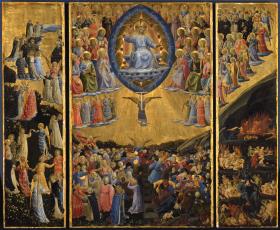
Auch wenn dieses Gemälde sich heute wie ein Triptychon präsentiert, bildete es ursprünglich ein Ganzes. Wichtiger als die Trennung in eine Mittel- und zwei Seitentafeln ist deshalb die symbolische Teilung des Bildraums in der Mitte. Jesus Christus hält, von Heiligen, Seligen und Engeln als Beisitzern flankiert, das Jüngste Gericht ab, dem jeder Christ voller Hoffnung und Angst entgegensieht. Die Gräber der Toten öffnen sich, wie im unteren Teil des Bildes dargestellt, und die Seele jedes Einzelnen wird gewogen. Wessen Seele unbelastet ist, steigt auf ins Paradies (links),wessen Sünde zu schwer wiegt, fährt zur Hölle (rechts), wo er die schlimmsten Strafen erleidet. Es gibt keine Hoffnung, diesem Schicksal zu entrinnen: Die Frau in dem roten Gewand in der unteren Bildmitte, die sich zwischen die geretteten Seelen zu mogeln versucht hat, wird von einem Engel erbarmungslos zur Gruppe der Verdammten gestoßen.Fra Angelico beschäftigte sich während seiner gesamten künstlerischen Laufbahn mit dem Thema des Jüngsten Gerichts. Der Alltag des observanten Dominikanermönchs, der im Konvent von S. Domenico in Fiesole lebte, bestand aus Beten und Malen. Dieses Gemälde kann als eine direkte Kritik am Verhalten seiner Zeitgenossen interpretiert werden: Es finden sich viele bedeutende Persönlichkeiten unter den Verdammten, sowohl Könige als auch Bischöfe und Geistliche. Doch obwohl Fra Angelico sich einem gewissen Symbolismus verpflichtet fühlte, integrierte er auch die neuen Darstellungstechniken in sein Bild, die Masaccio in den 1420er-Jahren in Florenz eingeführt hatte. Die Gräberreihe in der Mitte ist nach den Gesetzen der Zentralperspektive gemalt und sorgt so für eine überzeugende Raumwirkung. Im oberen Teil des Gemäldes hingegen konterkarieren der Hintergrund aus Blattgold und die intensiven Farben jede Raumillusion. Es ist, als habe Fra Angelico sich gar nicht zwischen Tradition und Moderne, zwischen Gotik und Renaissance, entscheiden wollen.In der Mitte des linken Seitenteils ziehen zwei Gestalten die Aufmerksamkeit des Betrachters auf sich: eine von hinten dargestellte Figur mit Papstkrone und eine Figur in Dominikanertracht mit Kardinalshut. Wahrscheinlich handelt es sich um zwei Zeitgenossen des Künstlers: Papst Eugen IV. und Juan de Torquemada. Beide hielten sich Ende der 1430er-Jahre tatsächlich in Florenz auf und Eugen IV. könnte die Fresken Fra Angelicos im Konvent von St. Marco gesehen haben. Nachdem er nach Rom zurückgekehrt war, bat er den Maler, für ihn im Vatikan zu arbeiten. Kardinal Torquemada kannte Fra Angelico womöglich persönlich. Er leitete später die römische Bruderschaft in S. Maria sopra Minerva, wo Fra Angelico das letzte Jahrzehnt seines Lebens verbrachte, und war wahrscheinlich der Auftraggeber des Jüngsten Gerichts. Obwohl das Werk erstmals in Rom urkundlich erwähnt wurde, ist es möglich, dass es während des päpstlichen Exils in Florenz entstand. Es verlor auch in der Folgezeit nicht an Bedeutung: Viel später, im Jahr 1570, bat der Dominikanerpapst Pius V. den flämischen Künstler Bartholomäus Spranger, eine zeitgenössische Kopie des Gemäldes anzufertigen. Neville Rowley | 200 Meisterwerke der europäischen Malerei - Gemäldegalerie Berlin, 2019________________________________________________________________Even if this painting has today the appearance of a triptych, it was originally a continuous panel. In fact, the most important separation in the image does not take place in the lateral parts of the painting but in its middle, where Jesus-Christ, surrounded by a tribunal of saints, blessed and angels, pronounces what every Christian awaited with hope and anguish, the Last Judgement. On that day, the graves of the dead will open, as seen in the lower part of the painting, and the souls of each one will be weighed. Those who are light enough will be able to go to Paradise, on the left side; souls heavy with sin will be pushed mercilessly to Hell, on the right, in order to suffer the worst punishments. Any hope of escaping this destiny is a vain thing: the woman in red who had tried to slip among the saved souls is pushed without gentleness by an angel on the side of the damned.Throughout his career, Fra Angelico has painted this theme of the Last Judgement with the greatest attention. As a Dominican observant friar, living in the convent of San Domenico in Fiesole, his life was only made of prayer and painting. This work can be seen as a direct criticism of the mores of his contemporaries: one distinguishes many important persons among the damned, whether kings, bishops, or religious. If Fra Angelico’s painting is symbolic, it does not abandon the pictorialinnovations introduced in Florence by Masaccio during the 1420s (fig. p. 297). The central path of the tombs follows the laws of perspective, and allows to build a convincing space. The upper part of the painting seems to deny this interest for space, making great use of gold leaf and intense colours. It is as if Fra Angelico had never wanted to choose between tradition and modernity, between Gothic and Renaissance.In the middle of the left fragment of the picture, two characters attract attention; one is viewed from behind, wearing the papal tiara, the second is in profile, dressed with a Dominican habit and bearing a cardinal’s hat. It is likely that these characters are contemporaries of the artist, Pope Eugene IV and Cardinal Juan de Torquemada. Eugene IV had indeed stayed in Florence in the late 1430s, and had been able to admire the fresco decoration made by Fra Angelico in the convent of San Marco. Once he settled in Rome, he would ask the painter to work for him in the Vatican. Cardinal Torquemada was also present in Florence with Eugenius IV; he may have known Fra Angelico at the time. He would later rule the Roman convent of Santa Maria sopra Minerva, where Fra Angelico spent the last decade of his life, and is likely to be the patron of the painting. Even if the work is documented for the first time in Rome, it is possible that it was painted in Florence, during the stay of the Pontifical Court. Its importance did not diminish with time: as late as 1570, the Dominican Pope Pius V asked the Flemish painter Bartholomeus Spranger to paint a modernised copy of it. Neville Rowley | 200 Masterpieces of European Painting - Gemäldegalerie Berlin, 2019

Maria mit dem Kind

Maria mit dem Kind

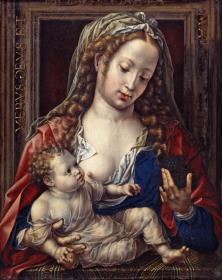
Die Madonnenbilder bezeichnen einen der Höhepunkte im Schaffen Gossaerts. Überblickt man die Entwicklung des traditionsreichen Bildthemas, das in der niederländischen Malerei von van Eyck über Memling, Sittow und Massys bis hin zu Gossaert führt, dann zeigt sich, in welchem Ausmaß man die künstlerische Überlieferung zu bewahren verstand, sie andererseits jedoch um neue Möglichkeiten zu bereichern wußte. Die Enge der Raumbühne, auf der die Bildfiguren kaum Platz finden, entspringt dem Anliegen, deren Körperlichkeit besonderen Nachdruck zu verleihen. Maria und das Kind werden von einem reich profilierten graubraunen Rahmen eingefaßt, den sie mehrfach überschneiden, und aus dem heraus sie uns fast greifbar entgegentreten. Die rotbraun getönte Rückplatte des Rahmens bildet den Hintergrund, vor dem sich das schöne Antlitz Marias kontrastreich abhebt. Die differenzierte Modellierung durch Licht und Schatten ist dabei ebenso zu bewundern wie die malerische Behandlung der Haare, der Hände oder des unruhig bewegten Faltenwurfs der Gewänder. Die Beherrschung illusionistischer Effekte erweist sich besonders deutlich an den leicht gewölbten, wie aus Metall geschnittenen Buchstaben in der Hohlkehle der gemalten Rahmung. Sie bilden von links nach rechts umlaufend die folgende Inschrift: »VERVS DEVS ET HOMO – CASTA MATER ET VIRGO« (Ein wahrer Gott und Mensch, eine reine Mutter und Jungfrau). Mit leicht geneigtem Kopf und gesenkten Augen blickt Maria auf das Kind herab, das vor ihr auf der mit einem Teppich bedeckten Brüstung ruht. Maria trägt einen roten Mantel und ein blaues Kleid, das über der rechten Brust geöffnet ist. Ein weißes Kopftuch bedeckt das lange rotblonde Haar, das über die Schultern herabfällt. In ihrer linken Hand hält sie eine Weintraube, nach der das Kind verlangend die Hand ausstreckt. Dieser Gebärde gilt der sinnende Blick der Gottesmutter, in dem sich das Wissen um das Schicksal ihres Sohnes ausdrückt. Das lebhafte Kind ist nur mit einem dünnen Hemdchen bekleidet, unter dem sich sein kräftiger Körper abzeichnet. In der rechten Hand hält es den Apfel. Es ist die Frucht, die einst den Sündenfall besiegelte und sich nun in ein Unterpfand der Erlösung verwandelt hat. In dem Symbol des Apfels verdichten sich die vielfältigen Anspielungen und sinnbildhaften Bezüge auf die Inkarnation und den Kreuzestod Christi und seine Bedeutung für die auf Erlösung harrende Welt. Die Vorstellung, daß der Apfel den Menschen einst das Verderben brachte, sie damit aber auch am Erlösungswerk teilhaben läßt, ist Ausdruck jener alten Idee, nach der sich alle Ereignisse in der Neuschöpfung der Welt durch Christus gleichsam spiegelbildlich wiederholen. Die Gegenüberstellung des alten und des neuen Adam, der mit Christus gleichgesetzt wurde, sowie der ersten und der zweiten Eva, in der man die Gottesmutter erkannte, weisen auf dieselbe Ideenverbindung hin. So wie man Maria stets als den Weinstock besungen hat, an dem die Traube reifte, die uns den Wein des eucharistischen Blutes spendete, so ist die Traube in ihrer Hand ein sichtbares Zeichen dafür, daß das in der Passion vergossene Blut Christi den Fluch tilgen wird, den Eva über die Menschheit brachte, als sie den Apfel vom Baum der Erkenntnis pflückte. All diese Gedankenverbindungen waren dem gläubigen Betrachter unmittelbar verständlich und gegenwärtig. Rainald Grosshans | 200 Meisterwerke der europäischen Malerei – Gemäldegalerie Berlin, 2019SIGNATUR / INSCHRIFT: VERVS DEVS ET HOMO CASTA MATER ET VIRGO_____________________________________________________Images of the Madonna represent one of the highpoints of Gossart’s artistic oeuvre. When we survey the development of this pictorial type, so rich in tradition, and extending in Netherlandish painting from van Eyck to Memling, Sittow, and Massys, and all the way to Gossart, it becomes evident the degree to which artistic conventions were preserved while at the same time being consistently enriched with new possibilities.The narrowness of this pictorial stage, which barely affords the figures any space at all, is intended to endow their physicality with special emphasis. The Virgin Mary and the Christ child are framed by a richly-profiled, greyish-brown frame which they overlap repeatedly, and from which they almost seem to emerge directly into the viewer’s physical space. The reddish-brown-toned back panel of the frame forms a background against which Mary’s lovely countenance is set off in strong contrast. The nuanced modelling of light and shadow is as admirable as the painterly handling of the hair and the hands and the restless, agitated drapery folds of the garments. Gossart’s mastery of illusionistic effects is especially evident in the slightly convex letters, seemingly fashioned from cut metal, which are set against the fillet of the painted frame. Circumferentially from left to right, they form the following inscription: “VERVS DEVS ET HOMO – CASTA MATER ET VIRGO” (A true God and man, a pure mother and virgin).Her head slightly bowed and with lowered eyes, Mary gazes downward at the child, who rests before her on a parapet that is covered by a carpet. Mary wears a red cloak and blue gown, the latter opened to reveal her right breast. Her long, reddish blonde hair, which falls across her shoulders, is covered by a white headscarf. In her left hand, she holds a bunch of red grapes, towards which the Christ child eagerly stretches out his hand. This gesture seems to elicit the pensive gaze of the Mother of God, who seems aware of her son’s impending fate. The lively child is clad only in a thin undershirt, which delineates his powerful body. He holds an apple in his right hand – the fruit that precipitated the Fall from Grace, transformed now into a prerequisite for redemption.Concentrated in the symbol of the apple are a multiplicity of allusions and emblematic references to the Incarnation and to Christ’s death by crucifixion and its significance for a world that awaits salvation. The notion that the same apple that spelled the downfall of humanity now participates in the work of redemption is an expression of the venerable idea according to which all of the events transpiring during Christ’s re-creation of the world are so to speak recapitulated in mirror-invertedform. The juxtaposition of the old and new Adam, who was equated with Christ, as well as of the first and second Eve, in whom the Mother of God was discerned, points towards the same conceptual complex. Just as Mary was consistently extolled as the grapevine where the grapes ripen that bestow on us the wine of the Eucharistic blood, the grapes she holds in her hand are a visible sign that the blood of Christ, which flows during the Passion, redeems the curse which Eve imposed on humankind when she plucked the apple from the Tree of Knowledge. All of these associated ideas would have been comprehensible and palpable to early believing beholders of this image. Rainald Grosshans | 200 Masterpieces of European Painting – Gemäldegalerie Berlin, 2019