Logo

Die Himmelfahrt Mariae mit den Hl. Julian und Minias von Florenz

Ident. Nr.: 47A

ObjID: obj:868880

Details (expert)

Creator/Entity
Ausführung: Andrea dal Castagno (1410 - 1457),
Maler*in
Date(s)
Ausführung: 1449 - 1450
Systematics/Type
Additional titles
Die Himmelfahrt Mariae mit den Hl. Julian und Minias von Florenz
Translation: The Assumption of the Virgin with Saints Julian and Minas of Florence
Geographical references
Herstellungsort: Italien,
Land
Material / Technique
Pappelholz
Dimensions
Bildmaß: 131,3 x 150,3 cm
Acquisition
1821 Ankauf vermutlich mit der Sammlung des Kaufmanns Edward Solly

Object Description

Andrea del Castagno stammte, wie sein Beiname sagt, aus Castagno im Mugello bei Florenz. Sein erstes dokumentiertes, aber verlorenes Werk war ein Fresko der nach der Anghiarischlacht 1440 gehängten Verschwörer der Albizzi-Verschwörung (1433) an der Fassade des Palazzo del Podestà. Bald nach diesem parteipolitischen Auftrag verließ er die Stadt. 1442 war er in Venedig, wo er mit Francesco da Faenza
die Apsiswölbung einer Kapelle in S. Zaccaria freskierte. 1444 kam er zurück nach Florenz, wo er in die Malerzunft eingeschrieben wurde. 1447 schuf er die Fresken des Abendmahls und der Passionsszenen im Refektorium von S. Apollonia und im November 1449 erhielt er den Auftrag vom Rektor der kleinen, im Herzen der Stadt gelegenen Kirche S. Miniato fra le Torri, Ser Lionardo di Francesco de’ Falladanzi da Orte, ein Altarbild für die Kirche zu malen, das sich heute in Berlin befindet. Im April 1450 war das Bild fertig. Im Sommer des gleichen Jahres arbeitete er bereits an den berühmten Fresken der Uomini illustri in der Villa Carducci in Legnaia bei Florenz. Anschließend, von 1451 bis 1453, setzte er den von Domenico Veneziano
1439/45 begonnenen Freskenzyklus im Chor von S. Egidio (S. Maria Nuova) fort, brach aber seinerseits die Arbeiten wegen Zwistigkeiten mit dem Kloster ab. 1455/56 freskierte er das berühmte Reitermonument im Dom. Im Mai 1457 vollendete er sein letztes Werk, das Fresko des Abendmahls im Refektorium von S. Maria Nuova. Im Herbst des gleichen Jahres starb er an der Pest.

Die Altartafel zeigt Maria, wie eine Nonne gekleidet, sitzend, in betender Haltung emporblickend, vor einer aus feurigen Wolken gebildeten mandorlaartigen Gloriole, die von vier fliegenden Engeln emporgetragen wird, aus dem Sarkophag heraus, in den das untere Ende der Glorie noch hineinragt. Im offenen Sarkophag werden Rosen und Lilien sichtbar, mit denen nach der Legenda aurea die Apostel bei der Himmelfahrt Mariä umgeben waren. Die Rosen hätten die Gegenwart der Märtyrer, die Lilien die der Engel und Jungfrauen angezeigt. Die Kühnheit der Haltungen der fliegenden Engel (derjenige links unten ist in Dreiviertelansicht von hinten gesehen) mit den vom Flugwind stark bewegten Draperien wurde schon von Vasari (bei den Engeln der Verkündigung in S. Egidio) konstatiert.

Begleitet wird die Mittelgruppe von zwei stehenden jugendlich-ritterlichen Heiligen, links der heilige Julian, rechts der heilige Minias, der zu Maria emporblickt. Minias war einer der Stadtpatrone von Florenz und der Titelheilige der Kirche, für die das Altarbild bestimmt war. Nach der Legende war er ein Soldat, der um 250
nahe der Stadt enthauptet wurde, an der Stelle, wo heute die Kirche S. Miniato al Monte steht. Später hielt man ihn für einen armenischen Prinzen, daher hält er ein Zepter und trägt eine Krone, über der der perspektivisch dargestellte Nimbus die flammende Wolkenglorie spiegelt. Der heilige Julianus (Hospitator), den Fuß
des linken Spielbeins leicht angehoben, aus dem Bild herausblickend, mit beiden Händen das Schwert haltend, sein Attribut, das auf seinen irrtümlichen Elternmord hindeutet, war ein junger christlicher Ritter und Märtyrer. Er wurde in Florenz als Schutzheiliger der Gastwirte verehrt.

Die Gestalten der beiden jungen Märtyrer, deren edel geformte Gesichter den Einfluss von Castagnos Zeitgenosse Domenico Veneziano verraten und auf dessen Figuren der Uomini illustri vorausweisen, sind silhouettenhaft vor die Glorie mit der Assunta gesetzt, wobei es im Grenzbereich der Sphären zu verwirrenden,
unharmonischen Überschneidungen ihrer Konturen mit den Engelsfiguren kommt. Das räumliche Verhältnis ist ungelöst. Die Verwendung von Goldgrund, der viel leicht vom Auftraggeber gefordert wurde, war um 1450 sicherlich anachronistisch. Castagno bezog ihn aber bewusst in die Farbkomposition ein, die auf den Kontrast von Gold und Rot einerseits sowie Blau und Dunkelgrün andererseits abzielt. Erich Schleier | 200 Meisterwerke der europäischen Malerei - Gemäldegalerie Berlin, 2019
________________________________________________

Andrea del Castagno came, as his name indicates, from Castagno in the Mugello, a region near Florence. His first documented work, now lost, was a fresco on the façade of the Palazzo del Podestà of the conspirators in the Albizzi plot (1433), who were hanged after the Battle of Anghiari in 1440. Soon after completing this political commission, he left the city. In 1442, he was in Venice, where with Francesco da Faenza he carried out frescoes for the apse vault of a chapel in San Zaccaria. In 1444, he returned to Florence, where he became a member of the guild of painters. In 1447, he painted the frescoes of the Last Supper and the Passion scenes in the refectory of Sant’Apollonia, and in November 1449, he was commissioned by Ser Lionardo di Francesco de’ Falladanzi da Orte, the rector of San Miniato fra le Torri, a small church in the heart of the city, to paint for this church the altarpiece that is now in Berlin. The work was completed in April 1450. In summer of the same year, he was already working on the famous frescoes of Uomini illustri at Villa Carducci in Legnaia near Florence. Subsequently, from 1451 to 1453, he continued the cycle of frescoes in the choir of Sant’Egidio (Santa Maria Nuova), which had been started by Domenico Veneziano in 1439/45, but broke off this work as a result of disagreements with the monastery. In 1455/56, he frescoed the famous equestrian monument to Niccolò da Tolentino in the cathedral. In May 1457, he completed his final work, the fresco of the Last Supper in the refectory of Santa Maria Nuova. In autumn of that year, he died of the plague.

The altarpiece shows the Virgin Mary, dressed as a nun, seated, looking upwards in the posture of prayer, behind her a mandorla-like aureole of fiery clouds that is being borne aloft by four flying angels, rising from the sarcophagus, into which the lower end of the aureole is still projecting. Roses and lilies, which according to the Legenda aurea surrounded the apostles at the Assumption of the Virgin, are visible in the open sarcophagus. In the Legenda, the roses indicated the presence of the martyrs, the lilies the presence of angels and virgins. The boldness of the postures of the flying angels (the angel on the lower left is seen from behind in a three-quarter view) with drapery blown strongly by the motion of flight, was noted by Vasari (for the angel of the Annunciation in Sant’Egidio).

The group in the middle is accompanied by two standing saints with a youthful and knightly appearance: on the left Saint Julian, on the right Saint Minias, who looks up to Mary. Minias was one of the patron saints of Florence. The church for which Andrea del Castagno painted the altarpiece was dedicated to and named after him. A legend names him as a soldier who was beheaded near the city in about the year 250, at the place where the Church of San Miniato al Monte stands today. Later he was held to have been an Armenian prince, which is why he holds a scepter and wears a crown, above which a nimbus rendered in perspective reflects the flaming aureole of clouds. Saint Julian (the Hospitaller), his left foot slightly raised and bearing his weight on the right leg, looks out of the picture, holding with both hands a sword, his attribute and a reference to his unintentional killing of his own parents. A young Christian knight and martyr, he was revered in Florence as the patron saint of inn-keepers.

The figures of the two young martyrs, whose noble facial features betray the influence of Castagno’s contemporary Domenico Veneziano and foreshadow Andrea’s figures of the Uomini illustri, are placed in silhouette in front of the aureole with the Assumption. At the margins of the spheres, the martyrs’ contours overlap con fusingly and unharmoniously with the figures of the angels. Their spatial relationship is undefined. The use of a golden ground, which may have been demanded by the patron of the work, was undoubtedly anachronistic by the year 1450. However, Castagno consciously incorporated it into the colour composition, in which a contrast is created between, on the one hand, gold and red, and on the other hand blue and dark green. Erich Schleier | 200 Masterpieces of European Painting - Gemäldegalerie Berlin, 2019

Last updated: 30.07.2026

Contact

Institution:

Gemäldegalerie

Additional items from the collections

Die Apostel Petrus und Johannes, segnend

Die Apostel Petrus und Johannes, segnend

Das Bild stammt von einer beidseitig bemalten Prozessionsfahne, die Vasari für die Compagnia dello Spirito Santo malte. Auf der anderen Seite war das Pfingstwunder dargestellt. Es befindet sich heute in der Bildergalerie, Potsdam Sanssouci. Beide Szenen stehen inhaltlich in unmittelbarem Zusammenhang. Nach der Ausgießung des Heiligen Geistes zu Pfingsten treten Petrus und Johannes gemeinsam auf, um als Jünger Christi dessen Lehre zu verbreiten. Auf den göttlichen Auftrag verweist die Taube des Heiligen Geistes, die über der Szene schwebt. Laut Apostelgeschichte hält Petrus eine wirkungsvolle Predigt und heilt im Beisein von Johannes einen Lahmen (Apg. 3,1-10). Er ist der Stellvertreter Christi auf Erden, ist befähigt, Wunder zu tun und kann darüber hinaus als Repräsentant der Kirche angesehen werden. Mit den Darstellungen auf der Prozessionsfahne, die zu Pfingsten durch die Stadt getragen wurde, verwiesen die Mitglieder der Bruderschaft auf ihre eigene Jüngerschaft und ihre Aufgabe als Verkünder des Evangeliums. Vasari war als Maler und Baumeister in Arezzo, Florenz und Rom tätig. Auf vielen Reisen sammelte er Material für die Lebensbeschreibungen italienischer Künstler, die heute eine der wichtigsten Quellen der Kunstgeschichte sind. | Prestel-Museumsführer - Gemäldegalerie Berlin, 2017__________________________________________________The picture conies from a processional banner painted on both sides that Vasari painted for the Compagnia dello Spirito Santo. The miracle of Pentecost was depicted on the other side. This work is now in the Bildergalerie in Potsdam- Sanssouci. The two scenes are closely linked in terms of content. After the outpouring of the Holy Spirit at Pentecost, Peter and John appeared together to spread Christ’s teaching as his disciples. The pentecostal dove hovering over the scene refers to the divine mission. The account adds that sick people were healed by Peter’s shadow as he passed by (Acts of the Apostles 3, 1-10). He is Christ’s representative on earth, is able to perform miracles and can also be seen as representing the whole church. The members of the Brotherhood were identifying their own discipleship and their mission to proclaim the gospel in the images on the processional banner that was carried through the city at Whitsuntide. Vasari worked as a painter and architect in Arezzo, Florence and Rome. He travelled a great deal, and collected material for accounts of Italian artists’ lives, which are important sources of art history. | Prestel Museum Guides - Gemäldegalerie Berlin, 2017

Thronende Madonna / Glatzer Madonna

Thronende Madonna / Glatzer Madonna

Im Jahre 1902 erwarb das Museum durch den Kaiser-Friedrich-Museums-Verein aus dem Gymnasium zu Glatz, einer Stadt im Grenzbereich zwischen Schlesien und Nordböhmen, ein Hauptwerk der Böhmischen Schule. Die nach ihrer Herkunft Glatzer Madonna benannte Altartafel legt Zeugnis ab für die Blüte der Kunst am Hof Karls IV. zu Prag. Sie zeigt die Gottesmutter mit dem Kind auf einem architektonisch reich gestalteten Thron. Ein Engel setzt ihr eine Krone auf. In der Hand hält sie ein Lilienszepter. Ein Reichsapfel liegt in ihrem Schoß, ein Engel reicht ihr, die Knie beugend, einen weiteren dar. Diese Attribute kennzeichnen Maria als »regina coeli«, als Himmelskönigin. Der Christusknabe in ihrem Schoß hält eine Schriftrolle als einen Hinweis auf die »Schrift«, die nun erfüllt sei. Zwei Engel oben halten ein kostbares Ehrentuch, zwei weitere neigen sich aus Fenstern und schwingen Weihrauchfässer. Ein Engel links weist mit großer Gebärde auf die Gestalt des Stifters am Fuß des Thrones hin. In der vielgliedrigen Gestalt des aus kostbaren Materialien bestehenden Throns soll gleichsam ein himmlisches Gebäude anschaulich werden. Marmor und Edelsteine verschiedener Farbe bestimmen den Eindruck. Auffällig ist daneben die aus Brettern gefügte Rückwand, womit vielleicht Zedernholz gemeint ist, das beim Bau des Salomonischen Tempels Verwendung fand. In zwei tempelartigen Gehäusen oben sieht man zwei Löwen. Sie erinnern, wie auch die Bretter aus Zedernholz, an die Beschreibung des Thrones und Tempels Salomos. Der Sinnbezug auf den Salomonischen Thron deutet den Christusknaben als Neuen Salomo und setzt seine Mutter, in deren Schoß er ruht, dem Salomonischen Thron gleich. Maria wird so auch gekennzeichnet als Sitz der göttlichen Weisheit. Vielfältiger Art sind die in die Darstellung verwobenen symbolischen Anspielungen. Ein Stern über dem Thron im Goldgrund erinnert an den Beinamen Marias: »stella maris«, Maria als der Stern des Meeres. Die uns erhaltene Tafel ist unvollständig. Sie war ursprünglich nach italienischen Vorbildern von kleineren Darstellungen rahmenartig eingefaßt. Eine Schrift des 17. Jahrhunderts berichtet über den damaligen Zustand, wonach als kleine Bilder um die Tafel herum angeordnet waren: die Geburt Christi, die Beschneidung Christi, die Flucht nach Ägypten und Jesus im Tempel, also wohl eine Folge von Szenen aus dem Marienleben (Depictae in parvis imaginibus curae Divae Virginis ut …). Der Stifter am Fuß des Throns ist durch seine Amtszeichen, Pallium und Patriarchalkreuz, als Erzbischof ausgewiesen. Seine bischöflichen Insignien bringt er wie ein Opfer auf den Stufen des Throns dar. Anhand seiner Würdezeichen ist der Stifter der Tafel zu identifizieren. Es ist Ernst von Pardubitz, der erste Erzbischof Prags. Er ging in Glatz zur Schule, studierte in Italien und Paris und wurde 1343 zum Bischof ernannt. 1344 erwirkte er von Papst Clemens VI. in Avignon die Erhebung Prags zum Erzbistum. Prag wurde damit vom Erzbistum Mainz unabhängig und selbständig. Um 1350 gründete der Erzbischof in Glatz ein Augustinerchorherrenstift. In die Kirche dieses Klosters stiftete er möglicherweise unsere Altartafel. Wilhelm H.Köhler | 200 Meisterwerke der europäischen Malerei - Gemäldegalerie Berlin, 2019_____________________________In 1902, with the help of the Kaiser Friedrich Museumsverein, the museum acquired one of the major works of the Bohemian School from the secondary school in Glatz (Kłodzko), a town in the border area between Silesia and Northern Bohemia. The altar panel known as the Virgin of Kłodzko, named after the place where it comes from, testifies to the flourishing of the arts at the Prague court of Charles IV. It shows the Mother of God with the Christ child sitting on a throne of elaborate architecture. An angel is placing a crown on her head. In her hand, she holds a scepter of lilies. An imperial orb lies in her lap, while a kneeling angel holds out a second one to her. These attributes identify Mary as regina coeli, the queen of heaven. The Christ child in her lap is holding a scroll as a reference to the “scriptures” that have now been fulfilled. Two angels at the top of the painting hold a precious cloth of honour; two others are leaning out of the windows swinging censers. An angel on the left is gesturing towards the figure of the patron at the foot of the throne. The throne, made of precious materials, is divided into many sections and as such is intended to represent a celestial edifice. Marble and precious stones in various colours confirm this impression. Noteworthy is its back made of wooden planks, perhaps cedar, the wood used to build Solomon’s Temple. Two lions can be seen intwo temple-like enclosures above the throne. Like the cedar planks, they recall the description of Solomon’s throne and temple. The symbolic reference to the throne suggests that the Christ child is the New Solomon and thus places his mother, in whose lap he lies, on a par with the throne itself. Mary is thus also identified as the seat of divine wisdom. Myriad symbolic allusions are woven into the depiction. A star above the throne in the gold ground recalls Mary’s epithet: stella maris or “star of the sea”.The surviving panel is incomplete. It was originally framed by smaller depictions, a design that followed Italian models. A 17th-century text tells us about the small images that were once placed around the central image: the Nativity, the Circumcision of Christ, the Flight into Egypt and Jesus in the Temple, evidently a series of scenes from the Life of the Virgin: “Depictae in parvis imaginibuscurae Divae Virginis ut […]”. The patron at the foot of the throne is identifiable as an archbishopthrough his official insignia, pallium and patriarchal cross. He lays his bishop’s insignia on the steps of the throne like a sacrifice. The patron of the panel can be identified: it is Ernst of Pardubice, Prague’s first archbishop, who attended school in Glatz (Kłodzko), studied in Italy and Paris and was appointed a bishop in 1343. In 1344, he succeeded in having Prague raised to the status of an archbishopric by Pope Clemens VI in Avignon. Prague thus became independent of the archbishopric of Mainz and an archbishopric in its own right. Around 1350, the archbishop founded an Augustinian canonical seminary in Glatz (Kłodzko). He may have donated this altar panel to the monastery church. Wilhelm H.Köhler | 200 Masterpieces of European Painting - Gemäldegalerie Berlin, 2019

Das jüngste Gericht

Das jüngste Gericht

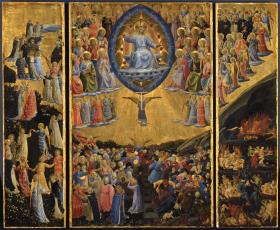
Auch wenn dieses Gemälde sich heute wie ein Triptychon präsentiert, bildete es ursprünglich ein Ganzes. Wichtiger als die Trennung in eine Mittel- und zwei Seitentafeln ist deshalb die symbolische Teilung des Bildraums in der Mitte. Jesus Christus hält, von Heiligen, Seligen und Engeln als Beisitzern flankiert, das Jüngste Gericht ab, dem jeder Christ voller Hoffnung und Angst entgegensieht. Die Gräber der Toten öffnen sich, wie im unteren Teil des Bildes dargestellt, und die Seele jedes Einzelnen wird gewogen. Wessen Seele unbelastet ist, steigt auf ins Paradies (links),wessen Sünde zu schwer wiegt, fährt zur Hölle (rechts), wo er die schlimmsten Strafen erleidet. Es gibt keine Hoffnung, diesem Schicksal zu entrinnen: Die Frau in dem roten Gewand in der unteren Bildmitte, die sich zwischen die geretteten Seelen zu mogeln versucht hat, wird von einem Engel erbarmungslos zur Gruppe der Verdammten gestoßen.Fra Angelico beschäftigte sich während seiner gesamten künstlerischen Laufbahn mit dem Thema des Jüngsten Gerichts. Der Alltag des observanten Dominikanermönchs, der im Konvent von S. Domenico in Fiesole lebte, bestand aus Beten und Malen. Dieses Gemälde kann als eine direkte Kritik am Verhalten seiner Zeitgenossen interpretiert werden: Es finden sich viele bedeutende Persönlichkeiten unter den Verdammten, sowohl Könige als auch Bischöfe und Geistliche. Doch obwohl Fra Angelico sich einem gewissen Symbolismus verpflichtet fühlte, integrierte er auch die neuen Darstellungstechniken in sein Bild, die Masaccio in den 1420er-Jahren in Florenz eingeführt hatte. Die Gräberreihe in der Mitte ist nach den Gesetzen der Zentralperspektive gemalt und sorgt so für eine überzeugende Raumwirkung. Im oberen Teil des Gemäldes hingegen konterkarieren der Hintergrund aus Blattgold und die intensiven Farben jede Raumillusion. Es ist, als habe Fra Angelico sich gar nicht zwischen Tradition und Moderne, zwischen Gotik und Renaissance, entscheiden wollen.In der Mitte des linken Seitenteils ziehen zwei Gestalten die Aufmerksamkeit des Betrachters auf sich: eine von hinten dargestellte Figur mit Papstkrone und eine Figur in Dominikanertracht mit Kardinalshut. Wahrscheinlich handelt es sich um zwei Zeitgenossen des Künstlers: Papst Eugen IV. und Juan de Torquemada. Beide hielten sich Ende der 1430er-Jahre tatsächlich in Florenz auf und Eugen IV. könnte die Fresken Fra Angelicos im Konvent von St. Marco gesehen haben. Nachdem er nach Rom zurückgekehrt war, bat er den Maler, für ihn im Vatikan zu arbeiten. Kardinal Torquemada kannte Fra Angelico womöglich persönlich. Er leitete später die römische Bruderschaft in S. Maria sopra Minerva, wo Fra Angelico das letzte Jahrzehnt seines Lebens verbrachte, und war wahrscheinlich der Auftraggeber des Jüngsten Gerichts. Obwohl das Werk erstmals in Rom urkundlich erwähnt wurde, ist es möglich, dass es während des päpstlichen Exils in Florenz entstand. Es verlor auch in der Folgezeit nicht an Bedeutung: Viel später, im Jahr 1570, bat der Dominikanerpapst Pius V. den flämischen Künstler Bartholomäus Spranger, eine zeitgenössische Kopie des Gemäldes anzufertigen. Neville Rowley | 200 Meisterwerke der europäischen Malerei - Gemäldegalerie Berlin, 2019________________________________________________________________Even if this painting has today the appearance of a triptych, it was originally a continuous panel. In fact, the most important separation in the image does not take place in the lateral parts of the painting but in its middle, where Jesus-Christ, surrounded by a tribunal of saints, blessed and angels, pronounces what every Christian awaited with hope and anguish, the Last Judgement. On that day, the graves of the dead will open, as seen in the lower part of the painting, and the souls of each one will be weighed. Those who are light enough will be able to go to Paradise, on the left side; souls heavy with sin will be pushed mercilessly to Hell, on the right, in order to suffer the worst punishments. Any hope of escaping this destiny is a vain thing: the woman in red who had tried to slip among the saved souls is pushed without gentleness by an angel on the side of the damned.Throughout his career, Fra Angelico has painted this theme of the Last Judgement with the greatest attention. As a Dominican observant friar, living in the convent of San Domenico in Fiesole, his life was only made of prayer and painting. This work can be seen as a direct criticism of the mores of his contemporaries: one distinguishes many important persons among the damned, whether kings, bishops, or religious. If Fra Angelico’s painting is symbolic, it does not abandon the pictorialinnovations introduced in Florence by Masaccio during the 1420s (fig. p. 297). The central path of the tombs follows the laws of perspective, and allows to build a convincing space. The upper part of the painting seems to deny this interest for space, making great use of gold leaf and intense colours. It is as if Fra Angelico had never wanted to choose between tradition and modernity, between Gothic and Renaissance.In the middle of the left fragment of the picture, two characters attract attention; one is viewed from behind, wearing the papal tiara, the second is in profile, dressed with a Dominican habit and bearing a cardinal’s hat. It is likely that these characters are contemporaries of the artist, Pope Eugene IV and Cardinal Juan de Torquemada. Eugene IV had indeed stayed in Florence in the late 1430s, and had been able to admire the fresco decoration made by Fra Angelico in the convent of San Marco. Once he settled in Rome, he would ask the painter to work for him in the Vatican. Cardinal Torquemada was also present in Florence with Eugenius IV; he may have known Fra Angelico at the time. He would later rule the Roman convent of Santa Maria sopra Minerva, where Fra Angelico spent the last decade of his life, and is likely to be the patron of the painting. Even if the work is documented for the first time in Rome, it is possible that it was painted in Florence, during the stay of the Pontifical Court. Its importance did not diminish with time: as late as 1570, the Dominican Pope Pius V asked the Flemish painter Bartholomeus Spranger to paint a modernised copy of it. Neville Rowley | 200 Masterpieces of European Painting - Gemäldegalerie Berlin, 2019

Maria mit dem Kind

Maria mit dem Kind

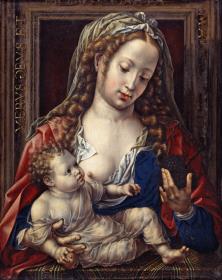
Die Madonnenbilder bezeichnen einen der Höhepunkte im Schaffen Gossaerts. Überblickt man die Entwicklung des traditionsreichen Bildthemas, das in der niederländischen Malerei von van Eyck über Memling, Sittow und Massys bis hin zu Gossaert führt, dann zeigt sich, in welchem Ausmaß man die künstlerische Überlieferung zu bewahren verstand, sie andererseits jedoch um neue Möglichkeiten zu bereichern wußte. Die Enge der Raumbühne, auf der die Bildfiguren kaum Platz finden, entspringt dem Anliegen, deren Körperlichkeit besonderen Nachdruck zu verleihen. Maria und das Kind werden von einem reich profilierten graubraunen Rahmen eingefaßt, den sie mehrfach überschneiden, und aus dem heraus sie uns fast greifbar entgegentreten. Die rotbraun getönte Rückplatte des Rahmens bildet den Hintergrund, vor dem sich das schöne Antlitz Marias kontrastreich abhebt. Die differenzierte Modellierung durch Licht und Schatten ist dabei ebenso zu bewundern wie die malerische Behandlung der Haare, der Hände oder des unruhig bewegten Faltenwurfs der Gewänder. Die Beherrschung illusionistischer Effekte erweist sich besonders deutlich an den leicht gewölbten, wie aus Metall geschnittenen Buchstaben in der Hohlkehle der gemalten Rahmung. Sie bilden von links nach rechts umlaufend die folgende Inschrift: »VERVS DEVS ET HOMO – CASTA MATER ET VIRGO« (Ein wahrer Gott und Mensch, eine reine Mutter und Jungfrau). Mit leicht geneigtem Kopf und gesenkten Augen blickt Maria auf das Kind herab, das vor ihr auf der mit einem Teppich bedeckten Brüstung ruht. Maria trägt einen roten Mantel und ein blaues Kleid, das über der rechten Brust geöffnet ist. Ein weißes Kopftuch bedeckt das lange rotblonde Haar, das über die Schultern herabfällt. In ihrer linken Hand hält sie eine Weintraube, nach der das Kind verlangend die Hand ausstreckt. Dieser Gebärde gilt der sinnende Blick der Gottesmutter, in dem sich das Wissen um das Schicksal ihres Sohnes ausdrückt. Das lebhafte Kind ist nur mit einem dünnen Hemdchen bekleidet, unter dem sich sein kräftiger Körper abzeichnet. In der rechten Hand hält es den Apfel. Es ist die Frucht, die einst den Sündenfall besiegelte und sich nun in ein Unterpfand der Erlösung verwandelt hat. In dem Symbol des Apfels verdichten sich die vielfältigen Anspielungen und sinnbildhaften Bezüge auf die Inkarnation und den Kreuzestod Christi und seine Bedeutung für die auf Erlösung harrende Welt. Die Vorstellung, daß der Apfel den Menschen einst das Verderben brachte, sie damit aber auch am Erlösungswerk teilhaben läßt, ist Ausdruck jener alten Idee, nach der sich alle Ereignisse in der Neuschöpfung der Welt durch Christus gleichsam spiegelbildlich wiederholen. Die Gegenüberstellung des alten und des neuen Adam, der mit Christus gleichgesetzt wurde, sowie der ersten und der zweiten Eva, in der man die Gottesmutter erkannte, weisen auf dieselbe Ideenverbindung hin. So wie man Maria stets als den Weinstock besungen hat, an dem die Traube reifte, die uns den Wein des eucharistischen Blutes spendete, so ist die Traube in ihrer Hand ein sichtbares Zeichen dafür, daß das in der Passion vergossene Blut Christi den Fluch tilgen wird, den Eva über die Menschheit brachte, als sie den Apfel vom Baum der Erkenntnis pflückte. All diese Gedankenverbindungen waren dem gläubigen Betrachter unmittelbar verständlich und gegenwärtig. Rainald Grosshans | 200 Meisterwerke der europäischen Malerei – Gemäldegalerie Berlin, 2019SIGNATUR / INSCHRIFT: VERVS DEVS ET HOMO CASTA MATER ET VIRGO_____________________________________________________Images of the Madonna represent one of the highpoints of Gossart’s artistic oeuvre. When we survey the development of this pictorial type, so rich in tradition, and extending in Netherlandish painting from van Eyck to Memling, Sittow, and Massys, and all the way to Gossart, it becomes evident the degree to which artistic conventions were preserved while at the same time being consistently enriched with new possibilities.The narrowness of this pictorial stage, which barely affords the figures any space at all, is intended to endow their physicality with special emphasis. The Virgin Mary and the Christ child are framed by a richly-profiled, greyish-brown frame which they overlap repeatedly, and from which they almost seem to emerge directly into the viewer’s physical space. The reddish-brown-toned back panel of the frame forms a background against which Mary’s lovely countenance is set off in strong contrast. The nuanced modelling of light and shadow is as admirable as the painterly handling of the hair and the hands and the restless, agitated drapery folds of the garments. Gossart’s mastery of illusionistic effects is especially evident in the slightly convex letters, seemingly fashioned from cut metal, which are set against the fillet of the painted frame. Circumferentially from left to right, they form the following inscription: “VERVS DEVS ET HOMO – CASTA MATER ET VIRGO” (A true God and man, a pure mother and virgin).Her head slightly bowed and with lowered eyes, Mary gazes downward at the child, who rests before her on a parapet that is covered by a carpet. Mary wears a red cloak and blue gown, the latter opened to reveal her right breast. Her long, reddish blonde hair, which falls across her shoulders, is covered by a white headscarf. In her left hand, she holds a bunch of red grapes, towards which the Christ child eagerly stretches out his hand. This gesture seems to elicit the pensive gaze of the Mother of God, who seems aware of her son’s impending fate. The lively child is clad only in a thin undershirt, which delineates his powerful body. He holds an apple in his right hand – the fruit that precipitated the Fall from Grace, transformed now into a prerequisite for redemption.Concentrated in the symbol of the apple are a multiplicity of allusions and emblematic references to the Incarnation and to Christ’s death by crucifixion and its significance for a world that awaits salvation. The notion that the same apple that spelled the downfall of humanity now participates in the work of redemption is an expression of the venerable idea according to which all of the events transpiring during Christ’s re-creation of the world are so to speak recapitulated in mirror-invertedform. The juxtaposition of the old and new Adam, who was equated with Christ, as well as of the first and second Eve, in whom the Mother of God was discerned, points towards the same conceptual complex. Just as Mary was consistently extolled as the grapevine where the grapes ripen that bestow on us the wine of the Eucharistic blood, the grapes she holds in her hand are a visible sign that the blood of Christ, which flows during the Passion, redeems the curse which Eve imposed on humankind when she plucked the apple from the Tree of Knowledge. All of these associated ideas would have been comprehensible and palpable to early believing beholders of this image. Rainald Grosshans | 200 Masterpieces of European Painting – Gemäldegalerie Berlin, 2019