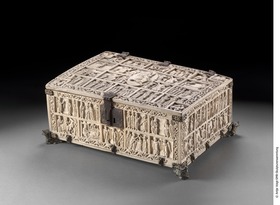

Kreuzigung Christi / The Crucifixion
Ident. Nr.: 2795
ObjID: obj:869248

Credit: Staatliche Museen zu Berlin, Skulpturensammlung und Museum für Byzantinische Kunst / Jörg P. Anders Public Domain Mark 1.0
Details (expert)
- Creator/Entity
- Date(s)
- Datierung: 1430–1440
- Systematics/Type
- Material / Technique
- gebrannter Ton, gefaßt
- Dimensions
- Höhe x Breite x Tiefe: 149 x 80 x 19 cmGewicht: 85,5 kg
- Permalink
- https://id.smb.museum/object/869248
Object Description
Inscription on the bottom of the frame: AVE MARIA GRATIE PLENA DOMINUS TEC[UM]; at the base of the frame are two coats of arms: of the Barbarori family on the right side; the one on the left hand side is unidentified.
Provenance
Santa Maria in Monteluce, Perugia (before 1903); Berlin, Skulpturensammlung/Kaiser-Friedrich-Museum (1904-1939); Berlin, storage (1939-1945); Soviet Union, secret storage (1945/46-1958); East Berlin, Skulpturensammlung/Bode-Museum (1958-1990); Berlin, Skulpturensammlung/Bode-Museum (1990-present).
Acquisition
Bought in 1903 (through the gift of James Simon) as by a Florentine Master, ca. 1450, together with a David by Antonio di Banco (Inv. SKS 2794), for 8,540 Mark. Acquisition file n°I. 3789/03 (Zentralarchiv der Staatlichen Museen zu Berlin).
Restoration
ca. 2000.
Exhibition
Schätze der Weltkultur von der Sowjetunion gerettet, East Berlin, National-Galerie and Pergamonmuseum, 1958, cat. D 76.
Curatorial files in the Bode-Museum
• Correspondence between Luciano Bellosi and Michael Knuth (1997-2007); see comment.
• Michael Knuth (April 1996) attribution to Dello Delli (on the basis of a Crucifixion from Careggi published in B. Borngässer, “Die Apsisdekoration der alten Kathedrale zu Salamanca”, Mitteilungen des Kunsthistorisches Institutes in Florenz, XXXI, 1987, p. 273 fig. 30).
Comment
This work is a pathetic yet beautiful vision of the moment of the Crucifixion of Jesus Christ: aspects of pure drama (such as the fainting Virgin Mary on the left foreground, surrounded by the Magdalene, St John and another Mary; or the suffering of the bad thief on the right-hand cross) are presented next to careful anatomical studies (such as Christ or the Roman soldier in the right foreground). The main interest of this work lies in the eclectic capacity of its author to switch from the “high” culture of the Renaissance, with foreshortening based on perspectival and anatomical studies (the two thieves and their crosses), to “low” culture related to popular devotion, sometimes at the limits of caricature (the standing Roman soldiers at the feet of the Cross).
The plinth of the relief’s frame bears the inscription “Ave Maria Gratia Plena, Dominus Tecum”, which has led to the assumption that it did not originally belong with the relief, as the salutation to the Virgin is better suited to an Annunciation or a Virgin and Child (see Schottmüller 1913 and 1933); however the frame appears to be original to the relief. The armorial shield at the bottom-right of the frame is that of the Barbadori family; the one on the left is unidentified, even though it is close to that of the Florentine Ricasoli family – it is possibly the shield of a family from Perugia, where the relief comes from (it is said to come from the church of Santa Maria in Monteluce in Perugia, which was rebuilt during the 16th century). Schottmüller 1913 saw affinities with the works of Sienese sculptors of the second half of the 15th century: Neroccio de’ Landi, Vecchietta, Francesco di Giorgio Martini and Giacomo Cozzarelli. The latter artist was suggested as the author of the work by Bode 1916, followed by Bange 1933 and Schottmüller 1933, while Meller 1963 thought of the eccentric Florentine artist who went to Spain, Dello Delli. Another Florentine artist who went to Spain has been the most cited author of the relief: Giuliano di Nofri, also called Giuliano Fiorentino. This proposition of Schubring 1919 (see also Schubring 1921) was recently reassessed by Franci 2001 and has been endorsed by Gentilini 2007: the affinities of the Berlin relief with the marble decoration of the Cathedral of Valencia, especially the reliefs of the Crucifixion and Samson Breaking the Doors of Gaza, are indeed quite compelling. Giancarlo Gentilini (oral communication, May 2014) made an interesting confrontation with another Crucifixion in the Szépmüvészeti Múzeum in Budapest, which may be by the same artist (cartapesta with gilt background, 70 x 42 cm, Inv. 51.929; see Mária G. Aggházy, Italian and Spanish Sculpture, Budapest, Kossuth Printing House, 1977, cat. 15).
Before attributing the relief to Giuliano Fiorentino, Schubring had stated that that it reminded him of Donatello’s style, especially as seen in the bronze pulpits of San Lorenzo – one of the master’s last works. This relationship to Donatello, which must have been more compelling when the relief was covered with a bronze patina (removed in a restoration during the 2000s), had almost convinced one of the greatest specialists on Donatello, Luciano Bellosi, to attribute the work to the artist. Between 1997 and 2007, Bellosi repeatedly wrote to Michael Knuth, curator of the Berlin Skulpturensammlung, to share his opinion; a passage from one of Bellosi’s articles dedicated to the early activity of Donatello for the Florentine Cathedral also argues in favor of this attribution; Bellosi never published the text (see the article in Margaret Haines (ed.), Santa Maria del Fiore. The Cathedral and its Sculpture, Fiesole, Cadmo, 2001), which is preserved in the archive of the Bode-Museum.
Literature
Schubring 1907
Paul Schubring, “Gli acquisti del museo ‘Kaiser Friedrich’”, L’Arte, X, 1907, p. 451: recalls Donatello, especially the pulpits of San Lorenzo in Florence.
Schottmüller 1913
Frida Schottmüller, Die italienischen und spanischen Bildwerke der Renaissance und des Barocks in Marmor, Ton, Holz und Stuck, Berlin, Georg Reimer, 1913, pp. 104-105 cat. 257: Sienese, ca. 1450-70; the inscription means that the frame is probably not original; mixture of Sienese (Jacopo della Quercia) and Donatellesque elements; close to Vecchietta; the figures around the fainting Virgin recall the group in the Osservanza, Siena; maybe a Sienese artist active in Umbria and in the Marche, not necessarily Francesco di Giorgio Martini or Giacomo Cozzarelli.
Bode 1916
Wilhelm von Bode, “Die Sammlung der Sienesischen Bildwerke des Quattrocento im Kaiser-Friedrich-Museum”, Amtliche Berichte aus der Königl. Kunstsammlungen, XXXVII, n°9, June 1916, col. 176-79: Giacomo Cozzarelli?
Scgubring 1919
Paul Schubring, Die italienische Plastik des Quattrocento, Berlin, Akademische Verlagsgesellschaft Athenaion, 1919, pp. 26, 193: Giuliano Fiorentino, before 1450.
Bode 1921
Wilhelm von Bode, Bollettino d’arte, 2nd series, I, 1921, p. 347. (reference to be checked)
Mayer 1922-23
August L. Mayer, “Giuliano Fiorentino”, Bollettino d’arte, II, 1922-23, p. 337 or 341: not Giuliano Fiorentino? (reference to be checked)
Bange 1933
E. F. Bange, Italienische Skulpturen im Kaiser Friedrich Museum, Berlin, Staatliche Museen in Berlin, 1933, pl. 47: Giacomo Cozzarelli?
Schottmüller 1933
Frida Schottmüller, Die italienischen und spanischen Bildwerke der Renaissance und des Barock. Erster Band. Die Bildwerke in Stein, Holz, Ton und Wachs, Zweite Auflage, Berlin and Leipzig, Walter de Gruyter & Co., 1933, p. 94: Giacomo Cozzarelli? The base with the inscription comes from a tabernacle of the Virgin and Child or an Annunciation. Derives from Jacopo della Quercia and Vecchietta.
Middeldorf 1938
Ulrich Middeldorf, review of Schottmüller 1933, Rivista d’arte, XX, 1938 now in: idem, Raccolta di scritti that is Collected Writings. I. 1924-1938, Florence, SPES, 1979-80, p. 382: better and earlier than Cozzarelli. Magnificent.
Schätze der Weltkultur… 1958
Schätze der Weltkultur von der Sowjetunion gerettet, exh. cat. (East Berlin, National-Galerie and Pergamonmuseum, 1958), East Berlin, Staatliche Museen zu Berlin, 1958, cat. D 76: Giacomo Cozzarelli?
Franci 2001
Andrea Franci, “Giuliano di Nofri scultore fiorentino”, Mitteilungen des Kunsthistorischen Institutes in Florenz, XLV, n°3, 2001, pp. 439-440, 457 notes 30-31: Giuliano di Nofri, ca. 1430; compared to a Crucifixion and a Samson breaking the doors of Gaza in the Cathedral of Valencia; an 1872 guide by Guardabassi mentions a wooden Crucifixion in the church of Santa Maria in Monteluce.
Bellandi 2005
A. Bellandi in Botticelli, Via Maggio, Florence, 2005, n. p. (reference to be checked)
Franci 2007
Andrea Franci, “Giuliano di Nofri”, in Saur Allgemeines Künstlerlexikon, Munich and Leipzig, Saur, 55, 2007, p. 425: Giuliano di Nofri, said to be formerly in Berlin (sic).
Gentilini 2007
Giancarlo Gentilini, Donatello e Nanni di Bartolo. Una inedita Madonna in terracotta, Milan, Cesati e Cesati, 2007, p. 37 note 17: accepts the attribution to Giuliano di Nofri of this work and of the tabernacle of the Virgin and Child in the Museo Civico, Prato, but not the rest of the reconstruction in Franci 2001.
Neville Rowley (24 May 2016)
Last updated: 29.07.2026
Contact
Institution:
Skulpturensammlung und Museum für Byzantinische Kunst
Email:
sbm@smb.spk-berlin.de