Logo

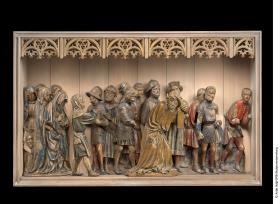
Kreuzigung Christi / The Crucifixion

Ident. Nr.: 2795

ObjID: obj:869248

Details (expert)

Creator/Entity
zugeschrieben: Giuliano Fiorentino,
Bildhauer*in
Date(s)
Datierung: 1430–1440
Systematics/Type
Material / Technique
gebrannter Ton, gefaßt
Dimensions
Höhe x Breite x Tiefe: 149 x 80 x 19 cm
Gewicht: 85,5 kg

Object Description

Inscription on the bottom of the frame: AVE MARIA GRATIE PLENA DOMINUS TEC[UM]; at the base of the frame are two coats of arms: of the Barbarori family on the right side; the one on the left hand side is unidentified.

Provenance
Santa Maria in Monteluce, Perugia (before 1903); Berlin, Skulpturensammlung/Kaiser-Friedrich-Museum (1904-1939); Berlin, storage (1939-1945); Soviet Union, secret storage (1945/46-1958); East Berlin, Skulpturensammlung/Bode-Museum (1958-1990); Berlin, Skulpturensammlung/Bode-Museum (1990-present).

Acquisition
Bought in 1903 (through the gift of James Simon) as by a Florentine Master, ca. 1450, together with a David by Antonio di Banco (Inv. SKS 2794), for 8,540 Mark. Acquisition file n°I. 3789/03 (Zentralarchiv der Staatlichen Museen zu Berlin).

Restoration
ca. 2000.

Exhibition
Schätze der Weltkultur von der Sowjetunion gerettet, East Berlin, National-Galerie and Pergamonmuseum, 1958, cat. D 76.

Curatorial files in the Bode-Museum
• Correspondence between Luciano Bellosi and Michael Knuth (1997-2007); see comment.
• Michael Knuth (April 1996) attribution to Dello Delli (on the basis of a Crucifixion from Careggi published in B. Borngässer, “Die Apsisdekoration der alten Kathedrale zu Salamanca”, Mitteilungen des Kunsthistorisches Institutes in Florenz, XXXI, 1987, p. 273 fig. 30).

Comment

This work is a pathetic yet beautiful vision of the moment of the Crucifixion of Jesus Christ: aspects of pure drama (such as the fainting Virgin Mary on the left foreground, surrounded by the Magdalene, St John and another Mary; or the suffering of the bad thief on the right-hand cross) are presented next to careful anatomical studies (such as Christ or the Roman soldier in the right foreground). The main interest of this work lies in the eclectic capacity of its author to switch from the “high” culture of the Renaissance, with foreshortening based on perspectival and anatomical studies (the two thieves and their crosses), to “low” culture related to popular devotion, sometimes at the limits of caricature (the standing Roman soldiers at the feet of the Cross).
The plinth of the relief’s frame bears the inscription “Ave Maria Gratia Plena, Dominus Tecum”, which has led to the assumption that it did not originally belong with the relief, as the salutation to the Virgin is better suited to an Annunciation or a Virgin and Child (see Schottmüller 1913 and 1933); however the frame appears to be original to the relief. The armorial shield at the bottom-right of the frame is that of the Barbadori family; the one on the left is unidentified, even though it is close to that of the Florentine Ricasoli family – it is possibly the shield of a family from Perugia, where the relief comes from (it is said to come from the church of Santa Maria in Monteluce in Perugia, which was rebuilt during the 16th century). Schottmüller 1913 saw affinities with the works of Sienese sculptors of the second half of the 15th century: Neroccio de’ Landi, Vecchietta, Francesco di Giorgio Martini and Giacomo Cozzarelli. The latter artist was suggested as the author of the work by Bode 1916, followed by Bange 1933 and Schottmüller 1933, while Meller 1963 thought of the eccentric Florentine artist who went to Spain, Dello Delli. Another Florentine artist who went to Spain has been the most cited author of the relief: Giuliano di Nofri, also called Giuliano Fiorentino. This proposition of Schubring 1919 (see also Schubring 1921) was recently reassessed by Franci 2001 and has been endorsed by Gentilini 2007: the affinities of the Berlin relief with the marble decoration of the Cathedral of Valencia, especially the reliefs of the Crucifixion and Samson Breaking the Doors of Gaza, are indeed quite compelling. Giancarlo Gentilini (oral communication, May 2014) made an interesting confrontation with another Crucifixion in the Szépmüvészeti Múzeum in Budapest, which may be by the same artist (cartapesta with gilt background, 70 x 42 cm, Inv. 51.929; see Mária G. Aggházy, Italian and Spanish Sculpture, Budapest, Kossuth Printing House, 1977, cat. 15).
Before attributing the relief to Giuliano Fiorentino, Schubring had stated that that it reminded him of Donatello’s style, especially as seen in the bronze pulpits of San Lorenzo – one of the master’s last works. This relationship to Donatello, which must have been more compelling when the relief was covered with a bronze patina (removed in a restoration during the 2000s), had almost convinced one of the greatest specialists on Donatello, Luciano Bellosi, to attribute the work to the artist. Between 1997 and 2007, Bellosi repeatedly wrote to Michael Knuth, curator of the Berlin Skulpturensammlung, to share his opinion; a passage from one of Bellosi’s articles dedicated to the early activity of Donatello for the Florentine Cathedral also argues in favor of this attribution; Bellosi never published the text (see the article in Margaret Haines (ed.), Santa Maria del Fiore. The Cathedral and its Sculpture, Fiesole, Cadmo, 2001), which is preserved in the archive of the Bode-Museum.

Literature
Schubring 1907
Paul Schubring, “Gli acquisti del museo ‘Kaiser Friedrich’”, L’Arte, X, 1907, p. 451: recalls Donatello, especially the pulpits of San Lorenzo in Florence.
Schottmüller 1913
Frida Schottmüller, Die italienischen und spanischen Bildwerke der Renaissance und des Barocks in Marmor, Ton, Holz und Stuck, Berlin, Georg Reimer, 1913, pp. 104-105 cat. 257: Sienese, ca. 1450-70; the inscription means that the frame is probably not original; mixture of Sienese (Jacopo della Quercia) and Donatellesque elements; close to Vecchietta; the figures around the fainting Virgin recall the group in the Osservanza, Siena; maybe a Sienese artist active in Umbria and in the Marche, not necessarily Francesco di Giorgio Martini or Giacomo Cozzarelli.
Bode 1916
Wilhelm von Bode, “Die Sammlung der Sienesischen Bildwerke des Quattrocento im Kaiser-Friedrich-Museum”, Amtliche Berichte aus der Königl. Kunstsammlungen, XXXVII, n°9, June 1916, col. 176-79: Giacomo Cozzarelli?
Scgubring 1919
Paul Schubring, Die italienische Plastik des Quattrocento, Berlin, Akademische Verlagsgesellschaft Athenaion, 1919, pp. 26, 193: Giuliano Fiorentino, before 1450.
Bode 1921
Wilhelm von Bode, Bollettino d’arte, 2nd series, I, 1921, p. 347. (reference to be checked)
Mayer 1922-23
August L. Mayer, “Giuliano Fiorentino”, Bollettino d’arte, II, 1922-23, p. 337 or 341: not Giuliano Fiorentino? (reference to be checked)
Bange 1933
E. F. Bange, Italienische Skulpturen im Kaiser Friedrich Museum, Berlin, Staatliche Museen in Berlin, 1933, pl. 47: Giacomo Cozzarelli?
Schottmüller 1933
Frida Schottmüller, Die italienischen und spanischen Bildwerke der Renaissance und des Barock. Erster Band. Die Bildwerke in Stein, Holz, Ton und Wachs, Zweite Auflage, Berlin and Leipzig, Walter de Gruyter & Co., 1933, p. 94: Giacomo Cozzarelli? The base with the inscription comes from a tabernacle of the Virgin and Child or an Annunciation. Derives from Jacopo della Quercia and Vecchietta.
Middeldorf 1938
Ulrich Middeldorf, review of Schottmüller 1933, Rivista d’arte, XX, 1938 now in: idem, Raccolta di scritti that is Collected Writings. I. 1924-1938, Florence, SPES, 1979-80, p. 382: better and earlier than Cozzarelli. Magnificent.
Schätze der Weltkultur… 1958
Schätze der Weltkultur von der Sowjetunion gerettet, exh. cat. (East Berlin, National-Galerie and Pergamonmuseum, 1958), East Berlin, Staatliche Museen zu Berlin, 1958, cat. D 76: Giacomo Cozzarelli?
Franci 2001
Andrea Franci, “Giuliano di Nofri scultore fiorentino”, Mitteilungen des Kunsthistorischen Institutes in Florenz, XLV, n°3, 2001, pp. 439-440, 457 notes 30-31: Giuliano di Nofri, ca. 1430; compared to a Crucifixion and a Samson breaking the doors of Gaza in the Cathedral of Valencia; an 1872 guide by Guardabassi mentions a wooden Crucifixion in the church of Santa Maria in Monteluce.
Bellandi 2005
A. Bellandi in Botticelli, Via Maggio, Florence, 2005, n. p. (reference to be checked)
Franci 2007
Andrea Franci, “Giuliano di Nofri”, in Saur Allgemeines Künstlerlexikon, Munich and Leipzig, Saur, 55, 2007, p. 425: Giuliano di Nofri, said to be formerly in Berlin (sic).
Gentilini 2007
Giancarlo Gentilini, Donatello e Nanni di Bartolo. Una inedita Madonna in terracotta, Milan, Cesati e Cesati, 2007, p. 37 note 17: accepts the attribution to Giuliano di Nofri of this work and of the tabernacle of the Virgin and Child in the Museo Civico, Prato, but not the rest of the reconstruction in Franci 2001.

Neville Rowley (24 May 2016)

Last updated: 29.07.2026

Contact

Institution:

Skulpturensammlung und Museum für Byzantinische Kunst

Additional items from the collections

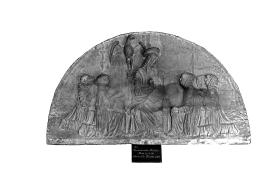
Allegorie des Wahnsinns

Allegorie des Wahnsinns

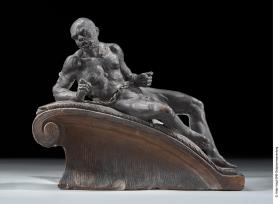
Die auf einem Segmentbogen lagernde Aktfigur eines kahlköpfigen, finster dreinblickenden Mannes scheint in einem Anfall von Wut mit weit geöffnetem Mund zu brüllen. Aufgrund seines unberechenbaren Temperaments sind die Hände an den Gelenken miteinander verkettet. Nicht nur der sanft geschwungene Giebel, auch die Komposition der darauf ausgestreckten Figur erinnert an Michelangelos lagernde, die Zeiten des Tages symbolisierende Gottheiten aus der Medici-Kapelle in San Lorenzo in Florenz. Insbesondere das Motiv des sich auf dem Unterarm stützenden Armes, der die Aufrichtung des Oberkörpers erlaubt, ist Michelangelos Figur des „Abends“ entlehnt.Das bei seiner Erwerbung 1908 zunächst noch Pietro Tacca (1577-1640) zugeschriebene Modell konnte inzwischen mit überzeugenden Argumenten dem dänischen und überwiegend in England tätigen Bildhauer Caius Gabriel Cibber zugewiesen werden. Die hier dargestelte Allegorie des Wahnsinns ist das Pendant zur Liegefigur der Melancholie, die der Bildhauer als Giebelfiguren für das Hauptportal des Royal Bethlem Hospitals in Moorfields schuf. Das 1247 in Bedlam, vor den Toren Londons gegründete Hospital war seit dem Ende des 14. Jahrhunderts ein Heim für Geisteskranke. Als die Stadt 1666 einem Brand weitgehend zum Opfer fiel, ließ man zwischen 1674 bis 1676 einen Neubau nach den Plänen des Architekten Robert Hooke (1635-1703) außerhalb der Stadt in Moorfields errichten, wofür Cibber schließlich die beiden lebensgroßen Liegefiguren in Stein schuf. Bei dem hier ausgestellten Werk handelt es sich um einen ersten künstlerischen Entwurf des Künstlers.

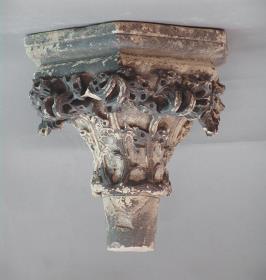
Wandkonsole mit reichem Blattbesatz (Laubwerkkonsole)

Wandkonsole mit reichem Blattbesatz (Laubwerkkonsole)

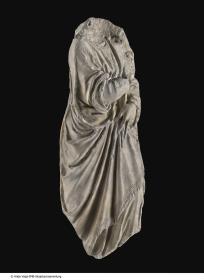
Die Konsole hat eine kelchförmige Gestalt mit Blattornamenten und rechteckiger Deckplatte. Die Deckplatte zeigt ein halbiertes Sechseck und ist wohl dadurch zu erklären, dass sie im schrägen Gewände des Portals gestanden haben wird. Der vegetabile Schmuck besteht aus einer Reihe von Blättern, die dem Kelch aufgelegt sind und zur eckigen Form der Deckplatte vermitteln. Dadurch wird die tektonische Strenge überspielt, ohne gegen die Konventionen des Aufbaus einer gotischen Konsole zu verstoßen.Die Kirche des in den 1030er-Jahren am linken Aaufer gegründeten Damenstifts Liebfrauen war von Beginn an zugleich Pfarrkirche der Bürger der Münsteraner Vorstadt Überwasser. Diese Doppelfunktion, die sich auch in der Finanzierung und Nutzung des 1340 begonnenen Neubaus spiegelt, dürfte für die Konzeption des Westportals von Bedeutung gewesen sein. Mit der Errichtung des Turms wurde, wie man aus einem Bauvertrag weiß, 1363/64 begonnen. 1374 ließ Fürstbischof Florenz von Wevelinghoven (amt. 1364–78) mehrere Reliquien in der rechten Schulter des Marienbildes am Portal einschließen und man hat zu Recht angenommen, dass zu diesem Zeitpunkt das Portal mit seinem Figurenschmuck vollendet war, vielleicht auch schon bereits seit mehreren Jahren. Die Funktion der Konsolen ist die Vermittlung zwischen der streng geometrischen Architektursprache des kunstvollen Portalgebildes und der menschlichen Figur. Daher wurden auch die einzelnen Glieder (Halsring und Kelch) in fantasievolle pflanzliche Gebilde aufgelöst, deren wohl kalkulierter Verismus nicht auf effektvolle Überraschung abzielt, sondern der Wirkungs- und Bedeutungseinheit von Architektur und Skulptur dient.Die Konsolen des Westportals der Liebfrauenkirche passen gut in die Genese gotischer Laubwerkgestaltung, bei der um 1350 eine Tendenz zur stärkeren Bewegung und einem Verwischen der Grenzen zwischen Wand und Ornament festzustellen ist. Die Werkstatt hat, wie die geringere Qualität der späteren Konsolen in Münster zeigt, die Stadt wieder verlassen, möglicherweise, um in Utrecht zu arbeiten, wo sich am Dom um 1380 vergleichbare figürliche Darstellungen finden. Der Steinmetz hat sich eindeutig an der Bauornamentik des Kölner Doms orientiert, wie eine Durchsicht der dortigen Kapitelle im Chor und Langhaus zeigt. (Auszug aus: Tobias Kunz, Bildwerke nördlich der Alpen. 1050 bis 1380. Kritischer Bestandskatalog der Berliner Skulpturensammlung, Petersberg, Michael Imhof Verlag 2014)

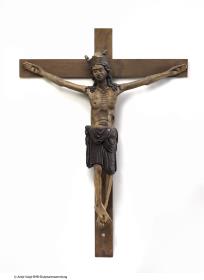
Kruzifixus

Kruzifixus

Das Kruzifix stammt mit größter Wahrscheinlichkeit aus der Stabkirche von Vang im Valdres-Tal (Oppland, Norwegen), die der Maler Johan Christian Dahl am 18. Januar 1841 für den preußischen König Friedrich Wilhelm IV. erwerben ließ. Der König wollte die Stabkirche zunächst auf die Pfaueninsel unweit seiner Potsdamer Residenz versetzen. Doch bereits im Winter 1841/42 entschied Friedrich Wilhelm IV., die Kirche nicht als Baudenkmal in Hauptstadtnähe, sondern als Gotteshaus im schlesischen Riesengebirge in Brückenberg (Karpacz Górny) in der Nähe seiner Sommerresidenz Erdmannsdorf (Mysłakowice) wieder aufbauen zu lassen. Von den beweglichen Ausstattungsstücken begleiteten lediglich zwei Leuchter die Kirche nach Schlesien. Es ist unklar, was mit den weiteren Werken aus Norwegen geschah. Sicher ist, dass Friedrich Wilhelm IV. 1845, das Kruzifix als Geschenk an die Kunstkammer überwiesen hat, von wo aus es später in den Besitz des Deutschen Museums überging. Die zeitliche Nähe dieser Schenkung zu der überlieferten Lagerung des Vanger Kruzifixes in Berlin, die Tatsache, dass es sich um königlichen Privatbesitz handelte und die Singularität einer norwegischen Skulptur in den Königlichen Museen lassen keinen anderen sinnvollen Schluss zu, als dass es sich bei Inv. 364 um das Kruzifix aus Vang handelt.Das Kruzifix ist schwer einzuordnen. Sämtliche Details gehören dem 13. Jahrhundert an, sind aber sehr roh und eigentlich kaum verstanden, wie Tuchfalten, Oberkörper und Gesicht demonstrieren. Unter den erhaltenen norwegischen Werken findet sich keines mit einer über Motive hinausgehenden Verwandtschaft. Der erhobene Kopf und die gezackten Locken sind ohne Parallele. Es fragt sich angesichts des ausgeprägten Zickzackverlaufs der Haare und der zeichenhaften Ausbildung des Oberkörpers, ob dem Schnitzer nicht eine Buchmalerei als Vorlage gedient hat, wo gerade diese Elemente besonders ausgeprägt waren. Überhaupt scheint es, als wäre der Bildschnitzer ungeübt im Schnitzen eines Kruzifixus gewesen, hätte aber streng nach einer Vorlage aus dem 13. Jahrhundert gearbeitet. Diese Arbeitsweise spricht jedoch auch gegen die im 19. Jahrhundert übliche Vorgehensweise neugotischer Bildschnitzer. Außerdem muss das Werk deutlich vor 1840 entstanden sein, da es damals keine liturgische Funktion mehr in der Stabkirche hatte. Gemeinsam mit den technologischen Befunden, vor allem zur Fassung (keine älteren Reste unter der heute sichtbaren), und den Erwerbungsumständen bleibt daher nur der Schluss, dass es sich um eine Arbeit der Zeit vor 1800, vielleicht des 18. Jahrhunderts handelt, bei der ein möglicherweise beschädigtes Kruzifix des 13. Jahrhunderts nachgeahmt wurde. Solche Fälle sind im Norwegen des 17. und 18. Jahrhunderts nicht selten.(Auszug aus: Tobias Kunz, Bildwerke nördlich der Alpen. 1050 bis 1380. Kritischer Bestandskatalog der Berliner Skulpturensammlung, Petersberg, Michael Imhof Verlag 2014)

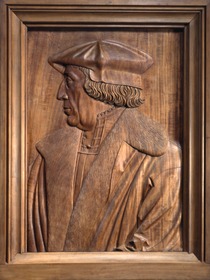
Bildnis des Bischof Philipp von Freising

Bildnis des Bischof Philipp von Freising

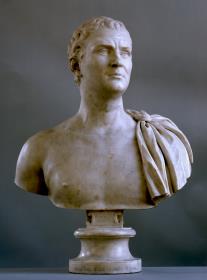
Das markante Gesicht des Dargestellten ist im strengen Profil nach links wiedergeben, während der Oberkörper sich ein wenig zum Betrachter hinwendet, was eine leichte Bewegung suggeriert. Das Barett mit herabgeschlagener Krempe wie auch der Mantel mit pelzverbrämtem Kragen, der so genannten Schaube, zeigen an, dass hier eine vornehme Persönlichkeit porträtiert wurde, ist doch die beschriebene Tracht allein dem ersten Stand vorbehalten gewesen. Das Relief weist weder eine Inschrift noch ein Familienwappen auf, die die Identität des hier Dargestellten preisgibt. Das scharf gezogene Profil mit der leicht gebogenen Nase und dem runden Kinn lassen den Porträtierten nicht zuletzt auch aufgrund seiner halblangen, die Ohren bedeckenden Haare, leicht als den Bischof Philipp von Freising und Naumburg identifizieren, wie der Vergleich zu zahlreich gesicherten Porträts des Dargestelllten belegen. Neben Gemälden existieren von ihm auch weitere Bildnisreliefs, von denen das von Loy Hering (1484/85-nach 1554) in Solnhofener Stein gearbeitete (Germanischen Nationalmuseum, Nürnberg) zu den prominentesten zählt. Das hier vorgestellte Brustbild Philipps ist hingegen für die Zeit von ungewöhnlicher Größe. Wie bereits festgestellt wurde, handelt es sich hier wohl um eine eigenhändige Wiederholung von Friedrich Hagenauers Medaille des Bischofs Philipp von Freising und Naumburgs. Durch die Übertragung vom ausgewogenen rund der Medaille in das hochrechteckige Format entstand ein ungewöhnlicher, weitaus steilerer Bildausschnitt. Es wird vermutet, dass Friedrich Hagenauer die Vergrößerung auf Wunsch des Auftraggebers ausführte. Der vorgesehene Bestimmungsort des Reliefs blieb bis heute unbekannt.Hans-Ulrich Kessler

Madonna mit der Rose

Madonna mit der Rose

Florentine artistVirgin and Child, known as the Madonna with the RosePainted papier-mâché81 x 65 cmBerlin, Staatliche Museen, Skulpturensammlung, Inv. SKS 1716.Bode-Museum, storage.ProvenanceFlorence, Stefano Bardini (1890); Berlin, Skulpturensammlung/Altes Museum (1890-1904); Berlin, Skulpturensammlung/Kaiser-Friedrich-Museum (1904-1939); Berlin, storage (1939-1945); Soviet Union, secret storage (1945/46-1958); East Berlin, Skulpturensammlung/Bode-Museum (1958-1990); Berlin, Skulpturensammlung/Bode-Museum (1990-present).AcquisitionBought from the dealer Stefano Bardini in Florence in 1890, together with Inv. SKS 1730 and Inv. SKS 1734, for 8,900 Mark (see the acquisition file n°1322/90 in the Zentralarchiv der Staatlichen Museen zu Berlin).Restorations1958, 1978-79.ExhibitionSchätze der Weltkultur von der Sowjetunion gerettet, East Berlin, National-Galerie and Pergamonmuseum, 1958, cat. D 51.Other Versions• Bergamo, Accademia Carrara. Provenance: Giovanni Morelli. Photo Kunsthistorisches Institut Florenz: n°49459.• London, Victoria and Albert Museum, Inv. 8376-1863. Marble, 79.2 x 64.8 cm.• Florence, villa La Pietra, Acton collection. Painted stucco. Provenance: Stefano Bardini. Photo Kunsthistorisches Institut Florenz: n°224659.• Formerly Florence, Davanzati Palace. Its sale, 1916, lot 100.DescriptionChrist is seated on a cushion, his body twisted between his mother and a hypothetical beholder to the right. The Virgin also looks in this direction, while holding her Child with the right hand and a rose with the other one. Christ reaches for the rose with the left hand, while blessing the viewer with the other. The papier-mâché relief has preserved its polychromy, with a gilt background and an integrated frame with an architectural motif.In 1890, this relief known as the Madonna with the Rose was bought for the Berlin Museums by Wilhelm Bode from Stefano Bardini in Florence as by the “school of Donatello”. Bode connected the work with a marble relief acquired by the Victoria and Albert Museum in 1863, which he attributed to Donatello himself – somewhat enlarging Donatello’s paternity to the Berlin relief (see Bode 1894). The authenticity of the London marble has been questioned by many art historians (from Balcarres 1903 to Negri Arnoldi 1970). While an inscription with the date 1550 on the reverse has been taken to mean that that relief was created in the 16th century (see Maclagan and Longhurst 1932), the absence of the rose proves that this is not the original model (Pope-Hennessy 1964).Many things in the composition evoke motifs by Donatello, such as the way the Virgin is seen, cut at the waist to appear closer to the viewer, or the dynamic gestures of the hands or even the blessing gesture of the Child (see the Virgin and Child Inv. SKS 54, but even more a terracotta relief in the Musée du Louvre, Inv. RF 353). However, the quality of the present cartapesta and the marble from London are not sufficient to give these works to Donatello. The name of Andrea Guardi, a minor follower of Donatello in Pisa, has been tentatively suggested by Schottmüller 1933.LiteratureBode 1894Wilhelm Bode, Denkmäler der Renaissance-Sculptur Toscanas, Munich, F. Bruckmann, 1894, II, pl. 69: Donatello (caption of the plate).Bode 1902Wilhelm Bode, Florentiner Bildhauer der Renaissance, Berlin, Bruno Cassirer, 1902, pp. 102-103, 104 fig. 38: after Donatello; the marble in the Victoria and Albert Museum, London (Inv. 8376-1863) is incorrectly seen as a fake but was made in Donatello’s workshop.Balcarres 1903Lord Balcarres, Donatello, London and New York, Duckworth & Co. and Charles Scribner’s Sons, 1903, p. 183: said to be a copy in stucco after a lost original by Donatello; the version in the Victoria and Albert Museum is a forgery. Mentions another version in the Morelli collection, Bergamo.Schubring 1907Paul Schubring, Donatello. Des Meisters Werke in 277 Abbildungen, Stuttgart and Leipzig, Deutsche Verlags-Anstalt, 1907, pp. 85, 198: Donatello; connected to the marble in the Victoria and Albert Museum, which is considered a forgery.Schottmüller 1913Frida Schottmüller, Die italienischen und spanischen Bildwerke der Renaissance und des Barocks in Marmor, Ton, Holz und Stuck, Berlin, Georg Reimer, 1913, pp. 17-18 cat. 35: after the original by Donatello in the Victoria and Albert Museum, wrongly considered a forgery.Bode 1921Wilhelm Bode, Florentiner Bildhauer der Renaissance, Berlin, Bruno Cassirer, 1921, p. 99 fig. 54: Donatello.Wulff 1922Oskar Wulff, Donatello, Leipzig, E. A. Seemann, 1922, p. 7, fig. 12.Colasanti 1931Arduino Colasanti, Donatello, Rome, Valori Plastici, s. d., pl. CCXL French trans., Paris, Crès, 1931, p. 89, pl. CCXXXV: Donatello, the authenticity of the marble in the Victoria and Albert Museum is problematic.Maclagan and Longhurst 1932Eric Maclagan and Margaret H. Longhurst, Catalogue of Italian Sculpture, London, Victoria and Albert Museum, 1932, p. 25: an inscription on the reverse side of the marble in the Victoria and Albert Museum was found, with the date 30 September 1550; this dates the piece.Schottmüller 1933Frida Schottmüller, Die italienischen und spanischen Bildwerke der Renaissance und des Barock. Erster Band. Die Bildwerke in Stein, Holz, Ton und Wachs, Zweite Auflage, Berlin and Leipzig, Walter de Gruyter & Co., 1933, p. 20: after Andrea Guardi?; Bode thought the work derived from a terracotta sketch by Donatello; the relief in the Victoria and Albert Museum is probably by Andrea di Francesco Guardi, and the Berlin relief is a derivation from it.Middeldorf 1938Ulrich Middeldorf, review of Schottmüller 1933, Rivista d’arte, XX, 1938 now in: idem, Raccolta di scritti that is Collected Writings, I. 1924-1938, Florence, SPES, 1979-80, p. 379: the quality of the work is too high for it to be by Andrea Guardi.Rezio Buscaroli, L’arte di Donatello, Florence, Monsalvato, 1942, p. 152 cat. 147: mediocre follower of Donatello.Schätze der Weltkultur… 1958Schätze der Weltkultur von der Sowjetunion gerettet, exh. cat. (East Berlin, National-Galerie and Pergamonmuseum, 1958), East Berlin, Staatliche Museen zu Berlin, 1958, cat. D 51: after Andrea Guardi.Pope-Hennessy 1964John Pope-Hennessy, Catalogue of Italian Sculpture in the Victoria and Albert Museum, London, Her Majesty’s Stationary Office, 1964, I, pp. 97-98: style of Donatello; the absence of a flower in the London version suggests that it was not the prototype for the Berlin version.Negri Arnoldi 1970Francesco Negri Arnoldi, “Scultura italiana al Victoria and Albert Museum. II”, Commentari, XXI, 1970, pp. 206-207: forgery.Restaurierte Kunstwerke… 1980Restaurierte Kunstwerke in der Deutschen Demokratischen Republik, exh. cat. (Berlin, n. pl., April-June 1980), n. pl. East Berlin, Ministerium für Kultur, 1980, pp. 147-148 cat. 58: restored in 1978-79.Ehlich 1987Volker Ehlich, “Naturwissenschaftliche Untersuchungsmethoden. Grundlagen der Restaurierung im Bestand der Skulpturensammlung der Staatlichen Museen zu Berlin”, Neue Museums Kunde, XXX, n°3, 1987, pp. 220-222: about the 1978-79 restoration.Osservatorio delle arti 1988Osservatorio delle arti (Rivista semestriale dell’Accademia Carrara di Bergamo), 1988, pp. 28-29: Donatello.Jolly 1998Anna Jolly, Madonnas by Donatello and his Circle, Frankfurt am Main et al., Peter Lang, 1998, p. 184 cat. 77.1: circle of Donatello and Michelozzo, ca. 1430s; “the best surviving cast of the series”.Neville Rowley (20 May 2016)