
Credit: Staatliche Museen zu Berlin, Gemäldegalerie / Jörg P. Anders Public Domain Mark 1.0
Details (expert)
- Creator/Entity
- Date(s)
- Ausführung: 1716/17
- Systematics/Type
- Additional titles
- Collection title: Die italienische KomödieTranslation: The Italian Comedy
- Geographical references
- Material / Technique
- Leinwand
- Dimensions
- Bildmaß: 38,5 x 49,1 cm
- Acquisition
- 1829/30 Überweisung aus den Königlich Preußischen Schlössern
- Permalink
- https://id.smb.museum/object/869369
Object Description
Watteau kam erst 1702 nach Paris und wurde 1712 »agréé« der Académie royale de peinture et de sculpture. Erst 1717 lieferte er das Gemälde Pilgerzug zur Insel Kythera (Paris, Musée du Louvre) als sein obligatorisches Aufnahmestück ab, mit dem die Académie die von ihm erfundene Bildgattung der »fêtes galantes« offiziell bestätigte. Viele seiner Bilder lassen heute ihre ursprüngliche malerische Qualität kaum noch erkennen, weil Watteau maltechnisch nicht sehr sorgfältig gearbeitet hat. Die beiden Berliner Theaterbilder Die französische Komödie (Kat.Nr. 468) und Die italienische Komödie sind dagegen außergewöhnlich gut erhalten, sodass sie zu den schönsten Beispielen seiner Kunst gehören. Ihre Titel und damit einen Hinweis auf ihre Zusammengehörigkeit als Gegenstücke verdanken sie den Reproduktionsstichen von Charles-Nicolas Cochin d. Ä. von 1734. Friedrich der Große kaufte beide Bilder vor 1769 für seine Galerie in Sanssouci. Sie wurden bereits 1829 an die neue Gemäldegalerie nach Berlin abgegeben. [...]
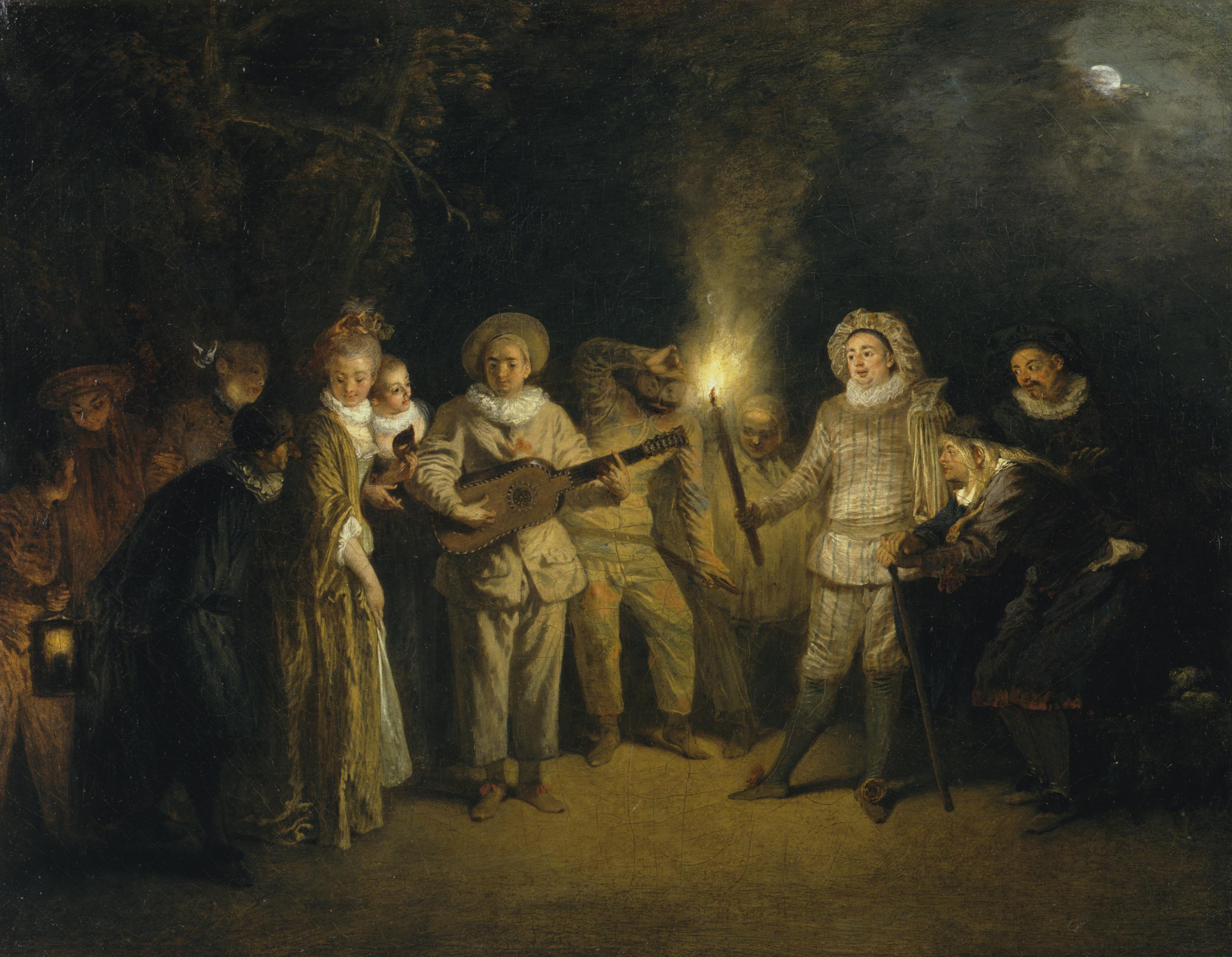
Die italienische Komödie ist die einzige nächtliche Szene, die Watteau gemalt hat. Zwölf Schauspieler der Commedia dell’arte haben sich ebenfalls auf einer Lichtung versammelt. In der Mitte steht Pierrot mit der Gitarre, neben ihm Colombine (mit der Maske) und Isabella, die sich dem alten Pantalone zuwendet. Rechts neben Pierrot folgen Harlekin mit einer Gebärde des Erschreckens, Pulcinella (?), Mezzetin mit einer Fackel, der Doktor Marcisino, auf einen Stock gestützt, und Scaramuccia.
Watteau habe, so heißt es in der Ankündigung der Reproduktionsstiche von 1734, in diesem Bild seine kostümierten Freunde gemalt. Deshalb ist in ihm wohl eine Art Schlussszene, ein »Vaudeville« aller Aufführungen, zu sehen, in denen Watteau Charaktere der italienischen Komödie und die nächtliche Stimmung, also die Illusion des Theaters und der Wirklichkeit, verschmolzen hat. Zu beiden Bildern gibt es zahlreiche Vorzeichnungen. Henning Bock | 200 Meisterwerke der europäischen Malerei - Gemäldegalerie Berlin, 2019
____________________________________
Watteau arrived in Paris only in 1702, and was “agréé” (approved) by the Académie royale de peinture et de sculpture in 1712. Only in 1717 did he deliver his Pilgrimage to Cythera (Paris, Musée du Louvre) as his obligatory reception piece, in relation to which the Académie recognised the pictorial genre of the “fêtes galantes”, originated by Watteau. Since this artist’s working technique was not especially meticulous, the original painterly quality of many of his pictures is barely recognizable. Despite this, the two Berlin theatre pictures The French Comedy (cat. no. 468) and The Italian Comedy are extraordinarily well preserved, and are among the most beautiful exemplars of his art. They owe their titles, and hence a reference to their relatedness as pendants, to a pair of reproductive engravings by Charles-Nicolas Cochin the Elder from 1734. Frederick the Great purchased both pictures before 1769 for his gallery in Sanssouci. In 1829, they were delivered to the new Gemäldegalerie in Berlin. [...]
The Italian Comedy is the only nocturnal scene Watteau painted. Twelve actors from the Commedia dell’arte have gathered, also in a clearing. Standing at the centre with a guitar is Pierrot, and alongside him Colombine (with the mask) and Isabella, who turns towards the old Pantalone. On the right next to Pierrot, we see Harlequin in an attitude of alarm, Pulcinella (?), Mezzetin with a torch, the doctor Marcisino, who supports himself with a cane, and Scaramuccia. In this picture (as we read in the announcement accompanying the engraved reproduction of 1734), Watteau painted his costumed friends. It can therefore be regarded as a kind of final scene, a “vaudeville” of all performances, in which Watteau has fused characters from the Italian comedy with the nocturnal atmosphere, which is to say the illusion of the theatre and of reality. Numerous preparatory drawings for both pictures have survived. Henning Bock | 200 Masterpieces of European Painting - Gemäldegalerie Berlin, 2019
Last updated: 24.09.2026
Contact
Institution:
Gemäldegalerie
Email:
gg@smb.spk-berlin.de