
Logo

Die italienische Komödie

Ident. Nr.: 470

ObjID: obj:869369

Details (expert)

Involved
Ausführung: Jean Antoine Watteau (1684-1721),
Maler*in
Dating
Ausführung: 1716/17
Additional titles
Collection title: Die italienische Komödie
Translation: The Italian Comedy
Geographical references
Paris,
Stadt
Material / Technique
Leinwand
Dimensions
Bildmaß: 38,5 x 49,1 cm

Object Description

Watteau kam erst 1702 nach Paris und wurde 1712 »agréé« der Académie royale de peinture et de sculpture. Erst 1717 lieferte er das Gemälde Pilgerzug zur Insel Kythera (Paris, Musée du Louvre) als sein obligatorisches Aufnahmestück ab, mit dem die Académie die von ihm erfundene Bildgattung der »fêtes galantes« offiziell bestätigte. Viele seiner Bilder lassen heute ihre ursprüngliche malerische Qualität kaum noch erkennen, weil Watteau maltechnisch nicht sehr sorgfältig gearbeitet hat. Die beiden Berliner Theaterbilder Die französische Komödie (Kat.Nr. 468) und Die italienische Komödie sind dagegen außergewöhnlich gut erhalten, sodass sie zu den schönsten Beispielen seiner Kunst gehören. Ihre Titel und damit einen Hinweis auf ihre Zusammengehörigkeit als Gegenstücke verdanken sie den Reproduktionsstichen von Charles-Nicolas Cochin d. Ä. von 1734. Friedrich der Große kaufte beide Bilder vor 1769 für seine Galerie in Sanssouci. Sie wurden bereits 1829 an die neue Gemäldegalerie nach Berlin abgegeben. [...] 
Die italienische Komödie ist die einzige nächtliche Szene, die Watteau gemalt hat. Zwölf Schauspieler der Commedia dell’arte haben sich ebenfalls auf einer Lichtung versammelt. In der Mitte steht Pierrot mit der Gitarre, neben ihm Colombine (mit der Maske) und Isabella, die sich dem alten Pantalone zuwendet. Rechts neben Pierrot folgen Harlekin mit einer Gebärde des Erschreckens, Pulcinella (?), Mezzetin mit einer Fackel, der Doktor Marcisino, auf einen Stock gestützt, und Scaramuccia.
Watteau habe, so heißt es in der Ankündigung der Reproduktionsstiche von 1734, in diesem Bild seine kostümierten Freunde gemalt. Deshalb ist in ihm wohl eine Art Schlussszene, ein »Vaudeville« aller Aufführungen, zu sehen, in denen Watteau Charaktere der italienischen Komödie und die nächtliche Stimmung, also die Illusion des Theaters und der Wirklichkeit, verschmolzen hat. Zu beiden Bildern gibt es zahlreiche Vorzeichnungen. Henning Bock | 200 Meisterwerke der europäischen Malerei - Gemäldegalerie Berlin, 2019
____________________________________

Watteau arrived in Paris only in 1702, and was “agréé” (approved) by the Académie royale de peinture et de sculpture in 1712. Only in 1717 did he deliver his Pilgrimage to Cythera (Paris, Musée du Louvre) as his obligatory reception piece, in relation to which the Académie recognised the pictorial genre of the “fêtes galantes”, originated by Watteau. Since this artist’s working technique was not especially meticulous, the original painterly quality of many of his pictures is barely recognizable. Despite this, the two Berlin theatre pictures The French Comedy (cat. no. 468) and The Italian Comedy are extraordinarily well preserved, and are among the most beautiful exemplars of his art. They owe their titles, and hence a reference to their relatedness as pendants, to a pair of reproductive engravings by Charles-Nicolas Cochin the Elder from 1734. Frederick the Great purchased both pictures before 1769 for his gallery in Sanssouci. In 1829, they were delivered to the new Gemäldegalerie in Berlin. [...] 
The Italian Comedy is the only nocturnal scene Watteau painted. Twelve actors from the Commedia dell’arte have gathered, also in a clearing. Standing at the centre with a guitar is Pierrot, and alongside him Colombine (with the mask) and Isabella, who turns towards the old Pantalone. On the right next to Pierrot, we see Harlequin in an attitude of alarm, Pulcinella (?), Mezzetin with a torch, the doctor Marcisino, who supports himself with a cane, and Scaramuccia. In this picture (as we read in the announcement accompanying the engraved reproduction of 1734), Watteau painted his costumed friends. It can therefore be regarded as a kind of final scene, a “vaudeville” of all performances, in which Watteau has fused characters from the Italian comedy with the nocturnal atmosphere, which is to say the illusion of the theatre and of reality. Numerous preparatory drawings for both pictures have survived. Henning Bock | 200 Masterpieces of European Painting - Gemäldegalerie Berlin, 2019

Last updated: 03.07.2026

Contact

Institution:

Gemäldegalerie

Additional items from the collections

Die Auferstehung Christi

Die Auferstehung Christi

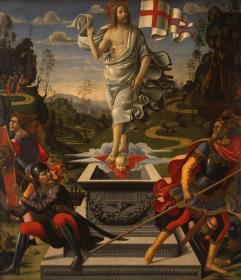
»Nun, da ich die Methoden dieser Kunst zu verstehen beginne, grämt es mich, dass sie mir nicht den Auftrag erteilen, das gesamte Rund der Stadtmauern von Florenz mit Geschichten zu bemalen.« Diese Aussage soll Domenico Ghirlandaio gegenüber seinem Bruder Davide geäußert haben, nachdem er den Chor der Dominikanerkirche S. Maria Novella ausgeschmückt hatte. Die Fresken sind heute nochzu sehen und gehören zu den künstlerischen Höhepunkten eines Florenzbesuchs. Doch Ghirlandaio war nicht nur ein bemerkenswerter Freskant, er ist auch für die Gemälde des Hochaltars verantwortlich, die Anfang des 19. Jahrhunderts veräußert wurden. Die Mitteltafel der Vorderseite, Maria mit dem Kinde und Heiligen, befindet sich heute in der Alten Pinakothek in München; die heute in der Gemäldegalerie in Berlin aufbewahrte Auferstehung nahm die Rückseite des Altarbilds ein, die nur für die Priester sichtbar war. Um die Mitteltafel und an den Seiten waren drei Heiligenpaare angeordnet. Zwei dieser Heiligen befanden sich einst in der Gemäldegalerie und wurden vermutlich im Mai 1945 in den letzten Tagen des Zweiten Weltkriegs zerstört (Abb. links).Die Auferstehung zeigt Jesus Christus am Ostermorgen, wie er dem Grab entsteigt und die vier römischen Soldaten, die es bewachen, in Schrecken versetzt. Ghirlandaio wich hier stark vom Inhalt der Heiligen Schrift ab: Das Grab Christi befand sich in einer Höhle und nicht unter freiem Himmel und keinesfalls wies es die Inschrift INRI auf (Jesus von Nazareth, König der Juden), die oben an seinem Kreuz angebracht gewesen sein soll. Auch der Pelikan, der seine Jungen mit demeigenen Blut nährt, entwickelte sich erst viel später zu einem Symbol Christi. Der Maler wollte hier die Theatralik der Szene betonen: Jesus scheint beinahe von einer unsichtbaren Maschinerie in die Luft gehoben, während die Soldaten ihre Überraschung und Angst zu überspielen suchen. Während des 19. Jahrhunderts erfuhr Ghirlandaio für seinen Sentimentalismus große Bewunderung, wurde von einigen Ästheten genau aus diesem Grund jedoch auch stark kritisiert. Der Landschaft in diesem Gemälde gebührt die gleiche Beachtung wie der bemerkenswerten Szene im Vordergrund. Auf der linken Seite nähern sich die drei Marien, die gleich das leere Grab Christi entdecken werden (ihre Namen variieren je nach Evangelium). Dahinter erkennt man im blauen Dunstschleier eine Stadt imflämischen Stil, mit einer besonderen Nähe zur Malweise des Hugo van der Goes. Am 28. Mai 1483 traf Van der Goes’ Bild für den Hochalter von S.’Egidio in Florenz ein (jetzt in den Uffizien), Domenico Ghirlandaio änderte daraufhin seine Vorstellung von Tafelmalerei.Ghirlandaio vollendete weder das Altarbild für S. Maria Novella, noch war es ihm vergönnt, die Stadtmauern von Florenz zu bemalen, wie er gehofft hatte: 1494 starb er im Alter von 45 Jahren an der Pest. Es hat etwas Bewegendes, stellt man sich vor, dass der Tod den Maler während der Arbeit an dieser Auferstehung ereilte, deren Botschaft die Hoffnung auf ein Leben nach dem Tod enthielt. Giorgio Vasari zufolge wurde dieser Teil des Bildes von Ghirlandaios Brüdern Davide undBenedetto fertiggestellt. Kritiker stimmen jedoch darin überein, dass die Landschaft von einem anderen Künstler stammen muss, in dem man Ghirlandaios Schüler Francesco Granacci sah, der heute als Pseudo Granacci bezeichnet wird. Trotz dessen Mitwirkens kann die Auferstehung als eines der letzten Meisterwerke von Domenico Ghirlandaio gelten. Neville Rowley | 200 Meisterwerke der europäischen Malerei - Gemäldegalerie Berlin, 2019________________________________________“Now that I have begun to understand the methods of this art, it grieves me that they will not commission me to paint the whole circuit of the walls of the city of Florence with stories.” This is what the painter Domenico Ghirlandaio is reputed to have said to his brother Davide, after having finished decorating the choir of the Dominican Church of Santa Maria Novella. The frescoes are still in place and are one of the highlights of any visitor who discovers Florence. But Ghirlandaio was not only a remarkable fresco painter: he was also responsible for the gigantic altarpiece adorning the chapel, dispersed at the beginning of the 19th century. The Virgin and Child in Glory among Saints which occupied the central compartment on the front side is now to be seen in Alte Pinakothek in Munich; as for the present Resurrection now in the Gemäldegalerie in Berlin, it was on the other side of the altarpiece, only visible to priests. Around the central panels and on the lateral sides of the altarpiece, three pairs of saints were displayed; two of these saints, once part of the collection of the Gemäldegalerie, were probably destroyed in May 1945 in the last days of the Second World War (fig. left).The Resurrection shows Jesus-Christ on Easter morning, coming out of his tomb, to the complete astonishment of the four Roman soldiers charged to guard his sepulture. Ghirlandaio freed himself largely from the Holy Scriptures: Christ’s tomb was set in a cave and not in the open air; and it was certainly not inscribed with the acronym “I.N.R.I.” (Jesus Christ King of Nazareth), placed instead on top of his cross, nor with the Pelican who fed his children with his blood, a symbol of Christ adopted much later (it is true that the inscription appears to have been painted over a former one). What mattered for the painter was to accentuate the theatrical character of the scene: Jesus seems to be pulled into the air by some backstage machinery, while the soldiers over-play their surprise and their fear. During the 19th century, Ghirlandaio was greatly admired for his sentimentalism; and also despised by a few aesthetes for this very reason.The landscape of this painting is to be admired on the same level as the ostentatious foreground. On the left side, we see the three Mary who, soon, will discover the empty tomb of Christ (their identities vary according to the gospels). Further on, one distinguishes a city in a blue mist, painted like in a Flemish style, and close in particular to Hugo van der Goes. On 28 May 1483, the high altarpiece of the church of Sant’Egidio, painted by Van der Goes, had arrived in Florence (it is now in the Uffizi); from that moment on, Domenico Ghirlandaio changed his conception of panel painting.Ghirlandaio did not have time to finish the Santa Maria Novella altarpiece, nor to fresco the whole circuit of the walls of Florence, as he had hoped: he died from the plague in 1494, only aged 45. There is something moving about imagining the painter agonizing while trying to complete this Resurrection, whose religious message is to give hope in a life after death. According to Vasari, this part of the altarpiece was completed by the painter’s brothers, Davide and Benedetto; but critics nowagree that the landscape is due to another artist, long confused with the pupil of Ghirlandaio Francesco Granacci and now known as the “Pseudo Granacci”. Despite the latter’s intervention, one can fully consider the Resurrection as one of the last masterpieces by Domenico Ghirlandaio. Neville Rowley | 200 Masterpieces of European Painting - Gemäldegalerie Berlin, 2019