
Logo

Die junge Mutter

Ident. Nr.: KFMV.269

ObjID: obj:869931

Details (expert)

Involved
Ausführung: Gerrit Dou (1613 - 1675),
Maler*in
Dating
Ausführung: 1655/60
Additional titles
Collection title: Die junge Mutter
Translation: The Young Mother
Geographical references
Leiden,
Stadt
Material / Technique
Eichenholz
Dimensions
Bildmaß: 49,2 x 37,4 cm oben halbrund

Object Description

Eine junge Mutter hält ihr Kind zum Stillen im Arm. Eine bezaubernde Unterbrechung erfährt der Vorgang durch ein junges Dienstmädchen dahinter, das durch den fröhlichen Klang seines Schellenspiels die Aufmerksamkeit des Kindes von der Brust der Mutter ablenkt. Schauplatz ist ein anspruchsvoll möbliertes Bürgerzimmer, an das sich links hinten ein weiterer Raum anschließt. Ein Arzt, erkennbar an dem Uringlas, das er im Seitenlicht des Fensters prüft, wird dort von einer wohl älteren Patientin konsultiert – ein merkwürdiger Handlungsaspekt, der zu dem, was davor geschieht, nicht zu passen scheint. Mittelpunkt des Gemäldes bildet, im wahrsten Sinne des Wortes, die Figur des Säuglings, der eben aus der Wiege gehoben, den Beginn des irdischen Daseins wiederspiegelt. Mit ihm auf Engste verknüpft ist die Gestalt der jungen Mutter, die – wie die volle Brust, ihre rosigen Wangen und ihr Lachen zeigen- in der Blüte ihres Lebens steht. Die Arztszene im Hintergrund dagegen, spielt auf den Niedergang des Lebens und sein Ende an. In der Abfolge präsentiert Gerard Dou dem Betrachter damit, beginnend mit der Babywiege vorne rechts, über den Säugling im Schoß seiner Mutter mittig, hin zu der Arztszene links hinten die verschiedenen Lebensstationen bzw. -alter.
Das Bild zählt zu den herausragenden Beispielen der zur vollen Reife entwickelten Kunst Gerard Dous. Bei glatt vertriebenen Farben, ohne sichtbare Spuren des Pinselduktus, treten die Motive in ihrer jeweils eigenen Gestalt und Stofflichkeit hervor: nicht in zeichnerischer Härte, sondern in einem atmosphärisch gestuften Helldunkel. Das Messing der Deckenkrone, deren dekoratives Lineament den Vorgang im wahrsten Sinne des Wortes bekrönt, reflektiert das Licht in wärmerem Schimmer als das Silber des Tischleuchters. Die samtene Hausjacke der Mutter unterscheidet sich fühlbar von der rauhen Webstruktur des Vorhangs. Joachim von Sandrart berichtet, der Maler habe »mit Hülf der Augengläser« gearbeitet. So erklärt sich vielleicht die kaum zu überbietende, detaillierte Wiedergabe der Holzmaserung auf den Dielenbrettern oder das glänzende Flechtwerk der Korbwiege. Dou gilt als der Begründer und zugleich als der wichtigste Vertreter der sogenannten »Leidener Feinmalerei«. Bereits die Zeitgenossen haben die Akribie seiner Gestaltgebung bewundert. Der Leidener Bürgermeister Orlers schrieb: »Jeder, welcher seine Arbeiten sah, konnte nicht anders als staunen vor der Sorgfalt und Merkwürdigkeit der Ausführung«. Die reichen Wechselbeziehungen zwischen Form, Farbe und Licht hat er mit der Andacht eines Stillebenmalers ausgekostet. In seinen besten Bildern hat Dou Feinmalerei nicht einfach praktiziert, sondern zelebriert. Dem an sich alltäglichen Beieinander von Mutter und Kind ist auf diese Weise der Anschein des Außergewöhnlichen verliehen, das der barock zur Seite drapierte Teppichvorhang – ein von Dou häufig verwendeter Kunstgriff – dem Auge des Betrachters enthüllt. Katja Kleinert und Jan Kelch | 200 Meisterwerke der europäischen Malerei - Gemäldegalerie Berlin, 2019
_________________________________________________________________

A young mother holds her child to give it the breast. This is charmingly interrupted by a young servant girl behind them, who diverts the child’s attention from the mother’s breast with the merry tinkling bells of a toy. The scene is set in an expensively furnished room of a middle-class home, with a second room adjoining on the left. A doctor, recognisable by the jar of urine that he is inspecting in the light entering laterally from a window, is being consulted by a female patient, who appears to be elderly – a strange feature of the narrative that appears not to match what is happening in the foreground. The centre point of the painting is literally the figure of the child, which has just been raised from its cot and reflects the beginning of an existence on earth. Intimately connected to the child is the figure of the young mother, who is in the full flower of her life, as her ripe breast, rosy cheeks and laughter show. The medical scene in the background, by contrast, refers to the decline and end of life. In this sequence, Gerard Dou thus presents to the beholder the various stages of life and old age, beginning with the baby’s cradle in the right foreground, then going on to the child in the mother’s lap at the centre, and in the background on the left the scene with the doctor.

This painting is an outstanding example of Gerard Dou’s art at its most mature stage of development. With smoothly applied paints, without visible traces of the brushstrokes, each motif stands out in its own form and materiality: not in hard draughtsmanship but in atmospheric gradations of darkness and light. The brass of the ceiling chandelier, whose decorative outline truly crowns the proceedings,
reflects the light with a warmer gleam than the silver of the table candlestick. The mother’s velvet housecoat is tangibly different from the rough woven texture of the curtain. Joachim von Sandrart reported that the artist worked “with the help of eye glasses”. This may explain the almost unsurpassable detailed rendering of the grain in the wood of the floorboards and the shining basketwork of the cradle. Dou is regarded as the founder and at the same time the most important exponent of what is called “Leiden fine painting”. Contemporaries admired his meticulous shaping
of forms. Mayor Orlers of Leiden wrote that “No one who saw his work could help being astonished at the care and curiosity of its execution”. He savoured opulent interrelationships between form, colour and light with the reverence of a still-life painter. In his best works, Dou not merely practised fine painting, he celebrated it. In this way, he imparted to the everyday companionship of the mother and child the appearance of something out of the ordinary, which the tapestry hanging, draped to the side in Baroque manner – a device frequently used by Dou – reveals to the beholder’s eye. Katja Kleinert und Jan Kelch | 200 Masterpieces of European Painting - Gemäldegalerie Berlin, 2019

Last updated: 16.04.2026

Contact

Institution:

Gemäldegalerie

Additional items from the collections

Die Auferstehung Christi

Die Auferstehung Christi

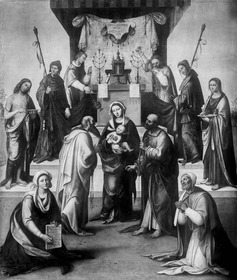
»Nun, da ich die Methoden dieser Kunst zu verstehen beginne, grämt es mich, dass sie mir nicht den Auftrag erteilen, das gesamte Rund der Stadtmauern von Florenz mit Geschichten zu bemalen.« Diese Aussage soll Domenico Ghirlandaio gegenüber seinem Bruder Davide geäußert haben, nachdem er den Chor der Dominikanerkirche S. Maria Novella ausgeschmückt hatte. Die Fresken sind heute nochzu sehen und gehören zu den künstlerischen Höhepunkten eines Florenzbesuchs. Doch Ghirlandaio war nicht nur ein bemerkenswerter Freskant, er ist auch für die Gemälde des Hochaltars verantwortlich, die Anfang des 19. Jahrhunderts veräußert wurden. Die Mitteltafel der Vorderseite, Maria mit dem Kinde und Heiligen, befindet sich heute in der Alten Pinakothek in München; die heute in der Gemäldegalerie in Berlin aufbewahrte Auferstehung nahm die Rückseite des Altarbilds ein, die nur für die Priester sichtbar war. Um die Mitteltafel und an den Seiten waren drei Heiligenpaare angeordnet. Zwei dieser Heiligen befanden sich einst in der Gemäldegalerie und wurden vermutlich im Mai 1945 in den letzten Tagen des Zweiten Weltkriegs zerstört (Abb. links).Die Auferstehung zeigt Jesus Christus am Ostermorgen, wie er dem Grab entsteigt und die vier römischen Soldaten, die es bewachen, in Schrecken versetzt. Ghirlandaio wich hier stark vom Inhalt der Heiligen Schrift ab: Das Grab Christi befand sich in einer Höhle und nicht unter freiem Himmel und keinesfalls wies es die Inschrift INRI auf (Jesus von Nazareth, König der Juden), die oben an seinem Kreuz angebracht gewesen sein soll. Auch der Pelikan, der seine Jungen mit demeigenen Blut nährt, entwickelte sich erst viel später zu einem Symbol Christi. Der Maler wollte hier die Theatralik der Szene betonen: Jesus scheint beinahe von einer unsichtbaren Maschinerie in die Luft gehoben, während die Soldaten ihre Überraschung und Angst zu überspielen suchen. Während des 19. Jahrhunderts erfuhr Ghirlandaio für seinen Sentimentalismus große Bewunderung, wurde von einigen Ästheten genau aus diesem Grund jedoch auch stark kritisiert. Der Landschaft in diesem Gemälde gebührt die gleiche Beachtung wie der bemerkenswerten Szene im Vordergrund. Auf der linken Seite nähern sich die drei Marien, die gleich das leere Grab Christi entdecken werden (ihre Namen variieren je nach Evangelium). Dahinter erkennt man im blauen Dunstschleier eine Stadt imflämischen Stil, mit einer besonderen Nähe zur Malweise des Hugo van der Goes. Am 28. Mai 1483 traf Van der Goes’ Bild für den Hochalter von S.’Egidio in Florenz ein (jetzt in den Uffizien), Domenico Ghirlandaio änderte daraufhin seine Vorstellung von Tafelmalerei.Ghirlandaio vollendete weder das Altarbild für S. Maria Novella, noch war es ihm vergönnt, die Stadtmauern von Florenz zu bemalen, wie er gehofft hatte: 1494 starb er im Alter von 45 Jahren an der Pest. Es hat etwas Bewegendes, stellt man sich vor, dass der Tod den Maler während der Arbeit an dieser Auferstehung ereilte, deren Botschaft die Hoffnung auf ein Leben nach dem Tod enthielt. Giorgio Vasari zufolge wurde dieser Teil des Bildes von Ghirlandaios Brüdern Davide undBenedetto fertiggestellt. Kritiker stimmen jedoch darin überein, dass die Landschaft von einem anderen Künstler stammen muss, in dem man Ghirlandaios Schüler Francesco Granacci sah, der heute als Pseudo Granacci bezeichnet wird. Trotz dessen Mitwirkens kann die Auferstehung als eines der letzten Meisterwerke von Domenico Ghirlandaio gelten. Neville Rowley | 200 Meisterwerke der europäischen Malerei - Gemäldegalerie Berlin, 2019________________________________________“Now that I have begun to understand the methods of this art, it grieves me that they will not commission me to paint the whole circuit of the walls of the city of Florence with stories.” This is what the painter Domenico Ghirlandaio is reputed to have said to his brother Davide, after having finished decorating the choir of the Dominican Church of Santa Maria Novella. The frescoes are still in place and are one of the highlights of any visitor who discovers Florence. But Ghirlandaio was not only a remarkable fresco painter: he was also responsible for the gigantic altarpiece adorning the chapel, dispersed at the beginning of the 19th century. The Virgin and Child in Glory among Saints which occupied the central compartment on the front side is now to be seen in Alte Pinakothek in Munich; as for the present Resurrection now in the Gemäldegalerie in Berlin, it was on the other side of the altarpiece, only visible to priests. Around the central panels and on the lateral sides of the altarpiece, three pairs of saints were displayed; two of these saints, once part of the collection of the Gemäldegalerie, were probably destroyed in May 1945 in the last days of the Second World War (fig. left).The Resurrection shows Jesus-Christ on Easter morning, coming out of his tomb, to the complete astonishment of the four Roman soldiers charged to guard his sepulture. Ghirlandaio freed himself largely from the Holy Scriptures: Christ’s tomb was set in a cave and not in the open air; and it was certainly not inscribed with the acronym “I.N.R.I.” (Jesus Christ King of Nazareth), placed instead on top of his cross, nor with the Pelican who fed his children with his blood, a symbol of Christ adopted much later (it is true that the inscription appears to have been painted over a former one). What mattered for the painter was to accentuate the theatrical character of the scene: Jesus seems to be pulled into the air by some backstage machinery, while the soldiers over-play their surprise and their fear. During the 19th century, Ghirlandaio was greatly admired for his sentimentalism; and also despised by a few aesthetes for this very reason.The landscape of this painting is to be admired on the same level as the ostentatious foreground. On the left side, we see the three Mary who, soon, will discover the empty tomb of Christ (their identities vary according to the gospels). Further on, one distinguishes a city in a blue mist, painted like in a Flemish style, and close in particular to Hugo van der Goes. On 28 May 1483, the high altarpiece of the church of Sant’Egidio, painted by Van der Goes, had arrived in Florence (it is now in the Uffizi); from that moment on, Domenico Ghirlandaio changed his conception of panel painting.Ghirlandaio did not have time to finish the Santa Maria Novella altarpiece, nor to fresco the whole circuit of the walls of Florence, as he had hoped: he died from the plague in 1494, only aged 45. There is something moving about imagining the painter agonizing while trying to complete this Resurrection, whose religious message is to give hope in a life after death. According to Vasari, this part of the altarpiece was completed by the painter’s brothers, Davide and Benedetto; but critics nowagree that the landscape is due to another artist, long confused with the pupil of Ghirlandaio Francesco Granacci and now known as the “Pseudo Granacci”. Despite the latter’s intervention, one can fully consider the Resurrection as one of the last masterpieces by Domenico Ghirlandaio. Neville Rowley | 200 Masterpieces of European Painting - Gemäldegalerie Berlin, 2019