
Logo

Die Verkündigung an Maria

Ident. Nr.: 73

ObjID: obj:871029

Details (expert)

Involved
Ausführung: Piero del Pollaiuolo (1441/42 - vor 1496),
Maler*in
Dating
Ausführung: um 1480
Additional titles
Collection title: Die Verkündigung an Maria
Translation: The Annunciation
Geographical references
Italien,
Land
Material / Technique
Pappelholz
Dimensions
Bildmaß: 152,1 x 176,5 cm

Object Description

Piero del Pollaiuolo war zehn Jahre jünger als sein bedeutenderer, berühmterer Bruder Antonio. Im Unterschied zu diesem, der vor allem Goldschmied, Bildhauer und Entwerfer war, war Piero in erster Linie Maler (so die vorvasarianischen Quellen). Nach Vasari war er Schüler von Andrea del Castagno, der allerdings 1457 starb, als Piero erst 16 oder 17 Jahre alt war. 1466 war er an der Dekoration der
Kapelle des Kardinals von Portugal in S. Miniato al Monte beteiligt, 1469 erhielt er den prominenten Auftrag, sechs Tugenden für den Saal der Arte della Mercanzia zu malen, wobei Antonio als geschäftsführendes Haupt der gemeinsamen Werkstatt die Qualität der Arbeit und die Pünktlichkeit der Ausführung zu garantieren hatte. 1473 war Piero als Maler in der Compagnia di S. Luca eingeschrieben. 1483 schließlich signierte und datierte er sein Altarbild in S. Agostino in S. Gimignano.

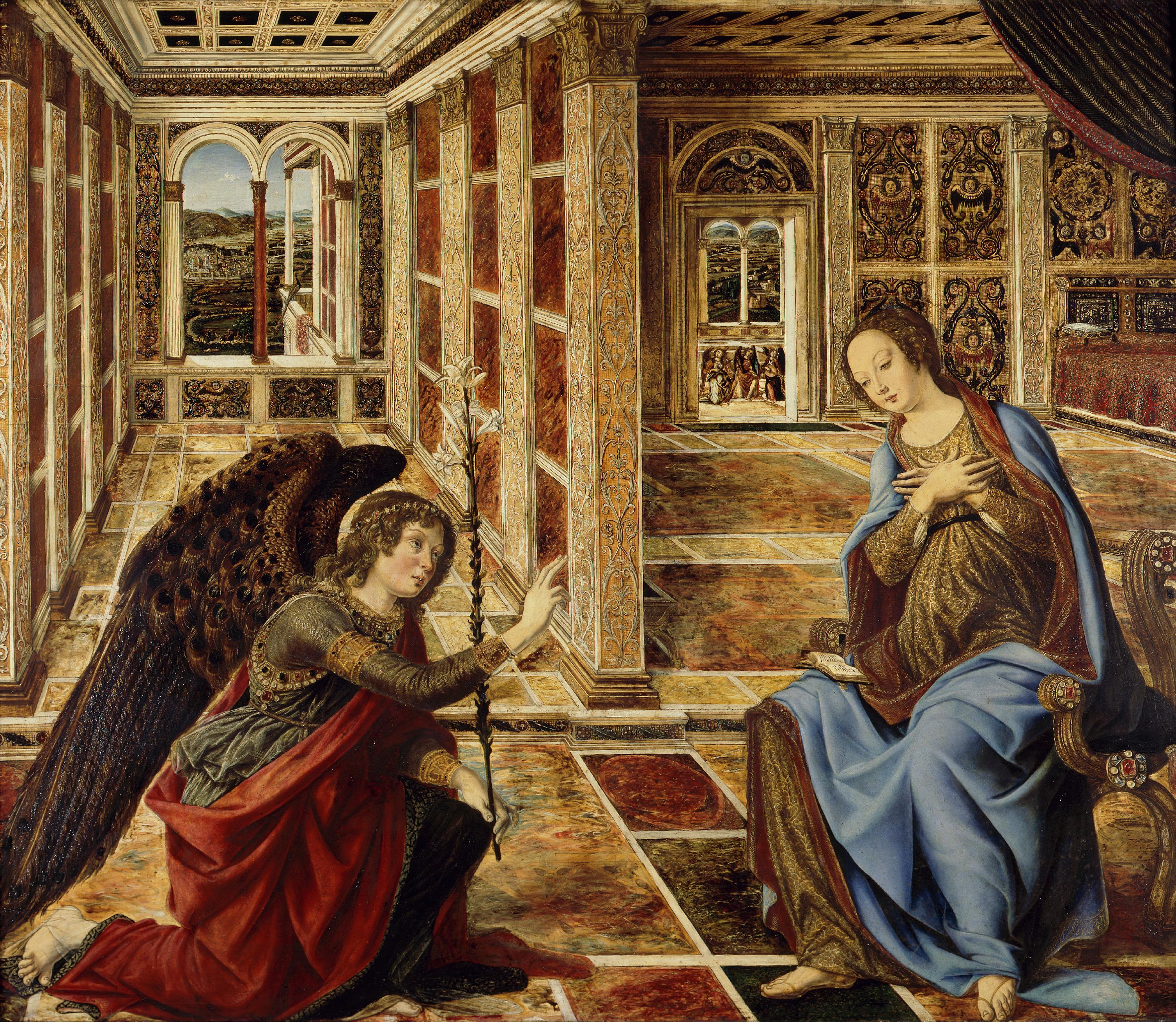
Die große Tafel der Verkündigung an Maria gilt im Allgemeinen als Werk Pieros und wird wegen der engen Verwandtschaft mit den Tugenden der Mercanzia um 1470 datiert. Beide Hauptfiguren sind in vorderster Bildebene platziert, in einem Vorraum, der durch eine Stufe von dem zweigeteilten Raum dahinter (Schlafgemach und Ankleideraum) abgesetzt ist. Jedem von ihnen ist als Hintergrund
ein Kompartiment des zweigeteilten Raums zugeordnet. Der Engel, der mächtige Flügel hat und ein grünes, mit Edelsteinen und goldgefassten Perlen kostbar geschmücktes Gewand und einen rubinroten Mantel trägt, kniet links vor der Madonna, hält in der Linken die hoch aufragende Lilie und hebt die Rechte zum Gruß. Maria sitzt auf einem mit Edelsteinen verzierten Stuhl und trägt einen hellblauen, rotbraun gefütterten Mantel über einem goldgemusterten Kleid. Sie hält ein kleines Buch auf den Knien, die Hände in einem Devotionsgestus vor der Brust gekreuzt, und lauscht der Botschaft des Engels. Der Hintergrund ist wohl die brillanteste Darstellung eines vornehmen Innenraums der Florentiner Frührenaissance in einem Bild, die wir kennen: ein zweigeteilter Raum im Piano nobile einer Villa auf den Hügeln nördlich von Florenz.

Das Bild ist eine tour de force an zentralperspektivischer Darstellung. Die Orthogonalen ziehen den Blick an den prächtigen Wänden vorbei in die Tiefe, durch das offene Arkadenfenster des linken Raums, wo sich ein Blick auf das Arnotal mit dem von Stadtmauern umgebenen Florenz auftut. Dom und Palazzo della Signoria sind deutlich zu erkennen. Der Fluchtpunkt liegt etwa am Horizont bei den blauen Bergen oberhalb des Palazzo Vecchio. Ein kurvenreicher Weg zieht sich von der Stadt zur Villa hinauf. Reiter nähern sich ihr. Die beiden Räume haben geometrisch gemusterte Steinfußböden und Kassettendecken über pilastergegliederten Wänden mit roten Füllungen links und mit kostbaren Ledertapeten im weiten Schlafgemach rechts. Hier befindet sich das reich verzierte Bett, links im Hintergrund führt eine Tür in einen loggiaartigen Raum, in dem drei kniende Engel musizieren. Durch das Fenster dieses Vorraums sieht man weitere Villen in der Landschaft und in der Ferne wohl die Stadt Prato.

Die ursprüngliche Bestimmung dieser großen Tafel ist unbekannt. M. Cruttwell (1907) meinte, dass Lorenzo de’ Medici sie als Altarbild für die Kapelle der Villa in Careggi bestellt haben könnte. S. Brink (1990) schlug vor, dass der Standpunkt des Malers die Villa La Petraia sei, die sich seit 1468 im Besitz des Benedetto d’Antonio di Filippo Salutati befand. Werden die Figuren im allgemeinen
Piero zuerkannt, so hat man für den Entwurf des reich dekorierten Innenraums an Antonio gedacht, dem Busignani (1970) die Ausführung der Landschaft zu schreibt. Brink (1990) glaubt, dass Antonio auch die Unterzeichnung des Mantels des Engels angelegt habe.

Die Infrarotreflektografie hat ergeben, dass der Künstler die Gliederung des Fußbodens erheblich verändert hat. »Bevor [dieser] die jetzt sichtbare Gestalt mit seinen großen Marmorplatten erhielt, sollte er kleiner, dafür ornamentreicher gefliest werden.« (Brink 1990). Erich Schleier | 200 Meisterwerke der europäischen Malerei - Gemäldegalerie Berlin, 2019
_________________________________________

Piero del Pollaiuolo was ten years younger than his more important and famous brother Antonio. In contrast to Antonio, who was primarily a goldsmith, sculptor and draughtsman, Piero was, according to sources before Vasari, mainly a painter. Vasari held him to be a pupil of Andrea del Castagno, who died in 1457, when Piero was 16 or 17 years old. In 1466, Piero was involved in decorating the chapel of the Cardinal of Portugal in San Miniato al Monte. In 1469, he received a prominent commission to paint six Virtues for the hall of the Arte della Mercanzia. For this Antonio, who as the head of the shared workshop took commercial responsibility, had to guarantee the quality of the work and its punctual execution. In 1473, Piero was enrolled as a painter in the Compagnia di San Luca. In 1483, he signed and dated his altarpiece in Sant’Agostino in San Gimignano.

The large panel of the Annunciation is generally regarded as a work by Piero, and is dated to approximately 1470 on account of its close relationship to the Virtues of the Mercanzia. Both of the main figures are placed in the very foreground of the picture, in an ante-chamber that is separated by a step from the two-part room (bedchamber and dressing room) behind it. A compartment of this room is allocated to each of the figures as background. The angel, who has great wings, a green robe preciously adorned with jewels and pearls set in gold, and a ruby-red cloak, kneels on the left before the Madonna, holding a tall lily in his left hand and raising his right hand in salutation. Mary sits on a chair decorated with jewels and wears a pale blue cloak with red-brown lining above a gold-patterned dress. She holds a small book on her knees, her hands crossed in front of her breast in a gesture of devotion, and listens to the angel’s message. The background must be the most brilliant depiction known to us in a painting of a high-class interior of the Florentine early Renaissance: a two-part room in the piano nobile of a villa in the hills north of Florence.

The work is a tour de force of representation in central perspective. The right-angled lines draw the eyes past the magnificent walls into the depths of the scene, through the open arcaded window of the room on the left, where a view of the Arno valley with Florence within its city walls is revealed. The cathedral and Palazzo della Signoria can clearly be identified. The vanishing point lies approximately on the horizon at the blue mountains above the Palazzo Vecchio. A curving path leads from the city up to the villa. Riders are approaching it. The two rooms have stone floors in a geometrical pattern and coffered ceilings above walls divided by pilasters, with red infill on the left and expensive leather wall-coverings in the bedchamber on the right. Here stands the richly decorated bed, while in the background on the left a door opens on to a loggia-like space in which three kneeling angels are making music. Through the window of this ante-chamber further villas are visible in the landscape, and in the distance what must be the town of Prato.

The original destination of this large panel is unknown. M. Cruttwell (1907) thought that Lorenzo de’ Medici might have ordered it for the chapel of the villa in Careggi. S. Brink (1990) suggested that the position of the painter was the villa La Petraia, which had been in the possession of Benedetto d’Antonio di Filippo Salutati since 1468. Whereas the figures are generally attributed to Piero, the design of the opulently decorated interior has been considered to be the work of Antonio, to whom
Busignani (1970) ascribes the execution of the landscape. Brink (1990) believes that Antonio also laid out the under-drawing of the angel’s cloak. Infra-red reflectography reveals that the artist made considerable alterations to the design of the floor. “Before [it] it was given its present form with large slabs of marble, it was to have been covered in smaller but more ornamental tiles” (Brink 1990). Erich Schleier| 200 Masterpieces of European Painting - Gemäldegalerie Berlin

Last updated: 03.07.2026

Contact

Institution:

Gemäldegalerie

Additional items from the collections

Die Auferstehung Christi

Die Auferstehung Christi

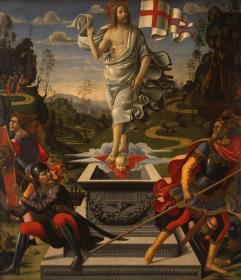
»Nun, da ich die Methoden dieser Kunst zu verstehen beginne, grämt es mich, dass sie mir nicht den Auftrag erteilen, das gesamte Rund der Stadtmauern von Florenz mit Geschichten zu bemalen.« Diese Aussage soll Domenico Ghirlandaio gegenüber seinem Bruder Davide geäußert haben, nachdem er den Chor der Dominikanerkirche S. Maria Novella ausgeschmückt hatte. Die Fresken sind heute nochzu sehen und gehören zu den künstlerischen Höhepunkten eines Florenzbesuchs. Doch Ghirlandaio war nicht nur ein bemerkenswerter Freskant, er ist auch für die Gemälde des Hochaltars verantwortlich, die Anfang des 19. Jahrhunderts veräußert wurden. Die Mitteltafel der Vorderseite, Maria mit dem Kinde und Heiligen, befindet sich heute in der Alten Pinakothek in München; die heute in der Gemäldegalerie in Berlin aufbewahrte Auferstehung nahm die Rückseite des Altarbilds ein, die nur für die Priester sichtbar war. Um die Mitteltafel und an den Seiten waren drei Heiligenpaare angeordnet. Zwei dieser Heiligen befanden sich einst in der Gemäldegalerie und wurden vermutlich im Mai 1945 in den letzten Tagen des Zweiten Weltkriegs zerstört (Abb. links).Die Auferstehung zeigt Jesus Christus am Ostermorgen, wie er dem Grab entsteigt und die vier römischen Soldaten, die es bewachen, in Schrecken versetzt. Ghirlandaio wich hier stark vom Inhalt der Heiligen Schrift ab: Das Grab Christi befand sich in einer Höhle und nicht unter freiem Himmel und keinesfalls wies es die Inschrift INRI auf (Jesus von Nazareth, König der Juden), die oben an seinem Kreuz angebracht gewesen sein soll. Auch der Pelikan, der seine Jungen mit demeigenen Blut nährt, entwickelte sich erst viel später zu einem Symbol Christi. Der Maler wollte hier die Theatralik der Szene betonen: Jesus scheint beinahe von einer unsichtbaren Maschinerie in die Luft gehoben, während die Soldaten ihre Überraschung und Angst zu überspielen suchen. Während des 19. Jahrhunderts erfuhr Ghirlandaio für seinen Sentimentalismus große Bewunderung, wurde von einigen Ästheten genau aus diesem Grund jedoch auch stark kritisiert. Der Landschaft in diesem Gemälde gebührt die gleiche Beachtung wie der bemerkenswerten Szene im Vordergrund. Auf der linken Seite nähern sich die drei Marien, die gleich das leere Grab Christi entdecken werden (ihre Namen variieren je nach Evangelium). Dahinter erkennt man im blauen Dunstschleier eine Stadt imflämischen Stil, mit einer besonderen Nähe zur Malweise des Hugo van der Goes. Am 28. Mai 1483 traf Van der Goes’ Bild für den Hochalter von S.’Egidio in Florenz ein (jetzt in den Uffizien), Domenico Ghirlandaio änderte daraufhin seine Vorstellung von Tafelmalerei.Ghirlandaio vollendete weder das Altarbild für S. Maria Novella, noch war es ihm vergönnt, die Stadtmauern von Florenz zu bemalen, wie er gehofft hatte: 1494 starb er im Alter von 45 Jahren an der Pest. Es hat etwas Bewegendes, stellt man sich vor, dass der Tod den Maler während der Arbeit an dieser Auferstehung ereilte, deren Botschaft die Hoffnung auf ein Leben nach dem Tod enthielt. Giorgio Vasari zufolge wurde dieser Teil des Bildes von Ghirlandaios Brüdern Davide undBenedetto fertiggestellt. Kritiker stimmen jedoch darin überein, dass die Landschaft von einem anderen Künstler stammen muss, in dem man Ghirlandaios Schüler Francesco Granacci sah, der heute als Pseudo Granacci bezeichnet wird. Trotz dessen Mitwirkens kann die Auferstehung als eines der letzten Meisterwerke von Domenico Ghirlandaio gelten. Neville Rowley | 200 Meisterwerke der europäischen Malerei - Gemäldegalerie Berlin, 2019________________________________________“Now that I have begun to understand the methods of this art, it grieves me that they will not commission me to paint the whole circuit of the walls of the city of Florence with stories.” This is what the painter Domenico Ghirlandaio is reputed to have said to his brother Davide, after having finished decorating the choir of the Dominican Church of Santa Maria Novella. The frescoes are still in place and are one of the highlights of any visitor who discovers Florence. But Ghirlandaio was not only a remarkable fresco painter: he was also responsible for the gigantic altarpiece adorning the chapel, dispersed at the beginning of the 19th century. The Virgin and Child in Glory among Saints which occupied the central compartment on the front side is now to be seen in Alte Pinakothek in Munich; as for the present Resurrection now in the Gemäldegalerie in Berlin, it was on the other side of the altarpiece, only visible to priests. Around the central panels and on the lateral sides of the altarpiece, three pairs of saints were displayed; two of these saints, once part of the collection of the Gemäldegalerie, were probably destroyed in May 1945 in the last days of the Second World War (fig. left).The Resurrection shows Jesus-Christ on Easter morning, coming out of his tomb, to the complete astonishment of the four Roman soldiers charged to guard his sepulture. Ghirlandaio freed himself largely from the Holy Scriptures: Christ’s tomb was set in a cave and not in the open air; and it was certainly not inscribed with the acronym “I.N.R.I.” (Jesus Christ King of Nazareth), placed instead on top of his cross, nor with the Pelican who fed his children with his blood, a symbol of Christ adopted much later (it is true that the inscription appears to have been painted over a former one). What mattered for the painter was to accentuate the theatrical character of the scene: Jesus seems to be pulled into the air by some backstage machinery, while the soldiers over-play their surprise and their fear. During the 19th century, Ghirlandaio was greatly admired for his sentimentalism; and also despised by a few aesthetes for this very reason.The landscape of this painting is to be admired on the same level as the ostentatious foreground. On the left side, we see the three Mary who, soon, will discover the empty tomb of Christ (their identities vary according to the gospels). Further on, one distinguishes a city in a blue mist, painted like in a Flemish style, and close in particular to Hugo van der Goes. On 28 May 1483, the high altarpiece of the church of Sant’Egidio, painted by Van der Goes, had arrived in Florence (it is now in the Uffizi); from that moment on, Domenico Ghirlandaio changed his conception of panel painting.Ghirlandaio did not have time to finish the Santa Maria Novella altarpiece, nor to fresco the whole circuit of the walls of Florence, as he had hoped: he died from the plague in 1494, only aged 45. There is something moving about imagining the painter agonizing while trying to complete this Resurrection, whose religious message is to give hope in a life after death. According to Vasari, this part of the altarpiece was completed by the painter’s brothers, Davide and Benedetto; but critics nowagree that the landscape is due to another artist, long confused with the pupil of Ghirlandaio Francesco Granacci and now known as the “Pseudo Granacci”. Despite the latter’s intervention, one can fully consider the Resurrection as one of the last masterpieces by Domenico Ghirlandaio. Neville Rowley | 200 Masterpieces of European Painting - Gemäldegalerie Berlin, 2019

Johannes der Täufer

Johannes der Täufer

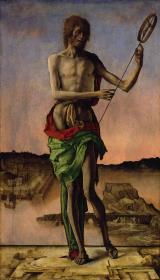
Johannes der Täufer predigt in der Wüste und verkündet die Ankunft des Messias. In diesem Gemälde ist er als Prophet dargestellt, mit einem vor Entbehrung ausgezehrtem Körper, eingefallenem Gesicht und beinahe ekstatisch auf das kleine Kruzifix starrend, das den Stab in seinen Händen krönt. Dieses Detail ist sehr ungewöhnlich, da sich das Kreuzsymbol erst lange nach dem Tod Jesu verbreitete. Dem Maler ging es jedoch nicht um historischen Realismus; vielmehr verstärkt er allein durch die Landschaft den zeitlosen Charakter einer fantastischen Vision, die auch aus einem modernen Science-Fiction-Film stammen könnte: Die Sonne ist gerade hinter dem Horizont einer unwirklich anmutenden Landschaft aus merkwürdig geformten und dunstverhangenen Felsen untergegangen. Links erkennt man eine bemerkenswert detailliert ausgeführte Hafenstadt, die Landzunge rechts im Vordergrund scheint einst über die zerstörte Brücke mit ihr verbunden gewesen zu sein. Alles in dieser Szenerie regt zum Nachdenken über zwei untrennbare Aspekte an: das tragische Schicksal Christi und die Vergänglichkeit der irdischen Welt.Trotz ihres zeitlosen Charakters handelt es sich um ein typisches Werk Ercole de’ Robertis, der bei Cosmè Tura in die Lehre gegangen und in Ferrara in der zweiten Hälfte des 15. Jahrhunderts tätig war. Die expressionistischen Züge von Turas Figuren und deren an Bronzeskulpturen erinnernden Drapierungen sind hier deutlich zu erkennen, während der Maler seine Originalität in der Landschaft bekundet. Bereits in seiner Altartafel für die Basilika S. Maria in Porto in Ravenna (heute in der Pinacoteca di Brera, Mailand) hatte Ercole dem traditionellen Schema der Sacra conversazione mit Maria, Christuskind und Heiligen unter dem Thron der Gottesmutter eine Landschaft hinzugefügt, die sich mit der Landschaft in diesem Gemälde vergleichen lässt.Die Landschaftsdarstellung ist hier als Mittel zu verstehen, die Kontemplation eines Gemäldes zu verstärken und die religiöse Meditation zu fördern – ein Bildverständnis, das sich nördlich der Alpen unter der Bezeichnung »Devotio Moderna« oder »neue Frömmigkeit« entwickelte. Der Venezianer Giovanni Bellini gilt als erster großer Interpret dieses Landschaftstypus in Norditalien. Seine heute in Berlin aufbewahrte Auferstehung Christi ist hier als exemplarisch anzusehen. Ercole übernahm von Bellini auch die Verwendung von Öl als Bindemittel, die damals in Norditalien, und vor allem in Ferrara, noch relativ ungebräuchlich war. Bis Ende des 19. Jahrhunderts wurde das Werk indes Bellinis Schwager Andrea Mantegna zugeschrieben, dessen enormer Ruf ihn zum Autor sehr unterschiedlicher Werke werden ließ (beispielsweise im Falle der Grabbereitung Christi von Vittore Carpaccio). Neville Rowley | 200 Meisterwerke der europäischen Malerei - Gemäldegalerie Berlin, 2019__________________________Saint John the Baptist spent his life in the desert announcing the advent of the Messiah: he is here shown as a prophet, his body stunted, his face emaciated and his possessed gaze turned towards the tiny Crucifix crowning the stock that he holds in his hands. Such a detail is most implausible, as the use of the Crucifix only spread long after the death of Jesus Christ, who was John’s contemporary. But the painter did not pay attention to historic realism; rather, the landscape itself reinforces this timeless impression of a fantastic vision, worthy of the best modern science fiction movies: the sun has just set on a phantasmagorical landscape, made of strangely shaped rocks invaded by mist. On the left is a remarkably detailed harbour city, while on the right a promontory seems to have been once connected to the city by a now destroyed bridge. Everything in this landscape encourages us to meditate on two inseparable aspects: the tragic destiny of Christ and the perishable nature of the human world.Even if this painting seems timeless, it is a characteristic work by Ercole de’ Roberti, a Ferrarese painter trained by Cosmè Tura in the second half of the 15th century. The expressionist character of Tura’s figures, and his draperies which look alike bronze sculptures are clearly visible here, even if the painter shows his originality into the landscape. In his altarpiece for the church of Santa Maria in Porto, near Ravenna (today in the Pinacoteca di Brera in Milan), Ercole had already decided to represent, in addition to the Virgin, the Christ Child and the Saints according to the traditional scheme known as the “holy conversation”, a far landscape view under the throne of the Virgin. Such a view is to be strictly compared to the present painting.Landscape is understood here as a way to extend the contemplation of a painting and to deepen religious meditation. This way of appreciating paintings came from the North of the Alps, where it was named devotio moderna or “modern devotion”. The first great interpret of this type of conception of landscape in Northern Italy was the Venetian painter Giovanni Bellini; his Resurrection, today in Berlin, is particularly characteristic in that sense. Ercole took also directly from Bellini the use of oil for binding pigments, which was a relative novelty in Northern Italy at the time, and especially in Ferrara. Until the end of the 19th century, however, the present work was attributed to Bellini’s brother-in-law, Andrea Mantegna, whose enormous fame justified he was considered as the author of many works that had only in common the virtuosity of drawing (this was also the case of the Preparation of Christ’s Tomb by Vittore Carpaccio). Neville Rowley | 200 Masterpieces of European Painting - Gemäldegalerie Berlin, 2019