
Credit: Staatliche Museen zu Berlin, Gemäldegalerie / Christoph Schmidt Public Domain Mark 1.0
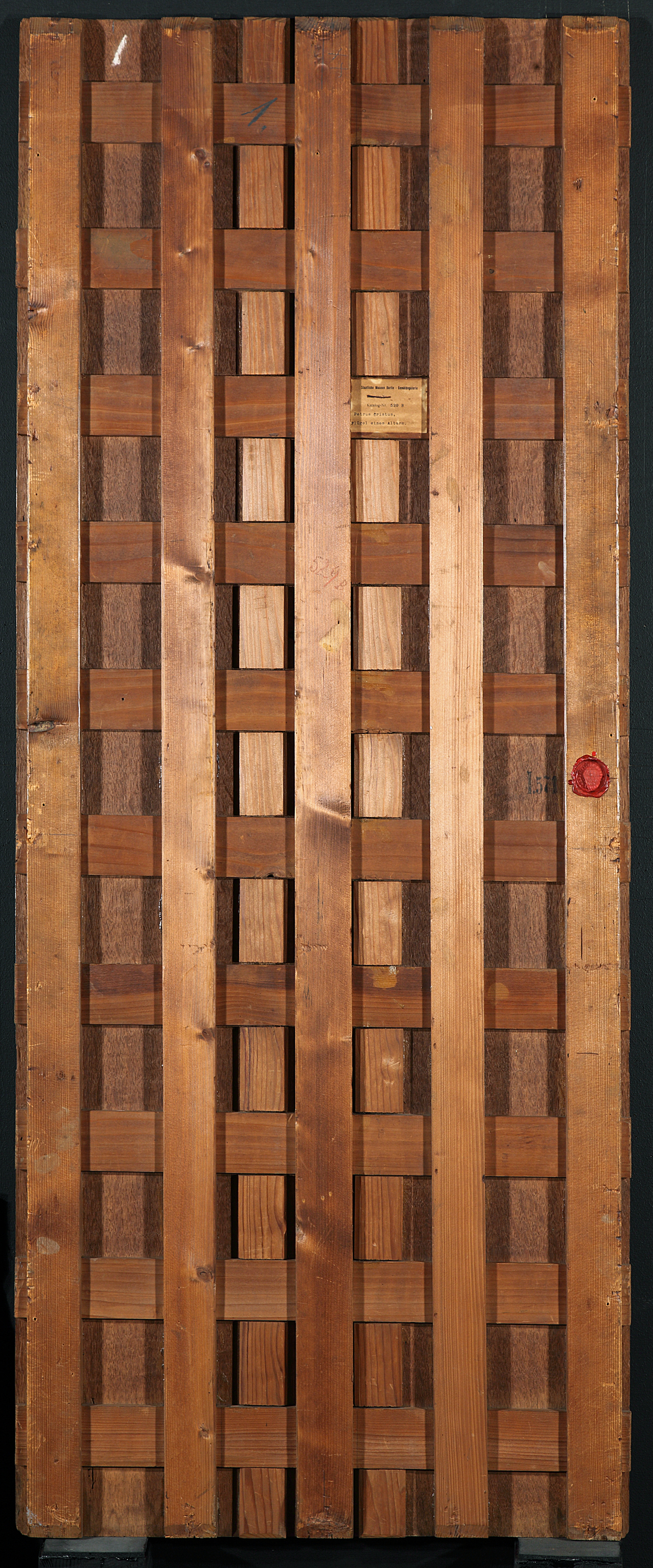
Credit: Staatliche Museen zu Berlin, Gemäldegalerie / Christoph Schmidt Public Domain Mark 1.0
Details (expert)
- Creator/Entity
- Date(s)
- Ausführung: 1452
- Additional titles
- Collection title: Das Jüngste Gericht (Altarflügel zu 529a)Translation: The Last Judgment (wing of the altar to 529A)
- Geographical references
- Material / Technique
- Eichenholz
- Dimensions
- Bildmaß: 147,2 x 59,5 cm
- Acquisition
- 1850 Ankauf durch den Kunsthändler Fidelis Butsch, Augsburg
- Permalink
- https://id.smb.museum/object/871257
Object Description
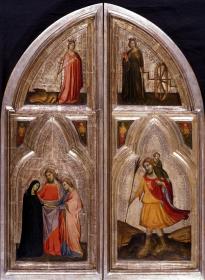
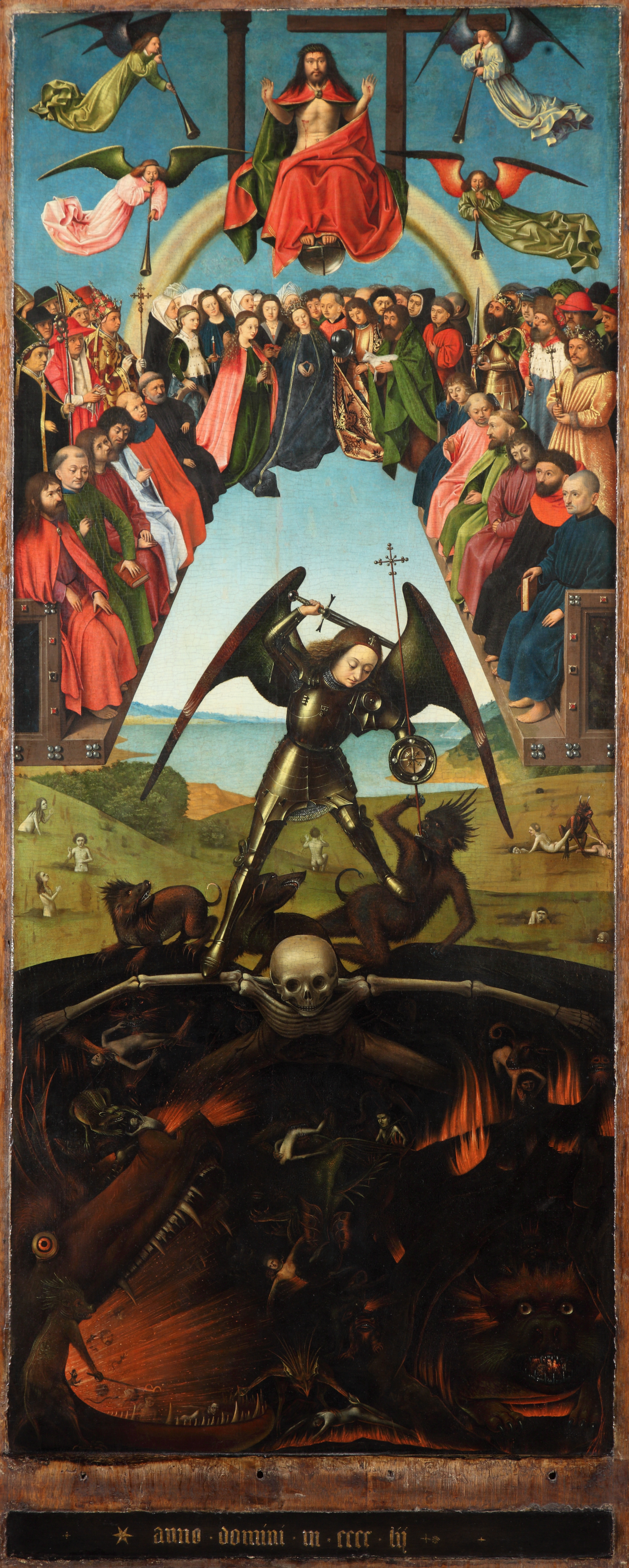
Die Altarflügel entstanden im Jahr 1452 und tragen die aus lateinischen und griechischen Buchstaben zusammengesetzte Signatur »petrus xpi«. Am 6. Juli 1444 erwarb der Künstler das Bürgerrecht von Brügge. Dort wird Petrus Christus zwischen 1454 und 1472 wiederholt in Urkunden erwähnt. Der Künstler, der auf den Errungenschaften von Jan van Eyck, Robert Campin und Rogier van der Weyden aufbaute, verdankt der neuartigen Verbindung von Figur und Raum seine unverwechselbare Stellung innerhalb der niederländischen Malerei. Die beiden Altarflügel gehörten zu einem Retabel, dessen Mittelteil vermutlich eine Szene aus dem Passionsgeschehen aufwies. Der linke Flügel ist zweigeteilt. Er zeigt in der oberen Hälfte die Verkündigung an Maria. Darunter ist die Geburt Christi zu sehen. Maria und Joseph beten das Kind an. Rechts vorn kniet Salome, die die jungfräuliche Geburt bezweifelte und durch ein Wunder bekehrt wurde. Die Komposition lässt deutliche Analogien zu Robert Campins »Geburt Christi« (Dijon) erkennen. Auf dem rechten Flügel ist das Jüngste Gericht dargestellt. Christus thront als Weltenrichter auf dem Regenbogen. Auf der Erde kämpft Erzengel Michael gegen Tod und Teufel. Es handelt sich um eine freie Wiederholung der Jan van Eyck zugeschriebenen Darstellung des gleichen Themas im Metropolitan Museum, New York.| Prestel-Museumsführer – Gemäldegalerie Berlin, 2017
____________________________________________________________________________________
These altar wings date from 1452 and carry the signature “petrus xpi”, made up of Latin and Greek letters. The artist became a citizen of Bruges on 6 July, 1444, and was repeatedly mentioned in documents between 1454 and 1472. Petrus Christus, who built on the achievements of Jan van Eyck, Robert Campin and Rogier van der Weyden, achieved his distinct position in Netherlandish painting because of his new combination of the figure and space. These two altar wings were part of a retable whose central section presumably showed a scene from Christ’s Passion. The left-hand wing is divided into two parts. The upper half shows the Annunciation to Mary. Under this the Birth of Christ is to be seen, and Mary and Joseph are worshipping the child. Salome is kneeling in the foreground on the right; she doubted the virgin birth and was converted by a miracle. The composition shows clear analogies with Robert Campin’s Birth of Christ in Dijon. The right-hand wing shows the Last Judgement, in which Christ is enthroned above the rainbow as judge of the world. On earth, the Archangel Michael is fighting against death and the Devil. This is an imaginative copy of a work on the same theme attributed to Jan van Eyck in the Metropolitan Museum of Art in New York.| Prestel Museum Guides – Gemäldegalerie Berlin, 2017
SIGNATUR / INSCHRIFT: unten rechts anno domini mcccclii
Last updated: 03.07.2026
Contact
Institution:
Gemäldegalerie
Email:
gg@smb.spk-berlin.de