
Logo

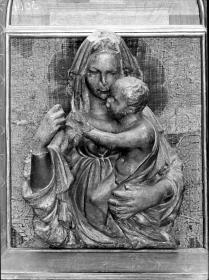
Madonna del sacco

Ident. Nr.: 140

ObjID: obj:871332

Details (expert)

Creator/Entity
Nachfolge: Donatello (um 1386-1466)
Date(s)
Datierung: Ende 15. Jahrhundert
Additional titles
Collection title: Madonna del sacco
The Virgin and Child between two Angels and Sts Francis and Anthony (known as the “Madonna del Sacco”)
Material / Technique
Stuck, gefaßt
Dimensions
Höhe x Breite x Tiefe: 63 x 60 x 7 cm (Relief)
Höhe x Breite x Tiefe: 78,5 x 81,5 x 11,2 cm (Rahmen)
Gewicht: 25,3 kg

Object Description

Maria sitzt im Profil auf einem niedrigen Polster (Sack?) und greift scherzend mit der Rechten nach dem Hals des nackten Kindes, das nach ihren Fingern greift. Die Mönche seitlich wahrscheinlich S. Franziskus und Antonius. Etwas zurück halten zwei Engel einen Vorhang empor.

English catalogue entry

Paduan artist?

Virgin and Child between two Angels and Sts Francis and Anthony
(known as the “Madonna del Sacco”)
ca. 1460

Gilt and painted stucco
60 x 59 cm
Inscription: MATER DOMINI.


Berlin, Staatliche Museen, Skulpturensammlung, Inv. SKS 140.
Bode-Museum, storage.


Provenance
Padua (?; before 1887); Venice, Guggenheim (1887); Berlin, Skulpturensammlung/Altes Museum (1887-1904); Berlin, Skulpturensammlung/Kaiser-Friedrich-Museum (1904-1939); Berlin, storage (1939-1945); Soviet Union, secret storage (1945/46-1958); East Berlin, Skulpturensammlung/Bode-Museum (1958-1990); Berlin, Skulpturensammlung/Bode-Museum (1990-present).

Acquisition
Acquired in 1880 in Venice from the dealer Guggenheim, 15,000 lire together with a Florentine Virgin and Child (Inv. SKS 93).
The acquisition file (736/80) is missing from the Zentralarchiv der Staatlichen Museen zu Berlin.

Exhibition
Schätze der Weltkultur von der Sowjetunion gerettet, East Berlin, Nationalgalerie and Pergamonmuseum, 1958, cat. D 80.

Bibliography
Cavallucci and Molinier 1884
J. Cavallucci and Émile Molinier, Les Della Robbia. Leur vie et leur œuvre d’après des documents inédits, 1884, pp. 34, 260 cat. 345: Luca della Robbia; first sketch for the bronze door of the Sacrestia delle Messe in the Florentine Cathedral; the lateral figures interfere with the clarity of the scene and the composition was abandoned.
Bode 1885
Wilhelm Bode, “Die Italienischen Skulpturen der Renaissance in den Königlichen Museen zu Berlin. V. Die Florentiner Tonbilder in den ersten Jahrzehnten des Quattrocento. Luca della Robbia”, Jahrbuch der königlich preußischen Kunstsammlungen, IV, 1885, pp. 180-181: Luca della Robbia, ca. 1450; replica from a bronze original; the blond angels are of “Aryan race”.
Bode 1887
Wilhelm Bode, Italienische Bildhauer der Renaissance. Studien zur Geschichte der italienischen Plastik und Malerei auf Grund der Bildwerke und Gemälde in den Königl. Museen zu Berlin, Berlin, W. Speemann, 1887, pp. 72-75: Luca della Robbia.
Bode and Tschudi 1888
Wilhelm Bode and Hugo von Tschudi, Königliche Museen zu Berlin. Beschreibung der Bildwerke der Christlichen Epoche, Berlin, W. Spemann, 1888, p. 37 cat. 114, pl. VI: Luca della Robbia, ca. 1450. The bronze patina means it was conceived as a decoration in this material.
Bode 1889
Wilhelm Bode, “Luca della Robbia ed i suoi precursori in Firenze”, Archivio storico dell’arte, II, 1889, p. 6: Luca della Robbia; the saints are probably Francis and Anthony; old bronze color; wooden frame is original with the work; ca. 1450; after a model for a bronze cast.
Reymond 1898
Marcel Reymond, La Sculpture florentine. Première moitié du XVe siècle, Florence, Alinari, 1898, pp. 233, 235 fig.: follower of Donatello in Padua.
Bode 1892-1905
Wilhelm Bode, Denkmäler der Renaissance-Sculptur Toscanas, Munich, Brückmann, 1892-1905, p. 76 and pl. 217b: Luca della Robbia.
Schottmüller 1913
Frida Schottmüller, Die italienischen und spanischen Bildwerke der Renaissance und des Barocks in Marmor, Ton, Holz und Stuck, Berlin, Georg Reimer, 1913, p. 39 cat. 91: Luca della Robbia.
Wulff 1917
Oskar Wulff, “Ein verkanntes Frühwerk von Luca della Robbia und des Künstlers Werdegang”, Jahrbuch der königlich Preußischen Kunstssammlungen, XXXVIII, 1917, pp. 235-236, 252: Donatello under the influence of Luca della Robbia.
Bode 1921
Wilhelm Bode, Florentiner Bildhauer der Renaissance, Berlin, Bruno Cassirer, 1921, p. 111: Donatello.
Schottmüller 1933
Frida Schottmüller, Die italienischen und spanischen Bildwerke der Renaissance und des Barock. Erster Band. Die Bildwerke in Stein, Holz, Ton und Wachs, Zweite Auflage, Berlin and Leipzig, Walter de Gruyter & Co., 1933, p. 103: Paduan, late 15th-century; Giovanni Minelli?
Middeldorf 1956
Ulrich Middeldorf, “Ein Jugendwerk des Amadeo”, in Wolfgang Braunfels (ed.), Kunstgeschichtliche Studien für Hans Kauffmann, Berlin, Mann, 1956, p. 140 note 26: Donatellesque, and perhaps Paduan.
Schätze der Weltkultur… 1958
Schätze der Weltkultur von der Sowjetunion gerettet, exh. cat. (East Berlin, National-Galerie and Pergamonmuseum, 1958), East Berlin, Staatliche Museen zu Berlin, 1958, cat. D 80: Paduan, 15th century.
Katalog der Originalabgüsse… 2000
Katalog der Originalabgüsse. Heft 6. Christliche Epochen. Spätantike. Byzanz. Italien. Freiplastik. Reliefs. Bronzestatuetten, Berlin, Staatliche Museen zu Berlin, 2000, cat. 2660: Paduan, 2nd half of the 15th century.
Rowley 2015
Neville Rowley, “À la recherche des Donatello perdus, de Florence à Berlin”, Figura, 2015 (http://figura.art.br/revista/studi-vari/studi-vari-3/4-a-la-recherche-des-donatello-perdus-de-florence-a-berlin/), fig. 10: circle of Donatello, ca. 1460.

Comment
The Virgin is seated almost on the ground and Jesus is lying on her lap, while she is supporting his head with her left hand, gently tickling him with the other hand. Both figures are protected by a cloth of honor raised by two angels; on each side stands a Franciscan saint – certainly the most reknowned ones, Francis and Anthony. Albeit darkened, the colors are vivid, enhanced by gold in many parts of the representation. The “seat” of the Virgin has been identified with a bag, hence connecting the representation to the iconographic type of the “Madonna del sacco” (i.e. the “Virgin of the bag”); the bag is a metonymy of the Flight to Egypt of the Holy Family, notably in paintings by Perugino or Andrea del Sarto. It is, however, difficult to identify the object with certainty.
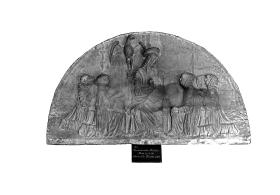
During the late 19th century, the work was covered with a bronze patina that was thought to be ancient. This is one of the reasons why the relief was identified as a model in imitation bronze made by Luca della Robbia (with the help of Michelozzo) for the doors of the Sagrestia delle Messe in the Florentine Cathedral (Cavallucci and Molinier 1884; the work was however not entirely patinated in bronze, as Bode 1885 speaks of the blond hair of the angels, while the cast in the Gipsformerei is fully colored). It is true that the triptych-like composition of the reliefs of the bronze door are not so far from our work; however, they differ in style, size and composition. The attribution to Luca della Robbia remained popular among scholars from Bode 1885 to Schottmüller 1913; but Wulff 1917 proposed an attribution to Donatello, under the influence of Luca della Robbia – and was followed by Bode 1921. One can understand this attribution, as the pose of the Virgin is indeed similar to the one of a gilt bronze tondo by Donatello preserved in the Kunsthistorisches Museum in Vienna (see Inv. SKS M 7 for a replica). The foreshortening of the body of Christ and the left hand of the Virgin are also typical of Donatello.
Some other aspects, however, are too unsatisfactory to attribute the work to Donatello himself: no anatomic consistency can be found in the Virgin’s left arm or the angels’ arms holding the curtains. Furthermore, the canopy is not covering the Virgin and Child (as should have been the intention of the artist), while the attendant saints seem too tall in such a composition. This combination of Donatellesque and more hesitant motifs raises the possibility that the work may be an assemblage of several original motifs or a copy after a lost original by Donatello (see Inv. SKS 1033 for another addition of Franciscan saints to a plaquette representing the Virgin and Child). As the two saints flanking the composition are in all likelihood Sts Francis and Anthony, and as the work allegedly comes from Padua, there is reason to believe that the relief was originally created in the cultural area of the Franciscan basilica of Sant’Antonio, where Donatello has been continuously working between 1443 and 1454. The attribution of Reymond 1898 to a Paduan follower of Donatello seems then still all the more valid.

Neville Rowley (24 February 2016)

Last updated: 29.07.2026

Contact

Institution:

Skulpturensammlung und Museum für Byzantinische Kunst

Additional items from the collections

Madonna mit Kind mit zwei Cherubinen

Madonna mit Kind mit zwei Cherubinen

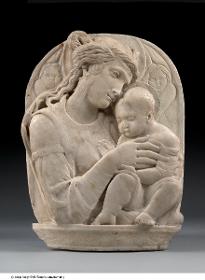
Dieses äußerst fein gearbeitete Relief wurde von einem Künstler ausgeführt, der mit Donatello eng zusammenarbeitete und die Marmordekorationen für den Hof des Medici-Palastes in Florenz ausgeführt hat. Das Relief war wahrscheinlich über der Augenhöhe angebracht: Christus schaut nach unten und segnet mit seiner rechten Hand den fiktiven Betrachter dieser Szene. Der Cherub auf der rechten Seite ist eine moderne Ergänzung.Erworben 1842This extremely refined relief was made by a close collaborator of Donatello, who was also the author of the marble courtyard decorations for the Medici Palace in Florence. The relief was probably placed above eye level: Christ is looking downward, blessing with his right hand the fictive viewer of this scene. The cherub on the right side is a modern addition.--Follower of DonatelloMadonna and Child with two Cherubsca. 1440-60Marble44 x 32.5 x 8.5 cmBerlin, Staatliche Museen, Skulpturensammlung, Inv. SKS 57.Bode-Museum, storage.ProvenanceFlorence (before 1842); Berlin, Skulpturensammlung/Altes Museum (1842-1904); Berlin, Skulpturensammlung/Kaiser-Friedrich-Museum (1904-1939); Berlin, storage (1939-1945); Merkers, storage (1945); Wiesbaden, Central Collecting Point (1945-1956); West Berlin, Skulpturensammlung/Museum Dahlem (1956-1997); Berlin, storage (1997-2006); Berlin, Skulpturensammlung/Bode-Museum (since 2006).AcquisitionBought in Florence in 1842.ExhibitionsBotticelli. Bildnis, Mythos, Andacht, Frankfurt am Main, Städel Museum, 13 November 2009-28 February 2010.From Renaissance to Rococo. Four Centuries of European Drawing, Painting and Sculpture, Tokyo, The National Museum of Western Art, 13 June-17 September 2012 and Kyushu, Kyushu National Museum, 9 October-12 December 2012, cat. 1.BibliographyTieck 1844Frédéric Tieck, Musées Royaux. Notice des sculptures antiques, Berlin, Moeser and Kühn, 1844, p. 61 cat. 688a: school of Sansovino.Kunstblatt, 1846Kunstblatt, 1846, p. 245. (reference to be checked)Bode 1884Wilhelm Bode, “Die italienischen Skulpturen der Renaissance in den Königlichen Museen zu Berlin. III”, Jahrbuch der Königlich preußischen Kunstsammlungen, V, 1884, pp. 33-34: school of Donatello; same sculptor of the Lombardi monument in the Medici chapel of Santa Croce, Florence.Bode 1887Wilhelm Bode, Italienische Bildhauer der Renaissance. Studien zur Geschichte der italienischen Plastik und Malerei auf Grund der Bildwerke und Gemälde in den Königl. Museen zu Berlin, Berlin, W. Speemann, 1887, pp. 36-38: school of Donatello.Tschudi 1887Hugo von Tschudi, Donatello e la critica moderna, Turin et al., Fratelli Bocca, 1887 (1st ed.: Rivista storica Italiana, IV, n° 2, 1887), p. 33.Bode and Tschudi 1888Wilhelm Bode and Hugo von Tschudi, Beschreibung der Bildwerke der christlichen Epoche, Berlin, W. Spemann, 1888, p. 17 cat 44, pl. IV: school of Donatello, probably a pupil from Padua; same hand of the Lombardi relief in the Medici chapel in Santa Croce, Florence; of a Virgin and Child with five Angels in the Victoria and Albert Museum, London (Inv. 7624-1861); of a relief in the Jacquemart-André collection (Inv. 1810) and in the Bardini collection (stucco); of a round plaquette in the Musée du Louvre, Paris, and in the Hainauer collection, Berlin now in the Bode-Museum, see Inv. SKS 2847.Semrau 1891Max Semrau, Donatellos Kanzeln in S. Lorenzo. Ein Beitrag zur Geschichte der italienieschen Plastik im XV. Jahrhundert, Breslau, Schottlaender, 1891, p. 87 note 2: Giovanni da Pisa.Bode 1902Wilhelm Bode, Florentiner Bildhauer der Renaissance, Berlin, Bruno Cassirer, 1902, pp. 106, 107 fig. 107: follower of Donatello, close to the Judith in the Palazzo Vecchio, Florence, and to the pulpits of San Lorenzo, Florence.Meyer 1903Alfred Gotthold Meyer, Donatello, Bielefeld and Leipzig, Delhagen and Klafing, 1903, p. 118: Donatello.Schubring 1907Paul Schubring, Donatello. Des Meisters Werke in 277 Abbildungen, Stuttgart and Leipzig, Deutsche Verlags-Anstalt, 1907, pp. 157,162: school of Donatello.Venturi 1908Adolfo Venturi, Storia dell’arte italiana. VI. La scultura del Quattrocento, Milan, Ulrico Hoepli, 1908, pp. 455, 459 fig. 301: school of Donatello.Schottmüller 1913Frida Schottmüller, Die italienischen und spanischen Bildwerke der Renaissance und des Barocks in Marmor, Ton, Holz und Stuck, Berlin, Georg Reimer, 1913, p. 17 cat. 34: a section of the background on the right has been replaced in plaster in modern time; ancient frame, but not from the same period as the relief; characteristic of the studio of Donatello ca. 1435; related to two works mentioned by Schubring 1907, pp. 162, 166.Bode 1921Wilhelm Bode, Florentiner Bildhauer der Renaissance, Berlin, Bruno Cassirer, 1921, p. 101 fig. 56: workshop of Donatello.Wulff 1922Oskar Wulff, Donatello, Leipzig, E. A. Seemann, 1922, p. 14, fig. 31: pupil of Donatello.Schottmüller 1933Frida Schottmüller, Die italienischen und spanischen Bildwerke der Renaissance und des Barock. Erster Band. Die Bildwerke in Stein, Holz, Ton und Wachs, Zweite Auflage, Berlin and Leipzig, Walter de Gruyter & Co., 1933, p. 13: workshop of Donatello, ca. 1435; after a composition by Donatello; close to a Virgin and Child in a private collection, Paris, and to the Madona del Perdono in the Museo dell’Opera metropolitana, Siena.Nicco Fasola 1956Giusta Nicco Fasola, “Bassorilievi donatelleschi nel museo Calvet”, Critica d’arte, III (new series), n° 18, 1956, p. 559 and fig. 292: workshop of Donatello.Neri Lusanna 1986Enrica Neri Lusanna in eadem and Lucia Faedo (eds.), Il museo Bardini a Firenze. Volume secondo: le sculture, Milan, Electa, 1986, p. 254: perhaps the same pupil of Donatello as the author of the Madonna dei Cordai in the Museo Bardini, Florence.Gentilini 1993Giancarlo Gentilini in Luciano Bellosi (ed.), Francesco di Giorgio e il Rinascimento a Siena 1450-1500, exh. cat. (Siena, Chiesa di Sant’Agostino, 25 April-31 July 1993), Milan, Electa, 1993, p. 177 fig. 2, p. 181: collaborator of Donatello, author of one part of the Madonna del Perdono, of the tondi of the courtyard of the Medici palace, Florence, of the Madonna Lombardi in the Medici Chapel of Santa Croce, Florence, and the Madonna and Child with Angels in the Victoria and Albert Museum (deriving from Inv. SKS M 88); possibly Andrea dell’Aquila.Jolly 1998Anna Jolly, Madonnas by Donatello and his Circle, Frankfurt am Main et al., Peter Lang, 1998, p. 156: Paduan follower of Donatello, late 15th century; motif of the base similar to the plaquette of the Madonna with Candelabra in the National Gallery of Art, Washington DC.Katalog der Originalabgüsse… 2000Katalog der Originalabgüsse. Heft 6. Christliche Epochen. Spätantike. Byzanz. Italien. Freiplastik. Reliefs. Bronzestatuetten, Berlin, Staatliche Museen zu Berlin, 2000, cat. 2655: workshop of Donatello.Eclercy 2009Bastian Eclercy in Andreas Schumacher (ed.), Botticelli. Bildnis. Mythos. Andacht, exh. cat. (Frankfurt am Main, Städel Museum, 13 November 2009-28 February 2010), Frankfurt am Main, Städel Museum, 2009, pp. 266-267 cat. 44: workshop of Donatello; the closed eyes of the Child are a premonition of his death; spatial ambiguity of the left hand and the veil of the Virgin.Weppelmann 2012Stefan Weppelmann in From Renaissance to Rococo. Four Centuries of European Drawing, Painting and Sculpture, exh. cat. (Tokyo, The National Museum of Western Art, 13 June-17 September 2012 and Kyushu, Kyushu National Museum, 9 October-12 December 2012), Tokyo, National Museum of Western Art, 2012, pp. 46-47 cat. 1: workshop of Donatello, ca. 1460.CommentThe Virgin is holding her baby by the chest, with her eyes raised to heaven – indicating her awareness of Jesus’ future death on the Cross. He is seated on his mother’s thighs; he caresses with his left hand the wrist of the Virgin, while blessing with his right hand a beholder who was probably intended to view the work from below (the lowered eyelids of the Christ Child are not a sign of sleep, as argued by Eclercy 2009). The figures are set in an ornamented base, finely carved with heads of putti and decorative, palm-trees motifs; the background is also decorated with two cherubs (the right one is a modern addition after the one on the left, which is very abraded, as is the case with the Virgin’s right hand, and Christ’s nose and legs). Jesus is wrapped in swaddling clothes, but his legs and left shoulder are left naked.The relief was bought for the Berlin Museums by Gustav Waagen in 1842. First attributed to the school of Sansovino – a most implausible judgement – it was connected to the school of Donatello by Bode 1884, an attribution that is still valid today. The relationship with the works of Donatello is indeed very strong; from the pose of the Virgin, reminiscent of a composition present in Berlin, in a terracotta and a plaquette (see Inv. SKS 56 and Inv. SKS 1028), to her complicated headdress (similar to the Virgin and Child in the Musée du Louvre, Paris, Inv. RF 353; but also to Holophernes in the Judith and Holophernes in the Palazzo Vecchio, Florence) or to the Blessing Christ (see for instance the Virgin and Child with four Cherubs in Berlin, Inv. SKS 54). However, the handling of the marble has always prevented critics from seeing an original work by Donatello, whose conception of space is always more mastered and whose handling of the faces less caricatural.The work has been most often compared to the relief known as the Madonna del Perdono, now in the Museo dell’Opera metropolitana in Siena but coming from the Sienese Cathedral: besides the composition, there are close similarities between the reliefs, such as the posture of the right arm of the Virgin, the background with cherubs or the intended view from below. If the Madonna del Perdono is accepted as an autograph work by Donatello, some parts of the relief have probably been carved by an assistant. This is why art historians have sometimes thought that this assistant may be the autor of the Berlin Madonna (see especially Gentilini 1993). Bode and Tschudi 1888 had also suggested a common paternity with a Virgin and Child in the Lombardi monument in the sacristy of Santa Croce, Florence and with a Virgin and Child with five Angels in the Victoria and Albert Museum (inv. 7624-1861). Gentilini 1993 added to this group the tondi of the courtyard of the Medici palace in Florence, and the decoration of the organ tribune of the church of San Lorenzo, Florence (oral communication); he suggested that their author might have been Andrea dell’Aquila, who was a pupil of Donatello between 1435 and 1443.Neville Rowley (18 February 2016)

Würfelkapitell mit Palmetten- und Blattornament

Würfelkapitell mit Palmetten- und Blattornament

Das Kapitell ist aus der Grundform des Würfels entwickelt und an allen vier Seiten ausgearbeitet. An den vier Schildflächen erscheinen leicht alternierende vegetabile Ornamente im flachen Relief. Es stammt aus dem Benediktinerkloster auf dem Huy, ein in fränkischer Zeit militärisch genutzter Höhenrücken im nördlichen Harzvorland. Von Beginn an stand das Kloster unter dem Schutz der Halberstädter Bischöfe, Burchard I. hatte neben der Marienkapelle auch eine Pfalz errichtet. Die Klosterchronik des 12. Jahrhunderts erwähnt die Fertigstellung des „monasteriums“ noch in der Regierungszeit Abt Alfrieds. Der Kreuzgang, der noch stehende, zweigeschossig gewölbte Bau an der Westseite des Südflügels und möglicherweise auch Gebäude östlich der Kirche können erst nach 1150 fertiggestellt worden sein. Dieser späteren Phase gehört wohl auch das Kapitell an. Im südlichen Abschnitt des Ostflügels hat es noch einen Zweistützenraum mit den bekannten Basen gegeben, in dem dieses Kapitell aufgestellt gewesen sein könnte. Die Bildhauer, die im dritten Viertel des 12. Jahrhunderts zum Ausbau der Huysburger Klausurgebäude herangezogen wurden, haben unter Verwendung des in Sachsen seit dem 11. Jahrhundert üblichen Würfelkapitells, aber auch der korinthischen Ordnung, vor allem durch die ausgeprägte Dreidimensionalität der Formen neue Maßstäbe in der Region gesetzt. Das ornamentale Kapitell ist eng mit der Bauskulptur des nördlichen Harzvorlandes verbunden und man kann davon ausgehen, dass die meisten der auf der Huysburg tätigen Bildhauer in sächsischen Werkstätten ausgebildet wurden und wohl auch an verschiedenen Baustellen der Region tätig waren.(Auszug aus: Tobias Kunz, Bildwerke nördlich der Alpen. 1050 bis 1380. Kritischer Bestandskatalog der Berliner Skulpturensammlung, Petersberg, Michael Imhof Verlag 2014)