
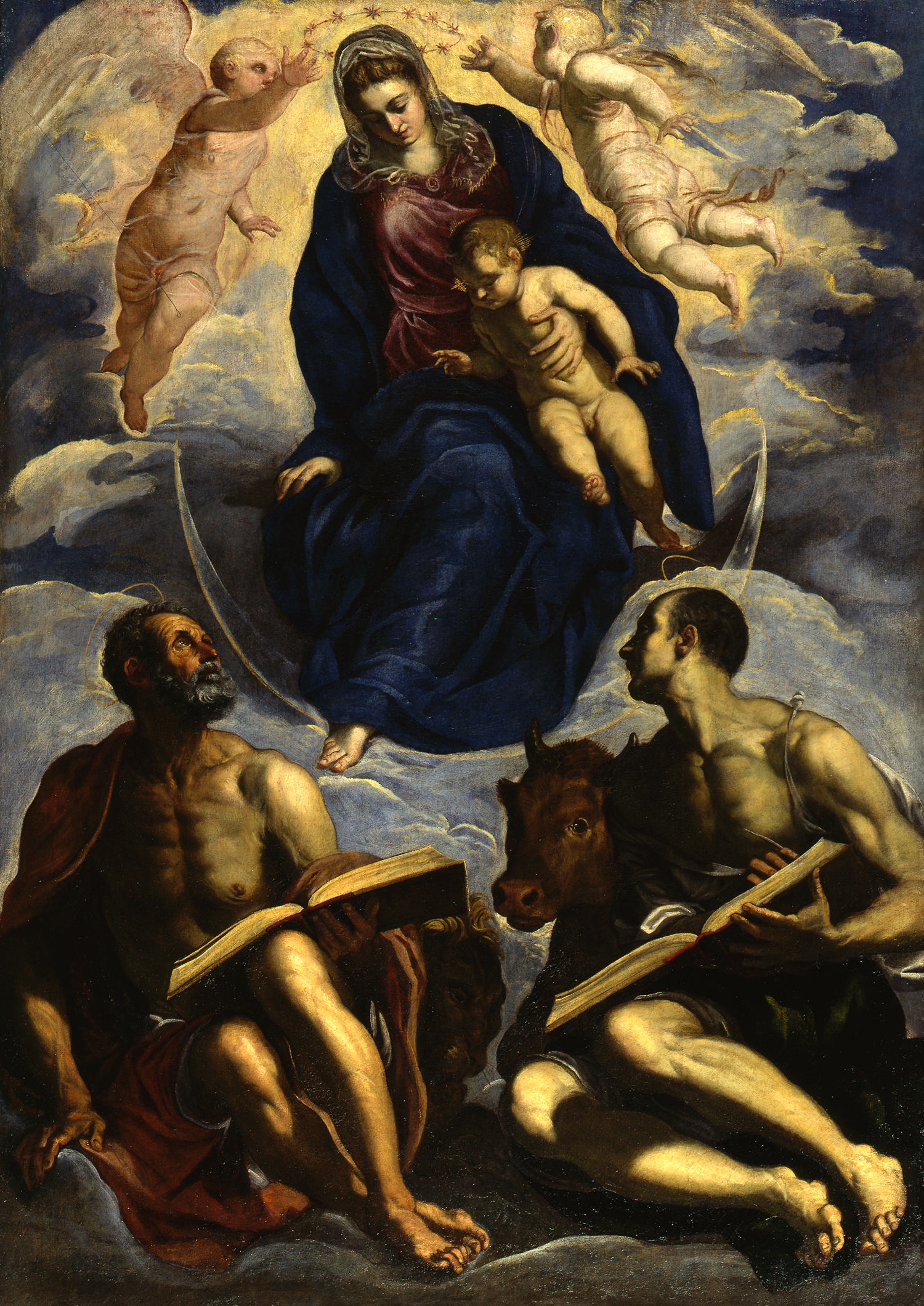
Maria mit dem Kind, von den Evangelisten Markus und Lukas verehrt
Ident. Nr.: 300
ObjID: obj:871352
Credit: Staatliche Museen zu Berlin, Gemäldegalerie / Jörg P. Anders Public Domain Mark 1.0
Details (expert)
- Creator/Entity
- Date(s)
- Ausführung: 1570/75
- Systematics/Type
- Additional titles
- Collection title: Maria mit dem Kind, von den Evangelisten Markus und Lukas verehrtTranslation: The Virgin and Child Adored by the Evangelists Sts. Mark and Luke
- Geographical references
- Material / Technique
- Leinwand
- Dimensions
- Bildmaß: 230,2 x 163,7 cm
- Acquisition
- 1841 Ankauf durch G. F. Waagen von dem Kunsthändler Francesco Pajaro, Venedig
- Permalink
- https://id.smb.museum/object/871352
Object Description
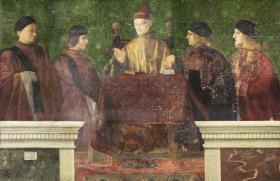
Zu den wenigen großformatigen Bildern des venezianischen Cinquecento, die kurz vor Kriegsende aus dem Flakturm Friedrichshain gerettet werden konnten, gehört Tintorettos Altarbild der Maria mit dem Kind, von den Evangelisten Markus und Lukas verehrt, das aus den Jahren 1570/75, aus der reifen Zeit Tintorettos stammt, kurz bevor er mit der Ausmalung der Sala Grande in der Scuola di San Rocco begann. Im Gegensatz zu dem anderen erhaltenen großen Bild Tintorettos in der Berliner Galerie, den drei venezianischen Stadtkämmerern (camerlenghi), Marco da Molin, Carlo Cornaro und Nicolò Zane, vor dem heiligen Markus aus dem Palazzo dei Camerlenghi in Venedig (1571), das unseres Erachtens mit Werkstattbeteiligung ausgeführt wurde, ist das Altarbild vollkommen eigenhändig gemalt. Schon mit bloßem Auge kann man die Pentimenti an den Folianten der Evangelisten und am Schulterkontur des Lukas erkennen, doch noch mehr enthüllt das Röntgenbild die kraftvoll ausfahrende Pinselschrift des Meisters. Der segnende Arm des Christkindes scheint ursprünglich weiter ausgegriffen zu haben. Rechts neben bzw. hinter Lukas scheint noch eine weitere Figur geplant gewesen zu sein. Vielleicht sollten ursprünglich alle vier Evangelisten dargestellt werden. Für welche Kapelle oder Kirche das Bild bestimmt war, wissen wir nicht. Im Gegensatz zur ausfahrenden Pinselschrift des vorbereitenden Stadiums, wie es von der Röntgenaufnahme bloßgelegt wird, fällt beim ausgeführten Bild die ungewöhnlich markante Plastizität der Formen auf, besonders die der beiden Evangelistenfiguren, die in kontrastreichem Helldunkel modelliert sind. Von der Bercken (1942) nahm an, daß die Haltung der Marienfigur von Michelangelos Madonna in der Medicikapelle in Florenz (S. Lorenzo) abgeleitet sei. Das Faltenrelief ihres blauen Mantels ist in seiner ursprünglichen Form im Zuge einer kürzlich im J. Paul Getty-Museum in Malibu vorgenommenen Reinigung unter Übermalungen wieder zum Vorschein gekommen. Auch die ursprüngliche Farbigkeit wurde zurückgewonnen. Eine quadrierte Kreidevorzeichnung für die Figur des Lukas befindet sich im Fitzwilliam Museum in Cambridge. Eine weitere quadrierte Kreidevorzeichnung für die Madonna und das Kind ist von einigen Autoren auf das Berliner Bild bezogen worden. Maria ist durch die Mondsichel und die Sternenkrone als Apokalyptisches Weib (Offenbarung Johannis 12, 1-17) und zugleich als Immaculata gekennzeichnet. Die »Unbefleckte Empfängnis Marias« fand im 16. Jahrhundert im Zuge der Gegenreformation bildliche Verbreitung in verschiedenen ikonographischen Ausprägungen, wurde aber erst im 17. Jahrhundert zu einem der Hauptthemen der Bilderwelt der katholischen Kirche. Erst nach 1600 bildeten sich verbindliche Bildtypen heraus. Die Darstellung Marias (mit Kind) mit den Attributen des Apokalyptischen Weibes bzw. der Immaculata in Kombination mit adorierenden Heiligen auf Wolken kommt bei Tintoretto mehrfach in den siebziger Jahren vor, in der Madonna mit den heiligen Cosmas und Damian in der Akademie in Venedig und in der Madonna mit der heiligen Katharina, ehemals Sammlung Chrysler, jetzt im Kunsthandel. Diese Kombination blieb jedoch im Gesamtbereich der italienischen Malerei ungewöhnlich und ohne Folgen, abgesehen von Ludovico Carraccis Scalzi-Madonna (mit den heiligen Hieronymus und Franziskus) in der Pinakothek in Bologna, die direkt von Tintorettos Berliner Bild inspiriert scheint. Erich Schleier | 200 Meisterwerke der europäischen Malerei - Gemäldegalerie Berlin, 2019
___________________________________________
Among the few large-format paintings from the Venetian Cinquecento that were successfully rescued from the flak tower in Friedrichshain just before the end of World War II was Tintoretto’s altarpiece depicting Mary with the Christ Child, Venerated by the Apostles Mark and Luke, which dates before 1570, which is to say from the later phase of Tintoretto’s career, and shortly before he began painting the Sala Grande of the Scuola di San Rocco. In contradistinction to the second surviving large-format painting by Tintoretto in Berlin, namely the Three Venetian Treasurers (camerlenghi) Marco da Molin, Carlo Cornaro and Nicolò Zane before Saint Mark, from the Palazzo dei Camerlenghi in Venice (1571), which in this author’s view was executed with workshop participation, this altarpiece is entirely from the artist’s own hand. Visible even to the naked eye are the pentimenti on the books held by the apostles and on the contour of Luke’s shoulder; even more crucial are the powerful, dynamic brushwork of the master, revealed by X-ray photographs. Originally, the Christ Child’s arm, which offers blessing, seems to have extended further. On the right-hand side, behind or alongside Luke, an additional figure seems to have been planned. Perhaps the initial intention was to depict all four Apostles. The chapel or church for which this picture was intended has not been identified. In contrast to the dynamic brushwork of the preparatory stages, as disclosed by X-ray images, the finished painting is striking by virtue of the exceptionally pronounced plasticity of the forms, in particular the two figures of Apostles, both modeled in a highly contrasting chiaroscuro. Von der Bercken (1942) believed that the pose of the figure of Mary was derived from Michelangelo’s Madonna in the Medici Chapel in Florence (San Lorenzo). In the course of a recent cleaning performed at the J. Paul Getty Museum in Malibu, later layers of paint were removed to reveal the original appearance of the drapery folds of the Virgin’s blue cloak. Restored as well was their original coloration. A square chalk drawing for the figure of Saint Luke is found in the Fitzwilliam Museum in Cambridge. A number of authors have associated another square chalk drawing, of the Madonna and Child, with the Berlin picture.
Through the crescent moon and crown of stars, Mary is identified as the Woman of the Apocalypse (Revelations 12:1–17), and at the same time as the Immaculata. In the course of the Counter Reformation of the 16th century, “Mary’s Immaculate Conception” was disseminated pictorially in various iconographic manifestations, but first developed into a principal theme of the pictorial universe of the Catholic Church in the 17th century. Only after 1600 did authoritative pictorial types evolve. During the 1570s, Tintoretto depicted Mary (with the Christ Child) with the attributes of the Woman of the Apocalypse or of the Immaculata in combination with adoring saints on clouds a number of times, in the Madonna with Saints Cosmas and Damian in the Galleria Dell’Accademia in Venice; in the Madonna with Saint Catherine, formerly in the Chrysler Collection, now on the art market. This combination nonetheless remained uncommon in Italian painting generally, with the exception of Ludovico Carracci’s Scalzi Madonna (with Saints Jerome and Francis) in the Pinacoteca Nazionale in Bologna, which seems to have been directly inspired by Tintoretto’s Berlin picture. Erich Schleier | 200 Masterpieces of European Painting - Gemäldegalerie Berlin, 2019
Last updated: 15.12.2025
Contact
Institution:
Gemäldegalerie
Email:
gg@smb.spk-berlin.de


![Ordner I Gemäldegalerie Bode-Museum Hauptgruppe II Gruppe 21 U-Gruppe 211 Gesamtinventar Inventar I 1833-1886 Inventar II 1886-1890 [= Transkription v. Inventaren I – II]](/media/images/thumbs/medium/398/006/6398416.jpg)