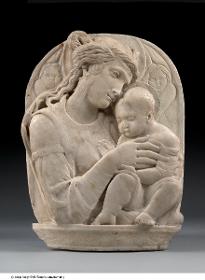

Madonna und Kind (Die Pazzi Madonna)
Ident. Nr.: 51
ObjID: obj:871363

Credit: Staatliche Museen zu Berlin, Skulpturensammlung und Museum für Byzantinische Kunst / Antje Voigt CC BY-SA 4.0
Details (expert)
- Creator/Entity
- Date(s)
- Datierung: ca. 1420
- Additional titles
- Collection title: Madonna und Kind (Die Pazzi Madonna)The Virgin and Child (the Pazzi Madonna)
- Material / Technique
- Marmor
- Dimensions
- Höhe x Breite x Tiefe: 74,5 x 73 x 6,5 cm (im Rahmen: 91 x 87 x 10 cm)
- Permalink
- https://id.smb.museum/object/871363
Object Description
(English version below)
Die Pazzi Madonna, die vermutlich aus dem Palast der Pazzi-Familie in Florenz stammt, ist eines der größten Meisterwerke von Donatello und ein Sinnbild der Bildhauerei der Frührenaissance. Sie verkörpert den Wunsch der Künstler jener Zeit, die Realität lebensecht darzustellen. Die Jungfrau und das Kind werden in Lebensgröße dargestellt, eingerahmt in eine Nische, die den Regeln der Linearperspektive folgt: Die Fluchtlinien der Nische laufen in einem einzigen Punkt zusammen. Dadurch scheinen beide Figuren in die Welt des Betrachters einzutreten. Die Beziehung der Mutter zu ihrem Kind ist ein anderer wichtiger Aspekt des Werkes: Maria legt ihre Stirn auf die des Jesuskindes, mit einer Geste, die sowohl als zart als auch als leidenschaftlich interpretiert werden kann. Eines betrübt sie: Sie weiß, dass ihr Sohn zu früh sterben wird.
The Pazzi Madonna, said to come from the palace of the Pazzi family in Florence, is one of the greatest masterpieces of Donatello and an emblem of early Renaissance sculpture. It embodies the aspiration of artists of the time at representing a convincing reality. The Virgin and Child are represented life-size and framed in a niche which follows the rules of linear perspective: the receding lines of the niche converge in one single point. As a result, both figures seem to emerge into the world of the spectator. The relationship of the mother with her child is another key aspect of the work: Mary is laying her forehead on Jesus’, in a gesture that can be read as both tender and violent. She is sad for one reason: she knows that her son will die too soon.
--
Donatello
Donato di Niccolò di Betto Bardi
Florence, ca. 1386-1466
Virgin and Child (called the Pazzi Madonna)
ca. 1420
Marble
91 x 87 x 10 cm
The frame is not original.
Berlin, Staatliche Museen, Skulpturensammlung, Inv. SKS 51.
Bode-Museum, on view.
Provenance
Florence, Pazzi Palace, courtyard (?); Florence, Raffaello Lamponi Leopardi (1886); Florence, Stefano Bardini (1886); Berlin, Skulpturensammlung/Altes Museum (1886-1904); Berlin, Skulpturensammlung/Kaiser-Friedrich-Museum (1904-39); Berlin, storage (1939-45); Merkers, storage (1945); Wiesbaden, Central Collecting Point (1945-56); West Berlin, Skulpturensammlung/Museum Dahlem (1956-97); Berlin, storage (1997-2006); Berlin, Skulpturensammlung/Bode-Museum (since 2006).
Acquisition
Bought from the dealer Stefano Bardini in 1886; the inventory book of the Bode-Museum mentions the price as 20,000 Mark.
The acquisition file of the Berlin Museum (1202/86) is missing from the Zentralarchiv der Staatlichen Museen zu Berlin.
The acquisition file is still preserved in the Bardini Archive, Florence: Polo Museale fiorentino, Archivio Stefano Bardini, CORR.I.B.1: bill of the 14 February 1886 (“1 Madonna di Casa Pazzi dal Donatello Lire 25.000”).
Restorations
1967; 1979; 2009.
Exhibitions
John Flaxman and the Renaissance. A Master of Neo-Classicism in Dialogue with Masaccio and Donatello, Berlin, Bode-Museum, 9 April-12 July 2009, cat. 10.
La primavera del Rinascimento. La scultura e le arti a Firenze 1400-1460, Florence, Palazzo Strozzi, 23 March-18 August 2013, cat. VIII. 5 / Le Printemps de la Renaissance. La sculpture et les arts à Florence 1400-1460, Paris, Musée du Louvre, 26 September 2013-6 January 2014, cat. VIII. 5.
Other versions
• Amsterdam, Rijksmuseum, Inv. NM 11935. Painted stucco, diameter: 70 cm, framed in the style of the Della Robbia.
• Bologna, Chiesa della Certosa. Stucco.
• Budapest, Szépmüvészeti Múzeum.
• Cambridge (Mass.), Fogg Art Museum.
• Castrocaro Terme, chiesa dei Santi Niccolò e Francesco.
• Dovadola, private collection. 71 x 52 x 4 cm.
• Florence, Conservatorio delle Signore Montalve alla Quiete.
• Florence, Convento della Calza.
• London, Victoria and Albert Museum, Inv. A.51-1935. Painted stucco, 50.8 x 37.5 cm.
• New York, The Metropolitan Museum of Art, Inv. 22.16.3. Stucco and colored glass, 114.3 x 71.1 cm. From the collection of James Stillman, gift of Dr. Ernest G. Stillman, 1922.
• Paris, Musée du Louvre, Inv. RF 744. Painted and gilt stucco, 75 x 54.5 cm.
• Prague, National Gallery, Inv. P379. Painted stucco, 76 x 71 cm.
• Strasbourg, Musée des Beaux-Arts. Stucco.
• Formerly Berlin, Adolf von Beckerath. His sale, 1916, lot 68.
• Formerly New York, Sotheby’s (sale 26 January 2012, lot. 328: http://www.sothebys.com/en/auctions/ecatalogue/2012/important-old-master-paintings-n08825/lot.328.html). Painted and gilt stucco. Height: 118.7 cm. Provenance: Stefano Bardini, Florence; Catalina von Pannwitz, Berlin; and Amsterdam, acquired from the above in 1913.
• Formerly Paris, Christie’s (sale 23 June 2014, lot 42). Painted and gilt stucco. Height: 73 cm (without frame: 64.5 cm). Provenance: Florence, Palazzo Davanzati (sale New York 1916, lot. 706 as by Donatello); William Boyce Thompson, Yonkers, New York; sale New York, Christie’s, 11 January 1994, lot 12.
Comment
Known since its acquisition by the Berlin Museums in 1886 as the Pazzi Madonna, this work has almost always been celebrated as one of the greatest masterpieces by Donatello. In his standard monograph on Donatello, Janson 1957 excluded from the artist’s oeuvre almost all the representations of the Virgin and Child that had been attributed to him in the past except for this one and two other. Famous as it is, the work has not been the subject of an in-depth exegesis: the composition is indeed very simple, with the Virgin holding her child in her arms, and touching his forehead with her own face – to the point that the profile of her nose covers his. This gesture primarily explains the success of such a work, multiplied in a number of copies and variants. The artist underlines the mixed feelings that the Virgin Mary was thought to have had: tenderness towards her son and sadness about his sacrifice to come. Unlike many Madonnas by Donatello, the general composition is statuesque and not dynamic, an impression conferred by the drapery of the Virgin’s mantle as well as by the Child’s pose. Held by the two hands of the Virgin, Jesus grasps his mother’s veil and puts his left foot on the edge of the niche.
The quality and coherence of the relief with the style of Donatello makes the attribution certain and has almost invariably been accepted as such in the art historical literature. Only Goldscheider 1947 labelled as by the “School of Donatello”, which is contradicted by the highest quality of the relief and its similarities with documented works by Donatello; while Strom 1982 argued for a 16th-century copy after a lost original by Donatello, partly followed by Bennett and Wilkins 1984, p. 229 note 30; the argumentation of Strom – based on the absence of haloes and on the supposed oversize – can be invalidated by many examples, such as the Orlandini Madonna in the Berlin Museums (see Inv. SKS 55).
The figures are set in a niche constructed according to the laws of central perspective (correctly calculated for the upper and lateral sides), which adds much to the spatial perception of the relief. As the work is generally dated ca. 1420, this niche has often been interpreted as a sign of modernity: linear perspective was invented in Florence around 1415 by Filippo Brunelleschi, and Donatello made his first use of the technique in 1417, in the predella of the St George niche carved for the church of Orsanmichele. The patron of the Pazzi Madonna must have been interested in “modern” art, i.e. the revival of Antiquity that was fascinating the Florentine artists of the early 15th century. The monochrome marble used for the relief (differing, in this period, from the more frequent use of color in sculpture) is another hint in this direction (see Motture 2004; for the fact that Donatello possibly played on the natural color of the marble block, see Fehrenbach 2011). Significantly, of the many preserved derivations from the Pazzi Madonna, the majority were used for popular devotion and suppressed the perspective niche while adding naturalistic colors.
The strong foreshortening of the niche is a probable sign that the work was placed in an elevated position on a wall (Bode 1886; Pope-Hennessy 1976 ed. 1980 has especially investigated the best point of vision for the photographer; see also Munman 1985). Rosenauer 1993 suggested an original provenance from a street tabernacle; this seems rather unlikely as the marble surface is very little abraded, even though the marble slab has been broken in some ten pieces (Lista 2003 asserted that the Madonna was broken in 14 pieces during its transfer to Berlin in 1886, thus creating a scandal in Italy; I have not found indications in that sense, either in the following correspondence between Bardini and Bode or in the contemporary press).
Cavallucci 1886 was the first to publish the relief, which was said to be in possession of Count Lamponi Leopardi and to come from the garden of the Pazzi Palace, which was partly destroyed during the 1870s to make way for the building of the Poste Italiane. Cavallucci connected this alleged provenance with a 1677 edition of a Florentine guide, where one can read the following description:
Casa di Francesco Pazzi nella quale è una bellissima Vergine di Basso rilievo in marmo di mano di Donatello: è il bambino Giesù a sedere sopra un Guanciale, e con la destra la Vergine il sostiene mentr’egli con la sinistra alzata regge i lembi del velo che dal capo della Madonna pendono; E’ vaga in ogni sua parte, ed i panneggiamenti sono bellissimi, esprime la Vergine l’affetto verso il figliuolo, con grande arte, ed è tale, che nelle divise seguite tra Pazzino, la prese Alessandro Padre di Francesco per sc. 500. Secondo la stima che ne fu fatta.
(In the house of Francesco Pazzi there is a beautiful marble Madonna in low relief by Donatello; the Christ Child, seated upon a cushion, is supported by the Virgin’s right hand, while he, with his raised left hand, holds the veil that hangs from her head. It is charming in every part, the draperies are most beautiful, and the Virgin’s tenderness toward her son is expressed with great art and is such, that in the following succession, Alessandro, the father of Francesco, bought it for 500 scudi according to the valuation that was made.)
Francesco Bocchi, Le bellezze della città di Firenze, Giovanni Chellini ed., Florence, Gugliantini, 1677, pp. 369-370.
Since Schmarsow 1889, however, many art historians have challenged the identification of the described work with the present relief, as the text explicitly mentions that the Child is seated upon a cushion and is supported by the Virgin’s right hand. Even if there exists a possibility that the work comes from the Pazzi Palace (as Cinelli may well have had lapses of memory; or as they could have been more than one Madonna by Donatello in the Pazzi Palace, see Schottmüller 1933), this provenance must remain hypothetical until new evidence is found. The other suggested provenances have remained inconclusive: from the Medici palace for Bertaux 1910 and Colasanti 1931; from Antonio de’ Nobili or Lelio Torelli for Janson 1957, based on descriptions by Giorgio Vasari. The name of the Pazzi Madonna has become too famous to be changed (see Avery 1986, who proposed to call the relief the Berlin Dahlem Madonna – a denomination that became obsolete after the Fall of the Berlin Wall and the reintegration of the relief on the Museums Island).
The work has been connected with 14th-century sources (such as the Maestà in the Museo di arte sacra in Massa Maritima by Ambrogio Lorenzetti, as suggested by Rosenauer 1993; but see also Kauffmann 1935) or even with Attic steles dating from the 4th and 5th century B.C. (Rosenauer 1993). However “Greek” her profile may appear at first sight, the Pazzi Madonna has no direct precedent (the right foot of the Christ, leaving the sole visible, is a motif of Byzantine origin).
Bode 1886 proposed to date the relief around 1420, an opinion that has been widely followed by the critics. The relative weakness of the foreshortening of the left hand of the Virgin (first pointed out by Schottmüller 1904) has always been seen as a mark of youth. This hand has been compared to the one of the Blessing God, carved ca. 1417 by Donatello on top of the St George niche in Orsanmichele (Lányi 1935; Kauffmann 1935); to the hand of the Sibyl documented in 1422 for the decoration of the Porta della Mandorla outside the Florentine Cathedral (Buscaroli 1942); and to the left hand of Herod in the bronze relief made by Donatello for the baptistery font in Siena between 1423 and 1427 (Pope-Hennessy 1996). Comparisons have also been made with a plaquette by Donatello where the Virgin is equally seen in profile (Pope-Hennessy 1964, ed. 1980; on this typology, see Inv. SKS 1028). One may add to these comparisons the forshortened hand of the Bishop in one of the reliefs of the Fondazione Romano in Florence, whose attribution to Donatello is not universally accepted. The dating of the work varies according to these comparisons, even if the more widely accepted is ca. 1422 (together with the Sibyl). The profile of Isaac in the group of Abraham and Isaac made in 1421 for the Campanile of the Florentine Cathedral (and now in the Museo dell’Opera del Duomo) makes it more reasonable to keep the dating of ca. 1420.
Besides the Orlandini Madonna in the Berlin Museums, possibly made by Michelozzo ca. 1426 (see Inv. SKS 55), an early reflection of the Pazzi Madonna can be found in a relief by Jacopo della Quercia: the Flight to Egypt carved between 1425 and 1434 for the façade of the San Petronio Cathedral, in Bologna (Jacopo della Quercia… 1975). Two images of the Virgin and Child in the Museo Nazionale del Bargello, Florence, the Madonna della Gherardesca and the Goretti Miniati Madonna, are also early echoes from the relief (see Natali 1980; and Gentilini 1985).
The work has also impressed many Florentine painters: the foreshortening of the left hand of the Virgin seems to have been in the mind of Masaccio when he drew the right hand of St Jerome in a panel with the Sts Jerome and John the Baptist now in the National Gallery, London (painted for Santa Maria Maggiore in Rome, ca. 1428; for other references to Masaccio, see Janson 1957; and Berti 1966). Pope-Hennessy 1993 compared the foreshortening of the niche to the one of the Carnesecchi Tabernacle (also in the National Gallery, London) painted by Domenico Veneziano ca. 1435, while Christiansen 2004 more accurately related it to the trompe-l’oeil frame of some paintings of the 1440s, such as Filippo Lippi’s Double portrait at the Metropolitan Museum, New York. Even if undirect, these echoes suggest that, even if the work may not have been originally in the Pazzi Palace, it was easily accessible by Florentine artists, not simply through casts (Strehlke 2004): only a masterpiece could have prompted such an artistic answer.
Literature
Wilhelm Bode, “Neue Erwerbungen für die Abteilung der christlichen Plastik in den königlichen Museen”, Jahrbuch der Königlich preußischen Kunstsammlungen, VII, 1886, pp. 203-206: Donatello, ca. 1420, made for the Pazzi family. Other works made for the Pazzi: a fountain in the Museo Nazionale del Bargello and the decoration of the Pazzi Chapel in Santa Croce, Florence. Details the acquisition and negotiation of the piece; the relief was probably made to be placed above a door. Compared to the Orlandini Madonna (Inv. SKS 55), which is attributed to a pupil of Donatello.
C. J. Cavallucci, Vita ed opere di Donatello, Naples, Milan and Pisa, Ulrico Hoepli, 1886, pp. 32-33: Donatello, early work close to the Cavalcanti Annunciation in Santa Croce, Florence. Engraved reproduction made after a photograph. Said to come from the garden of the Pazzi Palace (where it was mentioned in the 1677 edition of Le bellezze della città di Fiorenza, written by Francesco Bocchi and revised by Giovanni Cinelli), before the palace was destroyed to build the National Bank. Belongs to Count Lamponi Leopardi.
Wilhelm Bode, Italienische Bildhauer der Renaissance. Studien zur Geschichte der italienischen Plastik und Malerei auf Grund der Bildwerke und Gemälde in den Königl. Museen zu Berlin, Berlin, W. Speemann, 1887, pp. 16, 47-48.
Hans Semper, Donatellos Leben und Werke, Innsbruck, Wagnerischen Universitäts-Buchhandlung, 1887, p. 61: Donatello; described as in sandstone; Count Lamponi-Leopardi is mentioned as the previous owner.
Gaetano Milanesi, Catalogo delle opere di Donatello e bibliografia degli autori che ne hanno scritto, Firenze, Arte della Stampa, 1887, p. 64.
Hugo von Tschudi, Donatello e la critica moderna, Turin et al., Fratelli Bocca, 1887 (1st ed.: Rivista storica Italiana, IV, n° 2, 1887), p. 33: Donatello, before or ca. 1430.
Wilhelm Bode and Hugo von Tschudi, Königliche Museen zu Berlin. Beschreibung der Bildwerke der Christlichen Epoche, Berlin, W. Spemann, 1888, pp. 15-16 cat. 39, pl. X.
August Schmarsow, review of Bode and Tschudi 1888, Repertorium für Kunstwissenschaft, XII, 1889, p. 206: does not correspond to the description of Bocchi-Cinelli.
Wilhelm Bode, Denkmäler der Renaissance-Sculptur Toscanas, Munich, F. Bruckmann, 1894, II, pl. 68: Donatello.
Giovanni Mini, La Romagna Toscana. Notizie geografiche storiche industriali e commerciali, Castrocaro, Barboni, 1901, reprint 1978, p. 55: presents the version of Castrocaro Terme.
Wilhelm Bode, Florentiner Bildhauer der Renaissance, Berlin, Bruno Cassirer, 1902, pp. 19, 98-100.
Lord Balcarres, Donatello, London and New York, Duckworth & Co. and Charles Scribner’s Sons, 1903, p. 181: Donatello.
Alfred Gotthold Meyer, Donatello, Bielefeld and Leipzig, Delhagen and Klafing, 1903, pp. 60, 115.
Paul Schubring, Urbano da Cortona. Ein Beitrag zur Kenntnis der Schule Donatellos und der Sieneser Plastik im Quattrocento, Strasburg, Heitz, 1903, pp. 70, 89.
Frida Schottmüller, Donatello. Ein Beitrag zum Verständnis seiner künstlerischen Tat, Munich, Bruckmann, 1904, pp. 25, 36 note 3, 37 note 2, pp. 39, 99-100, 129: Donatello, early 1420s, youthful awkwardness of the left hand.
Paul Schubring, “Italienische Plastik”, Zeitschrift für bildende Kunst, new series, XVI, 1905, p. 56.
Paul Schubring, Donatello. Des Meisters Werke in 277 Abbildungen, Stuttgart and Leipzig, Deutsche Verlags-Anstalt, 1907, pp. 83, 198.
Wilhelm Bode, “Ein Blick in Donatellos Werkstatt”, Monatshefte für Kunstwissenschaft, I, n° 1-2, January-February 1908, pp. 4, 10.
Osvald Sirén, Florentinsk Renässansskultur och andra Konsthistoriska ämnen, Stockholm, Wahlström & Widstrand, 1909, p. 55.
Émile Bertaux, Donatello, Paris, Plon, 1910, p. 93: Donatello, ca. 1427; may be identified with the small marble panel by Donatello showing the Virgin with the Child in her arms in the inventory of Palazzo Medici written in 1492.
Michele Biancale, “Falsi attribuzioni donatelliane”, Acropoli, I, 4, April 1911, p. 375: Donatello, imperfect in the foreshortening of the left hand so to be dated early, ca. 1417; p. 382.
Maud Cruttwell, Donatello, London, Methuen, 1911, p. 134: Donatello, comes from the Pazzi Palace.
Adolfo Venturi, Storia dell’arte italiana. VI. La scultura del Quattrocento, Milan, Hoepli, 1911, pp. 266-267.
Frida Schottmüller, Die italienischen und spanischen Bildwerke der Renaissance und des Barocks in Marmor, Ton, Holz und Stuck, Berlin, Georg Reimer, 1913, p. 15 cat. 30: Donatello, ca. 1423; frame not contemporary with the sculpture; wrongly identified by Cavallucci 1886 with a relief mentioned in the Pazzi Palace by Bocchi-Cinelli; mentions other versions in the Musée du Louvre, Paris; the Victoria and Albert Museum, London; the Rijksmuseum, Amsterdam; the Beckerath collection, Berlin; the Davanzati Palace, Florence.
Georges Lafenestre, Paul Durrieu, André Michel and Léon Deshairs, Le Musée Jacquemart-André, Paris, Gazette des Beaux-Arts and Librairie G. van Oest, 1914, p. 88: about a stucco replica in the Musée Jacquemart-André, Paris.
Nachlass Adolf von Beckerath Berlin, sale cat. (Berlin, Rudolph Lepke, 23-26 May 1916), Berlin, Rudolph Lepke, 1916, p. 11 lot 68, pl. 14a: compared to the replica in the Beckerath sale.
Paul Schubring, Die Italienische Plastik des Quattrocento, Berlin, Akademische Verlagsgesellschaft Athenaion, 1919, p. 63 fig. 59.
Wilhelm Bode, Florentiner Bildhauer der Renaissance, Berlin, Bruno Cassirer, 1921, pp. 94, 95 fig. 50: Donatello.
Wilhelm Bode, Die Italienische Plastik, 7th ed., Berlin and Leipzig, Vereinigung wissenschaftlicher Verleger and De Gruyter, 1922, p. 70 fig. 33.
Oskar Wulff, Donatello, Leipzig, E. A. Seemann, 1922, p. 6-7, fig. 11: Donatello, ca. 1425.
Max Deri, Das Bildwerk, Berlin, Deutsche Buch-Gemeinschaft, 1926, pp. 104-113: the Pazzi Madonna is by Donatello and the Orlandini Madonna (Inv. SKS 55) by a follower of the artist.
Wilhelm von Bode, Mein Leben, Berlin, Reckendorf, 1930 then in: Thomas W. Gaehtgens and Barbara Paul eds., Berlin, Nicolai, 1997, I, p. 229, fig. 83; II, p. 213: said to have been bought in 1887.
William Ormsby Gore, Florentine Sculptors of the Fifteenth Century, London, MacMillan, 1930, p. 140: Donatello.
Arduino Colasanti, Donatello, French trans., Paris, Crès, 1931, pp. 88-89, pl. CCXXX: Donatello 1525-30 sic, probably a Medici provenance.
Francesco Malaguzzi Valeri, “Sculture del Rinascimento a Bologna”, Dedalo, III, 1932-33, p. 360: mentions as possibly by Donatello a version in the church of the Certosa, Bologna.
Frida Schottmüller, “Ein Jugendwerk Donatellos im Kaiser-Friedrich-Museum”, Zeitschrift für Kunstgeschichte, I, 1932-33, p. 339.
E. F. Bange, Italienische Skulpturen im Kaiser Friedrich Museum, Berlin, Staatliche Museen in Berlin, 1933, pl. 20.
Frida Schottmüller, Die italienischen und spanischen Bildwerke der Renaissance und des Barock. Erster Band. Die Bildwerke in Stein, Holz, Ton und Wachs, Zweite Auflage, Berlin and Leipzig, Walter de Gruyter & Co., 1933, p. 7: Donatello, ca. 1425; said to come from the Pazzi Palace, but not to be the Madonna described by Bocchi-Cinelli.
E. F. Bange, Die Italienischen Bildwerke im Kaiser-Friedrich-Museum, Berlin, Verlag für Kunstwissenschaft, 1934, p. 22.
Hans Kauffmann, Donatello. Eine Einführung in sein Bilden und Denken, Berlin, Grotesche Verlagsbuchandlung, 1935, pp. 67-68, 70, 83, 157, 215, 218 notes 203-207: Donatello, ca. 1418; the dating is based on the proximity with the relief of God the Father topping the St George Tabernacle outside the church of Orsanmichele, Florence; relates the work to a 14th-century Virgin and Child in the Pinacoteca, Lucca (Inv. 160).
Jenö Lányi, “Tre rilievi inediti di Donatello”, L’Arte, XXXVII, 1935, p. 292: immediate link with the God the Father carved above the St George Tabernacle in Orsanmichele, Florence.
Leo Planiscig, Donatello, Vienna, Anton Schroll, 1939, pp. 16, 37 fig. 33: Donatello, ca. 1430; close to the Christ Giving the Keys to St Peter in the Victoria and Albert Museum, and the Assumption of the Virgin on the tomb of Rinaldo Brancacci in Sant’Angelo a Nilo, Naples.
Rezio Buscaroli, L’arte di Donatello, Florence, Monsalvato, 1942, p. 146 cat. 63, p. 180, pl. XXXIII: Donatello; close to the Sibyl of the Porta della Mandorla outside the Florentine Cathedral.
Leo Planiscig, Desiderio da Settignano, Vienna, Anton Schroll, 1942, p. 14.
Harold E. Wethey, “The Early Works of Bartolomé Ordóñez and Diego de Siloe”, The Art Bulletin, XXV, 1943, p. 325: influence from the Pazzi Madonna in the Charity carved by Diego de Siloe for the Tomb of Luis de Acuña in the Cathedral of Burgos.
L. Goldscheider, Donatello, Paris, Phaidon, 1947, p. 39 fig. 106: school of Donatello.
Leo Planiscig, Donatello, Florence, Arnaud Editore, 1947, pp. 40-41: does not come from the Pazzi Palace.
H. W. Janson, “The Hildburgh Relief: Original or Copy?”, The Art Bulletin, XXX, 1948, p. 144.
Giuseppe Galassi, La scultura fiorentina del Quattrocento, Milan, Ulrico Hoepli, 1949, p. 104 and pl. 135: Donatello, ca. 1420-24. Formerly in Berlin.
“Editorial. Italian Sculpture in the Berlin Museums: Losses and Survivals”, The Burlington Magazine, XCVI, n° 612, March 1954, p. 69: thought to have been destroyed during WWII, until an exhibition in Wiesbaden during the summer of 1953 showed it had survived.
H. W. Janson, The Sculpture of Donatello, Princeton, Princeton University Press, 1957, II, pp. 32, 44-45: Donatello, ca. 1422; no certainty about the provenance of the relief, as Bode declares to have studied it shortly before buying it, two decades after the destruction of the Pazzi Palace; identification with the description of Bocchi-Cinelli rejected; probably the work mentioned by Vasari in the house of Antonio de’ Nobili, “a marble panel by Donatello showing a half-length figure of the Madonna in low relief”, or the one owned by Lelio Torelli “a marble panel of the Madonna by Donatello”; very Masacciesque in drapery and expression; close to the Prophet and Sibyl carved in 1422 for the Porta della Mandorla outside the Florentine Cathedral.
Peter Metz, Europäische Bildwerke von der Spätantike bis zum Rokoko aus den Beständen der Skulpturen-Abteilung der Ehem. Staatliche Museen Berlin-Dahlem, exh. cat. (Essen, Villa Hügel, 4 June-31 September 1957), Munich, Prestel, n. d. post 1958, p. 49 cat. 236, pl. 37.
Luigi Grassi (ed.), Tutta la scultura di Donatello, Milan, Rizzoli, 1958, p. 64: Donatello, ca. 1422, uncertain provenance from the Pazzi Palace; derives from a motif by the Lorenzetti brothers.
John Pope-Hennessy, Italian Renaissance Sculpture, London, Phaidon Press, 1958, pp. 22, 279 and pl. 19: Donatello; does not correspond to the description of Bocchi-Cinelli.
Giorgio Castelfranco, Donatello, Milan, Aldo Martello, 1963, p. 38: Donatello; dating 1422 in comparison with the Sibyl for the Porta della Mandorla outside the Florentine Cathedral.
John Pope-Hennessy, “The Italian Plaquette”, Proceedings of the British Academy, I, 1964 now in: idem, The Study and Criticism of Italian Sculpture, New York and Princeton, The Metropolitan Museum of Art and Princeton University Press, 1980, p. 194: comparison with a plaquette type (see Inv. SKS 1028).
Peter Metz, “Das neue Skulpturenmuseum in Dahlem”, Jahrbuch der Stiftung preußischer Kulturbesitz, III, 1964-65, p. 110.
Luciano Berti, “Donatello e Masaccio”, Antichità viva, V, 3, 1966, p. 12: close to the St Giovenale in Masaccio’s Triptych in Cascia di Regello, dated 1422; the motif of the veil of the Virgin will be reused for the Virgin in the S. Anna Metterza Altarpiece by Masolino and Masaccio in the Galleria degli Uffizi, Florence.
Peter Metz, Bildwerke der christlichen Epochen von der Spätantike bis zum Klassizismus aus den Beständen der Skulpturenabteilung der Staatliche Museen, Stiftung Preußischer Kulturbesitz, Berlin-Dahlem, Munich, Prestel, 1966, p. 89 cat. 496, pl. 75.
Charles Avery, Florentine Renaissance Sculpture, London, John Murray, 1970, pp. 87, 109, 111, 186 fig. 64: Donatello, ca. 1420.
Carlo Del Bravo, Scultura senese del Quattrocento, Florence, Edam, 1970, p. 41: Jacopo della Quercia cites the Pazzi Madonna in the background of the Martyr of St Ursula relief in the predella of the Trenta Altar in San Frediano, Lucca.
James H. Beck, “Masaccio’s Early Career as a Sculptor”, The Art Bulletin, LIII, n° 2, June 1971, pp. 178, 181 fig. 4: Masaccio’s St Giovenale Triptych is based on the Pazzi Madonna.
John Pope-Hennessy, Italian Renaissance Sculpture, 2nd edition, London, Phaidon Press, 1971, pp. 19, 258, pl. 18.
Jacopo della Quercia nell’arte del suo tempo. Mostra didattica, exh. cat. (Siena, Palazzo Pubblico, 24 May-12 October 1975), Florence, Centro Di, 1975, p. 246: compared to Jacopo della Quercia’s Flight to Egypt on the façade of St Petronio, Bologna.
Artur Rosenauer, Studien zum frühen Donatello. Skulptur im projektiven Raum der Neuzeit, Vienna, Adolf Holzhausen, 1975, p. 132.
John Pope-Hennessy, “The Madonna Reliefs of Donatello”, Apollo, CIII, n° 169, March 1976 now in: idem, The Study and Criticism of Italian Sculpture, New York and Princeton, The Metropolitan Museum of Art and Princeton University Press, 1980, pp. 72-74, 102-103 note 4: Donatello, ca. 1430; linked with the Sibyl of the Porta della Mandorla outside the Florentine Cathedral; discusses the original and photographic vantage point; does not exclude a provenance from the Pazzi Palace, saying that the Virgin bears the Child in her right hand.
Jane Schuyler, Florentine Busts: Sculpted Portraiture in the Fifteenth Century, Ph. D. (New York, Columbia University, 1972), New York and London, Garland, 1976, p. 22: close to the frescoes of Domenico di Bartolo in the hospital of Santa Maria della Scala in Siena.
Mária G. Aggházy, Italian and Spanish Sculpture, Budapest, Kossuth Printing House, 1977, p. 19: Donatello, 1420-22; related to Michelozzo’s Virgin and Child in the Szépmüvészeti Múzeum, Budapest (Inv. 1170).
John Pope-Hennessy, “The Evangelist Roundels in the Pazzi Chapel”, Apollo, CVI, n° 188, October 1977 now in: idem, The Study and Criticism of Italian Sculpture, New York and Princeton, The Metropolitan Museum of Art and Princeton University Press, 1980, p. 113.
Peter Bloch in Belser Kunstbibliothek. Die Meisterwerke aus der Skulpturengalerie Berlin Staatliche Museen Preussischer Kulturbesitz, Stuttgart and Zurich, Belser Verlag, 1980, pp. 64-65: Donatello, ca. 1420.
Antonio Natali in La civiltà del cotto. Arte della terracotta nell’area fiorentina dal XV al XX secolo, exh. cat. (Impruneta, May-October 1980), Florence, Officine Grafiche Firenze, 1980, p. 92: compared to the Madonna della Gherardesca in the Museo Nazionale del Bargello, Florence (Inv. Sculture 480).
Joachim Poeschke, Donatello. Figur und Quadro, Munich, Wilhelm Fink, 1980, pp. 39-40, pl. XXII fig. 33.
Seven Centuries of European Sculpture, exh. cat. (London, Heim Gallery, 9 June-27 August 1982), London, Heim Gallery, 1982, n. p.: compared to a relief by Bartolomeo Bellano (close to Inv. SKS 1992).
Deborah Strom, “Desiderio and the Madonna Relief in Quattrocento Florence”, Pantheon, XL, n° 2, April-June 1982, p. 134: genuineness suspect as the figures have no haloes; the size is similar to the works by Jacopo Sansovino dating from the 16th century; the left hand of the Virgin is “clumsy and inorganic”. “The Pazzi Madonna in Berlin, then, is probably a sixteenth century version of a famous Donatello invention.”
Bonnie A. Bennett and David G. Wilkins, Donatello, Oxford, Phaidon, 1984, pp. 49, 155: compared to the low viewpoint of the Chellini Madonna in the Victoria and Albert Museum, London, and of the Madonna del Perdono in the Museo dell’Opera metropolitana, Siena; p. 229 note 30: do not entirely reject the dating of Strom 1982 in the 16th century.
Hannelore Sachs, Donatello, East Berlin, Henschelverlag, 1984, cat. 6: Donatello, compared to the Virgin and Child with four Cherubs (Inv. SKS 54) and the Orlandini Madonna (Inv. SKS 55).
Giancarlo Gentilini in Paola Barocchi et al. (eds.), Omaggio a Donatello. 1386-1986. Donatello e la storia del Museo, exh. cat. (Florence, Museo Nazionale del Bargello, 19 December 1985-30 May 1986), Florence, SPES, 1985, p. 267: influenced the Madonna della Gherardesca in the Museo Nazionale del Bargello, Florence; p. 272: influenced the Madonna Goretti Miniati also in the Bargello; p. 431: relationship with the plaquette Madonna in a shell niche (see Inv. SKS 3044).
Robert Munman, Optical Corrections in the Sculpture of Donatello, Philadelphia, The American Philosophical Society, 1985, pp. 40-41 note 111: cites Pope-Hennessy 1976 ed. 1980 about the vantage point of this work.
Charles Avery, “Donatello’s Madonnas Reconsidered”, Apollo, new series, CXXIV, n° 295, September 1986, pp. 176, 182 note 7: Donatello, ca. 1422, not in the Pazzi Palace because the Bocchi-Cinelli description mentions a cushion (guanciale); proposes to call the work the “Berlin-Dahlem Madonna”.
Luciano Bellosi in Alan Phipps Darr and Giorgio Bonsanti (eds.), Donatello e i suoi, exh. cat. (Florence, Forte del Belvedere, 15 June-7 September 1986), Detroit and Florence, The Detroit Institute of Arts, La Casa Usher and Arnaldo Mondadori Editore, 1986, p. 147: the Mellon Madonna in the National Gallery of Art, Washington DC has a similar profile.
Luciano Berti in Alan Phipps Darr and Giorgio Bonsanti (eds.), Donatello e i suoi, exh. cat. (Florence, Forte del Belvedere, 15 June-7 September 1986), Detroit and Florence, The Detroit Institute of Arts, La Casa Usher and Arnaldo Mondadori Editore, 1986, p. 181 fig. 63: mentions the version of the Conservatorio delle Signore Montalve alla Quiete, Florence.
Enrica Neri Lusanna in eadem and Lucia Faedo (eds.), Il museo Bardini a Firenze. Volume secondo: le sculture, Milan, Electa, 1986, p. 254: connection with the type of Inv. SKS 67; p. 249: connection with another type close to Inv. SKS 66 and to Jacopo della Quercia’s Flight to Egypt carved on the façade of San Petronio, Bologna.
“Schätze aus der Skulpturengalerie. Die ‘Madonna Pazzi’ von Donatello”, Petrusblatt, 23 February 1986.
Patrick M. de Winter, “Recent Acquisitions of Italian Renaissance Decorative Arts. Part I: Incorporating Notes on the Sculptor Severo da Ravenna”, The Bulletin of the Cleveland Museum of Art, LXXIII, 3, March 1986, p. 76.
Volker Krahn and Johanna Lessmann, Italienische Renaissancekunst im Kaiser Wilhelm Museum Krefeld, Oberhausen, Karl Plitt, 1987, pp. 30-32: compared to the Virgin and Child by Desiderio da Settignano in the Galleria Sabauda, Turin.
Paul Joannides, “Masaccio, Masolino and ‘Minor’ Sculpture”, Paragone. Arte, XXXVIII, new series, n° 5 (451), September 1987, pp. 4-5.
Ronald G. Kecks, Madonna und Kind. Das häusliche Andachtsbild im Florenz des 15. Jahrhunderts, West Berlin, Gebr. Mann Verlag, 1988, pp. 89, 92.
Luciano Bellosi, “Donatello e il recupero della scultura in terracotta”, in Donatello-Studien, Munich, Bruckmann, 1989, p. 143.
Giorgio Bonsanti, “La Madonna delle Murate”, in Donatello-Studien, Munich, Bruckmann, 1989, p. 242: the marble of the Pazzi Madonna has some problems of conservation.
Antonio Natali, “Per due lastre tombali in San Francesco a Prato”, in Donatello-Studien, Munich, Bruckmann, 1989, p. 247.
Ursula Schlegel, Italienische Skulturen. Ein Gang durch die Berliner Skulpturengalerie, Berlin, Mann, 1989, p. 12.
Joachim Poeschke, Die Skulptur der Renaissance in Italien. Band 1. Donatello und seine Zeit, Munich, Hirmer, 1990, p. 23 and pl. 59: Donatello, ca. 1417-18.
Charles Avery, Donatello. Catalogo completo delle opere, Florence, Cantini, 1991, pp. 11, 16, 35 cat. 16, p. 49: connected to the type of Inv. SKS 1028.
Keith Christiansen in Jane Martineau (ed.), Andrea Mantegna, exh. cat. (London, Royal Academy of Arts, 17 January-5 April 1992; and New York, The Metropolitan Museum of Art, 9 May-12 July 1992), Milan, Olivetti-Electa, 1992, p. 141: foreshortening of the niche of the St Euphemia by Andrea Mantegna in the Museo di Capodimone, Naples, is taken from the Pazzi Madonna.
Andrea De Marchi in Luciano Bellosi (ed.), Una scuola per Piero. Luce, colore e prospettiva nella formazione fiorentina di Piero della Francesca, exh. cat. (Florence, Galleria degli Uffizi, 27 September 1992-10 January 1993), Venice, Marsilio, 1992, p. 70: influence of the Pazzi Madonna in the foreshortened hand on the Virgin and Child by Domenico di Bartolo in the Philadelphia Museum of Art (1437).
Chris Fischer, “Fra Bartolomeo and Donatello – a ‘New’ Tondo”, in Monika Cämerer (ed.), Kunst des Cinquecento in der Toskana, Munich, Bruckmann, 1992, p. 14.
Anthony Radcliffe, “Multiple Production in the Fifteenth-Century: Florentine Stucco Madonnas and the Della Robbia Workshop”, in idem, Malcom Baker and Michael Maek-Gérard (eds.), The Tyssen-Bornemisza Collection. Renaissance and Later Sculpture with Works of Art in Bronze, London, Sotheby’s Publications, 1992, pp. 17-18.
John Pope-Hennessy, Donatello Sculptor, New York, London and Paris, Abbeville Press, 1993, pp. 254-256: Donatello, ca. 1428-30, close to the Christ Giving the Keys to St Peter in the Victoria and Albert Museum, London; parallel in the perspective construction with the Carnescecchi Tabernacle by Domenico Veneziano in the National Gallery, London; work perceived as a reflection of contemporary life, as child mortality was high; p. 344 note 12: “a notably misleading catalogue entry by Janson 1957 makes no reference to the physical state of the relief, but contests its provenance from the Pazzi Palace.”
Artur Rosenauer, Donatello, Milan, Electa, 1993, pp. 89-90, 105: Donatello, 1425-30; doubts about the Pazzi Palace provenance; composition derived from the Madonna della Maestà in the Museo di arte sacra, Massa Maritima, by Ambrogio Lorenzetti; echoes Masaccio; recalls Attic steles of 5th or 4th-century B.C.; may have been part of a street tabernacle; analogies with the lute player in the Feast of Herod in the Baptistery Font of the Siena Cathedral and the apostles in the Christ Giving the Keys to St Peter in the Victoria and Albert Museum, London.
Luciano Bellosi and Giancarlo Gentilini, “Una nuova Madonna in terracotta del giovane Donatello”, Pantheon, LIV, 1996, pp. 19-26 (reprinted as a volume: Una nuova Madonna in terracotta del giovane Donatello, exh. cat. Turin, Antichi Maestri Pittori, 4 April-30 May 1998, Turin, Antichi Maestri Pittori, 1998, pp. 22-23: Donatello, ca. 1425.
John Pope-Hennessy, An Introduction to Italian Sculpture. Volume II. Italian Renaissance Sculpture, London, Phaidon, 4th edition, 1996, pp. 66-67: Donatello, ca. 1420; p. 355: Donatello, ca. 1430, foreshortening of the left hand of the Virgin similar to the left hand of Herod in the Feast of Herod in the Baptistery of Siena.
Dawson W. Carr, Andrea Mantegna. The Adoration of the Magi, Los Angeles, J. Paul Getty Museum, 1997, p. 69: window motif similar to Andrea Mantegna’s Presentation in the Temple in the Gemäldegalerie, Berlin, perhaps influenced by Donatello.
Anna Jolly, Madonnas by Donatello and his Circle, Frankfurt am Main et al., Peter Lang, 1998, pp. 100-103 cat. 16.1: Donatello, ca. 1417-20; one terracotta replica, seven in stucco; not the work described by Bocchi-Cinelli in the Pazzi Palace; pp. 144, 146: link with Inv. SKS 56 and Inv. SKS 1028; p. 185: link with the Madonna Goretti Miniati in the Museo Nazionale del Bargello, Florence; p. 190: link with the Amsterdam Madonna in the Rijksmuseum, Amsterdam; p. 196: not a Pazzi Palace provenance.
Francesca Picininni in Sulle traccie di Donatello: l’altarolo quattrocentesco del Museo Civico d’Arte, exh. cat. (Modena, Museo Civico d’Arte, 4 December 1999- May 2000), Modena, Comune di Modena, n. d. 1999, p. 9.
Max Seidel, “Das Renaissance-Museum. Wilhelm Bode als ‘Schüler’ Jacob Burckhardt”, in idem (ed.), Storia dell’arte e politica culturale intorno al 1900. La fondazione dell’Istituto Germanico di Storia dell’Arte di Firenze, Venice, Marsilio, 1999, pp. 55-109 Italian translation: “Il Renaissance-Museum di Berlino. Wilhelm Bode ‘allievo’ di Jacob Burckhardt”, in idem, Arte italiana del Medioevo e del Rinascimento. Volume 2: Architettura e scultura, Venice, Marsilio, 2003, p. 842: for the opening of the Kaiser-Friedrich-Museum in 1904, the Pazzi Madonna was not at the center of the wall, reserved for the Young St John the Baptist (Inv. SKS 1793) because Wilhelm Bode regretted not having acquired the Bust of Niccolò da Uzzano now in the Museo Nazionale del Bargello, Florence; p. 846.
Katalog der Originalabgüsse. Heft 6. Christliche Epochen. Spätantike. Byzanz. Italien. Freiplastik. Reliefs. Bronzestatuetten, Berlin, Staatliche Museen zu Berlin, 2000, cat. 2678; cover of the price volume.
Bruce Boucher (ed.), Earth and Fire. Italian Terracotta Sculpture from Donatello to Canova, exh. cat. (Houston, Museum of Fine Arts, 18 November 2001-3 February 2002 and London, Victoria and Albert Museum, 14 March-7 July 2002), New Haven and London, Yale University Press, 2001, p. 112: comparison with the Virgin and Child by Michelozzo in the Szépmüvészeti Múzeum, Budapest.
Alfredo Bellandi in Mariacristina Gori (ed.), Mater amabilis. L’iconografia mariana nella scultura della diocese di Forlì-Bertinoro fra Quattrocento e primo Novecento, Forlì, Diocesi di Forlì-Bentinoro, 2002, p. 72: entry about the version in the church of the Santi Niccolò e Francesco in Castrocaro Terme.
Tommaso Mozzati in Mina Gregori (ed.), In the Light of Apollo. Italian Renaissance and Greece, exh. cat. (Athens, National Gallery, 22 December 2003-31 March 2004), Cinisello Balsamo, Silvana Editoriale, 2003, p. 241: perspective similar to a work by Giovanni da Pisa (of the type of Inv. SKS 2949).
Giovanni Lista, Medardo Rosso. Scultura e fotografia, Milan, 5 Continents Editions, 2003, p. 54: the relief was broken in fourteen pieces when it was transferred to Berlin after its purchase in 1886; this created a big scandal in Italy.
Anabel Thomas, Art and Piety in the Female Religious Communities of Renaissance Italy. Iconography, Space, and the Religious Woman’s Perspective, Cambridge Cambridge University Press, 2003, p. 132 fig. 25.
Keith Christiansen in Matteo Ceriana et al. (eds.), Fra Carnevale. Un artista rinascimentale da Filippo Lippi a Piero della Francesca, exh. cat. (Milan, Pinacoteca di Brera, 13 October 2004-9 January 2005; and New York, Metropolitan Museum of Art, 1 February-1 May 2005), Milan, Olivares, 2004, p. 152: comparison of the tompe-l’oeil frame with Filippo Lippi’s Double portrait in the Metropolitan Museum of Art, New York (Inv. 89.15.19); p. 166: the niche was followed by Scheggia in a painted Madonna and Child not specified; p. 168: the niche contributes to the atmosphere of tragic premonition.
Peta Motture, “Making and Viewing: Donatello and the Treatment of Relief”, in Penelope Curtis (ed.), Depth of Field: the Place of Relief in the Time of Donatello, exh. cat. (Leeds, Henry Moore Institute, 23 September 2004-27 March 2005), Leeds, Henry Moore Foundation, 2004, pp. 20-21: the monochrome appearance was made for a sophisticated viewer.
Carl Brandon Strehlke, Italian Paintings 1250-1450 in the John G. Johnson Collection and the Philadelphia Museum of Art, Philadelphia, Philadelphia Museum of Art, 2004, p. 120 and fig. 21.8: comparison with the Virgin and Child by Domenico di Bartolo in the Philadelphia Museum of Art (foreshortening of the right hand); Domenico may have known a stucco version and not the original.
Jane van Deuren in Morten Steen Hansen and Joaneath A. Spicer (eds.), Masterpieces of Italian Painting. The Walters Art Museum, Baltimore, The Walters Art Museum, 2005, p. 46: connected to a Virgin and Child in the Walters Art Gallery, Baltimore, attributed to Filippo Lippi.
Michael Grisko, “Die Ausstellung: Einblicke in die vier Sammlungen”, in Carola Wedel (ed.), Das Bode-Museum. Schatzkammer der Könige, Berlin, Jaron Verlag, 2006 (2nd ed. 2007), p. 102.
Michaël Knuth in Skulpturensammlung im Bode-Museum, Munich et al., Prestel, 2006, p. 124.
Hans Körner, Botticelli, Cologne, Dumont, 2006, pp. 21-22, fig. 15.
Fabrizio Magnani in Davide Banzato, Alberta De Nicolò Salmazo and Anna Maria Spiazzi (eds.), Mantegna e Padova. 1445-1460, exh. cat. (Padua, Musei Civici agli Eremitani, 16 September 2006-14 January 2007), Milan, Skira, 2006, p. 246.
Francesco Rossi in idem (ed.), Plachette e rilievi di bronzo nell’età del Mantegna, exh. cat. (Mantua, Museo della Città di Palazzo San Sebastiano, 16 September 2006-14 January 2007), Milan, Skira, 2006, p. 38: influence on plaquettes attributed to Donatello.
The Borromeo Madonna by Donatello, sale cat. (New York, Sotheby’s, 26 January 2006), p. 10: relation to the so-called Borromeo Madonna attributed to Donatello now in Fort Worth, Kimbell Museum.
Marc Bormand, “Desiderio : un style pour la grâce”, in idem, Beatrice Paolozzi Strozzi and Nicholas Penny (eds.), Desiderio da Settignano. La scoperta della grazia nella scultura del Rinascimento, exh. cat. (Paris, Musée du Louvre, 27 October 2006-22 January 2007; Florence, Museo Nazionale del Bargello, 22 February-3 June 2007; Washington, National Gallery of Art, 1 July-8 October 2007), Paris and Milan, Musée du Louvre and 5 Continents, 2007, pp. 53, 56 fig. 29.
Miklós Boskovits, “Wilhelm von Bode als Kunstkenner”, in Stefan Weppelmann (ed.), Zeremoniell und Raum in der frühen italienischen Malerei, Petersberg, Michael Imhof Verlag, 2007, p. 19.
Marc Bormand, Donatello. La Vierge et l’Enfant. Deux reliefs en terre cuite, Paris, Musée du Louvre and Somogy, 2008, pp. 9-11, 15.
Volker Krahn, “Pastiche or Fake? A ‘Donatello’ by Medardo Rosso”, Apollo, CLXIX, June 2009, p. 45: Medardo Rosso probably made a bronze copy of the Pazzi Madonna.
Paola Mola and Fabio Vittucci (eds.), Medardo Rosso. Catalogo ragionato della scultura, Milan, Skira, 2009, p. 110 note 6, p. 340: Medardo Rosso probably had a cast of the Pazzi Madonna given by the Berlin Museums.
Valerie Niemeyer Chini, Stefano Bardini e Wilhelm Bode. Mercanti e connoisseur fra Ottocento e Novecento, Florence, Polistampa, 2009, pp. 79, 238-239 docs. 72-74, 80, 85: about the acquisition of the work by the Berlin Museums; the role of Stefano Bardini is evidenced for the first time.
Sylvie Tritz and Hans-Ulrich Kessler, John Flaxman and the Renaissance. A Master of Neo-Classicism in Dialogue with Masaccio and Donatello, exh. cat. (Berlin, Bode-Museum, 9 April-12 July 2009), Berlin, Staatliche Museen zu Berlin, 2009, cat. 10 pp. 80-81.
Frank Fehrenbach, “Coming Alive: Some Remarks on the Rise of ‘Monochrome’ Sculpture in the Renaissance”, Source, XXX, n°3, Spring 2011, pp. 51-53: Donatello played on the natural coloration of the marble.
Michael Knuth, “Desiderio da Settignano und seinem Umkreis zugeschriebene Bildwerke in Berlin”, in Joseph Connors et al. (eds.), Desiderio da Settignano, symposium papers (Florence, Kunsthistorisches Institut and Villa I Tatti, 9-12 May 2007), Venice, Marsilio, 2011, p. 197.
Agnès Cascio and Juliette Lévy, “Cercle de Donatello. La Vierge et l’Enfant (d’après Donatello, Madone Pazzi) 1450 c.”, Kermes, XXV, n° 87, juillet-septembre 2012, p. 24: about the restoration of the version in the Musée du Louvre, Paris.
Philippe Dagen, “Florence, au XVe siècle, berce de nouvelles formes”, Le Monde, 22 octobre 2013, p. 14 (illustrated).
Volker Krahn in Marc Bormand and Beatrice Paolozzi Strozzi (eds.), La primavera del Rinascimento. La scultura e le arti a Firenze 1400-1460, exh. cat. (Florence, Palazzo Strozzi, 23 March-18 August 2013 and Paris, Musée du Louvre, 26 September 2013-6 January 2014), Florence, Mandragora, 2013, p. 432 cat. VIII. 5; p. 434: Donatello, ca. 1420-25; doubts about the Pazzi Palace provenance; bought in 1886 from Stefano Bardini, who had acquired it from Count Lamponi Leopardi; acquired by the Berlin Museums on 18 April 1886 for 28,227.50 Mark; said to have been broken in 14 pieces during the transfer to Berlin (according to Lista 2003).
Tommaso Mozzati, “‘Alla maniera de’ Fiorentini’: diffusione e tendenze del gusto nel Rinascimento italiano”, in Marc Bormand and Beatrice Paolozzi Strozzi (eds.), La primavera del Rinascimento. La scultura e le arti a Firenze 1400-1460, exh. cat. (Florence, Palazzo Strozzi, 23 March-18 August 2013 and Paris, Musée du Louvre, 26 September 2013-6 January 2014), Florence, Mandragora, 2013, pp. 182-183, 187 note 18.
Neville Rowley, Donatello. La renaissance de la sculpture, Garches, A Propos, 2013, pp. 30-31.
Francesco Caglioti, “Donatello misconosciuto: il ‘San Lorenzo’ per la Pieve di Borgo San Lorenzo”, Prospettiva, 155-156, July-October 2014, p. 50.
Christie’s, sale cat. (Paris, Christie’s, 23 June 2014), sale 3617, lot 42: sale of the copy after the Pazzi Madonna formerly in the Davanzati palace, Florence, and attributed to the workshop of Donatello.
Paola Mola, “Vergini, fauni e senatori. Sui modelli per le copie dall’antico al Museo Rosso di Barzio”, in Mario Guderzo (ed.), Abitare il museo. Le case degli scultori, symposium papers (Possagno, Fondazione Canova, 4-5 May 2012), Crocetta del Montello, Terra Ferma, 2014, pp. 269, 274: Medardo Rosso probably had a cast of the Pazzi Madonna given by the Berlin Museums.
Jeremy Warren, Medieval and Renaissance Sculpture. A Catalogue of the Collection in the Ashmolean Museum, Oxford. Volume 2. Sculptures in Stone, Clay, Ivory, Bone and Wood, Oxford, Ashmolean Museum Publications, 2014, pp. 387-388.
Jeremy Warren, Medieval and Renaissance Sculpture. A Catalogue of the Collection in the Ashmolean Museum, Oxford. Volume 3. Plaquettes, Oxford, Ashmolean Museum Publications, 2014, p. 812.
Neville Rowley, “Wie man ein Denkmal wird. Wilhelm Bode und die Berliner Museen 1883/84”, in Nikolaus Bernau, Hans-Dieter Nägelke and Bénédicte Savoy (eds.), Museumsvisionen. Der Wettbewerb zur Erweiterung der Berliner Museumsinsel 1883/84, exh. cat. (Berlin, Bauakademie, 16 September–11 October 2015), Kiel, Ludwig, 2015, p. 90: compared to the Orlandini Madonna (Inv. SKS 55).
Neville Rowley (10 February 2016)
Last updated: 29.07.2026
Contact
Institution:
Skulpturensammlung und Museum für Byzantinische Kunst
Email:
sbm@smb.spk-berlin.de