
Logo

Der Johannesknabe

Ident. Nr.: 220

ObjID: obj:872043

Details (expert)

Creator/Entity
ungesichert: Giovanni Battista Crespi (il Cerano) (1573 - 1632),
Maler*in
Date(s)
Ausführung: 1620
Systematics/Type
Additional titles
Collection title: Der Johannesknabe
Translation: Young St. John
Geographical references
Herstellungsort: Italien,
Land
Material / Technique
Pappelholz
Dimensions
Bildmaß: 42,5 x 57 x 2 cm
Acquisition
1841/42 Ankauf aus der Sammlung Josue Rossi, Piacenza

Object Description

Dies ist, gemeinsam mit Francesco Cairos „Traum Josephs“, eines von nur zwei Werken der lombardischen Malerei des 17. Jahrhunderts im bisherigen Bestand des Museums. Quelle von Crespis Frühstil sind die Nachahmer Leonardo da Vincis im Piemont, wie Gaudenzio Ferrari. Ebenso stark ist der Einfluss der nordeuropäischen Spätmanieristen. Das skizzenartige Gemälde ist hier erstmals in frisch restauriertem Zustand zu sehen

SIGNATUR / INSCHRIFT: Spruchband am Kreuzstab ECCE AGNVS DEI
-
Together with Francesco Cairo’s “Dream of Joseph”, this is one of only two works in the museum’s collection to date of seventeenth-century Lombard painting. The sources of Crespi’s early style are the imitators of Leonardo da Vinci in Piedmont, such as Gaudenzio Ferrari. The influence of Northern European late Mannerists is equally strong. The sketch-like painting can be seen here for the first time after being freshly restored.

Last updated: 13.11.2025

Contact

Institution:

Gemäldegalerie

Additional items from the collections

Bildnis eines jungen Mannes

Bildnis eines jungen Mannes

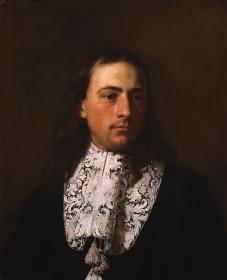
Versonnen blickt der dunkelhaarige junge Mann nach rechts in die Ferne. Von seinem schwarzen Gewand hebt sich ein kostbarer, weißer Spitzenkragen ab, auf den sein langes Haar fällt. Maratti präsentiert den Dargestellten hier schlicht und unprätentiös, zugleich jedoch sehr würdevoll und elegant. Durch eine Inschrift auf der Rückseite sind uns heute Entstehungsjahr und -ort des Gemäldes bekannt, sowie das Alter des Dargestellten. Als er sich 1663 in Rom porträtieren ließ, war er 24 Jahre und drei Monate alt. Maratti gehörte zu den begehrtesten Malern in Rom und arbeitete für die höchsten gesellschaftlichen Kreise, u.a. auch für Papst Clemens IX., dessen von Maratti geschaffenes Bildnis heute zu den bedeutendsten Porträts des 17. Jahrhunderts zählt.| Britta BodeSIGNATUR / INSCHRIFT: Auf der Doublierleinwand Transkription (des 19. Jh.) einer alten Inschrift: AETATIS VAE XXIV / ET III MENS / IN ROMA 1663 / C.M.F.___________________________________________________________________________With a pensive gaze, a dark-haired young man looks to the right into the distance. His long hair falls on the sumptuous, white lace collar that stands out against his black garment. Maratti presents the portrayed modestly and unpretentiously, yet also elegantly and dignified. An inscription on the back tells us the year and place of creation, as well as the age of the portrayed. In 1663, when he was painted in Rome, he was 24 years and three-months-old. Maratti was one of the most sought after artists in Rome and worked for the social elite, including Pope Clemens IX, whose portrait is considered one of the most important paintings of the 17th century.| Britta Bode