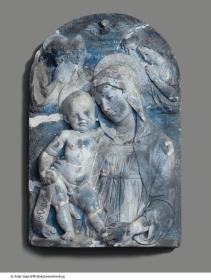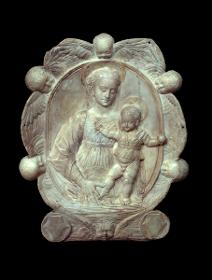

Madonna in Halbfigur / Virgin and Child
Ident. Nr.: 1028
ObjID: obj:1063455

Fotonachweis: Staatliche Museen zu Berlin, Skulpturensammlung und Museum für Byzantinische Kunst / Fotograf*in
Details (Expert)
- Beteiligte
- Datierung
- ca. 1430
- Geografische Bezüge
- Material / Technik
- Blei
- Abmessungen
- Höhe x Breite: 11,3 x 9,3 cm
- Permalink
- https://id.smb.museum/object/1063455
Objektbeschreibung
English catalogue entry
After Donatello
Virgin and Child
ca. 1430
Lead plaquette
11.3 x 9.3 cm
Formerly Berlin, Staatliche Museen, Skulpturensammlung, Inv. SKS 1028.
Lost since May 1945.
Provenance
Florence, Stefano Bardini (1880); Berlin, Skulpturensammlung/Altes Museum (1880-1904); Berlin, Skulpturensammlung/Kaiser-Friedrich-Museum (1904-1939); Berlin, storage (1939-1945); whereabouts unknown (1945-present).
Acquisition
Bought in Florence in 1880 from Stefano Bardini.
Other Versions
• Berlin, Staatliche Museen, Skulpturensammlung (Bode-Museum), Inv. SKS 56. Terracotta, formerly painted and gilt.
• Brescia, Santa Giulia, Museo della Città. Bronze, with an Imago pietatis on the reverse side.
• Cologne, Kunstgewerbemuseum. Silver, 11.2 x 10.2 cm.
• Cologne, Schnütgen Museum, Inv. G. 232. Gilt copper.
• Girona, Museo-Tesoro de la Catedral. Repoussé.
• London, Victoria and Albert Museum, Inv. 5473-1859. Bronze, 10.5 x 8.6 cm.
• London, Victoria and Albert Museum, Inv. 7474-1861. Bronze, 11.6 x 9.4 x 0.4 cm.
• London, Victoria and Albert Museum, Inv. A. 45-1926. Painted and gilt stucco, 36.5 x 20.2 x 5.3 cm.
• Paris, Musée Jacquemart-André, Inv. MJAP-OA.2085. Gilt bronze, 11.5 x 9.5 cm.
• Formerly Detroit, Ernest Kanzler collection. Gilt copper, 12.06 x 6.98 cm. Provenance: Luigi Grassi, Florence.
• Formerly Lyon, Jean-Baptiste Giraud collection. Repoussé.
Bibliography
Bode 1884
Wilhelm Bode, “Die italienischen Skulpturen der Renaissance in den Königlichen Museen zu Berlin. III. Bildwerke des Donatello und seiner Schule”, Jahrbuch der Königlich preußischen Kunstsammlungen, V, 1884, p. 39: Donatello?
Molinier 1886
Émile Molinier, Les Bronzes de la Renaissance. Les plaquettes. Catalogue raisonné, Paris, Jules Rouam, 1886, I, pp. 34-35 cat. 65: school of Donatello.
Bode 1894
Wilhelm Bode, Denkmäler der Renaissance-Sculptur Toscanas, Munich, F. Bruckmann, 1894, II, pl. 92: Donatello.
Bode 1902
Wilhelm Bode, Florentiner Bildhauer der Renaissance, Berlin, Bruno Cassirer, 1902, pp. 102, 103 fig. 37: Donatello.
Schubring 1907
Paul Schubring, Donatello. Des Meisters Werke in 277 Abbildungen, Stuttgart and Leipzig, Deutsche Verlags-Anstalt, 1907, pp. 94, 198.
Witte 1913
Fritz Witte, Die liturgischen Geräte und andere Werke der Metallkunst in der Sammlung Schnütgen in Cöln, Berlin, Verlag für Kunstwissenschaft, 1913, p. 116: the version in the Schnütgen collection, Cologne, is finer than the one in Berlin.
Bode 1921
Wilhelm von Bode, Florentiner Bildhauer der Renaissance, Berlin, Bruno Cassirer, 1921, p. 98 and fig. 53: after Donatello, workshop production.
Bange 1922
E. F. Bange, Die Italienischen Bronzen der Renaissance und des Barock, Zweiter Teil: Reliefs und Plaketten, Berlin and Leipzig, Walter de Gruyter, 1922, p. 39 cat. 291: early career of Donatello.
Maclagan 1924
Eric Maclagan, Catalogue of Italian Plaquettes, London, The Board of Education, 1924, p. 16.
Schottmüller 1933
Frida Schottmüller, Die italienischen und spanischen Bildwerke der Renaissance und des Barock. Erster Band. Die Bildwerke in Stein, Holz, Ton und Wachs, Zweite Auflage, Berlin and Leipzig, Walter de Gruyter & Co., 1933, p. 11: close to Inv. SKS 56.
Valentiner 1938
W. R. Valentiner, Catalogue of an Exhibition of Italian Gothic and Early Renaissance Sculptures, exh. cat. (Detroit, The Detroit Institute of Arts, 7 January-20 February 1938), Detroit, The Detroit Institute of Arts, 1938, n. p.: related to the cat. n. 26 in the exhibition, i.e. a version in the Kanzler collection in Detroit, acquired from Luigi Grassi, Florence.
Goldscheider 1947
L. Goldscheider, Donatello, Paris, Phaidon, 1947, p. 36 fig. 96, p. 38.
Pope-Hennessy 1964a
John Pope-Hennessy, Catalogue of Italian Sculpture in the Victoria and Albert Museum, London, Her Majesty’s Stationary Office, 1964, I, pp. 83-84: after Donatello.
Pope-Hennessy 1964b
John Pope-Hennessy, “The Italian Plaquette”, Proceeding of the British Academy, I, 1964 now in: idem, The Study and Criticism of Italian Sculpture, New York and Princeton, The Metropolitan Museum of Art and Princeton University Press, 1980, pp. 194-195: the prototype is related to Donatello, ca. 1435-45; compared with the Pazzi Madonna (Inv. SKS 51); no mention of the Berlin version.
Pope-Hennessy 1976 ed. 1980
John Pope-Hennessy, “The Madonna Reliefs of Donatello”, Apollo, CIII, n° 169, March 1976 now in: idem, The Study and Criticism of Italian Sculpture, New York and Princeton, The Metropolitan Museum of Art and Princeton University Press, 1980, p. 103 note 9: after Donatello.
Bennett and Wilkins 1984
Bonnie A. Bennett and David G. Wilkins, Donatello, Oxford, Phaidon, 1984, p. 49: the original work is the one in the Schnütgen Museum, Cologne; no mention of the Berlin version.
Avery 1991
Charles Avery, Donatello. Catalogo complete delle opere, Florence, Cantini, 1991, p. 49: relationship of the prototype with the Pazzi Madonna (Inv. SKS 51); no mention of the Berlin version.
Christiansen 1992
Keith Christiansen, “Early Works: Padua”, in Jane Martineau (ed.), Andrea Mantegna, exh. cat. (London, Royal Academy of Arts, 17 January-5 April 1992; and New York, Metropolitan Museum of Art, 9 May-12 July 1992), Milan, Olivetti-Electa, 1992, p. 97: the young Andrea Mantegna has been influenced by this composition, and by another Donatellesque relief (see the plaquette of the Virgin and Child in a Niche, Inv. SKS 3044).
Pope-Hennessy 1993
John Pope-Hennessy, Donatello Sculptor, New York, London and Paris, Abbeville Press, 1993, pp. 252-253: workshop of Donatello; no mention of the Berlin version.
Rosenauer 1993
Artur Rosenauer, Donatello, Milan, Electa, 1993, p. 299: after a lost original by Donatello, late 1420s-early 1430s.
Jolly 1998
Anna Jolly, Madonnas by Donatello and his Circle, Frankfurt am Main et al., Peter Lang, 1998, p. 122: the Virgin’s cloak pulled up and held under her arm is similar to the Verona Madonna (see Inv. SKS M 24 and Inv. SKS M 254); p. 145 cat. 43.6: after Donatello, early to mid 1420s.
Lambacher 2006
Lothar Lambacher (ed.), Staatliche Museen zu Berlin. Dokumentation der Verluste. Skulpturensammlung. Band VII. Skulpturen. Möbel, Berlin, Staatliche Museen zu Berlin-Preußischer Kulturbesitz, 2006, p. 188: lost in 1945; undocumented storage during the war.
Rossi 2006
Francesco Rossi in idem (ed.), Placchette e rilievi di bronzo nell’età di Mantegna, exh. cat. (Mantua, Museo della Città di Palazzo San Sebastiano, 16 September 2006-14 January 2007), Milan, Skira, 2006, p. 38: the original creation was a terracotta by Donatello; no mention of the Berlin version.
Bormand 2008
Marc Bormand, Donatello. La Vierge et l’Enfant. Deux reliefs en terre cuite, Paris, Musée du Louvre and Somogy, 2008, p. 8: after Donatello.
Caglioti 2010
Francesco Caglioti in Max Seidel et al. (eds.), Da Jacopo della Quercia a Donatello. Le arti a Siena nel primo Rinascimento, exh. cat. (Siena, Santa Maria della Scala, Opera della Metropolitana, Pinacoteca Nazionale, 26 March-11 July 2010), Milan, Federico Motta Editore, 2010, p. 382: after Donatello.
Comment
The Virgin supports her son with her left hand, while caressing his right forearm with the other hand. A veil covers the back of her head; over a tunic she wears a voluminous cloak that she gathers under her right elbow and that also seems to cover part of the Child’s body. Her left breast is bared to feed the Child, an iconography called the Madonna lactans, the “Nursing Madonna”. Even though he touches the upper part of the breast with his right hand, the Child seems disinterested in his mother, looking outside the composition. The frame surrounds the image very tightly, cropping the haloes but also the edge of Virgin’s right arm. By contrast, Christ’s shoulder protrudes over the frame – a play on the margins that draws the viewer into the scene.
Bought by Wilhelm Bode for the Berlin Museums through the Florentine dealer Stefano Bardini in 1880, this plaquette is known in several versions, either in metal (bronze, copper, lead) or stucco, but also in a larger-sized terracotta, also preserved in the Berlin Sculpture Collection (see Inv. SKS 56). Bode 1884 attributed the invention of this composition to Donatello, as he judged it close to the Feast of Herod, completed in 1427 for the baptistery font of the Siena Cathedral (an affinity later underlined by Valentiner 1938; Jolly 1998; and Caglioti 2010): in the Sienese relief, the frightened child in the left foreground, the profile of Salomé or the one of a musician are indeed very close to the plaquette. The latter then appears to reflect a Donatellesque invention and can be dated ca. 1425-27 (see Caglioti 2010, who rejects the dating of the composition in the mid-1430s, based on a stucco version in the Victoria and Albert, London, painted by Paolo Schiavo ca. 1435). Such a chronology also explains the dependence of the work on Donatello’s Pazzi Madonna (Inv. SKS 51), probably carved in the early 1420s (see Pope-Hennessy 1964b; Avery 1991). This plaquette is very important as one of the first known examples of a revival of this technique in Italy since Antiquity. As for terracotta, it allowed Donatello to compare himself with the Ancient Romans while allowing him to disseminate his inventions to a wider audience.
As Donatello often used marble or terracotta for the first formulation of his inventions, Rossi 2006 postulated that the original prototype for this composition was a lost terracotta of the same dimensions as the Berlin version (Inv. SKS 56). The number of plaquettes, the isolated scale and technique of Inv. SKS 56 and, above all, the higher quality of many small format versions suggest that Donatello worked out the composition on a reduced scale. Among the plaquettes, it is difficult to single out one original object by the hand of Donatello (even if Bennett and Wilkins 1984 have favored the version in the Schnütgen Museum, Cologne; and Jolly 1998 the one in the Museo-Tesoro de la Catedral in Giron). Caglioti 2010 has more carefully analysed the different categories of the composition, defining the work under discussion as directly deriving from Donatello. The generic handling and the overly decorative patterning of the haloes prevent an attribution of this plaquette to the master himself.
Neville Rowley (24 February 2016)
Letzte Aktualisierung: 20.04.2026
Kontakt
Einrichtung:
Skulpturensammlung und Museum für Byzantinische Kunst
E-Mail:
sbm@smb.spk-berlin.de