Logo

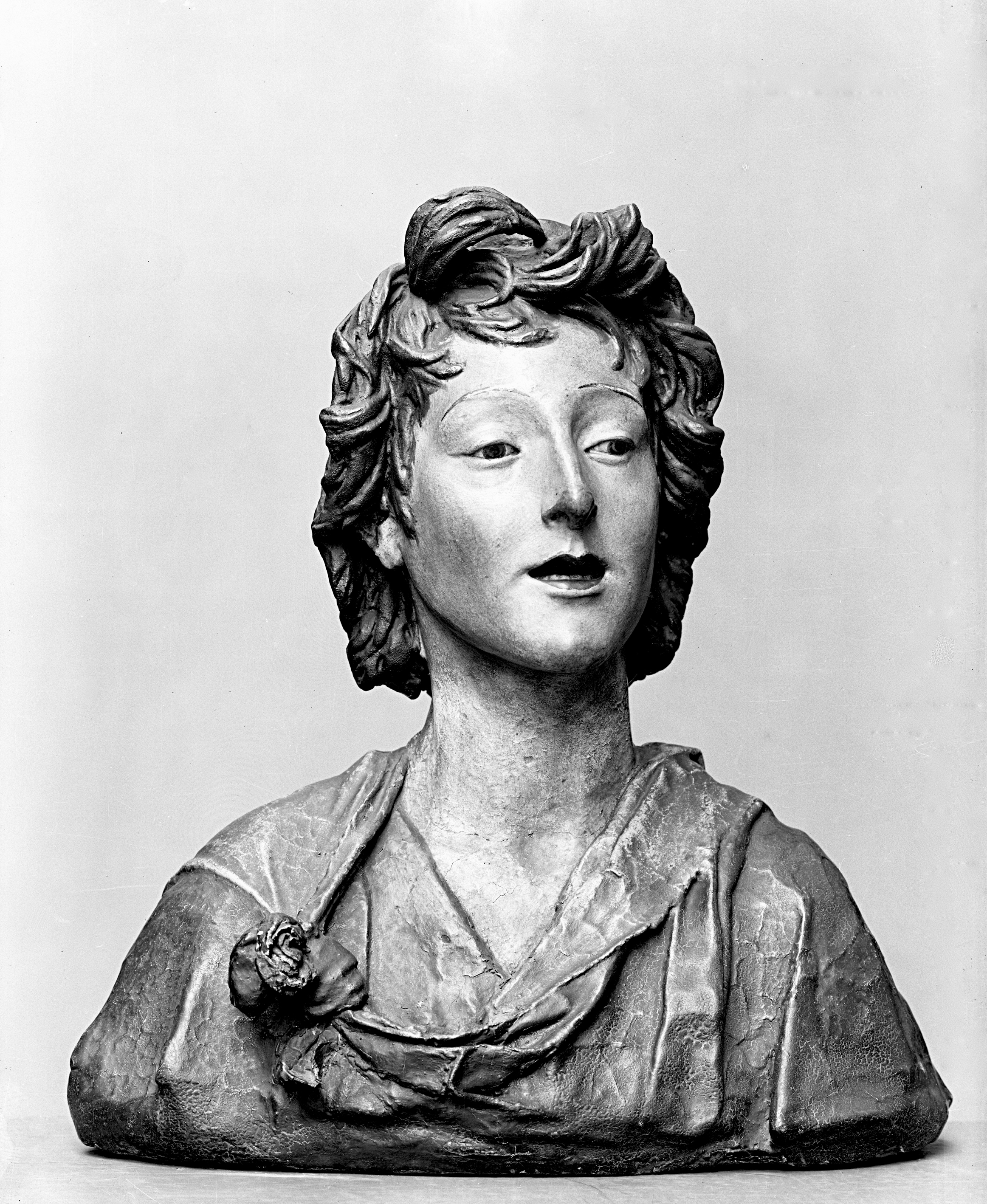
Johannes der Täufer

Ident. Nr.: 1793

ObjID: obj:1063468
Details (Expert)

Beteiligte
zugeschrieben: Desiderio da Settignano (1443-1464)
Datierung
1450–1455
Systematik/Art
Material / Technik
Stuck mit alter Fassung
Abmessungen
Höhe x Breite: 46,5 x 42 cm

Objektbeschreibung

Circle of Desiderio da Settignano

St John the Baptist
ca. 1450-55

Painted stucco
Height: 46.5 cm

Formerly Berlin, Staatliche Museen, Skulpturensammlung, Inv. SKS 1793.
Lost since May 1945.

Provenance
Florence, Stefano Bardini (1891); Berlin, Skulpturensammlung/Altes Museum (1891-1904); Berlin, Skulpturensammlung/Kaiser-Friedrich-Museum (1904-1939); Berlin, storage (1939-1945); whereabouts unknown (1945-present).

Acquisition
Bought in Florence in 1891 from Stefano Bardini.


Comment
Indebted to the typologies of reliquaries, sculptural busts of saints became highly popular in Tuscany in the early 15th century. Even though it is difficult to identify this young man, as no attribute can relate it to a peculiar action, his age and red cloak are associated with St John the Baptist, who was particularly revered in Italy at the time (the camel-hair cloak that would have proven the identification is absent here; for other bust representations of the Baptist in this period, see Pisani 2007). The work is closely related to a bust once in the Dreyfus Collection in Paris and now in the National Gallery of Art, Washington DC. Another version, less fine but also dating from the Renaissance, is preserved in the Isabella Stewart Gardner Museum, Boston (see Vermeule 1977). Balcarres 1903, p. 120 mentioned a similar version of the Berlin bust in the collection of Richard von Kauffmann in Berlin.
After the work was bought by the Berlin Museums, in 1891, Wilhelm Bode immediately attributed it to Donatello (Bode 1894). The bust was judged very close to another bust, variously identified as St Leonard or St Lawrence, in the Old Sacristy of San Lorenzo in Florence and traditionally thought to be by Donatello (Schubring 1907). Kaufmann 1935 was the first to challenge this attribution and to propose the name of Desiderio da Settignano instead, an artist to whom the bust in the Old Sacristy is commonly ascribed today (Clarence Kennedy had already expressed some doubts orally, see Schottmüller 1933). Another bust of this period has recently switched from a Donatello to a Desiderio paternity: the Bust of Niccolò Da Uzzano in the Museo Nazionale del Bargello, Florence. In 1878, Bode had attempted to acquire the latter work, but the purchase was made impossible by the merchant Stefano Bardini.
The disappearance of the bust of the Baptist in May 1945 makes it extremely hard to form a definitive judgement about its attribution. This is especially difficult as several problems of conservation had been stressed in the literature: the head of the sculpture was reported to have been severed and reattached (Schottmüller 1913), while the polychromy has often been judged later than the bust (a color photograph of the work has been published by Springer 1924; it was identified by Michael Knuth). The proximity to the Washington bust (especially in certain details, such as the tuft of hair standing up) is not enough to settle the attribution question conclusively; the work may well be by Desiderio da Settignano himself, after a lost prototype by Desiderio, or by a close follower.


Literature
Bode 1894
Wilhelm Bode, Denkmäler der Renaissance-Sculptur Toscanas, Munich, F. Bruckmann, 1894, II, pl. 93: Donatello.
Bode 1902
Wilhelm Bode, Florentiner Bildhauer der Renaissance, Berlin, Bruno Cassirer, 1902, pp. 243, 244 fig. 104: Donatello.
Balcarres 1903
Lord Balcarres, Donatello, London and New York, Duckworth & Co. and Charles Scribner’s Sons, 1903, p. 120: impossible to make a judgement about the attribution as long as the work remains polychrome; “but the whole conception is weakly and vapid”. Late imitator of Donatello ca. 1470. Close to a painting of a St John in the Musée du Louvre, Paris, Inv. 1274.
Meyer 1903
Alfred Gotthold Meyer, Donatello, Bielefeld and Leipzig, Delhagen and Klafing, 1903, pp. 38-39: forgery.
Schottmüller 1904
Frida Schottmüller, Donatello. Ein Beitrag zum Verständnis seiner künstlerischen Tat, Munich, F. Bruckmann, 1904, p. 100 note 2, p. 124.
Bode 1892-1905
Wilhelm Bode, Denkmäler der Renaissance-Sculptur Toscanas, Munich, Brückmann, 1892-1905, p. 32, pl. 93a: Donatello.
Schubring 1905
Paul Schubring, “Italienische Plastik”, Zeitschrift für bildende Kunst, new series, XVI, 1905, p. 56.
Schubring 1907
Paul Schubring, Donatello. Des Meisters Werke in 277 Abbildungen, Stuttgart and Leipzig, Deutsche Verlags-Anstalt, 1907, pp. 67, 197: Donatello, ca. 1440; close to the St John the Baptist in the Frari, Venice; and to the St Lawrence in the Old Sacristy of San Lorenzo, Florence.
Venturi 1908
Adolfo Venturi, Storia dell’arte italiana. VI. La scultura del Quattrocento, Milan, Ulrico Hoepli, 1908, pp. 295-296, 297 fig. 165: questions the attribution to Donatello.
Cruttwell 1911
Maud Cruttwell, Donatello, London, Methuen, 1911, p. 49: “one of the finest and most characteristic of Donatello’s work”.
Schottmüller 1913
Frida Schottmüller, Die italienischen und spanischen Bildwerke der Renaissance und des Barocks in Marmor, Ton, Holz und Stuck, Berlin, Georg Reimer, 1913, p. 15 cat. 28: Donatello, close to the St Lawrence in the Old Sacristy of San Lorenzo, Florence.
Bode 1921
Wilhelm Bode, Florentiner Bildhauer der Renaissance, Berlin, Bruno Cassirer, 1921, p. 219 fig. 132: Donatello.
Bode 1922
Wilhelm Bode, Die Italienische Plastik, 7th ed., Berlin and Leipzig, Vereinigung wissenschaftlicher Verleger and De Gruyter, 1922, p. 74 fig. 36: Donatello.
Wulff 1922
Oskar Wulff, Donatello, Leipzig, E. A. Seemann, 1922, p. 16, fig. 41: Donatello.
Springer 1924
Anton Springer, Handbuch der Kunstgeschichte. III. Die Renaissance in Italien, Georg Gronau ed., Leipzig, Alfred Kröner, 1924, pp. 79-80, pl. IV: Donatello, reproduced in color.
Kennedy 1928
Clarence Kennedy, Studies in the History… vol. 3, 1928, pl. 16-21: attributed to Donatello. (reference to be checked)
Bode 1930 ed. 1997
Wilhelm von Bode, Mein Leben, Berlin, Reckendorf, 1930 then in: Thomas W. Gaehtgens and Barbara Paul eds., Berlin, Nicolai, 1997, I, p. 229; II, p. 213: Donatello, bought in 1890.
Ormsby Gore 1930
William Ormsby Gore, Florentine Sculptors of the Fifteenth Century, London, MacMillan, 1930, p. 140: Donatello.
Colasanti 1931
Arduino Colasanti, Donatello, Paris, Crès, 1931, pp. 66-67: Donatello, as the Bust of Niccolò da Uzzano in the Museo Nazionale del Bargello, Florence.
Schottmüller 1933
Frida Schottmüller, Die italienischen und spanischen Bildwerke der Renaissance und des Barock. Erster Band. Die Bildwerke in Stein, Holz, Ton und Wachs, Zweite Auflage, Berlin and Leipzig, Walter de Gruyter & Co., 1933, p. 9: Donatello?; the polychromy dates from the 17th century; the costume is partly made of real cloth; close to the St Leonard in the Old Sacristy of San Lorenzo, Florence and to a work in the Dreyfus collection in Paris the Baptist now in the National Gallery of Art, Washington DC; doubts the attribution to Donatello because the sculpture is overpainted.
Kauffmann 1935
Hans Kauffmann, Donatello. Eine Einführung in sein Bilden und Denken, Berlin, Grotesche Verlagsbuchandlung, 1935, p. 241 note 478: Desiderio da Settignano. Later reproduction in the Dreyfus collection, Paris; the latter is close to the St Cecily in the Victoria and Albert Museum, London (Inv. 7585-1861).
Middeldorf 1938
Ulrich Middeldorf, review of Schottmüller 1933, Rivista d’arte, XX, 1938, p. 98 now in: idem, Raccolta di scritti that is Collected Writings. I. 1924-1938, Florence, SPES, 1979-80, p. 379: Desiderio da Settignano.
Pohl 1938
Joseph Pohl, Die Verwendung des Naturabgusses in der italienischen Porträtplastik der Renaissance, Ph.D. (Bonn, Reinischen Friedrich-Wilhelms-Universität, 1938), p. 49: Donatello; probably made for a procession altar, like the Bust of Niccolò Da Uzzano in the Museo Nazionale del Bargello, Florence.
Buscaroli 1942
Rezio Buscaroli, L’arte di Donatello, Florence, Monsalvato, 1942, p. 148 cat. 82: Donatello or Desiderio da Settignano.
Mack Bongiorno 1942
Laurine Mack Bongiorno, “Notes on the Art of Silvestro dell’Aquila”, The Art Bulletin, XXIV, 1942, p. 240 and note 52: “much more closely related to the art of Desiderio”.
Planiscig 1942
Leo Planiscig, Desiderio da Settignano, Vienna, Anton Schroll, 1942, pp. 26-27, 39, 45, pl. 37: Desiderio da Settignano; the paint dates from the Baroque era.
Duveen Sculpture… 1944
Duveen Sculpture in Public Collections of America. A Catalogue Raisonné with Illustrations of Italian Renaissance Sculptures by the Great Masters which Have Passed through the House of Duveen, New York, The William Bradford Press, 1944, cat. 15: attributed to Donatello; compared with the St John the Baptist in the National Gallery of Art, Washington DC (Mellon collection).
Jullian 1945
René Jullian, Catalogue du Musée de Lyon. III. La Sculpture du Moyen Âge et de la Renaissance, Lyon, Éditions de la plus grande France, 1945, p. 136: Donatello; close to the Baptist by Mino da Fiesole in the Musée des Beaux-Arts, Lyon.
Goldscheider 1947
L. Goldscheider, Donatello, Paris, Phaidon, 1947, pp. 28-29: style of Desiderio da Settignano.
Galassi s. d. 1949
Giuseppe Galassi, La scultura fiorentina del Quattrocento, Milan, Ulrico Hoepli, n. d. 1949, p. 273 pl. 249: close to Pollaiolo.
Seymour 1949
Charles Seymour Jr., Masterpieces of Sculpture from the National Gallery of Art, New York, Coward-McCann, 1949, p. 175: attributed to Desiderio da Settignano (under the suggestion of Clarence Kennedy).
“Verzeichnis…” 1953
“Verzeichnis der im Flakturm Friedrichshain verlorengangenen Bildwerke der Skulpturen-Abteilung”, Berliner Museen, new series, III, n°1-2, 1953, p. 11: the sculpture burnt between 5 and 10 May 1945.
Janson 1957
H. W. Janson, The Sculpture of Donatello, Princeton, Princeton University Press, 1957, II, p. 240 note 4: “clearly desideriesque”.
Cardellini 1962
Ida Cardellini, Desiderio da Settignano, Milan, Edizioni di Comunità, 1962, pp. 82, 85 fig. 57: Florentine, second half of the 15th century.
Vermeule, Wahn and Hadley 1977
Cornelius C. Vermeule, III, Walter Wahn and Rollin van N. Hadley, Sculpture in the Isabella Stewart Gardner Museum, Boston, Isabella Stewart Gardner Museum, 1977, p. 114: workshop of Benedetto da Maiano; preserved in West Berlin (sic).
Seidel 1999 ed. 2003
Max Seidel, “Das Renaissance-Museum. Wilhelm Bode als ‘Schüler’ Jacob Burckhardt”, in idem (ed.), Storia dell’arte e politica culturale intorno al 1900. La fondazione dell’Istituto Germanico di Storia dell’Arte di Firenze, Venice, Marsilio, 1999, pp. 55-109 Italian trans.: “Il Renaissance-Museum di Berlino. Wilhelm Bode ‘allievo’ di Jacob Burckhardt”, in idem, Arte italiana del Medioevo e del Rinascimento. Volume 2: Architettura e scultura, Venice, Marsilio, 2003, p. 842: the sculpture occupied the middle of a wall in the newly opened Kaiser-Friedrich-Museum in 1904; it was judged more important than the Pazzi Madonna (Inv. SKS 51), because Bode had previously failed to acquire the Bust of Niccolò Da Uzzano; p. 846.
Lambacher 2006
Lothar Lambacher (ed.), Staatliche Museen zu Berlin. Dokumentation der Verluste. Skulpturensammlung. Band VII. Skulpturen. Möbel, Berlin, Staatliche Museen zu Berlin-Preußischer Kulturbesitz, 2006, p. 137: last documented in the Leitturm of Friedrichshain on 7 April 1945, crate n°8a KFM.
Pisani 2007
Linda Pisani, “San Giovannino Battista nei busti del Rinascimento fiorentino”, in Kopf / Bild. Die Büste in Mittelalter und Früher Neuzeit, Munich and Berlin, Deutscher Kunstverlag, 2007, p. 232: Florentine master of the second half of the 15th century; in the Bode-Museum (sic).
Knuth 2011
Michael Knuth, “Desiderio da Settignano und seinem Umkreis zugeschriebene Bildwerke in Berlin”, in Joseph Connors et al. (eds.), Desiderio da Settignano, symposium papers (Florence, Kunsthistorisches Institut and Villa I Tatti, 9-12 May 2007), Venice, Marsilio, 2011, pp. 197-199: 17th century?

Neville Rowley (20 May 2016)

Letzte Aktualisierung: 29.07.2026

Kontakt

Einrichtung:

Skulpturensammlung und Museum für Byzantinische Kunst

Weitere Objekte aus den Sammlungen

Bildnis des Bischof Philipp von Freising

Bildnis des Bischof Philipp von Freising

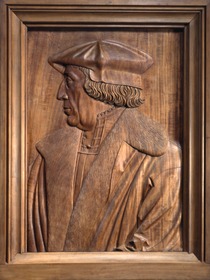
Das markante Gesicht des Dargestellten ist im strengen Profil nach links wiedergeben, während der Oberkörper sich ein wenig zum Betrachter hinwendet, was eine leichte Bewegung suggeriert. Das Barett mit herabgeschlagener Krempe wie auch der Mantel mit pelzverbrämtem Kragen, der so genannten Schaube, zeigen an, dass hier eine vornehme Persönlichkeit porträtiert wurde, ist doch die beschriebene Tracht allein dem ersten Stand vorbehalten gewesen. Das Relief weist weder eine Inschrift noch ein Familienwappen auf, die die Identität des hier Dargestellten preisgibt. Das scharf gezogene Profil mit der leicht gebogenen Nase und dem runden Kinn lassen den Porträtierten nicht zuletzt auch aufgrund seiner halblangen, die Ohren bedeckenden Haare, leicht als den Bischof Philipp von Freising und Naumburg identifizieren, wie der Vergleich zu zahlreich gesicherten Porträts des Dargestelllten belegen. Neben Gemälden existieren von ihm auch weitere Bildnisreliefs, von denen das von Loy Hering (1484/85-nach 1554) in Solnhofener Stein gearbeitete (Germanischen Nationalmuseum, Nürnberg) zu den prominentesten zählt. Das hier vorgestellte Brustbild Philipps ist hingegen für die Zeit von ungewöhnlicher Größe. Wie bereits festgestellt wurde, handelt es sich hier wohl um eine eigenhändige Wiederholung von Friedrich Hagenauers Medaille des Bischofs Philipp von Freising und Naumburgs. Durch die Übertragung vom ausgewogenen rund der Medaille in das hochrechteckige Format entstand ein ungewöhnlicher, weitaus steilerer Bildausschnitt. Es wird vermutet, dass Friedrich Hagenauer die Vergrößerung auf Wunsch des Auftraggebers ausführte. Der vorgesehene Bestimmungsort des Reliefs blieb bis heute unbekannt.Hans-Ulrich Kessler

Madonna mit der Rose

Madonna mit der Rose

Florentine artistVirgin and Child, known as the Madonna with the RosePainted papier-mâché81 x 65 cmBerlin, Staatliche Museen, Skulpturensammlung, Inv. SKS 1716.Bode-Museum, storage.ProvenanceFlorence, Stefano Bardini (1890); Berlin, Skulpturensammlung/Altes Museum (1890-1904); Berlin, Skulpturensammlung/Kaiser-Friedrich-Museum (1904-1939); Berlin, storage (1939-1945); Soviet Union, secret storage (1945/46-1958); East Berlin, Skulpturensammlung/Bode-Museum (1958-1990); Berlin, Skulpturensammlung/Bode-Museum (1990-present).AcquisitionBought from the dealer Stefano Bardini in Florence in 1890, together with Inv. SKS 1730 and Inv. SKS 1734, for 8,900 Mark (see the acquisition file n°1322/90 in the Zentralarchiv der Staatlichen Museen zu Berlin).Restorations1958, 1978-79.ExhibitionSchätze der Weltkultur von der Sowjetunion gerettet, East Berlin, National-Galerie and Pergamonmuseum, 1958, cat. D 51.Other Versions• Bergamo, Accademia Carrara. Provenance: Giovanni Morelli. Photo Kunsthistorisches Institut Florenz: n°49459.• London, Victoria and Albert Museum, Inv. 8376-1863. Marble, 79.2 x 64.8 cm.• Florence, villa La Pietra, Acton collection. Painted stucco. Provenance: Stefano Bardini. Photo Kunsthistorisches Institut Florenz: n°224659.• Formerly Florence, Davanzati Palace. Its sale, 1916, lot 100.DescriptionChrist is seated on a cushion, his body twisted between his mother and a hypothetical beholder to the right. The Virgin also looks in this direction, while holding her Child with the right hand and a rose with the other one. Christ reaches for the rose with the left hand, while blessing the viewer with the other. The papier-mâché relief has preserved its polychromy, with a gilt background and an integrated frame with an architectural motif.In 1890, this relief known as the Madonna with the Rose was bought for the Berlin Museums by Wilhelm Bode from Stefano Bardini in Florence as by the “school of Donatello”. Bode connected the work with a marble relief acquired by the Victoria and Albert Museum in 1863, which he attributed to Donatello himself – somewhat enlarging Donatello’s paternity to the Berlin relief (see Bode 1894). The authenticity of the London marble has been questioned by many art historians (from Balcarres 1903 to Negri Arnoldi 1970). While an inscription with the date 1550 on the reverse has been taken to mean that that relief was created in the 16th century (see Maclagan and Longhurst 1932), the absence of the rose proves that this is not the original model (Pope-Hennessy 1964).Many things in the composition evoke motifs by Donatello, such as the way the Virgin is seen, cut at the waist to appear closer to the viewer, or the dynamic gestures of the hands or even the blessing gesture of the Child (see the Virgin and Child Inv. SKS 54, but even more a terracotta relief in the Musée du Louvre, Inv. RF 353). However, the quality of the present cartapesta and the marble from London are not sufficient to give these works to Donatello. The name of Andrea Guardi, a minor follower of Donatello in Pisa, has been tentatively suggested by Schottmüller 1933.LiteratureBode 1894Wilhelm Bode, Denkmäler der Renaissance-Sculptur Toscanas, Munich, F. Bruckmann, 1894, II, pl. 69: Donatello (caption of the plate).Bode 1902Wilhelm Bode, Florentiner Bildhauer der Renaissance, Berlin, Bruno Cassirer, 1902, pp. 102-103, 104 fig. 38: after Donatello; the marble in the Victoria and Albert Museum, London (Inv. 8376-1863) is incorrectly seen as a fake but was made in Donatello’s workshop.Balcarres 1903Lord Balcarres, Donatello, London and New York, Duckworth & Co. and Charles Scribner’s Sons, 1903, p. 183: said to be a copy in stucco after a lost original by Donatello; the version in the Victoria and Albert Museum is a forgery. Mentions another version in the Morelli collection, Bergamo.Schubring 1907Paul Schubring, Donatello. Des Meisters Werke in 277 Abbildungen, Stuttgart and Leipzig, Deutsche Verlags-Anstalt, 1907, pp. 85, 198: Donatello; connected to the marble in the Victoria and Albert Museum, which is considered a forgery.Schottmüller 1913Frida Schottmüller, Die italienischen und spanischen Bildwerke der Renaissance und des Barocks in Marmor, Ton, Holz und Stuck, Berlin, Georg Reimer, 1913, pp. 17-18 cat. 35: after the original by Donatello in the Victoria and Albert Museum, wrongly considered a forgery.Bode 1921Wilhelm Bode, Florentiner Bildhauer der Renaissance, Berlin, Bruno Cassirer, 1921, p. 99 fig. 54: Donatello.Wulff 1922Oskar Wulff, Donatello, Leipzig, E. A. Seemann, 1922, p. 7, fig. 12.Colasanti 1931Arduino Colasanti, Donatello, Rome, Valori Plastici, s. d., pl. CCXL French trans., Paris, Crès, 1931, p. 89, pl. CCXXXV: Donatello, the authenticity of the marble in the Victoria and Albert Museum is problematic.Maclagan and Longhurst 1932Eric Maclagan and Margaret H. Longhurst, Catalogue of Italian Sculpture, London, Victoria and Albert Museum, 1932, p. 25: an inscription on the reverse side of the marble in the Victoria and Albert Museum was found, with the date 30 September 1550; this dates the piece.Schottmüller 1933Frida Schottmüller, Die italienischen und spanischen Bildwerke der Renaissance und des Barock. Erster Band. Die Bildwerke in Stein, Holz, Ton und Wachs, Zweite Auflage, Berlin and Leipzig, Walter de Gruyter & Co., 1933, p. 20: after Andrea Guardi?; Bode thought the work derived from a terracotta sketch by Donatello; the relief in the Victoria and Albert Museum is probably by Andrea di Francesco Guardi, and the Berlin relief is a derivation from it.Middeldorf 1938Ulrich Middeldorf, review of Schottmüller 1933, Rivista d’arte, XX, 1938 now in: idem, Raccolta di scritti that is Collected Writings, I. 1924-1938, Florence, SPES, 1979-80, p. 379: the quality of the work is too high for it to be by Andrea Guardi.Rezio Buscaroli, L’arte di Donatello, Florence, Monsalvato, 1942, p. 152 cat. 147: mediocre follower of Donatello.Schätze der Weltkultur… 1958Schätze der Weltkultur von der Sowjetunion gerettet, exh. cat. (East Berlin, National-Galerie and Pergamonmuseum, 1958), East Berlin, Staatliche Museen zu Berlin, 1958, cat. D 51: after Andrea Guardi.Pope-Hennessy 1964John Pope-Hennessy, Catalogue of Italian Sculpture in the Victoria and Albert Museum, London, Her Majesty’s Stationary Office, 1964, I, pp. 97-98: style of Donatello; the absence of a flower in the London version suggests that it was not the prototype for the Berlin version.Negri Arnoldi 1970Francesco Negri Arnoldi, “Scultura italiana al Victoria and Albert Museum. II”, Commentari, XXI, 1970, pp. 206-207: forgery.Restaurierte Kunstwerke… 1980Restaurierte Kunstwerke in der Deutschen Demokratischen Republik, exh. cat. (Berlin, n. pl., April-June 1980), n. pl. East Berlin, Ministerium für Kultur, 1980, pp. 147-148 cat. 58: restored in 1978-79.Ehlich 1987Volker Ehlich, “Naturwissenschaftliche Untersuchungsmethoden. Grundlagen der Restaurierung im Bestand der Skulpturensammlung der Staatlichen Museen zu Berlin”, Neue Museums Kunde, XXX, n°3, 1987, pp. 220-222: about the 1978-79 restoration.Osservatorio delle arti 1988Osservatorio delle arti (Rivista semestriale dell’Accademia Carrara di Bergamo), 1988, pp. 28-29: Donatello.Jolly 1998Anna Jolly, Madonnas by Donatello and his Circle, Frankfurt am Main et al., Peter Lang, 1998, p. 184 cat. 77.1: circle of Donatello and Michelozzo, ca. 1430s; “the best surviving cast of the series”.Neville Rowley (20 May 2016)

Würfelkapitell mit Blattornamenten

Würfelkapitell mit Blattornamenten

Das Kapitell ist aus der Grundform des Würfels entwickelt und an allen vier Seiten ausgearbeitet. Aus einem mittig unter der Kämpferplatte hervorragenden Knopf wächst eine sich nach unten schildartig ausbreitende Palmette, deren oberer Rand nach vorn umgeschlagen ist. Es stammt aus dem Benediktinerkloster auf dem Huy, ein in fränkischer Zeit militärisch genutzter Höhenrücken im nördlichen Harzvorland. Von Beginn an stand das Kloster unter dem Schutz der Halberstädter Bischöfe, Burchard I. hatte neben der Marienkapelle auch eine Pfalz errichtet. Die Klosterchronik des 12. Jahrhunderts erwähnt die Fertigstellung des „monasteriums“ noch in der Regierungszeit Abt Alfrieds. Der Kreuzgang, der noch stehende, zweigeschossig gewölbte Bau an der Westseite des Südflügels und möglicherweise auch Gebäude östlich der Kirche können erst nach 1150 fertiggestellt worden sein. Dieser späteren Phase gehört wohl auch das Kapitell an. Im südlichen Abschnitt des Ostflügels hat es noch einen Zweistützenraum mit den bekannten Basen gegeben, in dem dieses Kapitell aufgestellt gewesen sein könnte. Die Bildhauer, die im dritten Viertel des 12. Jahrhunderts zum Ausbau der Huysburger Klausurgebäude herangezogen wurden, haben unter Verwendung des in Sachsen seit dem 11. Jahrhundert üblichen Würfelkapitells, aber auch der korinthischen Ordnung, vor allem durch die ausgeprägte Dreidimensionalität der Formen neue Maßstäbe in der Region gesetzt. Das ornamentale Kapitell ist eng mit der Bauskulptur des nördlichen Harzvorlandes verbunden und man kann davon ausgehen, dass die meisten der auf der Huysburg tätigen Bildhauer in sächsischen Werkstätten ausgebildet wurden und wohl auch an verschiedenen Baustellen der Region tätig waren.(Auszug aus: Tobias Kunz, Bildwerke nördlich der Alpen. 1050 bis 1380. Kritischer Bestandskatalog der Berliner Skulpturensammlung, Petersberg, Michael Imhof Verlag 2014)

Bildnis Baron Otto Hermann Vietinghoff-Scheel

Bildnis Baron Otto Hermann Vietinghoff-Scheel

Über einem knappen Schulterausschnitt erhebt sich der leicht nacht rechts gewendete Kopf des ca. 55-jährigen Barons Otto Hermann von Vietinghoff-Scheel. Er trägt unter dem Rock eine Weste mit einem darüber diagonal verlaufenden Ordensband, weiter ein über die Brust reichendes Halstuch, das so genannte Jabot, mit dem der vordere Ausschnitt der Weste verdeckt wird. Sein Haar ist nach der im 18. Jahrhundert in Mode gekommenen Zopftracht mit Seitenlocken frisiert, die dem wohlgenährten Gesicht eine natürliche Würde verleiht.Der 1722 in Riga geborene Baron von Vietinghoff gehörte dem deutschbaltischen Uradel an und zählte zu den bedeutendsten Persönlichkeiten Livlands. Neben seinen Aufgaben als livländischer Gouvernementsregierungsrat in Riga, später Geheimrat und Senator, sowie am Hof von St. Petersburg, wo er im Dienste Katharina der Großen stand, machte er sich vor allem durch sein kulturelles, der Aufklärung verpflichtetes Engagement einen Namen. Sein immenser Reichtum erlaubte es ihm, die Kirche in Marienburg errichten zu lassen und ein großes Haus zu führen, im dem er die "Gesellschaft der Muße" gründete und ein Liebhaber-Theater einrichtete, deren Direktor er lange Zeit war. Darüber hinaus unterhielt er ein Orchester mit hervorragenden Musikern. Seine breitgefächerte Bildung und Kunstkenntnisse wie auch seinen ausgeprägten, in verschiedenen zeitgenössischen Quellen gerühmten Geschmack erwarb er durch zahlreiche ausgedehnte Reisen durch Frankreich und Italien. Unter seinem Einfluß erlebte seine Heimatstadt Riga einen kulturellen Aufschwung.Auf einer seiner zahlreichen Reisen in die französische Hauptstadt suchte der Baron - vermutlich 1777 - auch die Werkstatt von Jean-Antoine Houdon auf, um sich von dem erst 36-Jährigen, aber schon im Zenit seines Ruhmes stehenden Billdhauer porträtieren zu lassen. Houdon, der sculpteur der französischen Aufklärung, hatte sich vor allem durch seine Büsten der philosophes, der Pariser Intellektuellen wie u. A. Denis Diderot (1771) hervorgetan.Die zunächst in Gips ausgeführte Büste des Baron von Vietinghoff wurde im Pariser Salon von 1777 - wohl nur kurze Zeit nach ihrer Entstehung - mit 25 weiteren Werken Houdons ausgestellt, wie das livret unter der Nr. 238 vermerkt: "Portrait de M. le Baron de Vietinghoff (buste platre)". Diese frühe Fassung, von der noch weitere, nicht datierte Gipsrepliken existieren, dürfte als Modell für das hier gezeigte Marmorporträt von 1791 gedient haben, den es zeigt zweifellos den Mittfünfziger und nicht den 69-Jährigen, am Ende seines Lebens stehenden Baron. Houdon erfaßte in diesem Porträt nicht nur den selbstbewußten Staatsmann, dessen energisches Durchsetzungsvermögen uns in der Profilansicht besonders hervortritt, sondern auch den aufmerksamen lebensbejahenden Menschen, charkterisiert durch die leicht geöffneten Lippen und vor allem seinen offenen Blick, der einen Eindruck von jener Aktivität vermitttelt, mit der er durch sein wohltätiges Handeln einen kulturellen Wandel in seiner Heimatstadt herbeiführte. Houdon hat mit dieser Büste den Ruhm und die Verdienste des Barons auf eindrucksvolle Weise der Nachwelt überliefert.Hans-Ulrich Kessler