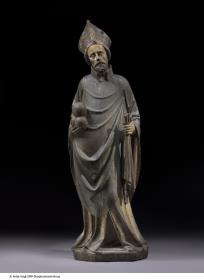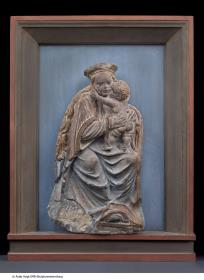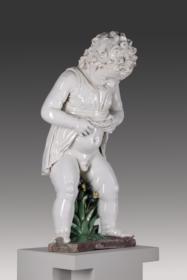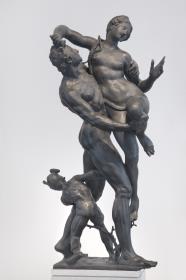

Johannes der Täufer
Ident. Nr.: 1793
ObjID: obj:1063468
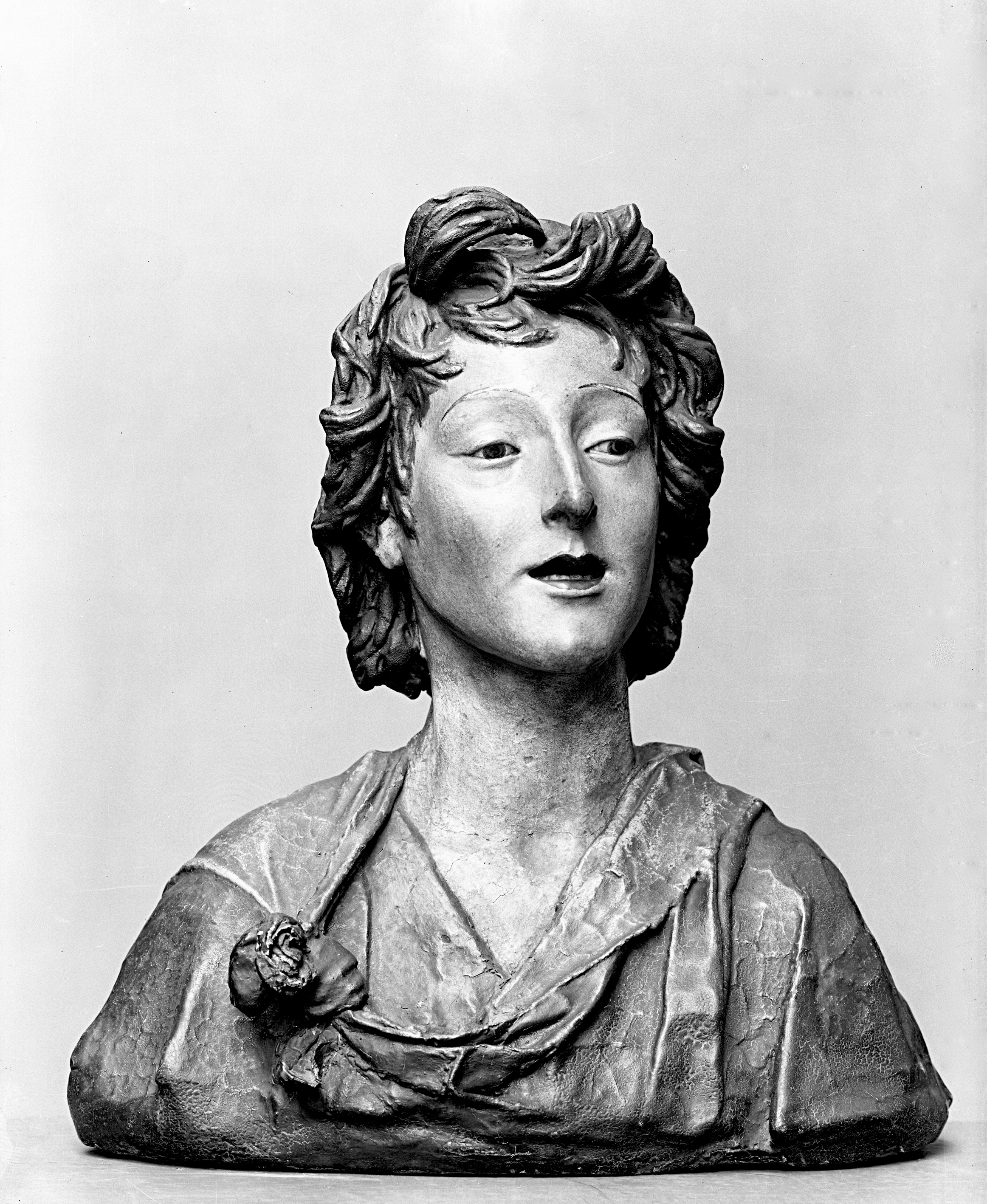
Fotonachweis: Staatliche Museen zu Berlin, Skulpturensammlung und Museum für Byzantinische Kunst / Unbekannt Public Domain Mark 1.0
Details (Expert)
- Beteiligte
- Material / Technik
- Stuck mit alter Fassung
- Abmessungen
- Höhe x Breite: 46,5 x 42 cm
- Permalink
- https://id.smb.museum/object/1063468
Objektbeschreibung
Circle of Desiderio da Settignano
St John the Baptist
ca. 1450-55
Painted stucco
Height: 46.5 cm
Formerly Berlin, Staatliche Museen, Skulpturensammlung, Inv. SKS 1793.
Lost since May 1945.
Provenance
Florence, Stefano Bardini (1891); Berlin, Skulpturensammlung/Altes Museum (1891-1904); Berlin, Skulpturensammlung/Kaiser-Friedrich-Museum (1904-1939); Berlin, storage (1939-1945); whereabouts unknown (1945-present).
Acquisition
Bought in Florence in 1891 from Stefano Bardini.
Comment
Indebted to the typologies of reliquaries, sculptural busts of saints became highly popular in Tuscany in the early 15th century. Even though it is difficult to identify this young man, as no attribute can relate it to a peculiar action, his age and red cloak are associated with St John the Baptist, who was particularly revered in Italy at the time (the camel-hair cloak that would have proven the identification is absent here; for other bust representations of the Baptist in this period, see Pisani 2007). The work is closely related to a bust once in the Dreyfus Collection in Paris and now in the National Gallery of Art, Washington DC. Another version, less fine but also dating from the Renaissance, is preserved in the Isabella Stewart Gardner Museum, Boston (see Vermeule 1977). Balcarres 1903, p. 120 mentioned a similar version of the Berlin bust in the collection of Richard von Kauffmann in Berlin.
After the work was bought by the Berlin Museums, in 1891, Wilhelm Bode immediately attributed it to Donatello (Bode 1894). The bust was judged very close to another bust, variously identified as St Leonard or St Lawrence, in the Old Sacristy of San Lorenzo in Florence and traditionally thought to be by Donatello (Schubring 1907). Kaufmann 1935 was the first to challenge this attribution and to propose the name of Desiderio da Settignano instead, an artist to whom the bust in the Old Sacristy is commonly ascribed today (Clarence Kennedy had already expressed some doubts orally, see Schottmüller 1933). Another bust of this period has recently switched from a Donatello to a Desiderio paternity: the Bust of Niccolò Da Uzzano in the Museo Nazionale del Bargello, Florence. In 1878, Bode had attempted to acquire the latter work, but the purchase was made impossible by the merchant Stefano Bardini.
The disappearance of the bust of the Baptist in May 1945 makes it extremely hard to form a definitive judgement about its attribution. This is especially difficult as several problems of conservation had been stressed in the literature: the head of the sculpture was reported to have been severed and reattached (Schottmüller 1913), while the polychromy has often been judged later than the bust (a color photograph of the work has been published by Springer 1924; it was identified by Michael Knuth). The proximity to the Washington bust (especially in certain details, such as the tuft of hair standing up) is not enough to settle the attribution question conclusively; the work may well be by Desiderio da Settignano himself, after a lost prototype by Desiderio, or by a close follower.
Literature
Bode 1894
Wilhelm Bode, Denkmäler der Renaissance-Sculptur Toscanas, Munich, F. Bruckmann, 1894, II, pl. 93: Donatello.
Bode 1902
Wilhelm Bode, Florentiner Bildhauer der Renaissance, Berlin, Bruno Cassirer, 1902, pp. 243, 244 fig. 104: Donatello.
Balcarres 1903
Lord Balcarres, Donatello, London and New York, Duckworth & Co. and Charles Scribner’s Sons, 1903, p. 120: impossible to make a judgement about the attribution as long as the work remains polychrome; “but the whole conception is weakly and vapid”. Late imitator of Donatello ca. 1470. Close to a painting of a St John in the Musée du Louvre, Paris, Inv. 1274.
Meyer 1903
Alfred Gotthold Meyer, Donatello, Bielefeld and Leipzig, Delhagen and Klafing, 1903, pp. 38-39: forgery.
Schottmüller 1904
Frida Schottmüller, Donatello. Ein Beitrag zum Verständnis seiner künstlerischen Tat, Munich, F. Bruckmann, 1904, p. 100 note 2, p. 124.
Bode 1892-1905
Wilhelm Bode, Denkmäler der Renaissance-Sculptur Toscanas, Munich, Brückmann, 1892-1905, p. 32, pl. 93a: Donatello.
Schubring 1905
Paul Schubring, “Italienische Plastik”, Zeitschrift für bildende Kunst, new series, XVI, 1905, p. 56.
Schubring 1907
Paul Schubring, Donatello. Des Meisters Werke in 277 Abbildungen, Stuttgart and Leipzig, Deutsche Verlags-Anstalt, 1907, pp. 67, 197: Donatello, ca. 1440; close to the St John the Baptist in the Frari, Venice; and to the St Lawrence in the Old Sacristy of San Lorenzo, Florence.
Venturi 1908
Adolfo Venturi, Storia dell’arte italiana. VI. La scultura del Quattrocento, Milan, Ulrico Hoepli, 1908, pp. 295-296, 297 fig. 165: questions the attribution to Donatello.
Cruttwell 1911
Maud Cruttwell, Donatello, London, Methuen, 1911, p. 49: “one of the finest and most characteristic of Donatello’s work”.
Schottmüller 1913
Frida Schottmüller, Die italienischen und spanischen Bildwerke der Renaissance und des Barocks in Marmor, Ton, Holz und Stuck, Berlin, Georg Reimer, 1913, p. 15 cat. 28: Donatello, close to the St Lawrence in the Old Sacristy of San Lorenzo, Florence.
Bode 1921
Wilhelm Bode, Florentiner Bildhauer der Renaissance, Berlin, Bruno Cassirer, 1921, p. 219 fig. 132: Donatello.
Bode 1922
Wilhelm Bode, Die Italienische Plastik, 7th ed., Berlin and Leipzig, Vereinigung wissenschaftlicher Verleger and De Gruyter, 1922, p. 74 fig. 36: Donatello.
Wulff 1922
Oskar Wulff, Donatello, Leipzig, E. A. Seemann, 1922, p. 16, fig. 41: Donatello.
Springer 1924
Anton Springer, Handbuch der Kunstgeschichte. III. Die Renaissance in Italien, Georg Gronau ed., Leipzig, Alfred Kröner, 1924, pp. 79-80, pl. IV: Donatello, reproduced in color.
Kennedy 1928
Clarence Kennedy, Studies in the History… vol. 3, 1928, pl. 16-21: attributed to Donatello. (reference to be checked)
Bode 1930 ed. 1997
Wilhelm von Bode, Mein Leben, Berlin, Reckendorf, 1930 then in: Thomas W. Gaehtgens and Barbara Paul eds., Berlin, Nicolai, 1997, I, p. 229; II, p. 213: Donatello, bought in 1890.
Ormsby Gore 1930
William Ormsby Gore, Florentine Sculptors of the Fifteenth Century, London, MacMillan, 1930, p. 140: Donatello.
Colasanti 1931
Arduino Colasanti, Donatello, Paris, Crès, 1931, pp. 66-67: Donatello, as the Bust of Niccolò da Uzzano in the Museo Nazionale del Bargello, Florence.
Schottmüller 1933
Frida Schottmüller, Die italienischen und spanischen Bildwerke der Renaissance und des Barock. Erster Band. Die Bildwerke in Stein, Holz, Ton und Wachs, Zweite Auflage, Berlin and Leipzig, Walter de Gruyter & Co., 1933, p. 9: Donatello?; the polychromy dates from the 17th century; the costume is partly made of real cloth; close to the St Leonard in the Old Sacristy of San Lorenzo, Florence and to a work in the Dreyfus collection in Paris the Baptist now in the National Gallery of Art, Washington DC; doubts the attribution to Donatello because the sculpture is overpainted.
Kauffmann 1935
Hans Kauffmann, Donatello. Eine Einführung in sein Bilden und Denken, Berlin, Grotesche Verlagsbuchandlung, 1935, p. 241 note 478: Desiderio da Settignano. Later reproduction in the Dreyfus collection, Paris; the latter is close to the St Cecily in the Victoria and Albert Museum, London (Inv. 7585-1861).
Middeldorf 1938
Ulrich Middeldorf, review of Schottmüller 1933, Rivista d’arte, XX, 1938, p. 98 now in: idem, Raccolta di scritti that is Collected Writings. I. 1924-1938, Florence, SPES, 1979-80, p. 379: Desiderio da Settignano.
Pohl 1938
Joseph Pohl, Die Verwendung des Naturabgusses in der italienischen Porträtplastik der Renaissance, Ph.D. (Bonn, Reinischen Friedrich-Wilhelms-Universität, 1938), p. 49: Donatello; probably made for a procession altar, like the Bust of Niccolò Da Uzzano in the Museo Nazionale del Bargello, Florence.
Buscaroli 1942
Rezio Buscaroli, L’arte di Donatello, Florence, Monsalvato, 1942, p. 148 cat. 82: Donatello or Desiderio da Settignano.
Mack Bongiorno 1942
Laurine Mack Bongiorno, “Notes on the Art of Silvestro dell’Aquila”, The Art Bulletin, XXIV, 1942, p. 240 and note 52: “much more closely related to the art of Desiderio”.
Planiscig 1942
Leo Planiscig, Desiderio da Settignano, Vienna, Anton Schroll, 1942, pp. 26-27, 39, 45, pl. 37: Desiderio da Settignano; the paint dates from the Baroque era.
Duveen Sculpture… 1944
Duveen Sculpture in Public Collections of America. A Catalogue Raisonné with Illustrations of Italian Renaissance Sculptures by the Great Masters which Have Passed through the House of Duveen, New York, The William Bradford Press, 1944, cat. 15: attributed to Donatello; compared with the St John the Baptist in the National Gallery of Art, Washington DC (Mellon collection).
Jullian 1945
René Jullian, Catalogue du Musée de Lyon. III. La Sculpture du Moyen Âge et de la Renaissance, Lyon, Éditions de la plus grande France, 1945, p. 136: Donatello; close to the Baptist by Mino da Fiesole in the Musée des Beaux-Arts, Lyon.
Goldscheider 1947
L. Goldscheider, Donatello, Paris, Phaidon, 1947, pp. 28-29: style of Desiderio da Settignano.
Galassi s. d. 1949
Giuseppe Galassi, La scultura fiorentina del Quattrocento, Milan, Ulrico Hoepli, n. d. 1949, p. 273 pl. 249: close to Pollaiolo.
Seymour 1949
Charles Seymour Jr., Masterpieces of Sculpture from the National Gallery of Art, New York, Coward-McCann, 1949, p. 175: attributed to Desiderio da Settignano (under the suggestion of Clarence Kennedy).
“Verzeichnis…” 1953
“Verzeichnis der im Flakturm Friedrichshain verlorengangenen Bildwerke der Skulpturen-Abteilung”, Berliner Museen, new series, III, n°1-2, 1953, p. 11: the sculpture burnt between 5 and 10 May 1945.
Janson 1957
H. W. Janson, The Sculpture of Donatello, Princeton, Princeton University Press, 1957, II, p. 240 note 4: “clearly desideriesque”.
Cardellini 1962
Ida Cardellini, Desiderio da Settignano, Milan, Edizioni di Comunità, 1962, pp. 82, 85 fig. 57: Florentine, second half of the 15th century.
Vermeule, Wahn and Hadley 1977
Cornelius C. Vermeule, III, Walter Wahn and Rollin van N. Hadley, Sculpture in the Isabella Stewart Gardner Museum, Boston, Isabella Stewart Gardner Museum, 1977, p. 114: workshop of Benedetto da Maiano; preserved in West Berlin (sic).
Seidel 1999 ed. 2003
Max Seidel, “Das Renaissance-Museum. Wilhelm Bode als ‘Schüler’ Jacob Burckhardt”, in idem (ed.), Storia dell’arte e politica culturale intorno al 1900. La fondazione dell’Istituto Germanico di Storia dell’Arte di Firenze, Venice, Marsilio, 1999, pp. 55-109 Italian trans.: “Il Renaissance-Museum di Berlino. Wilhelm Bode ‘allievo’ di Jacob Burckhardt”, in idem, Arte italiana del Medioevo e del Rinascimento. Volume 2: Architettura e scultura, Venice, Marsilio, 2003, p. 842: the sculpture occupied the middle of a wall in the newly opened Kaiser-Friedrich-Museum in 1904; it was judged more important than the Pazzi Madonna (Inv. SKS 51), because Bode had previously failed to acquire the Bust of Niccolò Da Uzzano; p. 846.
Lambacher 2006
Lothar Lambacher (ed.), Staatliche Museen zu Berlin. Dokumentation der Verluste. Skulpturensammlung. Band VII. Skulpturen. Möbel, Berlin, Staatliche Museen zu Berlin-Preußischer Kulturbesitz, 2006, p. 137: last documented in the Leitturm of Friedrichshain on 7 April 1945, crate n°8a KFM.
Pisani 2007
Linda Pisani, “San Giovannino Battista nei busti del Rinascimento fiorentino”, in Kopf / Bild. Die Büste in Mittelalter und Früher Neuzeit, Munich and Berlin, Deutscher Kunstverlag, 2007, p. 232: Florentine master of the second half of the 15th century; in the Bode-Museum (sic).
Knuth 2011
Michael Knuth, “Desiderio da Settignano und seinem Umkreis zugeschriebene Bildwerke in Berlin”, in Joseph Connors et al. (eds.), Desiderio da Settignano, symposium papers (Florence, Kunsthistorisches Institut and Villa I Tatti, 9-12 May 2007), Venice, Marsilio, 2011, pp. 197-199: 17th century?
Neville Rowley (20 May 2016)
Letzte Aktualisierung: 02.07.2026
Kontakt
Einrichtung:
Skulpturensammlung und Museum für Byzantinische Kunst
E-Mail:
sbm@smb.spk-berlin.de