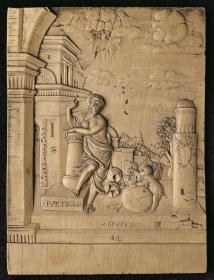

Madonna mit der Girlande / Virgin of Humility with Two Angels
Ident. Nr.: M 7
ObjID: obj:1063653

Fotonachweis: Staatliche Museen zu Berlin, Skulpturensammlung und Museum für Byzantinische Kunst / Unbekannt Public Domain Mark 1.0
Details (Expert)
- Beteiligte
- Datierung
- Datierung: ca. 1455
- Material / Technik
- —
- Abmessungen
- Durchmesser: 26,5 cmDurchmesser: (mit Rahmen): 38 cm
- Permalink
- https://id.smb.museum/object/1063653
Objektbeschreibung
After Donatello
Virgin of Humility with Two Angels
ca. 1455
Painted stucco on wood (figures are painted in white; the background is blue; traces of gilding)
Diameter: 26.5 cm
Berlin, Staatliche Museen, Skulpturensammlung, Inv. SKS M 7.
Formerly Kaiser-Friedrich-Museum, lost since May 1945.
Provenance
Florence, Stefano Bardini (1894); Berlin, Skulpturensammlung/Altes Museum (1894-1904); Berlin, Skulpturensammlung/Kaiser-Friedrich-Museum (1904-1939); Berlin, storage (1939-1945); whereabouts unknown (1945-present).
Acquisition
Bought in 1894 through Stefano Bardini, for 2,000 Mark. Gift of the Kaiser-Friedrich-Museums-Verein
Other version and early copy
• Vienna, Kunsthistorisches Museum, Inv. Pl. 7462. Gilt bronze, diameter: 27 cm.
• Florence, Galleria degli Uffizi, Gabinetto dei disegni e stampe, Inv. 9124 recto, attributed to Alonso Berruguete, ca. 1508-10 (copy of the Virgin and Child).
Comment
This composition of the Virgin seated in a meadow is known as the “Virgin of Humility” and emerged in the Sienese painting of the 14th century. The Virgin is praying with her hands joined, looking at the Christ Child seated between her thighs; the latter holds the Virgin’s veil in his right hand, while grasping her leg with the left one in order to keep his balance. Behind the two figures, two winged putti hold a garland; their posture and the folds of their clothes suggest that they are jumping.
This relief was acquired by Wilhelm Bode for 2,000 Mark for the Berlin Museums through the Florentine dealer Stefano Bardini in 1894; it was one of the first acquisitions financed by the Kaiser Friedrich-Museums-Verein, which was officially created in 1897. It was subsequently on view in the Kaiser-Friedrich-Museum from its opening in 1904 (Seidel 2003 publishes p. 842 fig. 20 and p. 844 fig. 22 two photographs of different rooms of the museum where the relief appears; this proves that they are not contemporary and should not be both dated 1904). It was stored at the end of WWII in the vault of the Neue Reichsmünze and has been untraced since April 1945.
Bode 1896 first categorized the work as by an “unknown follower of Donatello”, a judgement that retained its currency for over a century (even though Bode 1892-1905 later suggested an authorship by Luca della Robbia, an opinion that remained isolated). The connection had been made early on with a gilt bronze relief with the same dimensions that was then in the Estense Collection in Vienna (since 1923 in the Kunsthistorisches Museum in Vienna; Inv. Pl. 7462). The motif of the putti holding a garland was also used in a 16th-century replica of the Dudley Madonna by Donatello in the Musée Calvet, Avignon (see Inv. KFM 2627).
Whereas the quality of the Vienna tondo speaks for an execution by Donatello himself (while the frame has been convincingly attributed to Desiderio da Settignano), this version is weaker in many aspects (note for instance the hands). It is a perfunctory replica probably made by a follower of Donatello.
Bibliography
Jahresbericht 1894-96
Jahresbericht des Kaiser-Friedrich-Museums Verein, 1894-96, p. 13. (reference to be checked)
Bode 1896
Wilhelm Bode, Der Berliner Museums-Verein. Bericht über Erwerbungen des Vereins in den Jahren 1894 und 1895, Berlin, W. Büxenstein, 1896, p. 13: unknown pupil of Donatello.
Bode 1902
Wilhelm Bode, Florentiner Bildhauer der Renaissance, Berlin, Bruno Cassirer, 1902, p. 116, 117 fig. 50: after a marble original by Donatello.
Bode 1892-1905
Wilhelm Bode, Denkmäler der Renaissance-Sculptur Toscanas, Munich, Brückmann, 1892-1905, p. 77, pl. 247: Luca della Robbia, influenced by Donatello.
Hermann 1906
Hermann Julius Hermann, “Aus den Kunstsammlungen des Hauses Este in Wien”, Zeitschrift für bildende Kunst, new series, XVII, 1906, p. 91: Donatello.
Schubring 1907
Paul Schubring, Donatello. Des Meisters Werke in 277 Abbildungen, Stuttgart and Leipzig, Deutsche Verlags-Anstalt, 1907, pp. 164, 201: close to Giovanni da Pisa.
Schottmüller 1913
Frida Schottmüller, Die italienischen und spanischen Bildwerke der Renaissance und des Barocks in Marmor, Ton, Holz und Stuck, Berlin, Georg Reimer, 1913, p. 18 cat. 36: ancient copy of the bronze relief in the collection of Franz Ferdinand of Austria in Vienna now in the Kunsthistorisches Museum, Vienna.
Planiscig 1919
Leo Planiscig, Die Estensische Kunstsammlung. I. Skulpturen und Plastiken des Mittelalters und der Renaissance, Vienna, Anton Schroll, 1919, p. 51: ancient replica of the Vienna version, which is attributed here to Donatello in the 1440s.
Bode 1921
Wilhelm von Bode, Florentiner Bildhauer der Renaissance, Berlin, Bruno Cassirer, 1921, p. 110 fig. 66: after Donatello.
Bode 1925
Wilhelm von Bode, Bertolodo und Lorenzo dei Medici. Die Kunstpolitik des Lorenzo il Magnifico im Spiegel der Werke seines Lieblingskünstlers Bertoldo di Giovanni, Freiburg im Breisgau, Pontos-Verlag, 1925, p. 64: stucco after the work by Donatello in Vienna.
Planiscig 1927
Leo Planiscig, Andrea Riccio, Vienna, Anton Schroll, 1927, pp. 15-17: the bronze relief in Vienna is by Giovanni da Pisa (and its frame possibly by Pietro Lombardo); the Berlin version is a repetition in stucco.
Schottmüller 1933
Frida Schottmüller, Die italienischen und spanischen Bildwerke der Renaissance und des Barock. Erster Band. Die Bildwerke in Stein, Holz, Ton und Wachs, Zweite Auflage, Berlin and Leipzig, Walter de Gruyter & Co., 1933, p. 102: after Giovanni da Pisa; the putti are found in a forgery that is in the Musée Calvet, Avignon (see Inv. SKS 2627); the angels are reminiscent of Domenico di Paris in the Palazzo Schifanoia, Ferrara.
Kauffmann 1935
Hans Kauffmann, Donatello. Eine Einführung in sein Bilden und Denken, Berlin, Grotesche Verlagsbuchandlung, 1935, pp. 157 and 241 note 473: a drawing in the Galleria degli Uffizi, Florence (Santarelli 9124) reproduces the Madonna of the Clouds in the Museum of Fine Arts, Boston, and the relief in Vienna related to Inv. SKS M 7. This is a sign that both works were in the same place originally.
Fasola 1956
Giusta Nicco Fasola, “Bassorilievi donatelleschi nel museo Calvet”, Critica d’arte, III (new series), n°18, 1956, p. 552 and fig. 290: workshop of Donatello.
Janson 1957
H. W. Janson, The Sculpture of Donatello, Princeton, Princeton University Press, 1957, II, p. 244: produced not long after Donatello’s death in the 1460s or 1470s by the same author as the Vienna version, the “Medici Crucifixion” in the Museo Nazionale del Bargello, Florence, the “Camondo Crucifixion” in the Musée du Louvre, Paris, and the “Martyrdom of St Sebastian” in the Musée Jacquemart-André, Paris.
Kaiser-Friedrich-Museums-Verein Berlin… 1972
Kaiser-Friedrich-Museums-Verein Berlin. Erwerbungen 1897-1972, n. pl., Adolph Fürst & Sohn, 1972, p. 22 cat. 7: style of Donatello.
Pope-Hennessy 1976 ed. 1980
John Pope-Hennessy, “The Madonna Reliefs of Donatello”, Apollo, CIII, n°169, March 1976 now in: idem, The Study and Criticism of Italian Sculpture, New York und Princeton, The Metropolitan Museum of Art und Princeton University Press, 1980, pp. 71, 103 note 15¬: after Donatello.
Radcliffe and Avery 1976 ed. 1988
Anthony Radcliffe and Charles Avery, “The ‘Chellini Madonna’ by Donatello”, The Burlington Magazine, CXVIII, 1976, p. 384 and note 55 then in Charles Avery, Studies in European Sculpture II, London, Christie’s, 1988, pp. 46, 47 note 55: original by Donatello, perhaps in wax, the Vienna version is not by Donatello but by an assistant.
Leithe-Jasper 1985
Manfred Leithe-Jasper in Italian Renaissance Sculpture in the Time of Donatello, exh. cat. (Detroit, The Detroit Institute of Arts, 23 October 1985-5 January 1986 and Fort Worth, Kimbell Museum of Art, 22 February-5 April 1986), Detroit, The Detroit Institute of Arts, 1985, p. 135.
Leithe-Jasper 1986
Manfred Leithe-Jasper in Alan Phipps Darr and Giorgio Bonsanti (eds.), Donatello e i suoi, exh. cat. (Florence, Forte del Belvedere, 15 June-7 September 1986), Detroit and Florence, The Detroit Institute of Arts, La Casa Usher and Arnaldo Mondadori Editore, 1986, p. 165.
Neri Lusanna 1986
Enrica Neri Lusanna, “Stefano Bardini e la collezione di sculture”, in eadem and Lucia Faedo (eds.), Il museo Bardini a Firenze. Volume secondo: le sculture, Milan, Electa, 1986, pp. 24, 31: Bardini provenance.
Rosenauer 1993
Artur Rosenauer, Donatello, Milan, Electa, 1993, p. 301.
Keller 1997
Peter Keller, “Katalog der Bildwerke (Skulptur) und des Kunstgewerbes des Kaiser-Friedrich-Museums-Vereins”, in 100 Jahre Mäzenatentum. Die Kunstwerke des Kaiser-Friedrich-Museums-Vereins Berlin, Berlin, Kaiser-Friedrich-Museums-Verein, 1997, pp. 230-231: after Giovanni da Pisa, ca. 1443.
Jolly 1998
Anna Jolly, Madonnas by Donatello and his Circle, Frankfurt am Main et al., Peter Lang, 1998, p. 142: after Donatello; the “Vienna Madonna” is given to Donatello, ca. 1460s.
Sénéchal 1998
Philippe Sénéchal in Philippe Malgouyres and Philippe Sénéchal, Peintures et sculptures d’Italie. Collections du XVe au XIXe siècle du Musée Calvet, Avignon, exh. cat. (Avignon, Musée Calvet, 7 March-7 June 1998), Avignon and Paris, Musée Calvet and RMN, 1998, p. 104: replica of the Vienna version; the angels are reproduced in a 16th-century relief in the Musée Calvet, Avignon.
Seidel 1999
Max Seidel, “Das Renaissance-Museum. Wilhelm Bode als ‘Schüler’ Jacob Burckhardt”, in idem (ed.), Storia dell’arte e politica culturale intorno al 1900. La fondazione dell’Istituto Germanico di Storia dell’Arte di Firenze, Venice, Marsilio, 1999, pp. 55-109; Italian trans.: “Il Renaissance-Museum di Berlino. Wilhelm Bode ‘allievo’ di Jacob Burckhardt”, in idem, Arte italiana del Medioevo e del Rinascimento. Volume 2: Architettura e scultura, Venice, Marsilio, 2003, p. 841: acquired in 1894 for the opening of the KFM; p. 842 fig. 20 and p. 844 fig. 22.
Olson 2000
Roberta J. M. Olson, The Florentine Tondo, Oxford, Oxford University Press, 2000, p. 134 note 13.
Lambacher 2006
Lothar Lambacher (ed.), Staatliche Museen zu Berlin. Dokumentation der Verluste. Skulpturensammlung. Band VII. Skulpturen. Möbel, Berlin, Staatliche Museen zu Berlin-Preußischer Kulturbesitz, 2006, p. 147: lost after 7 April 1945; it was at that date in the vault of the New Reichsmünze (crate 636 KFM).
Neville Rowley (24 May 2016)
Letzte Aktualisierung: 22.05.2026
Kontakt
Einrichtung:
Skulpturensammlung und Museum für Byzantinische Kunst
E-Mail:
sbm@smb.spk-berlin.de