
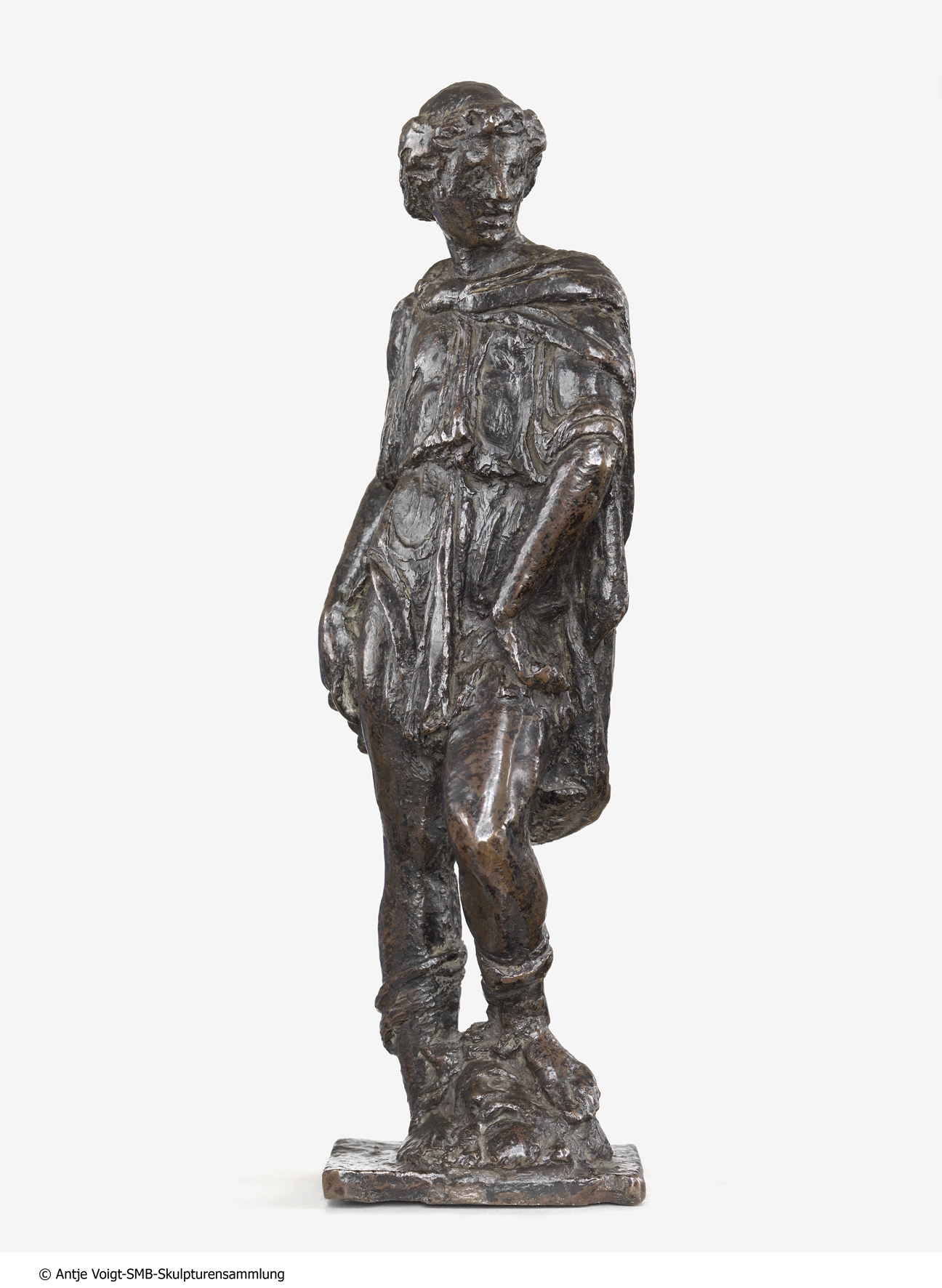
David mit dem Haupt des Goliath
Ident. Nr.: 2262
ObjID: obj:1368651
Fotonachweis: Staatliche Museen zu Berlin, Skulpturensammlung und Museum für Byzantinische Kunst / Antje Voigt CC BY-SA 4.0

Fotonachweis: Staatliche Museen zu Berlin, Skulpturensammlung und Museum für Byzantinische Kunst / Antje Voigt CC BY-NC-SA 4.0

Fotonachweis: Staatliche Museen zu Berlin, Skulpturensammlung und Museum für Byzantinische Kunst / Antje Voigt CC BY-NC-SA 4.0

Fotonachweis: Staatliche Museen zu Berlin, Skulpturensammlung und Museum für Byzantinische Kunst / Antje Voigt CC BY-NC-SA 4.0

Fotonachweis: Staatliche Museen zu Berlin, Skulpturensammlung und Museum für Byzantinische Kunst / Antje Voigt CC BY-NC-SA 4.0
Details (Expert)
- Beteiligte
- Datierung
- Mitte 15. Jahrhundert
- Systematik/Art
- Geografische Bezüge
- Material / Technik
- Bronze
- Abmessungen
- Höhe x Breite x Tiefe: 37 x 10,5 x 10,5 cm (mit Marmorsockel: 54 cm)Gewicht: Skulptur 8,32 kg
- Permalink
- https://id.smb.museum/object/1368651
Objektbeschreibung
Donatello
David with the Head of Goliath
Cast ca. 1460-70 after a wax model by Donatello ca. 1455
Bronze
Height: 37 cm
The socle dates from the early 19th century and is already visible in a 1896 photograph of the bronze in the Neues Museum, Berlin.
Berlin, Staatliche Museen, Skulpturensammlung, Inv. SKS 2262.
Bode-Museum, on view.
Provenance
Private collection, Florence; Carlo and Giuliano Della Porta, Gubbio (1887); private collection, Faenza; Bayersdörfer Collection, Munich; London, Henry Joseph Pfungst (until 1895); Berlin, Skulpturensammlung/Neues Museum (1896-1904); Berlin, Skulpturensammlung/Kaiser-Friedrich-Museum (1904-1939); Berlin, storage (1939-1945); Merkers, storage (1945); Wiesbaden, Central Collecting Point (1945-1956); West Berlin, Skulpturensammlung/Museum Dahlem (1956-1990); Berlin, Skulpturensammlung/Museum Dahlem (1990-1997); Berlin, storage (1997-2006); Berlin, Skulpturensammlung/Bode-Museum (since 2006).
Acquisition
Bought in London from Henry Joseph Pfungst (acquisition file n°1451/95 in the Zentralarchiv der Staatlichen Museen zu Berlin).
Other Version
• Washington DC, National Gallery of Art. Provenance: Kenneth Clark, Saltwood Castle (Kent); Sackler collection.
Exhibitions
Italian Renaissance Sculpture in the Time of Donatello, Detroit, The Detroit Institute of Arts, 23 October 1985-5 January 1986 and Fort Worth, Kimbell Museum of Art, 22 February-5 April 1986, cat. 25.
Donatello e i suoi, Florence, Forte del Belvedere, 15 June-7 September 1986, cat. 32.
(possibly Montreal, 1993)
Il bronzo e l’oro. Il David del Verrocchio restaurato, Florence, Museo Nazionale del Bargello, 7 October-9 November 2003; Atlanta, High Museum of Art, 22 November 2003-8 February 2004; Washington DC, National Gallery of Art, 13 February-21 March 2004.
Description
This statuette represents the biblical hero David, the future king of Israel, after he killed Goliath, who was terrorizing his people. Although a young boy with far less physical strength than his rival, David was wily: he threw a stone with his sling, hitting Goliath on the head, killing him at once. David then decapitated the giant and came back to his people, showing them the enemy’s head. He is seen here, triumphant, with one foot resting on the head; the back of his left hand rests graciously on his raised thigh. In his right hand, David holds an object meant to be the sling, formerly extended by a rope in another material. He is dressed in an Antique tunic, a cape on his shoulders and what seems to be a cap on his head. While some parts of the work are finely chiseled (such as David’s legs and arms), others are left unfinished: this is most obviously the case for the hero’s face, his right foot or the rear of the sculpture.
The work first became known in 1887, when it was exhibited as a Donatello in the monographic exhibition in Florence marking the fifth centenary of the sculptor’s birth. Said then to be owned by a Florentine collector, it changed hands several times until it was bought by Wilhelm Bode in 1895 for the Berlin Museums (the inventory book of the Bode-Museum indicates that it comes from the collection of Henry Joseph Pfungst in London). Bode 1896 endorsed the ancient attribution to Donatello, and connected the sculpture with a celebrated marble ascribed to the same artist then in the Palazzo Martelli, the so-called David of the Casa Martelli (now in the National Gallery of Art, Washington DC, Widener Collection). Even though there are some differences between the two sculptures, not only in size and material, but also in the mantle draped around the bronze David and absent from the marble version, the pose of the two figures is strikingly similar (see Parronchi 1980 for a photo montage of both sculptures). The prevailing theory for much of the twentieth century was that the David in Berlin had been cast from a wax model for the David of the Casa Martelli (see especially Schlegel 1968).
After WWII, scholars increasingly doubted the attribution to Donatello of the David of the Casa Martelli. If the marble sculpture was kept in the catalogue of the autograph works of Donatello by Janson 1957, it was progressively ascribed to one of the Rossellino brothers (either Antonio, for John Pope-Hennessy, or Bernardo, for Frederick Hartt). As to the Berlin David, Janson 1957 thought it was by a weak imitator of Donatello of the late 15th century, as were a derivation from the sculpture, then in the collection of the art historian Kenneth Clark now in the National Gallery of Art, Washington DC, and a small bronze with the same iconography, preserved in the Louvre and called the “David Pulszky”. John Pope-Hennessy changed his mind several times on the Berlin David, calling it a work from the second quarter of the 16th century (Pope-Hennessy 1959, ed. 1968), then an unifinished work by Antonio del Pollaiolo (Pope-Hennesy 1986), and finally just excluding it from Donatello’s oeuvre (Pope-Hennessy 1993, according to whom the “diagonal scheme” of the sculpture had no parallel in the work of Donatello; in the same book p. 86-87, the author praised the same “diagonal” aspect in the Berlin Putto, see Inv. SKS 2653).
Pope-Hennessy 1993, p. 337 note 20 declares having been alerted about the suspicious aspects of the Berlin David by Volker Krahn, curator of the Berlin Sculpture collection. Krahn later dedicated a full article to demonstrating that the Berlin David was a pastiche by the Italian sculptor Medardo Rosso (1858-1928), made in Florence on the basis of the David of the Casa Martelli before the bronze was included in the Donatello exhibition of 1887 (Krahn 2009; the latter also mentions p. 43-44 note 1 to have shared his doubts about the statuette with several Donatello scholars, which is echoed by Sénéchal 2007). The key piece of this argumentation was a photograph showing the studio of Medardo Rosso in Barzio, in which appears, alongside a sculpture by Rosso, a version of the Berlin David; Krahn identified it as a wax model. The David Pulzky and the other bronze version of the David were also said to be by Rosso (the latter sculpture’s authenticity had already been questioned by Boucher 1986 and Darr 1989).
Krahn’s thesis met with little following. Mozzatti 2010 reassessed the attribution of the David Pulszki to Giovan Francesco Rustici, first made by Caglioti 1996 and generally accepted. Mola and Vittucci 2009, but more precisely Mola 2014 demonstrated that the Berlin David could not in any case be by Medardo Rosso. The arguments are compelling: Rosso never visited Florence until 1910 so he could not have directly studied the David of the Casa Martelli; he worked from the Antique and Renaissance sculpture much later than 1887; he used neither patination nor chiseling for his bronzes, both visible in the Berlin David; he worked from existing forms and not from pure invention, which excludes he modeled the piece. The David visible in the photograph of Rosso’s studio is not a plaster cast but a bronze, different from the Berlin version and most probably presented by Bode to Rosso when the sculpture was already in Berlin.
Caglioti 2000 pointed out the similarities of the Berlin David to a figure with a turban in one of the scenes of the bronze pulpit of San Lorenzo (Christ before Caiphas), made by Donatello in old age. This and the Berlin’s sculpture resemblance in pose to a David by a pupil of Agostino di Duccio in marble on the right pilaster of the portal of the Cappella dei Caduti in the Tempio Malatestiano in Rimini, carved before 1457 (and already noticed by Schlegel 1968), led Caglioti to conclude that the Berlin bronze had been cast around 1460 from a wax model by Donatello made in the mid-1450s. To this day, this hypothesis remains the most convincing one, even if the chronology may be slightly enlarged, as one cannot exclude that the bronze was cast after the death of Donatello on 13 December 1466, in order to preserve one of his never achieved creations.
For Radke 2003, this David was ordered by the Medici from Donatello, who was too old to complete a commission eventually awarded to Andrea del Verrocchio (whose bronze David, made for the Medici, is now at the Museo Nazionale del Bargello, Florence). This is pure speculation, as the proposition by Seymour 1967 that the work reflects Agostino di Duccio’s initial idea for the monumental marble that he attempted to carve for one of the buttresses of the Florentine Cathedral and that Michelangelo eventually turned into his famous David (now in the Galleria dell’Accademia, Florence). While such proposition lacks a firm basis, the connection of the pose of the Berlin David with the one of the bronze David made by Michelangelo at the beginning of the 16th century and lost in France during the Revolution is especially intriguing (see the drawing of the Musée du Louvre, Inv. 714).
Literature
Esposizione Donatelliana 1887
Esposizione Donatelliana nel R. Museo Nazionale in Firenze, exh. cat. (Florence, Museo Nazionale del Bargello, 1887), Florence, Tipografia dei Fratelli Bencini, 1887, p. 9 cat. 59: bozzetto of the David of the Casa Martelli then in the Martelli palace, Florence; now in the National Gallery of Art, Washington DC; the work is lent by: “Della Porta C.ti Carlo e Giulio, fratelli – Gubbio”.
Semper 1887
Hans Semper, Donatellos Leben und Werke, Innsbruck, Wagnerischen Universitäts-Buchhandlung, 1887, p. 72 note: in the Brothers Porta collection, Gubbio; certainly made after the wax model for the David of the Casa Martelli.
Bode 1894
Wilhelm Bode, Denkmäler der Renaissance-Sculptur Toscanas, Munich, F. Bruckmann, 1894, II, pl. 75: Donatello; the work is mentioned as being in a private collection in England.
Bode 1896
Wilhelm Bode, “Aus der Abteilung Italienischer Bronzen”, Pan, IV, 1896, 4, p. 256, illustrated in front of p. 251: Donatello.
Bode 1902
Wilhelm Bode, “Florentiner Bronzestatuetten in den Berliner Museen”, Jahrbuch der Königlich preussischen Kunstsammlungen, XXIII, 1902, pp. 75-76: typical of Donatello, ca. 1430 (close to the David of the Casa Martelli); formerly in possession of a Florentine family, then with different owners, before it was acquired by the Berlin Museums.
Balcarres 1903
Lord Balcarres, Donatello, London and New York, Duckworth & Co. and Charles Scribner’s Sons, 1903, pp. 52-53: improbable that Donatello made a modello in bronze; however the work is certainly by Donatello, made after the David of the Casa Martelli as it corrects its faults.
Meyer 1903
Alfred Gotthold Meyer, Donatello, Bielefeld and Leipzig, Delhagen & Klafing, 1903, p. 78 fig. 85, pp. 79, 123: Donatello, made after the wax model for the David of the Casa Martelli.
Bode 1904
Wilhelm Bode, “Musée de Berlin. Statuettes de bronze italiennes récemment acquises”, Les Arts, n°29, May 1904, p. 10, fig. III: Donatello.
Schottmüller 1904
Frida Schottmüller, Donatello. Ein Beitrag zum Verständnis seiner künstlerischen Tat, Munich, F. Bruckmann, 1904, p. 55.
Bode 1905
Wilhelm Bode, “Neue Forschungen über italienische Renaissance-Bronzen”, Zeitschrift für bildende Kunst, new series, XVI, 1905, p. 123: the David Pulszky Musée du Louvre, Paris may have been a first idea by Donatello for this David, which would become the David of the Casa Martelli.
Bode 1907
Wilhelm Bode, The Italian Bronze Statuettes of the Renaissance, London, H. Grevel & Co., 1907, p. 9 and pl. V: Donatello.
Schubring 1907
Paul Schubring, Donatello. Des Meisters Werke in 277 Abbildungen, Stuttgart and Leipzig, Deutsche Verlags-Anstalt, 1907, pp. 38, 196: Donatello, ca. 1430.
Bode 1908
Wilhelm Bode, “Ein Blick in Donatellos Werkstatt”, Monatshefte für Kunstwissenschaft, I, n°1-2, January-February 1908, pp. 5, 7.
Meyer 1908
Alfred Gotthold Meyer, Donatello, Bielefeld and Leipzig, Delhagen & Klafing, 19082, p. 80 fig. 85, pp. 80, 124: Donatello, made after the wax model for the David of the Casa Martelli.
Sirén 1909
Osvald Sirén, Florentinsk Renässansskultur och andra Konsthistoriska ämnen, Stockholm, Wahlström & Widstrand, 1909, p. 82: model for the David of the Casa Martelli.
Knapp n. d. 1910
Friedrich Knapp, Die Italienische Plastik vom XV. bis XVIII. Jahrhundert, Berlin, Fischer & Franke, n. d. 1910, p. 22 and pl. 28b: Donatello.
Émile Bertaux, Donatello, Paris, Plon, 1910, p. 122: Donatello; after the wax sketch used for the David of the Casa Martelli.
Cruttwell 1911
Maud Cruttwell, Donatello, London, Methuen, 1911, p. 24: free copy, made at a later date, of the David of the Casa Martelli. Lacks the simplicity and directness of Donatello.
Goldschmidt 1914
Fritz Goldschmidt, Die italienischen Bronzen der Renaissance und der Barock. Erster Teil: Büsten, Statuetten und Gebrauchsgegenstände, Berlin, Georg Reimer, 1914, p. 7 cat. 21, pl. 9: Donatello; possible model for the David of the Casa Martelli.
Marquand 1916
Allan Marquand, “The Martelli David and the Youthful St. John the Baptist”, Art in America, IV, n°6, October 1916, p. 363: “In my judgement the marble statue of the David of the Casa Martelli resembles Donatello’s work more than does the bronze statuette, hence could not have been derived from it”.
Sirén 1916
Osvald Sirén, “Two Florentine Sculptures Sold to America”, The Burlington Magazine, XXIX, n°156, August 1916, pp. 197-198: Donatello, bronze cast of the original sketch for the David of the Casa Martelli.
Bode 1922
Wilhelm Bode, Die Italienische Plastik, 7th ed., Berlin and Leipzig, Vereinigung wissenschaftlicher Verleger and De Gruyter, 1922, p. 117 fig. 69a: Donatello.
Wulff 1922
Oskar Wulff, Donatello, Leipzig, E. A. Seemann, 1922, p. 12, fig. 23: after a sketch used for the David of the Casa Martelli.
Bode n. d. 1923
Wilhelm von Bode, Die italienischen bronzestatuetten der Renaissance, Berlin, Bruno Cassirer, n. d. 1923, pl. 4: Donatello.
Bode 1930
Wilhelm von Bode, Die Italienischen Bildwerke der Renaissance und des Barock. II. Bronzestatuetten. Büste und Gebrauchsgegenstände, 4th edition, Berlin and Leipzig, Walter De Gruyter & Co, 1930, p. 7 cat. 25, pl. 11: Donatello; after the wax sketch used for the David of the Casa Martelli.
Planiscig 1930
Leo Planiscig, Piccoli bronzi italiani del Rinascimento, Milan, Fratelli Treves, 1930, p. 4 and pl. IV fig. 5: Donatello, from the wax model of the David of the Casa Martelli.
Colasanti 1931
Arduino Colasanti, Donatello, French trans., Paris, Crès, 1931, pl. XXXVI: Donatello, model for the David of the Casa Martelli.
Weinberger 1931-32
M. Weinberger, in Zeitschrift fur bild Kunst, LXV, 1931-32, p. 53: ca. 1500. (reference to be ckecked)
Bange 1933
E. F. Bange, Italienische Skulpturen im Kaiser Friedrich Museum, Berlin, Staatliche Museen in Berlin, 1933, pl. 24: Donatello.
Bange 1934
E. F. Bange, Die Italienischen Bildwerke im Kaiser-Friedrich-Museum, Berlin, Verlag für Kunstwissenschaft, 1934, p. 23: Donatello, ca. 1460.
Kauffmann 1935
Hans Kauffmann, Donatello. Eine Einführung in sein Bilden und Denken, Berlin, Grotesche Verlagsbuchandlung, 1935, pp. 46, 211: model for the David of the Casa Martelli; close to the bronze doors of the Old Sacristy of San Lorenzo, Florence.
Buscaroli 1942
Rezio Buscaroli, L’arte di Donatello, Florence, Monsalvato, 1942, p. 148 cat. 81: possibly by Donatello.
Goldscheider 1947
L. Goldscheider, Donatello, Paris, Phaidon, 1947, p. 22: Donatello, from the wax model used for the David of the Casa Martelli.
Seymour 1949
Charles Seymour, Jr., Masterpieces of Sculpture from the National Gallery of Art, Washington DC und New York, National Gallery of Art und Coward-McCann, 1949, p. 175: “done freely after” the David of the Casa Martelli.
Janson 1957
H. W. Janson, The Sculpture of Donatello, Princeton, Princeton University Press, 1957, II, p. 22 note 4: not Donatello, weak imitator of the late 15th century (together with the David Pulszky in the Musée du Louvre and the David in the Kenneth Clark collection now in the National Gallery of Art, Washington DC).
Metz n. d. 1957
Peter Metz, Europäische Bildwerke von der Spätantike bis zum Rokoko aus den Beständen der Skulpturen-Abteilung der Ehem. Staatliche Museen Berlin-Dahlem, Munich, Prestel, n. d. 1957, p. 49 cat. 238, fig. 38: Donatello, ca. 1430. Model for the David of the Casa Martelli.
Boeck 1958
Wilhelm Boeck, review of Janson 1957, Zeitschrift fur Kunstgeschichte, XXI, 1958, p. 188: variant after the marble David of the Casa Martelli.
Grassi 1958
Luigi Grassi (ed.), Tutta la scultura di Donatello, Milan, Rizzoli, 1958, pp. 80-81: Donatello, ca. 1443; close to the bronze doors of the Old Sacristy of San Lorenzo; not a model for the David of the Casa Martelli, but later.
Landais 1958
Hubert Landais, Les bronzes italiens de la Renaissance, Paris, Presses universitaires de France, 1958, p. 32: formerly attributed to Donatello, it is difficult to see the hand of the master.
Pope-Hennessy 1959 ed. 1968
John Pope-Hennessy, “The Martelli David”, The Burlington Magazine, CI, April 1959 now in idem, Essays on Italian Sculpture, London and New York, Phaidon, 1968, pp. 65-66: later than the second quarter of the 16th century (as the version in the Clark collection); the David di Casa Martelli is attributed in the same article to Antonio Rossellino.
Metz 1964-65
Peter Metz, “Das neue Skulpturenmuseum in Dahlem”, Jahrbuch der Stiftung preußischer Kulturbesitz, III, 1964-65, p. 109-10: Donatello, model for the David of the Casa Martelli.
Metz 1966
Peter Metz, Bildwerke der christlichen Epochen von der Spätantike bis zum Klassizismus aus den Beständen der Skulpturenabteilung der Staatliche Museen, Stiftung Preußischer Kulturbesitz, Berlin-Dahlem, Munich, Prestel, 1966, p. 89 cat. 498, pl. 76: Donatello, ca. 1430; model for the David of the Casa Martelli (which is not by Donatello).
Weihrauch 1967
Hans R. Weihrauch, Europäische Bronzestatuetten. 15.-18. Jahrhundert, Braunschweig, Klinkhardt & Biermann, 1967, p. 40 fig. 37, pp. 45-46, 79: Donatello.
Schlegel 1968
Ursula Schlegel, “Problemi intorno al David Martelli”, in Donatello e il suo tempo, symposium papers (Florence and Padua, 25 September-1st October 1966), Florence, Istituto Nazionale di Studi sul Rinascimento, 1968, pp. 245-258: Donatello, ca. 1440; model for the David of the Casa Martelli; made before 1457, as a follower of Agostino di Duccio echoed the composition in the Tempio Malatestiano, Rimini.
Jestaz 1969
Bertrand Jestaz, “Travaux récents sur les bronzes. I. Renaissance italienne”, Revue de l’art, 5, 1969, p. 79.
Sciolla 1970
Gianni Carlo Sciolla, La scultura di Mino da Fiesole, Torino, 1970, p. 20 note: model for the David of the Casa Martelli.
Bode 1980
Wilhelm Bode, The Italian Bronze Statuettes of the Renaissance, James D. Draper ed., New York, De Reinis, 1980, pl. V: Donatello.
Parronchi 1980
Alessandro Parronchi, Donatello e il potere, Bologna and Florence, Cappelli and Il Portolano, 1980, pp. 102, 130-131, 136 fig. 46a: Donatello?; model for the David of the Casa Martelli, which is by Donatello. Photo montage of the David of the Casa Martelli with the cloak of the bronze statuette, which is assumed to reflect the artist’s original intention for the marble.
Poeschke 1980
Joachim Poeschke, Donatello. Figur und Quadro, Munich, Wilhelm Fink, 1980, pl. XCIV fig. 170.
Herzner 1982
Volker Herzner, “David Florentinus. II. Der Bronze-David Donatellos im Bargello”, Jahrbuch der Berliner Museen, XXIV, 1982, pp. 120-123: late 15th-early 16th century, variation on the David of the Casa Martelli.
Avery 1984 ed. 1988
Charles Avery, “‘La Cera sempre aspetta’: Wax Sketch-Models for Sculpture”, Apollo, CXIX, March 1984, pp. 166-176 now in: idem, Studies in European Sculpture II, London, Christie’s, 1988, pp. 22, 23 pl. 3: unknown sculptor influenced by Donatello, ca. 1460.
Lewis 1985
Douglas Lewis in Italian Renaissance Sculpture in the Time of Donatello, exh. cat. (Detroit, The Detroit Institute of Arts, 23 October 1985-5 January 1986 and Fort Worth, Kimbell Museum of Art, 22 February-5 April 1986), Detroit, The Detroit Institute of Arts, 1985, pp. 127-128 cat. 25: after a model by Donatello, invention before 1446, cast ca. 1470.
Boucher 1986
Bruce Boucher, “Detroit and Fort Worth. Sculpture in the time of Donatello”, The Burlington Magazine, CXXVIII, n°994, January 1986, p. 68: “mid-fifteenth century cast after a deteriorated wax model, by or certainly close to Donatello. The Sackler bronze, here catalogued as almost contemporary with the Berlin version yet closer to the putative original, is simply a slick modern aftercast of no weight or distinction.”
Lewis 1986
Douglas Lewis in Alan Phipps Darr and Giorgio Bonsanti (eds.), Donatello e i suoi, exh. cat. (Florence, Forte del Belvedere, 15 June-7 September 1986), Detroit and Florence, The Detroit Institute of Arts, La Casa Usher and Arnaldo Mondadori Editore, 1986, pp. 143-144 cat. 32: after a model by Donatello, invention before 1446, cast ca. 1470.
Poeschke 1986
Joachim Poeschke, review of Darr and Bonsanti 1986, Kunstchronik, XXXIX, n°12, December 1986, p. 505: sketch for the David of the Casa Martelli.
Pope-Hennessy 1986
John Pope-Hennessy, “Donatello sconosciuto”, FMR (Italian edition), IX, n°42, May 1986, p. 64: typical work by Antonio Pollaiolo; unfinished.
Darr 1989
Alan Phipps Darr, “The Donatello Exhibition at Detroit and Florence: Results, Perspectives, and New Directions”, in Donatello-Studien, Munich, Bruckmann, 1989, p. 14: model for the David of the Casa Martelli; the version in the Sackler collection now in the National Gallery of Art, Washington DC does not date from the 15th century because of the markedly thin cast.
Avery 1991
Charles Avery, Donatello. Catalogo completo delle opere, Florence, Cantini, 1991, p. 123 cat. 70: Donatello; model for the David of the Casa Martelli.
Draper 1992
James David Draper, Bertoldo di Giovanni, Sculptor of the Medici Household. Critical Reappraisal and Catalogue Raisonné, Columbia and London, University of Missouri Press, 1992, pp. 30-31: Donatello, early idea for the David of the Casa Martelli, left unfinished; close to the Lamentation of Christ in the Victoria and Albert Museum.
Pope-Hennessy 1993
John Pope-Hennessy, Donatello Sculptor, New York, London and Paris, Abbeville Press, 1993, pp. 156, 337 note 20: not Donatello; diagonal scheme that has no parallel in the work of Donatello.
Rosenauer 1993
Artur Rosenauer, Donatello, Milan, Electa, 1993, pp. 326-327: not Donatello; second half of the 1430s.
Caglioti 1996
Francesco Caglioti, “Il perduto ‘David mediceo’ di Giovanfrancesco Rustici e il ‘David’ Pulszky del Louvre”, Prospettiva, n°83-84, July-October 1996, p. 97 note 32: follows the position of Schlegel 1968.
Echinger-Maurach 1998
Claudia Echinger-Maurach, “Zu Michelangelos Skizze für den verlorenen Bronzedavid und zum Beginn der ‘gran maniera degli ignudi’ in seinem Entwurf für den Marmordavid”, Zeitschrift für Kunstgeschichte, LXI, n°3, 1998, pp. 314-315, fig. 5.
Parronchi 1998
Alessandro Parronchi, Donatello, Vicenza, Neri Pozza, 1998, p. 54: 16th-century copy after the wax model of the David of the Casa Martelli.
Myssok 1999
Johannes Myssok, Bildhauerische Konzeption und plastisches Modell in der Renaissance, Münster, Rema, 1999, pp. 367-368 cat. 30: copy after Donatello?
Caglioti 2000
Francesco Caglioti, Donatello e i Medici. Storia del ‘David’ e della ‘Giuditta’, Florence, Leo S. Olschki Editore, 2000, I, pp. 251-252 note 110: after Donatello; compared to the pulpits of San Lorenzo, Florence; made before the David of the Casa Martelli, and before 1457, as a follower of Agostino di Duccio echoed the composition in the Tempio Malatestiano, Rimini; II fig. 252: from a wax by Donatello, ca. 1460.
Katalog der Originalabgüsse… 2000
Katalog der Originalabgüsse. Heft 6. Christliche Epochen. Spätantike. Byzanz. Italien. Freiplastik. Reliefs. Bronzestatuetten, Berlin, Staatliche Museen zu Berlin, 2000, cat. 2184: Donatello?, after 1430.
Pfisterer 2002
Ulrich Pfisterer, Donatello und die Entdeckung der Stile 1430-1445, Munich, Hirmer Verlag, 2002, p. 357.
Radke 2003
Gary M. Radke, “Verrocchio e l’immagine del giovane David nell’arte fiorentina”, in Beatrice Paolozzi Strozzi and Maria Grazia Vaccari (eds.), Il bronzo e l’oro. Il David del Verrocchio resaurato, exh. cat. (Florence, Museo Nazionale del Bargello, 7 October-9 November 2003; Atlanta, High Museum of Art, 22 November 2003-8 February 2004; Washington DC, National Gallery of Art, 13 February-21 March 2004), Atlanta and Florence, High Museum of Art and Giunti, 2003, pp. 44-45, fig. 14: after a wax by Donatello; perhaps made for the Medici before they commissioned Andrea del Verrocchio to produced his bronze David.
Paolozzi Strozzi 2007
Beatrice Paolozzi Strozzi, “Donatello e Desiderio. Una proposta e qualche riflessione intorno al San Giovanni Battista Martelli”, in Marc Bormand, Beatrice Paolozzi Strozzi and Nicholas Penny (eds.), Desiderio da Settignano. La scoperta della grazia nella scultura del Rinascimento, exh. cat. (Paris, Musée du Louvre, 27 October 2006-22 January 2007; Florence, Museo Nazionale del Bargello, 22 February 2007-3 June 2007; Washington DC, National Gallery of Art, 1 July 2007-8 October 2007), Paris and Milan, Musée du Louvre and 5 Continents, 2007, p. 73 note 13: related to the David Pulszky in the Musée du Louvre.
Sénéchal 2007
Philippe Sénéchal, Giovan Francesco Rustici 1475-1554. Un sculpteur de la Renaissance entre Florence et Paris, Paris, Arthéna, 2007, p. 104 note 607: the authenticity of the work is far from certain.
Krahn 2009
Volker Krahn, “Pastiche or Fake? A ‘Donatello’ by Medardo Rosso”, Apollo, CLXIX, June 2009, pp. 40-47: not Donatello but a pastiche or a fake by Medardo Rosso, as the version formerly in the Clark collection and the David Pulszky in the Musée du Louvre; the posture of the David did not exist before the 16th century; there is a pre-1887 photograph of the Berlin David in the studio of Medardo Rosso.
Mola and Vittucci 2009
Paola Mola and Fabio Vittucci (eds.), Medardo Rosso. Catalogo ragionato della scultura, Milan, Skira, 2009, pp. 340-341: not a fake; not created by Medardo Rosso (see Krahn 2009); not datable in the Milanese period of Rosso; p. 345 fig. 127: the photograph with a cast of the David and the Concierge by Rosso should be dated 1901-03.
Mozzati 2010
Tommaso Mozzati in idem, Beatrice Paolozzi Strozzi and Philippe Sénéchal (eds.), I grandi bronzi del Battistero. Giovanfrancesco Rustici e Leonardo, exh. cat. (Florence, Museo Nazionale del Bargello, 10 September 2010-10 January 2011), Florence, Giunti, 2010, p. 352: not Medardo Rosso (see Krahn 2009); a drawing in Windsor Castle and a bronze Hercules in the Frick Collection, New York (formerly attributed to Antonio del Pollaiolo) testify that the posture existed before the 16th century.
Mola 2014
Paola Mola, “Vergini, fauni e senatori. Sui modelli per le copie dall’antico al Museo Rosso di Barzio”, in Mario Guderzo (ed.), Abitare il museo. Le case degli scultori, symposium papers (Possagno, Fondazione Canova, 4-5 May 2012), Crocetta del Montello, Terra Ferma, 2014, pp. 260, 268, 271-272, 274, 278-280: the David seen in a photograph of the workshop of Medardo Rosso cannot be a fake by the young Rosso (as argued by Krahn 2009); it is not a bozzetto, but a bronze cast probably sent to Rosso by Wilhelm Bode after 1902.
Conservation files in the Bode-Museum
Letter dated 28.08.1991: the material cannot be dated.
Letter dated 17.10.91: composition of the bronze.
Neville Rowley (20 May 2016)
Letzte Aktualisierung: 29.07.2026
Kontakt
Einrichtung:
Skulpturensammlung und Museum für Byzantinische Kunst
E-Mail:
sbm@smb.spk-berlin.de