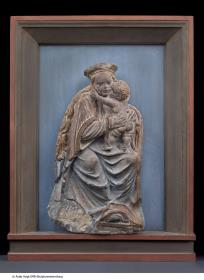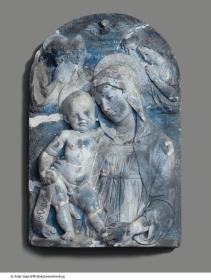

Madonna mit fünf Engeln / Virgin and Child with Five Angels
Ident. Nr.: M 88
ObjID: obj:1797590

Fotonachweis: Staatliche Museen zu Berlin, Skulpturensammlung und Museum für Byzantinische Kunst / Antje Voigt CC BY-SA 4.0
Details (Expert)
- Beteiligte
- Datierung
- Datierung: um 1465
- Material / Technik
- gebrannter Ton; Holz, gefasst (Rahmen)
- Abmessungen
- Höhe x Breite x Tiefe: 22,2 x 15,3 x 4,2 cm (Relief)Höhe x Breite x Tiefe: 45,6 x 30,7 x 10 cm (Rahmen)Gewicht: 1,9 kg (Relief)Gewicht: 1,3 kg (Relief)
- Permalink
- https://id.smb.museum/object/1797590
Objektbeschreibung
Attributed to Donatello
Virgin and Child with Five Angels
ca. 1445-50
Terracotta with traces of color
22 x 1.5 cm
Gilt frame, not original
Berlin, Staatliche Museen, Skulpturensammlung, Inv. SKS M 88.
Bode-Museum, storage.
Provenance
Florence, Luigi Grassi (1906); Berlin, Skulpturensammlung/Kaiser-Friedrich-Museum (1906-1939); Berlin, storage (1939-1945); Merkers, storage (1945); Wiesbaden, Central Collecting Point (1945-1956); West Berlin, Skulpturensammlung/Museum Dahlem (1956-1990); Berlin, Skulpturensammlung/Museum Dahlem (1990-1997); Berlin, storage (1997-2006); Berlin, Skulpturensammlung/Bode-Museum (since 2006).
Acquisition
Bought in Florence in 1906 from Luigi Grassi, for 2,440.50 Mark. Property of the Kaiser Friedrich-Museums-Verein.
Other Versions
• Berlin, Staatliche Museen, Skulpturensammlung, Inv. SKS 58.
• Paris, Musée Jacquemart-André, Inv. 1810. Marble, 68 x 50 cm.
Literature
Bode 1907
Wilhelm Bode in Kaiser Friedrich-Museums-Verein zu Berlin. Bericht über das Geschäftsjahr 1906-1907, Berlin, H. S. Hermann, 1907, pp. 15-17: sketch made by Donatello, who left it to his pupils for larger-scale versions.
Bode 1908
Wilhelm Bode, “Ein Blick in Donatellos Werkstatt”, Monatshefte für Kunstwissenschaft, I, n°1-2, January-February 1908, pp. 6-7: sketch made by Donatello.
Schottmüller 1913
Frida Schottmüller, Die italienischen und spanischen Bildwerke der Renaissance und des Barocks in Marmor, Ton, Holz und Stuck, Berlin, Georg Reimer, 1913, p. 20 cat. 41: sketch for the marble relief in the Musée Jacquemart-André, Paris.
Bode 1921
Wilhelm Bode, Florentiner Bildhauer der Renaissance, Berlin, Bruno Cassirer, 1921, p. 119 fig. 73: Donatello.
Wulff 1922
Oskar Wulff, Donatello, Leipzig, E. A. Seemann, 1922, p. 14.
Maclagan and Longhurst 1932
Eric Maclagan and Margaret H. Longhurst, Catalogue of Italian Sculpture, London, Victoria and Albert Museum, 1932, p. 25.
Schottmüller 1933
Frida Schottmüller, Die italienischen und spanischen Bildwerke der Renaissance und des Barock. Erster Band. Die Bildwerke in Stein, Holz, Ton und Wachs, Zweite Auflage, Berlin and Leipzig, Walter de Gruyter & Co., 1933, pp. 14-15: follower of Donatello; traces of paint; composition made after Inv. KFM 67; the composition is too unclear to be by Donatello.
Middeldorf 1938
Ulrich Middeldorf, review of Schottmüller 1933, Rivista d’arte, XX, 1938 now in: idem, Raccolta di scritti that is Collected Writings. I. 1924-1938, Florence, SPES, 1979-80, p. 379: workshop of Donatello.
Goldscheider 1947
L. Goldscheider, Donatello, Paris, Phaidon, 1947, p. 39 fig. 118: school of Donatello.
Pope-Hennessy 1964
John Pope-Hennessy, Catalogue of Italian Sculpture in the Victoria and Albert Museum, London, Her Majesty’s Stationary Office, 1964, I, pp. 80-81: the related Victoria and Albert Museum relief is after Donatello, but the model is not the present work.
Kunstwerke… 1966
Kunstwerke aus dem Besitz des Kaiser-Friedrich-Museums-Vereins, West Berlien, Kaiser-Friedrich-Museums-Verein, 1966, p. 42: follower of Donatello.
Kaiser-Friedrich-Museums-Verein Berlin… 1972
Kaiser-Friedrich-Museums-Verein Berlin. Erwerbungen 1897-1972, n. pl., Adolph Fürst & Sohn, 1972, pp. 70-71 cat. 88: follower of Donatello.
La Moureyre-Gavoty 1975
Françoise de La Moureyre-Gavoty, Inventaire des collections publiques françaises. 19. Institut de France. Paris – Musée Jacquemart-André, Paris, Édition des Musées Nationaux, 1975, cat. 25: probably Donatello.
Avery 1986
Charles Avery, “Donatello’s Madonnas Reconsidered“, Apollo, CXXIV, n°295 (new series), September 1986, pp. 181-182: Donatello, 1455-1460; close to the putti at the base of the Judith and Holophernes in the Palazzo Vecchio, Florence.
Neri Lusanna 1986
Enrica Neri Lusanna in eadem and Lucia Faedo (eds.), Il museo Bardini a Firenze. Volume secondo: le sculture, Milan, Electa, 1986, p. 253: the version in the Musée Jacquemart-André is a forgery.
Gentilini 1989
Giancarlo Gentilini, in idem and Carlo Sisi (eds.), La scultura. Bozzetti in terracotta, piccoli marmi e altre sculture dal XIV al XX secolo, 1 (Monte dei Paschi di Siena. Collezione Chigi Saracini 4.1), Siena, Palazzo Chigi Saracini, 1989, pp. 89, 94: sketch by Donatello, perhaps unfinished.
Schlegel 1989
Ursula Schlegel, Italienische Skulpturen. Ein Gang durch die Berliner Skulpturengalerie, Berlin, Staatliche Museen, 1989, p. 14.
Avery 1991
Charles Avery, Donatello. Catalogo completo delle opere, Florence, Cantini, 1991, p. 64 cat. 42: Donatello, 1455-1460; the versions in Berlin and Paris may be later creations.
Gentilini 1993
Giancarlo Gentilini in Luciano Bellosi (ed.), Francesco di Giorgio e il Rinascimento a Siena 1450-1500, exh. cat. (Siena, Chiesa di Sant’Agostino, 25 April-31 July 1993), Milan, Electa, 1993, p. 181: Donatello.
Bode 1997
Wilhelm von Bode “Unveröffentlichte Manuskripte zu den Jahren 1910-1929”, in idem, Mein Leben, Thomas W. Gaehtgens and Barbara Paul eds., Berlin, Nicolai, 1997, I, p. 387; II, p. 344¬: sketch by Donatello, as is Inv. SKS M 113.
Keller 1997
Peter Keller, “Katalog der Bildwerke (Skulptur) und des Kunstgewerbes des Kaiser-Friedrich-Museums-Vereins”, in 100 Jahre Mäzenatentum. Die Kunstwerke des Kaiser-Friedrich-Museums-Vereins Berlin, Berlin, Kaiser-Friedrich-Museums-Verein, 1997, p. 196: follower of Donatello.
Jolly 1998
Anna Jolly, Madonnas by Donatello and his Circle, Frankfurt am Main et al., Peter Lang, 1998, pp. 111-112 cat. 21.4: follower of Donatello, 1460s; possibly Bertoldo di Giovanni; head of the Virgin close to the bust of a Bacchante in the Museo archeologico, Florence, Inv. 14504.
Hoof 2005
Dieter Hoof, Die Engel-Vorstellung vom Kinde, Bochum, Verlag Dr. Dieter Winkler, 2005, p. 39: Donatello.
Gentilini 2007
Giancarlo Gentilini, “La ‘Madonna del Presepe’ ed altre immagini mariane tra Donatello e compagni”, in Giuseppe Adani, Giancarlo Gentilini and Cristina Grimaldi Fava (eds.), La Madonna del Presepe da Donatello a Guercino. Una devozione antica e nuova nella terra di Cento, exh. cat. (Cento, Pinacoteca Civica, 2 December 2007-13 April 2008), Bologna, Minerva Edizioni, 2007, pp. 112, 134 note 32: Donatello, the absence of color betrays this is an original sketch and not a work of devotion.
Sarchi 2007
Alessandra Sarchi, “Da Donatello all’allievo: Bartolomeo Bellano e la terracotta”, in Giuseppe Adani, Giancarlo Gentilini and Cristina Grimaldi Fava (eds.), La Madonna del Presepe da Donatello a Guercino. Una devozione antica e nuova nella terra di Cento, exh. cat. (Cento, Pinacoteca Civica, 2 December 2007-13 April 2008), Bologna, Minerva Edizioni, 2007, p. 143: Donatello.
Curatorial files in the Bode-Museum
Letter from Ursula Schlegel to Françoise de La Moureyre-Gavoty, 21 March 1967: the relief is not by Donatello, but from a later date.
Comment
This relief was acquired by Wilhelm Bode in 1906 in Florence for the Kaiser Friedrich-Museums-Verein, who is still the owner of the work. From 1881, the Berlin collection possessed a relief in marble with a similar composition (see Inv. SKS 58; it has been lost since 1945). The latter relief, as well as a similar one made by a different artist (and now in the Musée Jacquemart-André, Paris), has always been attributed to the school of Donatello, as the physiognomic exaggerations seem to speak against the master himself. The present relief was immediately published by Bode as a work by Donatello: the sketchiness was interpreted as typical of a model quickly made by the master and given to his assistants as a guide for the two known reliefs (see Bode 1907; Bode 1908). Even though the relief has often been forgotten in monographs dedicated to Donatello, some scholars have continued to consider it a work by the hand of the master (Avery 1991; Gentilini 1993 and 2007).
The quality of the relief is very high: even if the space is not clearly delineated, one has the impression of seeing various forms suddenly emerge from the raw material of the terracotta. Around the Virgin and Child, five angels are rendered in a sketchy manner but with lively attitudes: the pair at the top have full cheeks as they blow their horns, both angels in the the middle right are reading a book, while the one at the left points to the Child in the lower right, who, like the angels, is an assemblage of disjectae membrae: a head, two arms, only the right leg – but the ensemble seems coherent at first sight. As for the Virgin, her monumental face and right arm dwarf her leg, which is bent over a faldstool (on this motif, recurrent in Donatello’s oeuvre, see Inv. SKS 2431).
This license with anatomy and space is the reason why the relief was unsatisfyingly copied in the two known compositions in marble; on a smaller scale, the work gains in dynamism thanks to this sketchiness . A singular detail in that sense is the position of the Virgin’s hands: while the right arm is raised as if in a praying gesture (such as in the Madonna della seggiola type, see Inv. SKS 67), the left hand is lowered to caress the cheek and neck of the Child. All these imaginative and surprising aspects can be attributed to only one artist: Donatello himself.
Inv. SKS M 88 is probably one of the earliest preserved bozzetti in the history of Italian sculpture. Some motifs of the work, such as the angel on the left, recur in other works by the circle of Donatello (see Inv. SKS 2384). The question remains whether the Berlin work may have served as a model for other compositions, or if the motive derives from a drawing. As no drawing unanimously ascribed to Donatello is preserved, the former hypothesis seems the more probable. It is reasonable to think of Donatello formulating his compositions not so much through drawings, then an uncommon praxis for sculptors, but by modeling the forms directly. This would explain the plasticity that we feel in many works by the artist, and in Inv. SKS M 88 in particular.
Neville Rowley (24 May 2016)
Letzte Aktualisierung: 19.03.2026
Kontakt
Einrichtung:
Skulpturensammlung und Museum für Byzantinische Kunst
E-Mail:
sbm@smb.spk-berlin.de