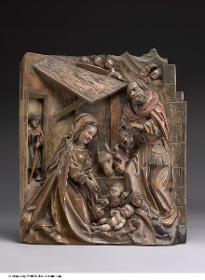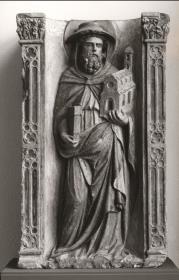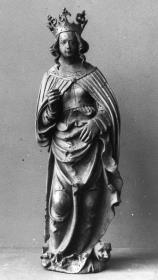

Kreuzigung Christi
Ident. Nr.: 53
ObjID: obj:1816759

Fotonachweis: Staatliche Museen zu Berlin, Skulpturensammlung und Museum für Byzantinische Kunst / Antje Voigt CC BY-SA 4.0
Details (Expert)
- Beteiligte
- Datierung
- Datierung: 15. Jh.
- Weitere Titel
- Sammlungstitel: Kreuzigung ChristiThe Crucifixion
- Material / Technik
- Pappelholz ( Populus tremula L.), Stuck, gefasst
- Abmessungen
- Höhe x Breite x Tiefe: 36,5 x 26,6 x 4 cm (Relief)Höhe x Breite x Tiefe: 53,5 x 45 x 7,5 cm (Rahmen)Gewicht: 4,94 kg
- Permalink
- https://id.smb.museum/object/1816759
Objektbeschreibung
Attributed to Donatello and his Workshop
The Crucifixion
ca. 1460-66
Stucco on wood with remnants of a complete gilding
53.5 x 44.5 cm (with frame)
36.5 x 26.5 cm (without)
The frame is original.
Berlin, Staatliche Museen, Skulpturensammlung, Inv. SKS 53.
Bode-Museum, storage.
Provenance
Florence, Charles Fairfax Murray (before 1883); Berlin, Skulpturensammlung/Altes Museum (1883-1904); Berlin, Skulpturensammlung/Kaiser-Friedrich-Museum (1904-1939); Berlin, storage (1939-1945); Merkers, storage (1945); Wiesbaden, Central Collecting Point (1945-1956); West Berlin, Skulpturensammlung/Museum Dahlem (1956-1997); Berlin, storage (1997-2006); Berlin, Skulpturensammlung/Bode-Museum (since 2006).
Acquisition
Bought in Florence in 1883 from Charles Fairfax Murray for 5,950 Italian lire, together with Inv. SKS 145 (Man of Sorrows) and Inv. SKS 279 (bronze Horse), and four unidentified plaquettes. Acquisition file (1096/83) in the Zentralarchiv der Staatlichen Museen zu Berlin.
Bibliography
Wilhelm Bode, “Die italienischen Skulpturen der Renaissance in den Königlichen Museen zu Berlin. III”, Jahrbuch der Königlich preußischen Kunstsammlungen, V, 1884, pp. 41-42: workshop of Donatello, after a lost original (possibly in terracotta); close to the pulpits of San Lorenzo, Florence.
Wilhelm Bode, Italienische Bildhauer der Renaissance. Studien zur Geschichte der italienischen Plastik und Malerei auf Grund der Bildwerke und Gemälde in den Königl. Museen zu Berlin, Berlin, W. Speemann, 1887, pp. 30-31: ancient copy after a lost model by Donatello, in the period of the pulpits of San Lorenzo in Florence; the red frame is authentic.
Wilhelm Bode and Hugo von Tschudi, Königliche Museen zu Berlin. Beschreibung der Bildwerke der Christlichen Epoche, Berlin, W. Spemann, 1888, p. 16 cat. 41: after a model by Donatello, in the period of the pulpits of San Lorenzo in Florence.
August Schmarsow, review of Bode and Tschudi 1888, Repertorium für Kunstwissenschaft, XII, 1889, p. 206: not Donatello, as it differs from the San Lorenzo pulpits.
Max Semrau, Donatellos Kanzeln in S. Lorenzo. Ein Beitrag zur Geschichte der italienieschen Plastik im XV. Jahrhundert, Breslau, Schottlaender, 1891, p. 79 note 1: pupil of Donatello, same artist as the Medici Crucifixion in the Museo Nazionale del Bargello, Florence, and the San Lorenzo pulpits. Stucco version after a model by Donatello.
Lord Balcarres, Donatello, London and New York, Duckworth & Co. and Charles Scribner’s Sons, 1903, p. 178: genuine sketch by Donatello himself, “sadly injured since its acquisition”; compared to the Forzori Altar in the Victoria and Albert Museum, London (Inv. 7619:1 to 3-1861).
Frida Schottmüller, Donatello. Ein Beitrag zum Verständnis seiner künstlerischen Tat, Munich, F. Bruckmann, 1904, pp. 76, 90, 125.
Maud Cruttwell, Donatello, London, Methuen, 1911, p. 68: “rough sketch” by Donatello; close to Christ Giving the Keys to St Peter in the Victoria and Albert Museum, London (Inv. 7629-1861), with the “same admirable effect of distance and space”.
Frida Schottmüller, Die italienischen und spanischen Bildwerke der Renaissance und des Barocks in Marmor, Ton, Holz und Stuck, Berlin, Georg Reimer, 1913, p. 15 cat. 29: after Donatello; from a sketch by Donatello in his late period; the head of the Virgin was lost when the work was at the Altes Museum, Berlin.
Arduino Colasanti, Donatello, French trans., Paris, Crès, 1931, pl. CXI: Donatello, mid 1430s, close to the great Crucifixion by Fra Angelico in the convent of San Marco, Florence.
Frida Schottmüller, Die italienischen und spanischen Bildwerke der Renaissance und des Barock. Erster Band. Die Bildwerke in Stein, Holz, Ton und Wachs, Zweite Auflage, Berlin and Leipzig, Walter de Gruyter & Co., 1933, p. 9: Donatello?; probably after a sketch by the artist in his later years; the Virgin’s head was lost when the relief was at the Altes Museum.
Hans Kauffmann, Donatello. Eine Einführung in sein Bilden und Denken, Berlin, G. Grote’sche Verlagsbuchhandlung, 1935, pp. 182, 184, 255-256 note 647: Donatello.
Ulrich Middeldorf, review of Kauffmann 1935, The Art Bulletin, XVIII, 1936, pp. 570-585 now in: idem, Raccolta di scritti that is Collected Writings. I. 1924-1938, Florence, SPES, 1979-80, p. 245.
Rezio Buscaroli, L’arte di Donatello, Florence, Monsalvato, 1942, p. 153 cat. 158: mediocre follower of Donatello.
H. W. Janson, The Sculpture of Donatello, Princeton, Princeton University Press, 1957, II, p. 244 note 1: not by Donatello, but the model for the Medici Crucifixion in the Museo Nazionale del Bargello, also not attributed to Donatello.
Luigi Grassi (ed.), Tutta la scultura di Donatello, Milan, Rizzoli, 1958, p. 101: follower of Donatello.
Peter Metz, Bildwerke der christlichen Epochen von der Spätantike bis zum Klassizismus aus den Beständen der Skulpturenabteilung der Staatliche Museen, Stiftung Preußischer Kulturbesitz, Berlin-Dahlem, Munich, Prestel, 1966, p. 89 cat. 500: style of Donatello’s late works.
Neville Rowley, “Wie man ein Denkmal wird. Wilhelm Bode und die Berliner Museen 1883/84”, in Nikolaus Bernau, Hans-Dieter Nägelke and Bénédicte Savoy (eds.), Museumsvisionen. Der Wettbewerb zur Erweiterung der Berliner Museumsinsel 1883/84, exh. cat. (Berlin, Bauakademie, 16 September–11 October 2015), Kiel, Ludwig, 2015, pp. 89-90.
Comment
The lower part of this Crucifixion is full of figures, some of them seemingly belonging to a different period from the event represented, such as the monk saint kneeling and embracing the cross of Christ, together with what seems to be a nun on the opposite side. Three holy figures are represented, each with a different sign of mourning: they must be the Virgin, St John and Mary Magdalene – even if their definitive identification remains speculative (see below). Two soldiers are bracketing the composition: one entering from the far right; the other going out through the left edge. One can distinguish other soldiers in the background, such as one crying, just to the right of the Cross. The impression of a receding landscape is given by the diminishing size of the trees.
The work was acquired by Wilhelm Bode in 1883 through the English painter and dealer Charles Fairfax Murray, together with other works (Schottmüller 1913 and 1933 wrongly records 1885 for this acquisition). Bode considered the relief a copy after a late work by Donatello, noting the similarities with the pulpits of the church of San Lorenzo in Florence, and especially with the Crucifixion and Deposition reliefs (see Bode 1884; Bode 1885; Bode and Tschudi 1888). This view was sometimes dismissed (Schmarsow 1889), sometimes followed (Schottmüller 1913); but one has to notice that many scholars have also argued for an attribution to Donatello himself (Balcarres 1903; Cruttwell 1911; Colasanti 1931; Kauffmann 1935; and, more tentatively, Schottmüller 1933). After WWII, the work was part of the collection in West Berlin, but presumably kept in storage as it was almost forgotten and only discussed briefly (see Janson 1957, who linked the work with the Medici Crucifixion in the Museo Nazionale del Bargello in Florence, a connection already made by Semrau 1891; Janson rejected the attribution to Donatello of both works).
This relative oblivion can partly be explained by the condition of the work, which has been problematic since its purchase. The stucco surface has severe cracks, while the gilding is widely abraded. Two losses are more important: Christ’s right arm (lost before 1883); and the head of a holy woman (often identified as the Virgin Mary), which was lost in Berlin before 1904 (see Schottmüller 1913). A small-sized engraving of the work before this damage had been published by Bode 1884, p. 41; significantly, no color photographs of the work have been published until yet.
Some parts of the relief seem at first glance to have been made separately and added on, such as the soldier on the far left, whose handling is unskillful and who has a darker coloration; of Jesus-Christ, who is almost detached from the relief, unlike the rest of the work (his body is also stylistically weaker than the rest of the anatomies). Even if the Crucifixion has often been judged since its publication by Bode as a replica after another composition, the thinness of the stucco surface makes it clear that it was directly modeled and not molded (this was first noted by Bodo Buczynski in 2014). The fact that no other similar composition exists only underlines the originality of the relief.
Various motifs of the work are reminiscent of Donatello. The mourning figure immediately to the right of the cross reminds one of the figures of the Deposition of Christ in the San Lorenzo pulpits, while the melancholy figure to his right, holding his head in his hand, is close to the St John of the bronze Lamentation over the Dead Christ in the Victoria and Albert Museum in London (Inv. 8552-1863). The two crosses of the thieves are similar to the lances flanking the bronze Crucifixion in the Musée du Louvre (Inv. OA 6477; the right cross in the present work is indeed topped by what seems to be a sponge, as in the Louvre Crucifixion).
It is difficult to identify with certainty the saints attending the drama: St John may be the melancholy figure, Mary Magdalene the one raising her arms, and the Virgin Mary the figure who lost her head, even if the latter two are good candidates to be a St John and a Magdalene (with her long hair, especially underlined by the 1884 etching). At the foot of the cross, the mourning female might also be the Virgin, but also (and more likely) a nun. The other saint kneeling under the cross is dressed as a monk; his dark mantle makes him perhaps a Dominican. This confusing iconography is coherent with Donatello’s habit of producing works with some iconographical ambiguities (for a similar case, related to the bronze relief of the Lamentation in the Victoria and Albert Museum, London, see Janson 1957, p. 187).
From a stylistic point of view, some parts of the work are of poor quality, such as the soldier on the left; or are not stylistically coherent with Donatello’s oeuvre, such as Christ on the cross. Some other parts, however, are not only directly comparable with Donatello’s work (especially the Forzori Altarpiece in the Victoria and Albert Museum, London: Inv. 7619:1 to 3-1861), but they also have the sketchy invention that is typical of the genuine works of the master: hence the idea to show soldiers going out of the frame, to depict expressive faces (the soldier in the mid-distance, between the cross and the ladder), or the decision to hide the right thief behind the ladder are unlikely to come from a mind other than Donatello’s. The landscape is also quite similar to the one in the Medici Crucifixion in the Bargello, a work that recent literature accepts as a genuine work. It is then tempting to think that Inv. SKS 53 is a product of the workshop of Donatello in his later years, with some parts directly modeled by the artist himself.
Neville Rowley (11 February 2016)
Letzte Aktualisierung: 26.03.2026
Kontakt
Einrichtung:
Skulpturensammlung und Museum für Byzantinische Kunst
E-Mail:
sbm@smb.spk-berlin.de