
Erasmus von Rotterdam
Ident. Nr.: 5365
ObjID: obj:2039298

Fotonachweis: Staatliche Museen zu Berlin, Skulpturensammlung und Museum für Byzantinische Kunst / Antje Voigt CC BY-SA 4.0
Details (Expert)
- Geografische Bezüge
- Material / Technik
- Silber
- Abmessungen
- Durchmesser: 3,4 cmTiefe: 0,3 cmGewicht: 17,9 g
- Permalink
- https://id.smb.museum/object/2039298
Objektbeschreibung
This silver medal took as its model the 10.7 cm diameter medallion of the painter Quentin Massys (c. 1466-1530) produced in 1519 (among others, Kunsthistorisches Museum, Viena).
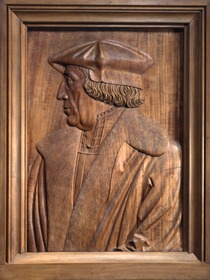
This profile portrait, facing left, shows the well-known scholar with a skullcap firmly fitted on his brow. He is wearing a cloak with a high fur collar. A knowing smile is on his thin, tightly-closed lips. The nose protrudes from the contour, the hairless cheeks and chin seem sunken, with the bones outlined. The gaze directed forward and the slightly raised chin give him an air of confident superiority.
The back shows a male bust on a base, with wind-blown hair. It is the Roman god Terminus, as may be deduced from the two-line inscription on the base: The maxim reads: “CON/ CEDO/NV/LLI” – “I yield to no-one”. The inscription in Latin: “MORS VLTIMA LINEA RERUM” translates as: “Death is the terminus of all things”, so for Erasmus the god Terminus signified death as the inevitable end of life.
A philologist, theologian and philosopher, Erasmus of Rotterdam is indisputably the most notable humanist north of the Alps. He was born in Rotterdam as the illegitimate son of the priest Rotger Gerhard and a doctor’s daughter. Having been ordained as a priest, he studied theology in Paris between 1495 and 1499. This was followed by numerous trips to England, where he forged a friendship with the statesman and humanist Thomas More (1478-1535), as well as with the young Prince Henry, who would later be known as Henry VIII during his reign from 1509 to 1547. Erasmus thus became familiar with life at the Court and transformed himself from a canon to a sophisticated man of the world. From 1500 on, he settled in the Netherlands, then in Paris and Italy and once more in England, where he studied at Cambridge University. From 1514 to 1529 and between 1535 and 1536 he mainly lived in Basel. As a scholar, he applied the critical study of sources not only to the writings of ancient authors, but also to the biblical texts and those of the fathers of the Church. In his best-known book The Praise of Folly, published in 1509 and of which thousands of copies were printed, he ironically criticised social disapproval and religious intolerance. With the translation into Latin of the original Greek of the New Testament, and his scientific and literary works, Erasmus became a forerunner of the Reformation. Nevertheless, as a cultivated and conservative man, he distanced himself both from Luther’s struggle against the papacy and the religious radicalism propagated by Zwingli and the Anabaptists.
Probably on the request of his friend Thomas More, Erasmus would have commissioned the Antwerp Quentin Massys with the medal which served as the model for this, and he would have sent it to relatives, influential nobles, bishops and vicars. The reduced version shown here would have been used for the same purpose.
Letzte Aktualisierung: 06.02.2026
Kontakt
Einrichtung:
Skulpturensammlung und Museum für Byzantinische Kunst
E-Mail:
sbm@smb.spk-berlin.de