
Logo

Kreuzigungsretabel aus Soest

Ident. Nr.: 1216A

ObjID: obj:862977

Details (Expert)

Beteiligte
Ausführung: Unbekannt,
Maler*in
Datierung
Ausführung: um 1240
Weitere Titel
Sammlungstitel: Kreuzigungsretabel aus Soest
Übersetzung: Crucifixion retable from Soest
Geografische Bezüge
Westfalen,
Region
Material / Technik
Pergament auf Eichenholz
Abmessungen
Bildmaß: 86 x 195,5 cm

Objektbeschreibung

In der Wiesenkirche in Soest in Westfalen wurden 1862 zwei Altaraufsätze des 13. Jahrhunderts entdeckt, die zu den Inkunabeln der deutschen Tafelmalerei zählen. Beide Tafeln sind älter als die Wiesenkirche. Sie müssen daher aus einem Vorgängerbau oder aus einer anderen Kirche dahin übertragen worden sein. Die ältere der beiden Tafeln, eines der frühesten Altarretabel Deutschlands überhaupt, ist etwa um 1240 gemalt worden. Die jüngere ist wohl zwanzig Jahre später entstanden.
Das frühere Werk ist eine breitrechteckige Tafel mit drei Bildfeldern. Das Bildprogramm behandelt die Bedeutung des Opfers Christi. Die Darstellung des Kreuzes mit dem übergroßen Leib Christi beherrscht die Mitte. Nur wenige Personen wohnen dem Ereignis bei. Links, auf der guten Seite, wohin Christus sein Haupt neigt, steht Maria mit den frommen Frauen und Johannes. Auf der rechten Seite, von der Christus sich abwendet, steht der römische Hauptmann mit seinen Soldaten und Zuschauer. Darüber, auf einer Art Brüstung, gleichsam auf einer höheren Ebene, erscheint links ein Engel mit der Ecclesia, der Verkörperung der christlichen Kirche. Mit einem Kelch fängt diese das Blut aus der Seitenwunde Christi auf und empfängt so Sakrament und Gnadenmittel der Kirche. Auf der gegenüberliegenden Seite rechts vertreibt ein Engel die Synagoge, die Personifikation des Alten Testaments, des Alten Bundes und des Judentums. Die Synagoge verliert ihre Krone zum Zeichen des Verlustes ihrer Herrschaft. Über dem Querbalken des Kreuzes öffnet sich eine weitere Sphäre, in der die Chöre der Engel schweben. Im linken Bildfeld wird Christus gefesselt vor die Hohepriester zum Verhör geführt. Kaiphas, der mit einem anderen Priester an einem Tisch sitzt, fragt ihn: »Wie lange willst Du uns noch hinhalten? Bist Du Christus, so sag es uns öffentlich. « Im Hintergrund, nur zeichenhaft angedeutet, erscheinen die Mauern und Zinnen der Stadt Jerusalem.
Das rechte Bildfeld zeigt Maria und ihre Begleiterinnen vor der Grabeshöhle, in der nur das Grablinnen zurückblieb. Ein Engel sitzt auf einem altarartigen Stein und weist mit großer Gebärde auf das leere Grab. Das bedeutet, Christus ist nicht mehr hier, er ist auferstanden. Rechts unten schlafen die römischen Grabwächter.
Das Programm wird mit dem Verhör Christi vor dem Hohepriester Kaiphas eröffnet. Christus steht von den Seinen verlassen vor seinen Anklägern. Diese Szene ist wohl als Beginn der Passion aufzufassen.
Der Kruzifixus in der mittleren Darstellung ist eingefasst von Ecclesia und Synagoge. Sieg und Aufstieg der einen und Niederlage und Abstieg der anderen bezeichnet die Bedeutung dieses heilsgeschichtlichen Ereignisses. In den Ecken der Bildfelder sind Halbfiguren von Propheten mit Schriftbändern angeordnet. Die Textstellen beziehen sich auf das Erscheinen des Messias, das mit Leben und Tod Christi erfüllt wurde. In den Propheten wie in Ecclesia und Synagoge wird so die Übereinstimmung des Alten und des Neuen Testaments sichtbar und die Fortdauer des Bundes mit Gott bestätigt. Die Schrift ist erfüllt worden.
Die Szene vor dem leeren Grab bezeugt die Auferstehung Christi von den Toten und macht die christliche Verheißung von der Überwindung des Todes anschaulich. Die einzelnen Darstellungen und ihre Elemente bilden zusammen ein sinnvolles Ganzes, das den Opfertod als zentrales Ereignis der Heilsgeschichte hervorhebt, das in der Messe am Altar immer wieder vergegenwärtigt wird.
Die äußere Form des Retabels erinnert in manchen Zügen noch an den Ursprung solcher Altarmalereien.
Im hohen Mittelalter war es üblich, die zu einem Altar gehörigen Reliquien von Heiligen in Schreinen auf der Altarmensa zur Schau zu stellen. Diese waren nicht selten von Gold und Silber, verziert mit edlen Steinen, Perlen und Emaillemalerei. Die frühen Retabel, die sie anscheinend ersetzten, übernahmen daher auch in Gestalt und Erscheinungsbild Elemente solcher Reliquienschreine. Der mehrfach geschweifte obere Umriss unseres Retabels ist vielleicht darauf zurückzuführen. Die Tafel und die Bildfelder sind von reliefierten Ornamentstreifen eingefasst, die von Werken der Goldschmiedekunst abzuleiten sind. Auch die Muldenform der runden Bildfelder, die den Glanz des Goldes besonders zur Geltung bringt, ist wohl von Goldschmiedearbeiten abhängig. Die Imitation fremder Techniken deutet darauf hin, dass wir es noch mit einem Beispiel aus der Frühzeit der Gattung Altarmalerei zu tun haben.
Stilistisch weist die Malerei Merkmale eines Übergangs auf. Manche Figuren tragen noch Gewanddraperien, wo Gegenstände oder Glieder mit parallelen Falten in Ovalen und Kreisen umschrieben werden. Diese an die ältere Entwicklung anschließenden Formen sind kurvig, weich und fließend. Andere, moderneren Prinzipien folgende Gewandbildungen zeigen kantige, kristalline, in splittrigen Brüchen aufgefächerte Formen, die aus der byzantinischen Tradition in die Malerei des 13. Jahrhunderts einflossen. Man nennt diese Formbildungen anschaulich Zackenstil. Unsere Tafel steht noch am Beginn dieser Stilphase. Die zweite, jüngere Tafel mit einer Darstellung der Heiligen Dreifaltigkeit – Gottvater, Sohn und Heiliger Geist – in Form eines Gnadenstuhls in der Mitte und Maria und Johannes, dem Evangelisten, als Fürbitter an den Seiten zeigt den Zackenstil in seiner reifsten Ausbildung. Alle Formen sind in eckige, spitze, kantige und scharfe Gebilde aufgelöst, die sich gegenseitig bedrängen und stoßen. Sie vermitteln den Eindruck von heftiger innererBewegung und großer Energie. Diese weitgehend abstrakte Übersteigerung der Stilelemente bezeichnet wohl eine Phase kurz vor dem Ende dieser Erscheinung um 1265/70. Wilhelm H. Köhler | 200 Meisterwerke der europäischen Malerei - Gemäldegalerie Berlin, 2019
______________________________

In 1862, two 13th-century altarpieces that count among the incunabula of German panel painting were discovered in the Wiesenkirche in Soest in Westphalia. Both panels are older than the Wiesenkirche itself and hence must have been transferred from a previous church building or from another church. The earlier of the two panels, one of the oldest altarpieces in Germany, was painted around 1240. The
other one was probably created 20 years later (fig left). The earlier work is a broad rectangular panel with three pictorial fields. Its iconography is devoted to the theme of Christ’s sacrifice. The cross with the over-dimensioned Corpus dominates the centre of the panel. Only a few people are attending
the crucifixion. Mary with the pious women and John stand on the left, the good side, towards which Christ is inclining his head. On the right, the side from which Christ is turning away, stands the Roman centurion with his soldiers and several onlookers. Above this scene, on a kind of parapet and as if at a higher level, an angel appears on the left with Ecclesia, the embodiment of the Christian Church. Ecclesia is catching the blood from the wound in Christ’s side in a chalice and is thus receiving the holy sacrament and means of grace. Opposite her on the right, an angel is driving away Synagogue, the personification of the Old Testament, the Old Covenant and Judaism. Synagogue is losing her crown, symbolising her loss of power. At the top, above the crossbar, choirs of angels can be seen floating in a still higher sphere.

The left pictorial field shows Christ, bound, being led to the high priests for interrogation. Caiaphas, who is sitting at a table with another priest, asks him: “How long are you going to keep us waiting? If you are Christ, then tell us so publicly.” In the background, the schematic outlines of the walls and towers of the City of Jerusalem can be seen. The right pictorial field shows Mary accompanied by women standing in front of the sepulchral cave where only Christ’s shroud remains. An angel is sitting on an altar-like stone gesturing towards the empty grave. Christ is no longer there, for he has risen. At bottom right, the Romans guarding the grave are asleep.

The iconography begins with the interrogation of Christ before the high priest Caiaphas. Christ stands before his accusers abandoned by those close to him. This scene should probably be interpreted as the beginning of the Passion. The crucifix in the centre is framed by Ecclesia and Synagogue. The meaning of the crucifixion in Salvation History is signified by the victory and rise of the one and the defeat and fall of the other. Half-length portraits of prophets with text scrolls are arranged in the corners of the pictorial fields. Their texts tell of the coming of the Messiah, a prophecy fulfilled by the life and death of Christ. The depictions of the prophets, like those of Ecclesia and Synagogue, illustrate the accordance between the Old and New Testaments and confirm the continuing covenant with God. The prophecy has been fulfilled. The scene before the empty grave attests to the resurrection of Christ from the dead and is a visual illustration of the Christian promise of overcoming
death. Taken together, each of the depictions and their composite elements form a meaningful whole that highlights Christ’s sacrifice as a central event in the story of redemption repeatedly recalled during mass at the altar.

The outer form of the altarpiece in some ways recalls the origins of this type of altar painting. In the High Middle Ages it was usual to display the relics of saints belonging to an altar in shrines on the altar mensa. Often these were made of gold and silver decorated with precious stones, pearls and enamel painting. In terms of shape and appearance, the early altarpieces that apparently replaced them adopted certain elements of such relic shrines. This may explain the undulating shape of
the top of the present altar.

The relief ornamental bands framing the panel and the pictorial fields were
inspired by goldsmith’s work. The same applies to the recessed shape of the round pictorial fields, which accentuates the gold sheen particularly well. The imitation of other media and techniques suggests that this is still an early example of painted altarpieces. In terms of style, the painting suggests a period of transition. Some of the figures are still wearing draped apparel, where objects and limbs are outlined in ovals and circles with parallel folds. These curvaceous, soft, flowing forms carry on an older tradition. By contrast, the depiction of other garments follows more modern principles, using angular, crystalline forms that splinter into fragments. Originating in the Byzantine tradition and influenced by the painting of the 13th century, these formations are described rather graphically as Zackenstil or jagged style.

The present panel was painted when this style was still in its infancy. The second, later panel, showing the Holy Trinity – God the Father, the Son and the Holy Spirit – in the form of the Throne of Mercy in the centre with Mary and John the Evangelist as intercessors at the sides, is a prime example of the Zackenstil. All the forms dissolve into angular, pointed, jagged and sharp entities, which crowd into
one another. They convey an impression of intense inner movement and a great deal of energy. This largely abstract heightening of the stylistic elements was probably characteristic of a phase shortly before this phenomenon came to an end around 1265/70. Wilhelm H. Köhler | 200 Masterpieces of European Painting - Gemäldegalerie Berlin, 2019

Letzte Aktualisierung: 03.07.2026

Kontakt

Einrichtung:

Gemäldegalerie

Weitere Objekte aus den Sammlungen

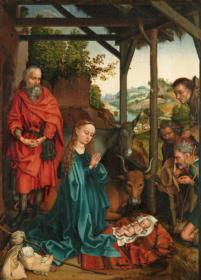
Die Geburt Christi mit der Anbetung der Hirten

Die Geburt Christi mit der Anbetung der Hirten

Eine der kraftvollsten Künstlerpersönlichkeiten, zugleich ein zartes, lyrisches Temperament, tritt als Vollender der spätgotischen Malerei in Deutschland in Erscheinung: Martin Schongauer aus Colmar. Seiner Kunst wegen nannten ihn seine Zeitgenossen »Hipsch Martin« oder auch »Martin Schön«, und nach seinem Tod wurde er als »pictorum gloria«, als Ruhm aller Maler, hoch gepriesen. Sein Einfluß auf die deutsche und niederländische Kunst zu Ende des 15. und bis weit ins 16. Jahrhundert hinein ist kaum zu überschätzen. Wir kennen ihn vorwiegend als Graphiker. 116 seiner Stiche sind erhalten geblieben. Sie waren in ganz Europa verbreitet und wirkten noch lange nach seinem Tod anregend auf andere Künstler. Auch Albrecht Dürer zog nach Colmar, um bei Schongauer zu arbeiten. Da dieser inzwischen verstorben war, lernte er ihn nicht mehr kennen. Dennoch ist Dürer wesentlich von der Formtradition der Schongauerwerkstatt geprägt worden. Das malerische Werk Schongauers wurde von den Bilderstürmen und den Zeitläuften weitgehend vernichtet. Nur wenige Gemälde seiner Hand sind auf uns gekommen und geben uns einen Begriff von seiner überragenden malerischen Kunst. Unter diesen ist die um 1480 gemalte Geburt Christi in Berlin eines der reifsten und schönsten. Erzählt wird das Geschehen in der Weihnachtsnacht, die Geburt des Kindes in einer Hütte vor einer Höhle am Wegrand. Der biblische Bericht ist mit legendären Zügen ausgeschmückt, die teils der Bildtradition, teils mystischen Schriften entstammen. Die einzelnen Elemente der Darstellung sind jedoch übersichtlich geordnet und sinnvoll zu einem Ganzen verschmolzen. Das Kind liegt auf einer weißen Windel am Boden. Das Weiß des Tuches, die hellste Farbe im Bild, steht sinnbildlich für den überirdischen Glanz, der nach der Legende von dem Knaben ausging. Das Kind ist das eigentliche Zentrum des Bildes, um das herum sich alles ordnet. Ihm wenden sich alle anderen Figuren in Bewegung oder Blickrichtung anbetend zu. Maria ist ihm am nächsten. Der Saum ihres Mantels, der zum Kind hin fällt, macht die Beziehung augenfällig. Joseph steht weiter weg. Durch den Wanderstab und das Bündel ist auch er mit dem Kind verbunden. Auch die Tiere, die die Heilige Familie begleiten, sind dem Kind zugewandt, der Ochs steht näher, der Esel ferner. Möglicherweise ist dies Ausdruck einer Deutung, die in den beiden Tieren Sinnbilder des Alten und Neuen Testaments erkennt. So erscheint die Familie mit den Tieren in der Hütte geborgen und von einem heiligen Bezirk umgrenzt. Die Hirten, die gekommen sind, den neugeborenen König zu verehren, verharren draußen vor der Hütte. In Nähe oder Ferne zu Christus ist das Verhältnis der einzelnen Gestalten zu ihm klar und anschaulich bestimmt. Der Betrachter des Bildes wohnt dem Ereignis gleichsam in der Hütte selbst bei und wird so in das Geschehen einbezogen. Die Hirten vor dem Stall, ein jüngerer, einer mittleren Alters und ein Greis, machen deutlich, daß alle Lebens alter, Jung und Alt, dem Neugeborenen huldigen. Die Stützen und Balken der Hütte gliedern das Bildfeld, ihre perspektivischen Linien leiten das Auge zugleich in die Tiefe des Raumes, in ein übersonntes, weites Flußtal mit Hirten und Herden. Über dem Dach der Hütte lagert aber noch das Dunkel der Nacht. Nach einer Legende nämlich war die Geburtsnacht vom Stern von Bethlehem erleuchtet und hell wie ein Tag, so daß es Nacht und Tag zugleich war. Legendäres und Symbolisches sind wie selbstverständlich in die Darstellung eingewoben. Der emaillehafte Schmelz der leuchtenden Farben trägt zur Klarheit der Komposition bei. Wilhelm H.Köhler | 200 Meisterwerke der europäischen Malerei – Gemäldegalerie Berlin, 2019____________________________________________________________________________________ The artist regarded as having brought late Gothic painting in Germany to its apogee was Martin Schongauer from Colmar, one of the strongest artistic personalities and at the same time a man with a gentle, lyrical temperament. His contemporaries nicknamed him “Hipsch Martin” (pretty Martin) or sometimes “Martin Schön” (Martin the beautiful) on account of his art; after his death he was venerated as pictorum gloria, the glory of all painters. His influence on German and Netherlandish artin the late 15th and well into the 16th century can scarcely be overestimated. We know him primarily as a graphic artist. 116 of his engravings have been preserved. They were distributed all over Europe and continued to provide inspiration for other artists long after his death. Albrecht Dürer moved to Colmar in order to work with Schongauer, but by the time he arrived Schongauer was already dead, so the two artists never met. Nevertheless, Dürer was influenced in major ways by the formal traditions of Schongauer’s workshop. Most of Schongauer’s painterly oeuvre was destroyed either by the iconoclasts or by the ravages of time. The few paintings that have come down to us give us an idea of his phenomenal painted art. The Nativity in the Berlin collection, dating from around 1475, counts among his most mature and most beautiful works.The painting narrates the events of Christmas night, the birth of the child in a hut before a cave at the side of the road. The Biblical account is embroidered with elements of legend, some taken from the pictorial tradition, others from the writings of the Mystics. The individual elements of the depiction are, however, clearly arranged and merged into a whole in a meaningful way. The child is lying on the ground in white swaddling clothes. The white of the cloth, the lightest colour in the painting, symbolises the celestial splendour that according to legend radiated from the infant. The child forms the centre of the picture; everything else is arranged around him. All the other figures are eithermoving towards him or gazing at him in veneration. Mary is closest. The hem of her coat is falling towards the child, making their relationship obvious. Joseph stands further away, but his staff and bundle connect him with the child. The animals accompanying the Holy Family are likewise turning towards the child, the ox closer, the ass further away.Perhaps this expresses an interpretation whereby the two animals symbolise the Old and New Testaments. Thus, the family and the animals are brought together in the hut’s shelter as if in a sacred enlosure. The shepherds who have come to pay their respects to the newborn king remain outside in front of the hut. The relationship of each of the figures to Christ is clearly illustrated by how close or distant they are. The viewer’s position seems to be inside the hut, too, and thus they are drawn intothe scene. The shepherds in front of the stable, one younger, one middle-aged, the third an old man, demonstrate that people of all ages, young and old, are paying homage to the new born. The supports and beams of the hut structure the pictorial field, their lines of perspective guiding the eye into the depths of the space, a sunny, broad river valley with shepherds and their flocks of sheep. Above the roof of the hut, the darkness of night still reigns. According to a legend, the night when Christ wasborn was light as day, illuminated by the star of Bethlehem, so that it was night and day at the same time. Legends and symbols are woven naturally into the depiction. The enamel-like glaze of the radiant colours adds clarity to the composition. Wilhelm H.Köhler | 200 Masterpieces of European Painting – Gemäldegalerie Berlin, 2019

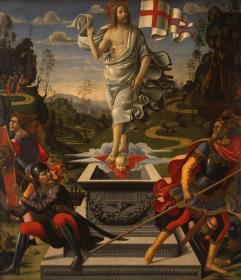
Die Auferstehung Christi

Die Auferstehung Christi

»Nun, da ich die Methoden dieser Kunst zu verstehen beginne, grämt es mich, dass sie mir nicht den Auftrag erteilen, das gesamte Rund der Stadtmauern von Florenz mit Geschichten zu bemalen.« Diese Aussage soll Domenico Ghirlandaio gegenüber seinem Bruder Davide geäußert haben, nachdem er den Chor der Dominikanerkirche S. Maria Novella ausgeschmückt hatte. Die Fresken sind heute nochzu sehen und gehören zu den künstlerischen Höhepunkten eines Florenzbesuchs. Doch Ghirlandaio war nicht nur ein bemerkenswerter Freskant, er ist auch für die Gemälde des Hochaltars verantwortlich, die Anfang des 19. Jahrhunderts veräußert wurden. Die Mitteltafel der Vorderseite, Maria mit dem Kinde und Heiligen, befindet sich heute in der Alten Pinakothek in München; die heute in der Gemäldegalerie in Berlin aufbewahrte Auferstehung nahm die Rückseite des Altarbilds ein, die nur für die Priester sichtbar war. Um die Mitteltafel und an den Seiten waren drei Heiligenpaare angeordnet. Zwei dieser Heiligen befanden sich einst in der Gemäldegalerie und wurden vermutlich im Mai 1945 in den letzten Tagen des Zweiten Weltkriegs zerstört (Abb. links).Die Auferstehung zeigt Jesus Christus am Ostermorgen, wie er dem Grab entsteigt und die vier römischen Soldaten, die es bewachen, in Schrecken versetzt. Ghirlandaio wich hier stark vom Inhalt der Heiligen Schrift ab: Das Grab Christi befand sich in einer Höhle und nicht unter freiem Himmel und keinesfalls wies es die Inschrift INRI auf (Jesus von Nazareth, König der Juden), die oben an seinem Kreuz angebracht gewesen sein soll. Auch der Pelikan, der seine Jungen mit demeigenen Blut nährt, entwickelte sich erst viel später zu einem Symbol Christi. Der Maler wollte hier die Theatralik der Szene betonen: Jesus scheint beinahe von einer unsichtbaren Maschinerie in die Luft gehoben, während die Soldaten ihre Überraschung und Angst zu überspielen suchen. Während des 19. Jahrhunderts erfuhr Ghirlandaio für seinen Sentimentalismus große Bewunderung, wurde von einigen Ästheten genau aus diesem Grund jedoch auch stark kritisiert. Der Landschaft in diesem Gemälde gebührt die gleiche Beachtung wie der bemerkenswerten Szene im Vordergrund. Auf der linken Seite nähern sich die drei Marien, die gleich das leere Grab Christi entdecken werden (ihre Namen variieren je nach Evangelium). Dahinter erkennt man im blauen Dunstschleier eine Stadt imflämischen Stil, mit einer besonderen Nähe zur Malweise des Hugo van der Goes. Am 28. Mai 1483 traf Van der Goes’ Bild für den Hochalter von S.’Egidio in Florenz ein (jetzt in den Uffizien), Domenico Ghirlandaio änderte daraufhin seine Vorstellung von Tafelmalerei.Ghirlandaio vollendete weder das Altarbild für S. Maria Novella, noch war es ihm vergönnt, die Stadtmauern von Florenz zu bemalen, wie er gehofft hatte: 1494 starb er im Alter von 45 Jahren an der Pest. Es hat etwas Bewegendes, stellt man sich vor, dass der Tod den Maler während der Arbeit an dieser Auferstehung ereilte, deren Botschaft die Hoffnung auf ein Leben nach dem Tod enthielt. Giorgio Vasari zufolge wurde dieser Teil des Bildes von Ghirlandaios Brüdern Davide undBenedetto fertiggestellt. Kritiker stimmen jedoch darin überein, dass die Landschaft von einem anderen Künstler stammen muss, in dem man Ghirlandaios Schüler Francesco Granacci sah, der heute als Pseudo Granacci bezeichnet wird. Trotz dessen Mitwirkens kann die Auferstehung als eines der letzten Meisterwerke von Domenico Ghirlandaio gelten. Neville Rowley | 200 Meisterwerke der europäischen Malerei - Gemäldegalerie Berlin, 2019________________________________________“Now that I have begun to understand the methods of this art, it grieves me that they will not commission me to paint the whole circuit of the walls of the city of Florence with stories.” This is what the painter Domenico Ghirlandaio is reputed to have said to his brother Davide, after having finished decorating the choir of the Dominican Church of Santa Maria Novella. The frescoes are still in place and are one of the highlights of any visitor who discovers Florence. But Ghirlandaio was not only a remarkable fresco painter: he was also responsible for the gigantic altarpiece adorning the chapel, dispersed at the beginning of the 19th century. The Virgin and Child in Glory among Saints which occupied the central compartment on the front side is now to be seen in Alte Pinakothek in Munich; as for the present Resurrection now in the Gemäldegalerie in Berlin, it was on the other side of the altarpiece, only visible to priests. Around the central panels and on the lateral sides of the altarpiece, three pairs of saints were displayed; two of these saints, once part of the collection of the Gemäldegalerie, were probably destroyed in May 1945 in the last days of the Second World War (fig. left).The Resurrection shows Jesus-Christ on Easter morning, coming out of his tomb, to the complete astonishment of the four Roman soldiers charged to guard his sepulture. Ghirlandaio freed himself largely from the Holy Scriptures: Christ’s tomb was set in a cave and not in the open air; and it was certainly not inscribed with the acronym “I.N.R.I.” (Jesus Christ King of Nazareth), placed instead on top of his cross, nor with the Pelican who fed his children with his blood, a symbol of Christ adopted much later (it is true that the inscription appears to have been painted over a former one). What mattered for the painter was to accentuate the theatrical character of the scene: Jesus seems to be pulled into the air by some backstage machinery, while the soldiers over-play their surprise and their fear. During the 19th century, Ghirlandaio was greatly admired for his sentimentalism; and also despised by a few aesthetes for this very reason.The landscape of this painting is to be admired on the same level as the ostentatious foreground. On the left side, we see the three Mary who, soon, will discover the empty tomb of Christ (their identities vary according to the gospels). Further on, one distinguishes a city in a blue mist, painted like in a Flemish style, and close in particular to Hugo van der Goes. On 28 May 1483, the high altarpiece of the church of Sant’Egidio, painted by Van der Goes, had arrived in Florence (it is now in the Uffizi); from that moment on, Domenico Ghirlandaio changed his conception of panel painting.Ghirlandaio did not have time to finish the Santa Maria Novella altarpiece, nor to fresco the whole circuit of the walls of Florence, as he had hoped: he died from the plague in 1494, only aged 45. There is something moving about imagining the painter agonizing while trying to complete this Resurrection, whose religious message is to give hope in a life after death. According to Vasari, this part of the altarpiece was completed by the painter’s brothers, Davide and Benedetto; but critics nowagree that the landscape is due to another artist, long confused with the pupil of Ghirlandaio Francesco Granacci and now known as the “Pseudo Granacci”. Despite the latter’s intervention, one can fully consider the Resurrection as one of the last masterpieces by Domenico Ghirlandaio. Neville Rowley | 200 Masterpieces of European Painting - Gemäldegalerie Berlin, 2019