
Fotonachweis: Staatliche Museen zu Berlin, Gemäldegalerie / Jörg P. Anders Public Domain Mark 1.0
Details (Expert)
- Beteiligte
- Datierung
- Ausführung: um 1420
- Weitere Titel
- Sammlungstitel: MarientriptychonÜbersetzung: Triptych: The Virgin and Child
- Geografische Bezüge
- Material / Technik
- Eichenholz
- Abmessungen
- Tafelmaß: Mitteltafel 39,5 x 33,5 cm mit Rahmen
- Permalink
- https://id.smb.museum/object/863769
Objektbeschreibung
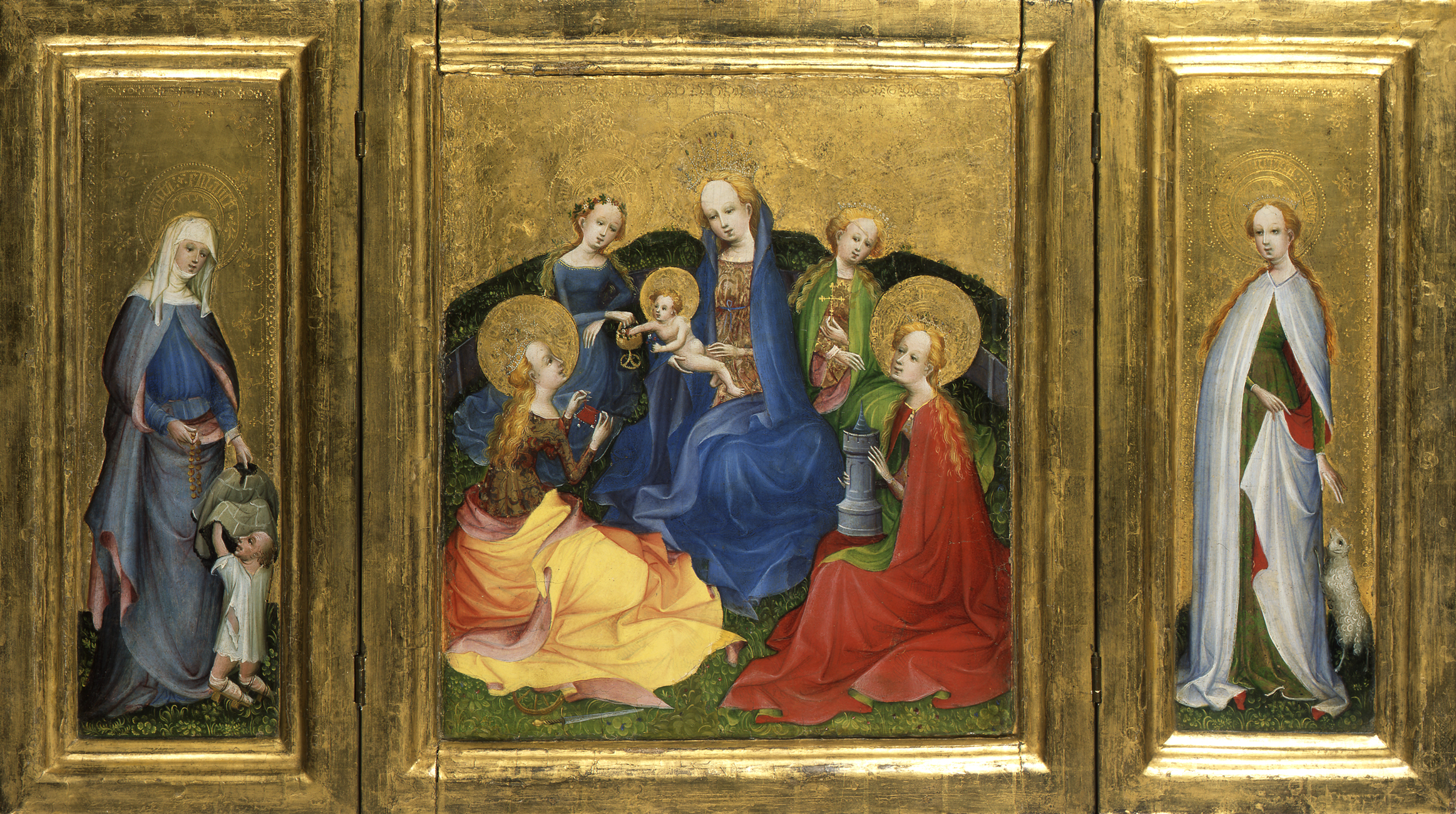
Der kleine Hausaltar übersetzt die Form eines großen dreiteiligen Altarretabels, eines sogenannten Triptychons, in Miniaturform. An einer größeren zentralen Tafel sind mittels Scharnieren bewegliche Flügel angebracht, die nur halb so breit wie die Mitteltafel sind. Diese Flügel können so vor das Mittelbild geklappt werden, dass sie es verschließen. Bei großen Altären sind auch die Außenseiten der Flügel bemalt, hier sind Rück- und Außenseiten nur rot gefasst. Die Mitteltafel unseres Triptychons zeigt Maria mit dem Christuskind auf dem Schoß, umgeben von vier hl. Jungfrauen, in einem blühenden Garten. Das mit mancherlei Blumen besetzte Rasenstück ist von einem Zaun umfangen und nach außen hin abgeschlossen. Maria ist durch eine Krone als »regina coeli«, als Himmelskönigin, gekennzeichnet. Die Jungfrauen sind durch Inschriften ihrer Namen in den Nimben und durch beigefügte Attribute bestimmt. Die hl. Dorothea in blauem Kleid, links neben Maria, trägt einen Kranz weißer und roter Rosen auf dem Haupt. Sie bietet dem Christusknaben ein Körbchen mit Rosenblüten dar. Sie war eine Jungfrau in Caesarea in Kappadokien, die während der diokletianischen Christenverfolgung den Tod erlitt. Die Rosen erinnern an ein Wunder während ihrer Marter. Vierzehn Nothelfern zu den auch sie zählt und zusammen mit den Jungfrauen Margareta, Katharina und Barbara zu den »virgines capitales«. Die heilige Margareta, rechts von Maria, in rotem Gewand und grünem Mantel, zeigt ein Kreuz. Während ihres Martyriums erschien ihr der Teufel in Gestalt eines Drachens, den sie mit dem Kreuz vertrieb. Links vorn in gelb-rot schattiertem Mantel sitzt die hl. Katharina. Sie war eine Jungfrau aus königlichem Stamm in Alexandrien in Ägypten. Kaiser Maxentius wollte sie vom christlichen Glauben abbringen und dazu zwingen, den heidnischen Göttern zu opfern. Sie widerstrebte und sollte durch das Rad gerichtet werden. Ein Engel verhinderte dies. Schließlich starb sie durch das Schwert. Dieses und Reste des Rades sind ihr als Attribute beigegeben. Die hl. Barbara, vorne rechts im roten Mantel, trägt einen Turm in ihrem Schoß als Erinnerung daran, dass ihr Vater sie in einem solchen verwahrte. Auch sie erlitt den Tod, weil sie ihrem Glauben treu blieb. Der eingefriedete, abgeschlossene Garten, in dem Maria mit anderen heiligen Jungfrauen auf dem Rasen ruht, ein »hortus conclusus«, ist nach dem Hohenlied Salomonis (»Du bist ein verschlossener Garten, meine Braut …«; 4, 12) auch eine Metapher für Maria. Die Gleichsetzung Mariens mit einem unberührten, verschlossenen Garten verweist sinnbildlich auf die Unbefleckte Empfängnis der Gottesmutter und auf ihre Jungfräulichkeit. Sie spielt aber auch an auf die Gleichsetzung Mariens mit der Braut des Hohenliedes der Bibel. Zugleich meint dieser Ort, an dem es immerwährend blüht, den Garten des Paradieses. Damit verbinden sich Vorstellungen himmlischer und ewiger Freuden. Darstellungen der Maria im Paradiesgarten finden sich seit der Zeit um 1400 mehrfach. Es sind von mystischer Gläubigkeit geprägte Andachtsbilder, die die Seligkeit der Gottesmutter und der Heiligen im Himmel den Gläubigen vor Augen stellen. Die beiden Seitenflügel zeigen einzelne Heilige. Auf dem linken Flügel ist die heilige Elisabeth, die Landgräfin von Thüringen, dargestellt. Sie hat sich während ihres Lebens in Marburg den Armen und Kranken zugewandt und sich deren Pflege gewidmet. Hier reicht sie einem bedürftigen Krüppel ein wärmendes Gewand. Auf dem rechten Flügel ist die heilige Agnes mit einem Lamm zu sehen. Sie starb den Martertod, um ihre Jungfräulichkeit zu bewahren. Das weiße Lamm als Attribut ist Hinweis auf ihre Unschuld. Der Anklang ihres Namens Agnes an »agnus« (Lamm) verbindet sie zugleich mit Christus, dem Lamm, das der Welt Sünde trägt. Der Stil der Tafel ist geprägt von einer hellen, blühenden Farbigkeit, wobei kontrastierende, changierende oder auch komplementäre Farbstellungen bevorzugt werden. Die Falten und Draperien der Gewänder sind in weiche, schmiegsame Kurven gelegt, wie sie charakteristisch sind für den Weichen Stil der Internationalen Gotik um 1400 und danach. Die puppenhaft schönen Köpfchen, die ohne tieferen Ausdruck sind, die maniriert gelängten Gestalten und das Preziöse der Gestik und Haltung spiegeln den Abglanz eines Schönheitsideals, das die höfische Gesellschaft dieser Zeit charakterisiert. Die Verkleinerung mancher Formen, etwa der Attribute – auch der Marterinstrumente–, bis hin zum Spielzeughaften zeigt das Bemühen um Zierlichkeit. Der Ausdruck des Weichen, Lyrischen und Empfindsamen, ferner des Preziösen, der Spätgotik ins - gesamt nicht fremd, kennzeichnet besonders die Kölner Kunst dieser Zeit. Im Stil steht dieses Altärchen der Malerei eines Altarretabels mit der Darstellung der Heiligen Sippe aus St. Heribert in Köln nahe (Köln, Wallraf-Richartz-Museum). Um dieses Werk hat man mehrere stilistisch ähnliche Gemälde gruppiert. Den mutmaßlichen Maler dieser Werke nannte man nach dem Altar aus St. Heribert Meister der Heiligen Sippe. Im Unterschied zu einem anderen anonymen Maler einer Heiligen Sippe vom Ende des Jahrhunderts heißt dieser auch Meister der älteren Heiligen Sippe oder der älteren Sippenaltars. Er war im ersten Drittel des 15. Jahrhunderts tätig. Wilhelm H.Köhler | 200 Meisterwerke der europäischen Malerei - Gemäldegalerie Berlin, 2019
_________________________
The small house altar transposes a larger three-part altarpiece, a so-called triptych, into miniature form. Moveable wings have been attached with hinges to a larger central panel. As they are each only half its width, they can be folded over to cover the middle panel. In larger altarpieces, the reverses of the wings are also painted, but here the back and outsides are simply done in red.
The central panel of this triptych shows Mary with the Christ child on her lap surrounded by four holy virgins in a garden full of flowers in bloom. The grass, strewn with a variety of flowers, is surrounded by a fence and hence closed off to the outside. Mary is wearing a crown, identifying her as regina coeli, the queen of heaven. The virgins are identified through inscriptions of their names in their
halos and by various accompanying attributes. To Mary’s left, Saint Dorothy in a blue dress is wearing a wreath of white and red roses on her head and is offering the Christ child a little basket of rose petals. As a Christian virgin, she was killed in Caesarea (Cappadocia) during the Diocletian persecution of Christians. The roses recall a miracle that occurred during her martyrdom. Together with the three Holy Helpers, Margaret of Antioch, Catherine of Alexandria and Barbara of Nicomedia, Dorothea is one of the virgines capitales.
To Mary’s right, Saint Margaret in a red robe and green mantle is holding up a cross. During her martyrdom, the devil appeared to her in the form of a dragon, which she banished with the cross. At the front on the left, wearing a mantle in shades of yellow and red, sits Saint Catherine, a Christian virgin from the royal tribe of Alexandria (Egypt). Emperor Maxentius tried to persuade her to relinquish her Christian faith and to force her to give sacrifices to pagan gods. She resisted and
was condemned to death by torture on the spiked wheel, but an angel intervened. Ultimately she died by the sword. Thus, the sword together with the remains of the spiked wheel are her attributes. Saint Barbara, in a red mantle at front right, has a tower on her lap, recalling the fact that her father kept her in a tower. She too was killed for remaining true to her faith.
The enclosed garden, a hortus conclusus in which Mary is resting on the grass with the other holy virgins, is also a metaphor for Mary as referred to in Solomon’s Song of Songs (“You are a garden locked up, my sister, my bride”; 4:12). The equation of Mary with an untouched, closed garden is an allusion to the Immaculate Conception of the Mother of God and to her virginity. At the same time it references the Bible’s equation of Mary with the bride in the Song of Songs. In addition, the garden where eternal flowers bloom recalls the Garden of Paradise, thus connecting ideas of heavenly and eternal joy. Several portrayals of Mary in the Garden of Paradise are to be found in the period around 1400. These are devotional images characterised by a mystical piety, which visually convey to the faithful beatitude of the Mother of God and the saints in heaven.
The two wings of the Mary Triptych show standing figures of saints. Saint Elizabeth, Landgravine of Thuringia, is depicted on the left. During her life in Marburg, she cared for the poor and the sick. Here she is seen giving a needy cripple a warm robe. The right wing shows Saint Agnes with a lamb. Saint Agnes was martyred for preserving her virginity. Her attribute, the white lamb, alludes to her innocence. The similarity between her name, Agnes, and the Latin word for lamb, agnus, also links her with Christ, the lamb who takes away the sins of the world.
In terms of style, the panel is characterised by its bright, vivid colouration. The artist is clearly fond of contrasting, iridescent and complementary colour schemes. The folds and draperies of the garments are depicted in the soft, supple curves characteristic of the “soft style” of International Gothic around 1400 and thereafter. The beautiful, doll-like heads without any profound expression, the mannered, elongated figures and the precious quality of their gestures and poses echo the ideal of beauty that characterised courtly society at this time. The diminution of some forms – the attributes, for instance, including the instruments of martyrdom – almost to the status of toys, testify to the artist’s striving to achieve a delicate portrayal. The soft, the lyrical, the sensitive and the precious, none of which was alien to the late Gothic period, are particularly characteristic of art in Cologne at this time.
Stylistically, this little altarpiece is close to the painting of an altarpiece from Saint Heribert in Cologne portraying the Holy Kinship (Cologne, Wallraf-Richartz-Museum). Several stylistically similar paintings have been grouped around this work. The painter of these has been named “Master of the Holy Kinship” after the Saint Heribert altarpiece. To distinguish him from another anonymous painter of the Holy Kinship from the end of the century, this painter is referred to as the “Master of the Holy Kinship the Elder” or “Master of the Older Kinship Altarpiece”. He was active during the first third of the 15th century. Wilhelm H.Köhler | 200 Masterpieces of European Painting - Gemäldegalerie Berlin, 2019
Letzte Aktualisierung: 03.07.2026
Kontakt
Einrichtung:
Gemäldegalerie
E-Mail:
gg@smb.spk-berlin.de