
Logo

Helios und Phaëton mit Saturnus und den vier Jahreszeiten

Ident. Nr.: 478

ObjID: obj:863862

Details (Expert)

Beteiligte
Ausführung: Nicolas Poussin (1594 - 1665),
Maler*in
Datierung
Ausführung: 1629 - 1630
Weitere Titel
Sammlungstitel: Helios und Phaëton mit Saturnus und den vier Jahreszeiten
Übersetzung: Helios and Phaëton with Saturn and the Four Seasons
Geografische Bezüge
Material / Technik
Leinwand
Abmessungen
Bildmaß: 125,1 x 155,7 cm
Erwerbung
1829/30 Überweisung aus den Königlich Preußischen Schlössern

Objektbeschreibung

Die komplexe, relativ seltene Darstellung hat ihre Quelle in den Metamorphosen des Ovid (II, 19-48), die durch die Übersetzung und Überarbeitung von Giovanni Andrea dell`Anguillara (Le Metamorfosi di Ovidio, 1561) zugänglich waren. Der junge Phaëton kniet vor seinem Vater, dem Sonnengott Helios (auch mit Apoll identifiziert) um ihn zu bitten, den links in Hintergrund von den Horen vorbereiteten Sonnenwagen für einen Tag herzuleihen. Ein Wunsch, der tödliche Konsequenzen für den Jungen haben sollte. Helios, unter einem Bogen von Tierkreiszeichen sitzend, ist mit der Leier Apolls gekennzeichnet, Personifikationen der Jahreszeiten umgeben ihn: Zu seiner rechten Seite verkörpert eine junge von Blumen gekrönte Dame den Frühling und reicht Blumen an einigen Amoretten; hinter Phaëton sitzt der Sommer als Frau mit einem Spiegel in den Händen; im Vordergrund liegt rechts der schlafende, betrunkene Herbst neben einer Vase voller Trauben; links die sitzende, frierende Figur des Winters, zu dessen Füßen zwei mit glühender Kohle gefüllten Kohlenbecken ein wenig Abwehr gegen die Kälte leisten. Hinter dem Winter schließlich läuft die geflügelte Darstellung der Zeit, der Titan Chronos, der allerfressende Vater von Zeus. Der greise Gigant isst - wie von Alessandro Della Latta anerkannt - einen Stein: Es war ein Trick seiner Frau Rea, die vermeiden wollte, dass auch Zeus wie der übrige Nachwuchs von Chronos gefressen wurde, und das Neugeborene durch einen Stein ersetze.
Dieses berühmte Gemälde wurde durch Nicolas Pérelle vor 1666 und später auch von dem Florentiner Cesare Fantetti seitenverkehrt gestochen. Höchstwahrscheinlich handelte es sich zudem um jenes Werk, das zwecks Begutachtung vom Maler und Kunsthändler Jean-Michel Picart in der Académie royale de peinture et de sculpture im Jahr 1674 vorgestellt wurde. Es ist ebenso möglich, wenngleich nicht sicher, dass unser Bild mit dem als „Jahreszeiten“ bezeichneten Gemälde identisch ist, das im Inventar des Sammlers Michel Passart 1684 aufgelistet wird. Seit 1773 gehörte die mythologische Darstellung zur Sammlung Friedrichs II., und wird in Oesterreichs Beschreibung des Neuen Palais in Potsdam aufgeführt.
In der Vergangenheit wurde das Werk zu spät datiert (1633-38), doch scheint es unmittelbar vor 1630 ausgeführt worden zu sein. Es gibt kompositorische Elemente, die z.B. an Poussins Parnass (Madrid, Museo del Prado, 1629: die Figur des Apoll) erinnern oder an dessen Tod des Germanicus von 1628 (Minneapolis, Institute of Arts); letzteres gleicht dem vorliegenden Werk auch in der Farbgebung. Die neovenezianisch orientierte Palette und die antiken Inspirationen schaffen eine Verbindung zu Poussins mythologischen Szenen der späten 20er-Jahre, bei denen es sich um freie Adaptionen von Werken Tizians handelt, besonders auffällig beispielsweise zu dem Midas und Bacchus der Alten Pinakothek, München. In dem herrlichen, damals in der Sammlung des Kardinals Mazarin, jetzt im Institute of Arts in Detroit befindlichen, Gemälde Diana und Endymion finden sich erhebliche Ähnlichkeiten, dazu ein ähnliches Format - identisch in der Höhe, aber 15 Zentimeter breiter -, was eine Wirkung als Pendant des vorliegenden Bildes nicht ausschließt. Auch thematisch gesehen wäre eine Verbindung mit dem Helios und Phaeton nicht auszuschließen, etwa, wenn man das Motiv des von vier Pferden gezogenen Wagens von Apoll/Helios im Hintergrund oben betrachtet. Ebenfalls in Poussins römischen Jahren, doch ein wenig später, wiederholte der Künstler den Wagen des Apoll/Helios, abermals vom Zodiakus umgeben, hoch am Himmel in seinem Reich der Flora (Dresden, Gemäldegalerie Alte Meister), einem Auftrag des Marquis Valguarnera von 1631. Die Figur des Apoll im Berliner Bild wiederholt sich im Parnass des Prado und in der Figur des Crocus im Dresdener Reich der Flora, einem Meisterwerk der ersten römischen Jahre. Roberto Contini | 200 Meisterwerke der europäischen Malerei - Gemäldegalerie Berlin, 2019
__________________________________________

This intricate, relatively uncommon pictorial theme has its source in the Metamorphoses of Ovid (II:19–48), which was made accessible in Italian through a translation and reworking by Giovanni Andrea dell’Anguillara (Le Metamorfosi di Ovidio, 1561). The young Phaeton kneels before his father, the sun god Helios (who is also identified with Apollo) and requests permission to borrow the sun chariot, being prepared by the Horae and visible here in the left-hand background, for one day. This desire will have fatal consequences for the youth. Helios, who is seated beneath an arch decorated with zodiacal symbols, is identified by Apollo’s lyre, and surrounded by personifications of the seasons: the young woman on his right, crowned with flowers, and shown proffering flowers to a number of cupids, embodies Springtime; seated behind Phaeton is Summer, who takes the form of a woman holding a mirror in her hands; reclining on the right foreground next to a vase filled with grapes is the sleeping, inebriated Autumn; and visible to his left is the seated, freezing figure of Winter, at whose feet a pair of braziers, filled with glowing coals, provide a minimal defence against the cold. Striding along behind Winter, finally, is the winged personification of Time, the Titan Chronos, the all-devouring father of Zeus. The aged giant eats – as recognized by Alessandro Della Latta – a stone: this was a trick of his wife Rea, who wanted to avoid having Zeus devoured by Chronos alongside her other offspring, and who therefore replaced the newborn with this object.

This famous painting was engraved by Nicolas Pérelle before 1666, and later by the Florentine artist Cesare Fantetti as well, this time laterally reversed. In all likelihood, moreover, this was the same work that was presented by the painter and art dealer Jean-Michel Picart to the Académie royale de peinture et de sculpture in 1674 for their appraisal. It also seems possible, despite some uncertainty that the Berlin picture is identical with the painting referred to as “Seasons” in the inventory of the collector Michel Passart in 1684. Beginning in 1773, this mythological composition was part of the collection of Frederick the Great, and was included in Oesterreich’s description of the Neues Palais in Potsdam.

In the past, this work has been given a date that seems too late (1633–38), for it seems to have been executed just before 1630. Certain compositional elements are reminiscent for example of Poussin’s Parnassus (Madrid, Museo del Prado, 1629: the figure of Apollo), or of his Death of Germanicus of 1628 (Minneapolis, Institute of Arts); the latter painting is also close to the present picture with regard to the colour scheme. The colour palette, with its neo-Venetian orientation, and the inspiration from antiquity, represents a connection to Poussin’s mythological scenes from the late 1620s, which involve free adaptations of works by Titian, an especially striking example being the Midas and Bacchus in the Alte Pinakothek in Munich. Detectable in the marvellous painting Diana and Endymion, formerly in the collection of Cardinal Mazarin and now in the Institute of Arts in Detroit, are significant similarities, and these include the format (identical in height, but 15 cm wider), suggesting the possibility that it functioned originally as a pendant to the present picture. Thematically as well, a connection with Helios and Phaeton cannot be excluded, particularly when we consider the motif of the chariot of Apollo/Helios in the background, a quadriga drawn by four horses. Also in the Roman years, albeit slightly later, Poussin repeated the chariot of Apollo/Helios, once again surrounded by zodiacal symbols, and set high up in the heavens in his Empire of Flora (Dresden, Gemäldegalerie Alte Meister), commissioned by the Marquis of Valguarnera in 1631. The figure of Apollo in the Berlin picture is repeated in the Parnassus in the Prado and in the figure of Crocus in the Dresden Empire of Flora, a masterwork from the first Roman years. Roberto Contini | 200 Masterpieces of European Painting - Gemäldegalerie Berlin, 2019

Letzte Aktualisierung: 03.07.2026

Kontakt

Einrichtung:

Gemäldegalerie

Weitere Objekte aus den Sammlungen

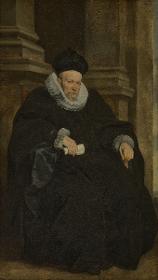
Bildnis des Alessandro Giustiniani-Longo

Bildnis des Alessandro Giustiniani-Longo

Als die Bildnisse von Alessandro Giustiniani-Longo (1544-1631) und seiner vermeintlichen Ehefrau (Kat.Nr. 782C) 1901 als Pendants in die Gemäldegalerie gelangten, hatten sie bereits eine lange gemeinsame Geschichte hinter sich. Schon zu Beginn des 18. Jahrhunderts befanden sie sich im Besitz von Costantino Balbi (1676-1740) in Genua, der das Frauenporträt vermutlich von Giovanni Luca Spinola, das des Mannes von Alessandro Saluzzo und seinen Brüdern erworben hatte. Beide Porträts dürften etwa zur selben Zeit, um 1622/23, von Anton van Dyck während seines Aufenthaltes in Italien (1621-1627) in Genua gemalt worden sein. Auf den Bildern treten dem Betrachter ausdrucksstarke, faszinierende Persönlichkeiten entgegen, in beiden Fällen wiedergegeben in Lebensgröße und in sitzender Haltung. Es verwundert daher kaum, dass man für mehr als 200 Jahre annahm, es handle sich bei den Porträts um die Darstellung eines Ehepaares. Wie die Forschung gezeigt hat, trifft diese Annahme jedoch nicht zu. Bei dem Bildnis des alten Mannes handelt es sich um den genuesischen Senator Alessandro Giustiniani-Longo, der um 1622/23 bereits weit in den Siebzigern war. Er entstammte einer alteingesessenen und hoch angesehenen, genuesischen Familie. Von 1611 bis 1613 bekleidete er das höchste Amt, das der aristokratisch konstituierte, ligurische Stadtstaat zu vergeben hatte: das des Dogen. 1613 wurde er schließlich auf Lebenszeit Prokurator (Sachverwalter für Finanzen) der Genueser Republik. Das gerollte Papier in der Rechten des Mannes sowie sein ebenso herrisch wie misstrauischer Blick scheinen dieser Position, deren Ausübung Unbestechlichkeit voraussetzte, zu entsprechen. Auch die von ihm getragene schwarze Kappe weist bereits auf eine offizielle Bestimmung seiner Person hin. Im Falle des Frauenbildnisses ist eine eindeutige Identifizierung der Dargestellten dagegen bislang nicht gelungen. Die von ihr getragene, auf der Stirn spitz zulaufende Haartracht verweist jedoch auf ihren Status als Witwe, was eine Zuordnung der beiden Porträts als Ehepaar sehr unwahrscheinlich macht. Zudem belegt eine Kopie des Bildes aus dem 17. Jahrhundert, dass das Werk ursprünglich nach links hin breiter angelegt war und erst nachträglich beschnitten und so dem Männerporträt angeglichen wurde. Auch widersprechen die unterschiedlichen Schauplätze und ihre spezifische Ausstattung sowie der Umstand, dass die Frau deutlich höher im Bild sitzt als der Mann, der Annahme, es handle sich hierbei um zusammengehörige Pendants. Porträts dieser Art verhalfen van Dyck zu weit verbreiteter Anerkennung und zu reichen Aufträgen durch die Familien des Adels, für die er vornehmlich gearbeitet hat. Ausgehend von Rubens, in dessen Antwerpener Atelier er als blutjunger, genialer Künstler im Alter von 17 Jahren eingetreten war, aber auch im Rückgriff auf den höfischen Porträtstil Tizians, entwickelte er jenen vornehm-gelassenen, distanzierten Ausdruck, der die Vorstellung vom aristokratischen Menschenbild für seine Zeit außerordentlich geprägt hat. Die Werke verblieben lange im Palazzo Balbi in Genua. 1828 wurden sie, durch Vermittlung des Malers David Wilkie, von dem englischen Sammler Sir Robert Peel erworben und gelangten aus dessen Hinterlassenschaft, die 1900 versteigert wurde, schließlich nach Berlin. Jan Kelch und Katja Kleinert | 200 Meisterwerke der europäischen Malerei - Gemäldegalerie Berlin, 2019________________________________________________________________________When the Gemäldegalerie received these two portraits as companion pieces in 1901, they already had a long common history behind them. At the beginning of the 18th century, the two portraits were owned by Costantino Balbi (1676–1740) in Genoa; he is believed to have purchased the portrait of the woman from Giovanni Luca Spinola, and that of the man from Alessandro Saluzzo and his brothers. Both portraits are very likely to have been painted in Genoa by Anton van Dyck around the same time – 1622–23 – during the artist’s stay in Italy (1621–27). Both portraits show very individual, compelling personalities; both are depicted in life-size and shown seated. It is unsurprising that for over 200 years it was assumed that these two pictures were portraits of a married couple. However, historical records show that this is not the case.The painting of the man is the portrait of the Genoese senator Alessandro Giustiniani- Longo (1544–1631), who was in his late seventies around 1622–23. He belonged to an ancient and very noble Genoese family. Between 1611 and 1613, he held the highest office that the oligarchic merchant city-state in Liguria had: that of the Doge. In 1613, he was appointed Procurator of the Genoese Republic, a life-long office that put him in charge of finances. The rolled document in his right hand and his imperious and suspicious gaze appear to correspond to this position, which presupposed incorruptibility. The black cap on his head also illustrates that the sitter holds a public office. In contrast, the identity of the woman remains uncertain. Her hairstyle with the lacy ornament on her forehead indicates that she is a widow, thus making it unlikely that the two portraits are pictures of a married couple. In addition, a copy of the portrait made in the 17th century shows that the picture was originally wider, and that a section on the left side was removed at a later point, presumably to make it match the portrait of the man. The different settings and the furnishing details, as well as the fact that the woman is sitting higher than the man also challenge the assumption that these are companion portraits.For Anton van Dyck, portraits such as these were useful in building his reputation as a portrait painter and gaining commissions from aristocratic families, who were his main clients. Inspired originally by Rubens, whose Antwerp studio he had joined as a young but precociously talented painter aged 17, and also by the courtly portrait style of Titian, van Dyck developed a distinguished, serene and distant expression which decisively influenced the idea of what an aristocrat should look like.The paintings remained in the Palazzo Balbi in Genoa for many decades. In 1828, they were acquired by the English collector Sir Robert Peel, through the mediation of the painter David Wilkie, and finally arrived in Berlin from his estate, which was sold at auction in 1900. Jan Kelch und Katja Kleinert | 200 Masterpieces of European Painting - Gemäldegalerie Berlin, 2019

Blick in den Chorumgang von St. Bavo in Haarlem

Blick in den Chorumgang von St. Bavo in Haarlem

Als einer der ersten niederländischen Maler spezialisierte sich Saenredam auf die Darstellung von Kirchenansichten, insbesondere von Kircheninnenräumen. Seine Bilder basieren auf exakten, nach Gesetzen der Perspektive konstruierten Vorstudien und liefern ein genaues Abbild der vorhandenen Situation. Auch zu dem Berliner Bild, einer Innenansicht der zwischen 1370 und 1520 erbauten spätgotischen St. Bavo-Kirche in Haarlem, existieren zwei Vorzeichnungen (Haarlem, Gemeentearchief / London, Courtauld Institute of Art, Witt Collection). Die dreischiffige Basilika wurde von Saenredam auch aus weiteren Blickwinkeln verewigt. Im Querschiff stehend, blickt der Betrachter Richtung Osten in den südlichen Chorumgang. Die sechs Joche, aus denen das Kreuzrippengwölbe entspringt, werden mit Rundpfeilern und Halbsäulen gebildet. Durch drei hohe Lanzettfenster mit weißer Verglasung und gotischen Maßwerkabschlüssen fällt kühles Licht ein. Den Eingangsbogen in den Umgang hat Saenredam aus der Symmetrieachse leicht nach links verschoben. Er wird vom oberen Bildrand überschnitten, was seine monumentale Wirkung noch unterstreicht und rahmt durch seine Positionierung im Bildvordergrund die Komposition.Seit ihrer Reformierung 1578 von allem bildlichen und architektonischen Zierrat befreit, wirkt die weiß getünchte Kirche ausschließlich über ihre architektonischen Formen und das Spiel von Licht und Schatten. Es entfaltet seine Wirkung insbesondere in der Gewölbezone, wo die tiefen Zwickelfelder zwischen den Kreuzrippen starke Hell- und Dunkelkontraste erzeugen und den Raum in abstrakt geometrische Formen auflösen. Dies sind die gestalterischen Mittel, die den Kern von Saenredams künstlerischem Schaffen bilden. Kristalline, grafische Klarheit sowie eine reduzierte Farbskala mit fein nuancierten Weiß- Grau- und Gelbwerten, für die auch Goldstaub zur Verwendung kam, sind charakteristische Merkmale seines Werks. Auf diese Weise verlieh der Maler den Kircheninnenräumen eine schlichte und zugleich differenzierte Lichtwirkung, ganz so, als würde die Architektur aus sich heraus leuchten. Die einzigen schmückenden Elemente sind zwei jeweils an einem Pfeilern bzw. einer Halbsäule angebrachte Totenschilde, sowie zwei vergoldete Kerzenleuchter. Eine in starkem Kontrast zu den hellen Wandflächen stehende Orgel aus dunklem Holz ist zwischen zwei Jochen an der Außenwand angebracht, an deren Brüstung der Maler das Gemälde gut sichtbar mit seiner Signatur „P. Saenredam fecit.“ versehen hat. Ergänzend findet sich die Datierung „P[ieter]S[aenredam]A[nno] 1635“ am Fuße eines Pfeilers in der rechten vorderen Bildecke.Die Figurenstaffage erzählt die biblische Szene der Darbringung Christi im Tempel: In der Brouwerskapel (die Kapelle der Brauergilde) wartet der Hohepriester auf die Heilige Familie. Maria und Josef folgen Simeon mit dem Jesuskind auf dem Arm. Die Prophetin Hanna tritt, auf einen Stock gestützt, aus dem Mittelschiff der Kirche zur der Gruppe. Durch ihre Verlegung in die Haarlemer Kirche wird die Szene in die Lebenswelt der zeitgenössischen Betrachter übertragen. Formal dient die Figurenstaffage der Klärung des Raumzusammenhangs, da sie auf die jenseits des Bildraums gelegenen Bauteile verweist, aus denen die Personen herantreten oder sich entfernen, wie etwa der Mann im Hintergrund, der nur diesem Zweck dient. Die Figurenstaffage wurde, in Kooperation mit Saenredam, von einem anderen, namentlich heute nicht mehr bekannten Künstler eingefügt. Eine derartige Form der Zusammenarbeit von zwei Spezialisten war gängige Praxis in den Niederlanden des 17. Jahrhunderts. Sarah Salomon | 200 Meisterwerke der europäischen Malerei - Gemäldegalerie Berlin, 2019SIGNATUR / INSCHRIFT: An der Plinthe der Orgelbalustrade: P. Saenredam fecit. PSA (verbunden) 1635___________________________________________________________________Saenredam was one of the first Dutch painters to specialise in depicting churches, especially church interiors. His works are based on exact preliminary studies, designed according to the laws of perspective, and provide a precise depiction of the situations that he found. For the painting in Berlin, an interior view of the late Gothic church of Sint Bavo in Haarlem, built between 1370 and 1520, two preliminary drawings exist (Haarlem, Gemeentearchief, and London, Courtauld Institute of Art, WittCollection). This basilica, with its nave and two aisles, was also commemorated by Saenredam from other viewpoints. Standing in the transept, the viewer looks east to the south choir ambulatory. The six bays that support the cross-ribbed vaulting are shown with round piers and half-columns. Cool light falls through three tall lancet windows with white glass and Gothic tracery at the top. Saenredam has shifted the arch at the entrance to the ambulatory slightly to the left of the axis of symmetry. It is cropped by the upper edge of the picture, underlining its monumental effect and framing the composition through its position in the foreground.Cleared of all visual and architectural adornment since becoming a Reformed church in 1578, the whitewashed building generates its effect entirely through its architectural forms and the play of light and shade. This applies particularly to the vaulting zone, where the deep squinches between the crossed ribs produce strong contrasts of dark and light, dissolving the space into abstract geometrical shapes. These are the artistic means that constitute the core of Saenredam’s creative work. Crystalline, graphic clarity and a reduced colour scale with finely nuanced shades of white, grey and yellow, for which gold dust was sometimes used, are characteristic features of his oeuvre. In this way the artist lent simple but at the same time differentiated effects of lighting to church interiors, as if the architecture radiated from within. The only decorative elements are the two memorials, one attached to a pier and one to a half-column, and two gilded candelabra. An organ of dark wood, forming a strong contrast to the bright surfaces of wall, is installed between two bays on the outer wall. On its balustrade, the artist has added his clearly visible signature “P. Saenredam fecit”. To complement this, the date “P[ieter]S[aenredam] A[nno] 1635” can be seen at the foot of a pier in the right-hand corner at the front.The staffage of figures tells the biblical story of the presentation of Christ in the temple: in the Brouwerskapel (the chapel of the guild of brewers), the high priest waits for the Holy Family. Mary and Joseph follow Simeon, who has the Christ Child on his arm. The prophet Hanna, supported by a stick, emerges from the choir of the church towards the group. By transporting the scene to the church in Haarlem, Saenredam transferred it to the world in which contemporary beholders lived. In formal terms the figures serve to clarify the spatial context, as they indicate parts of the building that lie beyond the space depicted, from which people approach or into which they disappear, like the man in the background who serves this purpose only. In cooperation with Saenredam, these figures were inserted by another artist, whose name is no longer known. This type of collaboration between two specialists was common practice in the Netherlands in the 17th century. Sarah Salomon | 200 Masterpieces of European Painting - Gemäldegalerie Berlin, 2019