
Logo

Christi Abschied von seiner Mutter

Ident. Nr.: 325

ObjID: obj:867120

Details (Expert)

Beteiligte
Ausführung: Lorenzo Lotto (ca. 1480 - 1556),
Maler*in
Domenico Tassi (16. Jahrhundert)
Datierung
Ausführung: 1521
Weitere Titel
Sammlungstitel: Christi Abschied von seiner Mutter
Übersetzung: Christ taking leave of his Mother
Geografische Bezüge
Italien,
Land
Material / Technik
Leinwand
Abmessungen
Bildmaß: 127,4 x 102 cm
Erwerbung
1821 Ankauf mit der Sammlung des Kaufmanns Edward Solly, Berlin

Objektbeschreibung

Nach Jahren unsteter Wanderschaft und ruhelosen Wechsels von Stadt zu Stadt wirkte Lotto von 1513 bis 1525 in Bergamo, bevor er 1526 für längere Zeit nach Venedig zurückkehrte. In Bergamo entstand 1521 das Bild Christi Abschied von seiner Mutter. Nach Ridolfis Zeugnis (1648) befand es sich damals im Hause Tassi. Der Palazzo Tassi ist noch erhalten. Nach Tassis Angabe ist die im Bild dargestellte Stifterin Elisabetta Rota, die Frau des Domenico Tassi, dessen Bruder Alvise, Bischof von Recanati, 1520 ermordet worden war. Domenico war als Stifter im Gegenstück, einer Anbetung des Kindes, dargestellt, deren Komposition durch eine alte Kopie (Venedig, Akademie) überliefert ist. Das Thema kommt in der italienischen Malerei verhältnismäßig selten vor. Nach der Erweckung des Lazarus und vor dem Einzug in Jerusalem, mit dem der Lebensabschnitt vom Leiden und Tod Christi beginnt, nimmt Christus in Bethanien am Mittwochabend der Karwoche Abschied von seiner Mutter. Begleitet von Petrus und einem anderen Apostel, der als Judas, Thomas, Joseph oder Jacobus Maior interpretiert wurde, kniet er vor ihr und bittet um ihren Segen. Er hatte ihr von der bevorstehenden Leidenszeit gesprochen und sie dem Schutz seines Jüngers Johannes und der Magdalena empfohlen, die hier die ohnmächtig zusammensinkende Muttergottes auffangen. Dargestellt ist die Szene in einer tonnengewölbten Säulenarkadenhalle, die an Höfe Bergamasker Paläste erinnert. Ganz links geht der Blick in die freie Landschaft. Im Hintergrund öffnet sich die Halle auf einen von hohen Mauern umgebenen Garten mit kreuzförmigem Laubengang (mit zentraler Kuppel), der von einem Zaun mit offenem Tor umgeben ist (Anspielung auf den »hortus conclusus«, den umschlossenen Garten, nach einer Metapher im Hohenlied Salomos [4, 2] ein Beiname Mariä, der sinnbildhaft auf die Unbefleckte Empfängnis weist). Vorn rechts kniet die Stifterin, von der Seite im Profil gesehen, von einem Hündchen begleitet. Sie blickt von einem Buche auf und wohnt der Abschiedsszene bei. Am unteren Bildrand, von ihm beschnitten, sind repoussoirartig ein Zweig mit Kirschen und eine Orange sichtbar, Anspielungen auf das Blut des Erlösers, aber auch auf die Freuden des Paradieses (Kirsche) bzw. auf die Erlösung (Orange). Daneben sieht man einen zusammengefalteten Brief mit der Signatur des Künstlers und dem Datum. Die Szene, die in den Evangelien nicht vorkommt, tauchte in der bildenden Kunst im späten Mittelalter unter dem Einfluß der »Meditationes« des Pseudo-Bonaventura auf, wurde durch Passionsspiele bekannt und mit dem Zyklus der »Sieben Schmerzen Mariä« verbunden. In den frühen Ausprägungen des Themas und vor allem im Norden (Dürer, Cranach) steht Christus vor Maria und segnet sie. Kniend, mit dem Ergebenheitsgestus der vor der Brust gekreuzten Arme, ist Christus erstmals in einem vor 1514 entstandenen Frühwerk Correggios (London, National Gallery) dargestellt, das offensichtlich das Vorbild für Lotto war. Wie Röntgenaufnahmen des Londoner Bildes zeigen, war Christus ursprünglich stehend dargestellt, womit Correggio direkt an Dürers Holzschnitt aus dem Marienleben (1511) anschloß. C. Gould (1981) vermutete, daß Lotto auf seiner Rückkehr aus Mittelitalien (Rom, Marken) auf dem Wege nach Bergamo in Correggio (bei Parma) den jungen Correggio getroffen und bei ihm das Bild gesehen haben könnte. Lottos Bild zeigt neben dem Einfluß nordalpiner Vorbilder auch die Wirkung von Raffaels und Fra Bartolomeos Florentiner Werken sowie den Einfluß des Werkes Leonardo da Vincis (M. Lucco 1997). Erich Schleier | 200 Meisterwerke der europäischen Malerei - Gemäldegalerie Berlin, 2019

SIGNATUR / INSCHRIFT: Unten in der Mitte auf einem Cartellino: mo Laurrenttjo / Lotto pictor / 1521
_________________________________

After years of erratic wandering, shifting restlessly from town to town, Lotto spent the years 1513 to 1525 in Bergamo before returning to Venice for an extended period in 1526. It was in Bergamo that he produced the painting Christ Taking Leave of his Mother in 1521. At that time, according to Ridolfi’s testimony (1648), the panel was found in the home of Tassi. According to declarations by Tassi, the female donor depicted in the painting is Elisabetta Rota, wife of Domenico Tassi, whose brother Alvise, the Bishop of Recanati, was murdered in 1520. As the donor, Domenico was depicted in the pendant to this work, the Adoration of the Christ Child, whose composition is known through an old copy (Venice, Galleria dell’Accademia).

The theme is a relative rarity in Italian painting. After the Resurrection of Lazarus and prior to the Entry into Jerusalem, which inaugurates the period of Christ’s life that is characterized by his suffering and death, the Savior takes leave of his mother in Bethany on Wednesday evening during Holy Week. Accompanied by Peter and another apostle, who has been interpreted as Judas, Thomas, Joseph, or James the Elder, Christ kneels before the Virgin and requests her blessing. He has spoken with her prior to the approaching events of the Passion, and has commended her to the protection of John and Mary Magdalene, who together catch the Virgin Mary as she collapses in unconsciousness. The scene is set in a barrel-vaulted, columnated, arcaded hall that recalls the courtyards of the palaces of Bergamo. In the background, the hall opens onto a garden, surrounded by a high wall, which contains a cruciform pergola (with central cupola) enclosed by a fence with an open doorway (an allusion to the hortus conclusus, the enclosed garden, a metaphor from the Song of Solomon (4:2) that serves as an epithet for the Virgin Mary, and an emblem of the Immaculate Conception). Kneeling in the right foreground and depicted in profile is the female donor, who is accompanied by a small dog. She looks up from her book to witness the farewell scene. Visible along the lower edge of the picture, and cut off by it, is the repoussoir-style motif of a branch with cherries and an orange, an allusion to the blood of the Redeemer, but also to the joys of Paradise (cherries) or to salvation (orange). Depicted next to it is a folded letter bearing the signature of the artist and the year date.

This scene, which does not feature in the Gospels, made its appearance in the fine arts in the late Middle Ages under the influence of the Meditationes of the Pseudo-Bonaventura, and became familiar through passion plays, becoming associated with the cycle of the Seven Sorrows of the Virgin Mary. In earlier versions of the scene, and in the north in particular (Dürer, Cranach), Christ stands before
Mary and blesses her. Christ is shown kneeling, his arms crossed before his breast in a gesture of humility, for the first time in early work by Correggio (London, The National Gallery), which dates from before 1514, and which apparently served Lotto as a model. X-ray images of the London picture have shown that Christ was originally depicted standing, a pose Correggio borrowed directly from a woodcut by Dürer from the Life of the Virgin (1511). C. Gould (1981) speculated that on his way toward Bergamo during his return from central Italy (Rome, the Marches), Lotto must have met the young Correggio in the town of Correggio (near Parma), where he may have viewed the London picture. Alongside the influence of models from north of the Alps, Lotto’s painting betrays the impact of the Florentine works of Raphael and Fra Bartolomeo, as well as the influence of the works of Leonardo da Vinci (M. Lucco 1997). Erich Schleier | 200 Masterpieces of European Painting - Gemäldegalerie Berlin, 2019

Letzte Aktualisierung: 03.07.2026

Kontakt

Einrichtung:

Gemäldegalerie

Weitere Objekte aus den Sammlungen

Der Raucher

Der Raucher

Das Genrebild zeigt einen jungen Mann mit Pelzhut und blonden Locken. Sein weißer Brustgurt mit dem dazugehörigen Säbel kennzeichnet ihn als Soldaten. Breitbeinig sitzt er an einem einfachen Holztisch, auf dessen Platte er die Arme stützt. In seiner Rechten hält er eine lange Tonpfeife, deren Ende in einem kleinen Kohlebecken ruht. Eine weitere, zerbrochene Pfeife liegt daneben. Die beruhigte Komposition, einer Momentaufnahme gleich, sowie feinmalerisch ausgearbeitete Details sind charakteristisch für ter Borch. Seitdem man Ende des 16. Jahrhunderts Tabak aus Übersee importierte, gehörte das Rauchen – zeitgenössisch sowohl positiv wie negativ bewertet – zu den häufig dargestellten Themen der niederländischen und flämischen Genremalerei des 17. Jahrhunderts._________________________________________________________________________This genre painting shows a young man with a fur hat and blonde curls. His white chest strap with sabre identifies him as a soldier. He sits at a simple wooden table, legs spread, resting his arms on the surface. In his right hand he holds a long clay pipe, the end of which rests in a coal basin. Another broken pipe lies next to it. The calm composition, a snap-shot like moment, as well as the delicately drawn out details are characteristic for ter Borch. Since the start of the overseas import of tobacco at the end of the 16th century, smoking– considered already by contemporaries positively as well as negatively – had become one of the most frequently painted topics in Dutch and Flemish genre paintings of the 17th century.

Bildnis einer vornehmen genuesischen Dame

Bildnis einer vornehmen genuesischen Dame

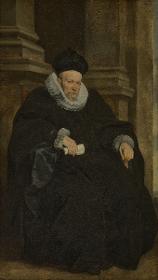
Als die Bildnisse von Alessandro Giustiniani-Longo und seiner vermeintlichen Ehefrau (Kat.Nr. 782C) 1901 als Pendants in die Gemäldegalerie gelangten, hatten sie bereits eine lange gemeinsame Geschichte hinter sich. Schon zu Beginn des 18. Jahrhunderts befanden sie sich im Besitz von Costantino Balbi (1676-1740) in Genua, der das Frauenporträt vermutlich von Giovanni Luca Spinola, das des Mannes von Alessandro Saluzzo und seinen Brüdern erworben hatte. Beide Porträts dürften etwa zur selben Zeit, um 1622/23, von Anton van Dyck während seines Aufenthaltes in Italien (1621-1627) in Genua gemalt worden sein. Auf den Bildern treten dem Betrachter ausdrucksstarke, faszinierende Persönlichkeiten entgegen, in beiden Fällen wiedergegeben in Lebensgröße und in sitzender Haltung. Es verwundert daher kaum, dass man für mehr als 200 Jahre annahm, es handle sich bei den Porträts um die Darstellung eines Ehepaares. Wie die Forschung gezeigt hat, trifft diese Annahme jedoch nicht zu. Bei dem Bildnis des alten Mannes handelt es sich um den genuesischen Senator Alessandro Giustiniani-Longo (1544-1631), der um 1622/23 bereits weit in den Siebzigern war. Er entstammte einer alteingesessenen und hoch angesehenen, genuesischen Familie. Von 1611 bis 1613 bekleidete er das höchste Amt, das der aristokratisch konstituierte, ligurische Stadtstaat zu vergeben hatte: das des Dogen. 1613 wurde er schließlich auf Lebenszeit Prokurator (Sachverwalter für Finanzen) der Genueser Republik. Das gerollte Papier in der Rechten des Mannes sowie sein ebenso herrisch wie misstrauischer Blick scheinen dieser Position, deren Ausübung Unbestechlichkeit voraussetzte, zu entsprechen. Auch die von ihm getragene schwarze Kappe weist bereits auf eine offizielle Bestimmung seiner Person hin. Im Falle des Frauenbildnisses ist eine eindeutige Identifizierung der Dargestellten dagegen bislang nicht gelungen. Die von ihr getragene, auf der Stirn spitz zulaufende Haartracht verweist jedoch auf ihren Status als Witwe, was eine Zuordnung der beiden Porträts als Ehepaar sehr unwahrscheinlich macht. Zudem belegt eine Kopie des Bildes aus dem 17. Jahrhundert, dass das Werk ursprünglich nach links hin breiter angelegt war und erst nachträglich beschnitten und so dem Männerporträt angeglichen wurde. Auch widersprechen die unterschiedlichen Schauplätze und ihre spezifische Ausstattung sowie der Umstand, dass die Frau deutlich höher im Bild sitzt als der Mann, der Annahme, es handle sich hierbei um zusammengehörige Pendants. Porträts dieser Art verhalfen van Dyck zu weit verbreiteter Anerkennung und zu reichen Aufträgen durch die Familien des Adels, für die er vornehmlich gearbeitet hat. Ausgehend von Rubens, in dessen Antwerpener Atelier er als blutjunger, genialer Künstler im Alter von 17 Jahren eingetreten war, aber auch im Rückgriff auf den höfischen Porträtstil Tizians, entwickelte er jenen vornehm-gelassenen, distanzierten Ausdruck, der die Vorstellung vom aristokratischen Menschenbild für seine Zeit außerordentlich geprägt hat. Die Werke verblieben lange im Palazzo Balbi in Genua. 1828 wurden sie, durch Vermittlung des Malers David Wilkie, von dem englischen Sammler Sir Robert Peel erworben und gelangten aus dessen Hinterlassenschaft, die 1900 versteigert wurde, schließlich nach Berlin. Jan Kelch und Katja Kleinert | 200 Meisterwerke der europäischen Malerei - Gemäldegalerie Berlin, 2019________________________________________________________________________When the Gemäldegalerie received these two portraits as companion pieces in 1901, they already had a long common history behind them. At the beginning of the 18th century, the two portraits were owned by Costantino Balbi (1676–1740) in Genoa; he is believed to have purchased the portrait of the woman from Giovanni Luca Spinola, and that of the man from Alessandro Saluzzo and his brothers. Both portraits are very likely to have been painted in Genoa by Anton van Dyck around the same time – 1622–23 – during the artist’s stay in Italy (1621–27). Both portraits show very individual, compelling personalities; both are depicted in life-size and shown seated. It is unsurprising that for over 200 years it was assumed that these two pictures were portraits of a married couple. However, historical records show that this is not the case.The painting of the man is the portrait of the Genoese senator Alessandro Giustiniani- Longo (1544–1631), who was in his late seventies around 1622–23. He belonged to an ancient and very noble Genoese family. Between 1611 and 1613, he held the highest office that the oligarchic merchant city-state in Liguria had: that of the Doge. In 1613, he was appointed Procurator of the Genoese Republic, a life-long office that put him in charge of finances. The rolled document in his right hand and his imperious and suspicious gaze appear to correspond to this position, which presupposed incorruptibility. The black cap on his head also illustrates that the sitter holds a public office. In contrast, the identity of the woman remains uncertain. Her hairstyle with the lacy ornament on her forehead indicates that she is a widow, thus making it unlikely that the two portraits are pictures of a married couple. In addition, a copy of the portrait made in the 17th century shows that the picture was originally wider, and that a section on the left side was removed at a later point, presumably to make it match the portrait of the man. The different settings and the furnishing details, as well as the fact that the woman is sitting higher than the man also challenge the assumption that these are companion portraits.For Anton van Dyck, portraits such as these were useful in building his reputation as a portrait painter and gaining commissions from aristocratic families, who were his main clients. Inspired originally by Rubens, whose Antwerp studio he had joined as a young but precociously talented painter aged 17, and also by the courtly portrait style of Titian, van Dyck developed a distinguished, serene and distant expression which decisively influenced the idea of what an aristocrat should look like.The paintings remained in the Palazzo Balbi in Genoa for many decades. In 1828, they were acquired by the English collector Sir Robert Peel, through the mediation of the painter David Wilkie, and finally arrived in Berlin from his estate, which was sold at auction in 1900. Jan Kelch und Katja Kleinert | 200 Masterpieces of European Painting - Gemäldegalerie Berlin, 2019

Bildnis des Alessandro Giustiniani-Longo

Bildnis des Alessandro Giustiniani-Longo

Als die Bildnisse von Alessandro Giustiniani-Longo (1544-1631) und seiner vermeintlichen Ehefrau (Kat.Nr. 782C) 1901 als Pendants in die Gemäldegalerie gelangten, hatten sie bereits eine lange gemeinsame Geschichte hinter sich. Schon zu Beginn des 18. Jahrhunderts befanden sie sich im Besitz von Costantino Balbi (1676-1740) in Genua, der das Frauenporträt vermutlich von Giovanni Luca Spinola, das des Mannes von Alessandro Saluzzo und seinen Brüdern erworben hatte. Beide Porträts dürften etwa zur selben Zeit, um 1622/23, von Anton van Dyck während seines Aufenthaltes in Italien (1621-1627) in Genua gemalt worden sein. Auf den Bildern treten dem Betrachter ausdrucksstarke, faszinierende Persönlichkeiten entgegen, in beiden Fällen wiedergegeben in Lebensgröße und in sitzender Haltung. Es verwundert daher kaum, dass man für mehr als 200 Jahre annahm, es handle sich bei den Porträts um die Darstellung eines Ehepaares. Wie die Forschung gezeigt hat, trifft diese Annahme jedoch nicht zu. Bei dem Bildnis des alten Mannes handelt es sich um den genuesischen Senator Alessandro Giustiniani-Longo, der um 1622/23 bereits weit in den Siebzigern war. Er entstammte einer alteingesessenen und hoch angesehenen, genuesischen Familie. Von 1611 bis 1613 bekleidete er das höchste Amt, das der aristokratisch konstituierte, ligurische Stadtstaat zu vergeben hatte: das des Dogen. 1613 wurde er schließlich auf Lebenszeit Prokurator (Sachverwalter für Finanzen) der Genueser Republik. Das gerollte Papier in der Rechten des Mannes sowie sein ebenso herrisch wie misstrauischer Blick scheinen dieser Position, deren Ausübung Unbestechlichkeit voraussetzte, zu entsprechen. Auch die von ihm getragene schwarze Kappe weist bereits auf eine offizielle Bestimmung seiner Person hin. Im Falle des Frauenbildnisses ist eine eindeutige Identifizierung der Dargestellten dagegen bislang nicht gelungen. Die von ihr getragene, auf der Stirn spitz zulaufende Haartracht verweist jedoch auf ihren Status als Witwe, was eine Zuordnung der beiden Porträts als Ehepaar sehr unwahrscheinlich macht. Zudem belegt eine Kopie des Bildes aus dem 17. Jahrhundert, dass das Werk ursprünglich nach links hin breiter angelegt war und erst nachträglich beschnitten und so dem Männerporträt angeglichen wurde. Auch widersprechen die unterschiedlichen Schauplätze und ihre spezifische Ausstattung sowie der Umstand, dass die Frau deutlich höher im Bild sitzt als der Mann, der Annahme, es handle sich hierbei um zusammengehörige Pendants. Porträts dieser Art verhalfen van Dyck zu weit verbreiteter Anerkennung und zu reichen Aufträgen durch die Familien des Adels, für die er vornehmlich gearbeitet hat. Ausgehend von Rubens, in dessen Antwerpener Atelier er als blutjunger, genialer Künstler im Alter von 17 Jahren eingetreten war, aber auch im Rückgriff auf den höfischen Porträtstil Tizians, entwickelte er jenen vornehm-gelassenen, distanzierten Ausdruck, der die Vorstellung vom aristokratischen Menschenbild für seine Zeit außerordentlich geprägt hat. Die Werke verblieben lange im Palazzo Balbi in Genua. 1828 wurden sie, durch Vermittlung des Malers David Wilkie, von dem englischen Sammler Sir Robert Peel erworben und gelangten aus dessen Hinterlassenschaft, die 1900 versteigert wurde, schließlich nach Berlin. Jan Kelch und Katja Kleinert | 200 Meisterwerke der europäischen Malerei - Gemäldegalerie Berlin, 2019________________________________________________________________________When the Gemäldegalerie received these two portraits as companion pieces in 1901, they already had a long common history behind them. At the beginning of the 18th century, the two portraits were owned by Costantino Balbi (1676–1740) in Genoa; he is believed to have purchased the portrait of the woman from Giovanni Luca Spinola, and that of the man from Alessandro Saluzzo and his brothers. Both portraits are very likely to have been painted in Genoa by Anton van Dyck around the same time – 1622–23 – during the artist’s stay in Italy (1621–27). Both portraits show very individual, compelling personalities; both are depicted in life-size and shown seated. It is unsurprising that for over 200 years it was assumed that these two pictures were portraits of a married couple. However, historical records show that this is not the case.The painting of the man is the portrait of the Genoese senator Alessandro Giustiniani- Longo (1544–1631), who was in his late seventies around 1622–23. He belonged to an ancient and very noble Genoese family. Between 1611 and 1613, he held the highest office that the oligarchic merchant city-state in Liguria had: that of the Doge. In 1613, he was appointed Procurator of the Genoese Republic, a life-long office that put him in charge of finances. The rolled document in his right hand and his imperious and suspicious gaze appear to correspond to this position, which presupposed incorruptibility. The black cap on his head also illustrates that the sitter holds a public office. In contrast, the identity of the woman remains uncertain. Her hairstyle with the lacy ornament on her forehead indicates that she is a widow, thus making it unlikely that the two portraits are pictures of a married couple. In addition, a copy of the portrait made in the 17th century shows that the picture was originally wider, and that a section on the left side was removed at a later point, presumably to make it match the portrait of the man. The different settings and the furnishing details, as well as the fact that the woman is sitting higher than the man also challenge the assumption that these are companion portraits.For Anton van Dyck, portraits such as these were useful in building his reputation as a portrait painter and gaining commissions from aristocratic families, who were his main clients. Inspired originally by Rubens, whose Antwerp studio he had joined as a young but precociously talented painter aged 17, and also by the courtly portrait style of Titian, van Dyck developed a distinguished, serene and distant expression which decisively influenced the idea of what an aristocrat should look like.The paintings remained in the Palazzo Balbi in Genoa for many decades. In 1828, they were acquired by the English collector Sir Robert Peel, through the mediation of the painter David Wilkie, and finally arrived in Berlin from his estate, which was sold at auction in 1900. Jan Kelch und Katja Kleinert | 200 Masterpieces of European Painting - Gemäldegalerie Berlin, 2019

Blick in den Chorumgang von St. Bavo in Haarlem

Blick in den Chorumgang von St. Bavo in Haarlem

Als einer der ersten niederländischen Maler spezialisierte sich Saenredam auf die Darstellung von Kirchenansichten, insbesondere von Kircheninnenräumen. Seine Bilder basieren auf exakten, nach Gesetzen der Perspektive konstruierten Vorstudien und liefern ein genaues Abbild der vorhandenen Situation. Auch zu dem Berliner Bild, einer Innenansicht der zwischen 1370 und 1520 erbauten spätgotischen St. Bavo-Kirche in Haarlem, existieren zwei Vorzeichnungen (Haarlem, Gemeentearchief / London, Courtauld Institute of Art, Witt Collection). Die dreischiffige Basilika wurde von Saenredam auch aus weiteren Blickwinkeln verewigt. Im Querschiff stehend, blickt der Betrachter Richtung Osten in den südlichen Chorumgang. Die sechs Joche, aus denen das Kreuzrippengwölbe entspringt, werden mit Rundpfeilern und Halbsäulen gebildet. Durch drei hohe Lanzettfenster mit weißer Verglasung und gotischen Maßwerkabschlüssen fällt kühles Licht ein. Den Eingangsbogen in den Umgang hat Saenredam aus der Symmetrieachse leicht nach links verschoben. Er wird vom oberen Bildrand überschnitten, was seine monumentale Wirkung noch unterstreicht und rahmt durch seine Positionierung im Bildvordergrund die Komposition.Seit ihrer Reformierung 1578 von allem bildlichen und architektonischen Zierrat befreit, wirkt die weiß getünchte Kirche ausschließlich über ihre architektonischen Formen und das Spiel von Licht und Schatten. Es entfaltet seine Wirkung insbesondere in der Gewölbezone, wo die tiefen Zwickelfelder zwischen den Kreuzrippen starke Hell- und Dunkelkontraste erzeugen und den Raum in abstrakt geometrische Formen auflösen. Dies sind die gestalterischen Mittel, die den Kern von Saenredams künstlerischem Schaffen bilden. Kristalline, grafische Klarheit sowie eine reduzierte Farbskala mit fein nuancierten Weiß- Grau- und Gelbwerten, für die auch Goldstaub zur Verwendung kam, sind charakteristische Merkmale seines Werks. Auf diese Weise verlieh der Maler den Kircheninnenräumen eine schlichte und zugleich differenzierte Lichtwirkung, ganz so, als würde die Architektur aus sich heraus leuchten. Die einzigen schmückenden Elemente sind zwei jeweils an einem Pfeilern bzw. einer Halbsäule angebrachte Totenschilde, sowie zwei vergoldete Kerzenleuchter. Eine in starkem Kontrast zu den hellen Wandflächen stehende Orgel aus dunklem Holz ist zwischen zwei Jochen an der Außenwand angebracht, an deren Brüstung der Maler das Gemälde gut sichtbar mit seiner Signatur „P. Saenredam fecit.“ versehen hat. Ergänzend findet sich die Datierung „P[ieter]S[aenredam]A[nno] 1635“ am Fuße eines Pfeilers in der rechten vorderen Bildecke.Die Figurenstaffage erzählt die biblische Szene der Darbringung Christi im Tempel: In der Brouwerskapel (die Kapelle der Brauergilde) wartet der Hohepriester auf die Heilige Familie. Maria und Josef folgen Simeon mit dem Jesuskind auf dem Arm. Die Prophetin Hanna tritt, auf einen Stock gestützt, aus dem Mittelschiff der Kirche zur der Gruppe. Durch ihre Verlegung in die Haarlemer Kirche wird die Szene in die Lebenswelt der zeitgenössischen Betrachter übertragen. Formal dient die Figurenstaffage der Klärung des Raumzusammenhangs, da sie auf die jenseits des Bildraums gelegenen Bauteile verweist, aus denen die Personen herantreten oder sich entfernen, wie etwa der Mann im Hintergrund, der nur diesem Zweck dient. Die Figurenstaffage wurde, in Kooperation mit Saenredam, von einem anderen, namentlich heute nicht mehr bekannten Künstler eingefügt. Eine derartige Form der Zusammenarbeit von zwei Spezialisten war gängige Praxis in den Niederlanden des 17. Jahrhunderts. Sarah Salomon | 200 Meisterwerke der europäischen Malerei - Gemäldegalerie Berlin, 2019SIGNATUR / INSCHRIFT: An der Plinthe der Orgelbalustrade: P. Saenredam fecit. PSA (verbunden) 1635___________________________________________________________________Saenredam was one of the first Dutch painters to specialise in depicting churches, especially church interiors. His works are based on exact preliminary studies, designed according to the laws of perspective, and provide a precise depiction of the situations that he found. For the painting in Berlin, an interior view of the late Gothic church of Sint Bavo in Haarlem, built between 1370 and 1520, two preliminary drawings exist (Haarlem, Gemeentearchief, and London, Courtauld Institute of Art, WittCollection). This basilica, with its nave and two aisles, was also commemorated by Saenredam from other viewpoints. Standing in the transept, the viewer looks east to the south choir ambulatory. The six bays that support the cross-ribbed vaulting are shown with round piers and half-columns. Cool light falls through three tall lancet windows with white glass and Gothic tracery at the top. Saenredam has shifted the arch at the entrance to the ambulatory slightly to the left of the axis of symmetry. It is cropped by the upper edge of the picture, underlining its monumental effect and framing the composition through its position in the foreground.Cleared of all visual and architectural adornment since becoming a Reformed church in 1578, the whitewashed building generates its effect entirely through its architectural forms and the play of light and shade. This applies particularly to the vaulting zone, where the deep squinches between the crossed ribs produce strong contrasts of dark and light, dissolving the space into abstract geometrical shapes. These are the artistic means that constitute the core of Saenredam’s creative work. Crystalline, graphic clarity and a reduced colour scale with finely nuanced shades of white, grey and yellow, for which gold dust was sometimes used, are characteristic features of his oeuvre. In this way the artist lent simple but at the same time differentiated effects of lighting to church interiors, as if the architecture radiated from within. The only decorative elements are the two memorials, one attached to a pier and one to a half-column, and two gilded candelabra. An organ of dark wood, forming a strong contrast to the bright surfaces of wall, is installed between two bays on the outer wall. On its balustrade, the artist has added his clearly visible signature “P. Saenredam fecit”. To complement this, the date “P[ieter]S[aenredam] A[nno] 1635” can be seen at the foot of a pier in the right-hand corner at the front.The staffage of figures tells the biblical story of the presentation of Christ in the temple: in the Brouwerskapel (the chapel of the guild of brewers), the high priest waits for the Holy Family. Mary and Joseph follow Simeon, who has the Christ Child on his arm. The prophet Hanna, supported by a stick, emerges from the choir of the church towards the group. By transporting the scene to the church in Haarlem, Saenredam transferred it to the world in which contemporary beholders lived. In formal terms the figures serve to clarify the spatial context, as they indicate parts of the building that lie beyond the space depicted, from which people approach or into which they disappear, like the man in the background who serves this purpose only. In cooperation with Saenredam, these figures were inserted by another artist, whose name is no longer known. This type of collaboration between two specialists was common practice in the Netherlands in the 17th century. Sarah Salomon | 200 Masterpieces of European Painting - Gemäldegalerie Berlin, 2019