
Logo

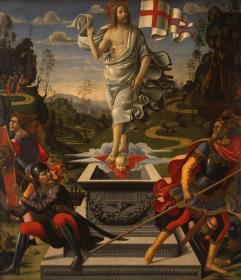
Die Auferstehung Christi

Ident. Nr.: 1177A

ObjID: obj:867398

Details (Expert)

Beteiligte
Ausführung: Giovanni Bellini (um 1435 - 1516),
Maler*in
Datierung
Ausführung: 1475 - 1479
Weitere Titel
Sammlungstitel: Die Auferstehung Christi
Übersetzung: The Resurrection of Christ
Geografische Bezüge
Italien,
Land
Abmessungen
Bildmaß: 148 x 128 cm

Objektbeschreibung

Dieses Gemälde entstand ursprünglich für den Altar der Zorzi-Kapelle in S. Michele in Isola, einer Kirche auf der gleichnamigen Friedhofsinsel von Venedig. Das dargestellte Sujet stimmte mit den Ambitionen der Auftraggeber, die nach dem Jüngsten Gericht ebenfalls auf Wiederauferstehung hofften, also perfekt überein.

Bellini legte in seinem Gemälde großen Wert auf die Darstellung der venezianischen Landschaft, die mit der Stadt Venedig nichts zu tun hat. Auch wenn das Dorf, das auf der Kuppe eines Hügels thront, mit dem Dorf Monselice verglichen wurde, ging es dem Künstler keineswegs um die Wiedergabe einer genauen topografischen Ansicht. Alles erscheint sehr realistisch, hat tatsächlich aber eine verschlüsselte Botschaft: das offene Grab im Vordergrund sowie die schlafenden oder wachenden
Wachsoldaten, die hilflos zusehen, wie Christus in den Himmel aufsteigt. Beim Betrachten wandert der Blick zunächst den Vordergrund entlang von links nach rechts, ehe er sich hebt, um sich in den Frühlingsmorgen und die Hügellandschaft mit ihren rätselhaften Figuren zu versenken, die die Andacht unterstützen sollten. Im damaligen Venedig waren reflexive Elemente in Gemälden explizit vorgeschrieben; man wollte das Auge zwingen, quasi in die Bildlandschaften hineinzuwandern, um die biblischen Geschehnisse bewusster wahrzunehmen.

In den 1450er- und 1460er-Jahren war der junge Giovanni Bellini ein eifriger Schüler seines Schwagers Andrea Mantegna gewesen. Er wollte alles auf die gleiche »mineralische« Weise malen. In den 1470er-Jahren entwickelte er eine freiere Handschrift – ohne Mantegna zu vergessen. Der Kormoran auf dem Baum oben links und der Schild des Soldaten rechts im Vordergrund sind Bildzitate, die berühmten Werken Mantegnas entnommen sind und fachkundigen Betrachtern nicht entgehen konnten. Doch die Wiedergabe des Lichts ist typisch für Bellini. Mantegna wäre zu
einer so subtilen Gestaltung des Himmels gar nicht in der Lage gewesen: Während manche Wolken in einem rosa getönten Orange erstrahlen, sind andere in Dunkelheit getaucht, weil sie noch nicht von einem Sonnenstrahl berührt wurden. Diesem präimpressionistischen morgendlichen Dämmerlicht gesellt sich zudem ein starkes Nachmittagslicht hinzu, das Christus erfasst. Es ist das Licht Gottes, in das Jesus direkt hineinblicken kann, ohne sich vor dem Erblinden fürchten zu müssen. Die Auferstehung Christi ist ein Gemälde mit einem beeindruckenden Realismus, der stark von der Symbolik der mittelalterlichen und byzantinischen Tradition geprägt ist. Nur Giovanni Bellini war fähig, diese beiden Welten, die sich bald vollständig trennen sollten, in seinen Bildern zu vereinen. Neville Rowley | 200 Meisterwerke der europäischen Malerei - Gemäldegalerie Berlin, 2019
_________________________________________________

This painting was originally the altarpiece of the Zorzi family chapel in the Venetian church of San Michele, which has the particularity of being located on an island entirely dedicated to the cemetery of the Venetians. The theme of Christ’s Resurrection was thus perfectly matching the ambitions of the patrons, who also hoped eventually to be reborn to life, when Last Judgement would come.

In his altarpiece, Giovanni Bellini gives great importance to the landscape, which has nothing to do with the city of Venice. We are on land, in the Veneto countryside. If the village nestled on top of a hill, on the right, has be compared to that of Monselice, the painter did not try to represent a precise topographical point of view. Everything seems very realistic but is in fact codified: the open tomb, in the foreground, and the soldiers in charge of guarding it who sleep, wake up or watch helplessly Christ rise in the air. The gaze of the viewer moves then from left to right, in the foreground, before rising and sinking into this spring morning, hilly landscape, crossing enigmatic figures that are as much support to meditation. In the Venice of the time, it was explicitly prescribed that paintings should have reflexive effects, that one must walk in their landscapes to be able to become better aware of the sacred events.

During the 1450s and 1460s, the young Giovanni Bellini had been a fervent disciple of Andrea Mantegna, his brother-in-law: he wanted to paint everything like him in a mineral way. In the 1470s, he allowed more freedom to his brush. In this work, Bellini did not forget Mantegna, whom he quotes directly in the cormorant on the tree at the top left of the painting, and in the soldier’s shield in the foreground on the right – references taken from famous works by Mantegna that learned viewers
could not fail to identify. However, the conception of light has become typical of the painter: Mantegna would have been properly unable to paint a sky with such subtlety, some clouds being of a pinkish orange and others remaining dark because they have not yet been touched by solar rays. This pre-impressionist light is not the only one in the painting, for Christ is struck by a strong light of noon that has nothing to do with dawn. It is the light of God, that Jesus can look at directly with no fear of getting blind. The Resurrection is then a painting with striking realism, which bears much of the symbolism inherited from medieval and Byzantine traditions. Only Giovanni Bellini could be able to unify these two worlds that would soon be completely torn apart. Neville Rowley | 200 Masterpieces of European Painting - Gemäldegalerie Berlin, 2019

Letzte Aktualisierung: 03.07.2026

Kontakt

Einrichtung:

Gemäldegalerie

Weitere Objekte aus den Sammlungen

Die Auferstehung Christi

Die Auferstehung Christi

»Nun, da ich die Methoden dieser Kunst zu verstehen beginne, grämt es mich, dass sie mir nicht den Auftrag erteilen, das gesamte Rund der Stadtmauern von Florenz mit Geschichten zu bemalen.« Diese Aussage soll Domenico Ghirlandaio gegenüber seinem Bruder Davide geäußert haben, nachdem er den Chor der Dominikanerkirche S. Maria Novella ausgeschmückt hatte. Die Fresken sind heute nochzu sehen und gehören zu den künstlerischen Höhepunkten eines Florenzbesuchs. Doch Ghirlandaio war nicht nur ein bemerkenswerter Freskant, er ist auch für die Gemälde des Hochaltars verantwortlich, die Anfang des 19. Jahrhunderts veräußert wurden. Die Mitteltafel der Vorderseite, Maria mit dem Kinde und Heiligen, befindet sich heute in der Alten Pinakothek in München; die heute in der Gemäldegalerie in Berlin aufbewahrte Auferstehung nahm die Rückseite des Altarbilds ein, die nur für die Priester sichtbar war. Um die Mitteltafel und an den Seiten waren drei Heiligenpaare angeordnet. Zwei dieser Heiligen befanden sich einst in der Gemäldegalerie und wurden vermutlich im Mai 1945 in den letzten Tagen des Zweiten Weltkriegs zerstört (Abb. links).Die Auferstehung zeigt Jesus Christus am Ostermorgen, wie er dem Grab entsteigt und die vier römischen Soldaten, die es bewachen, in Schrecken versetzt. Ghirlandaio wich hier stark vom Inhalt der Heiligen Schrift ab: Das Grab Christi befand sich in einer Höhle und nicht unter freiem Himmel und keinesfalls wies es die Inschrift INRI auf (Jesus von Nazareth, König der Juden), die oben an seinem Kreuz angebracht gewesen sein soll. Auch der Pelikan, der seine Jungen mit demeigenen Blut nährt, entwickelte sich erst viel später zu einem Symbol Christi. Der Maler wollte hier die Theatralik der Szene betonen: Jesus scheint beinahe von einer unsichtbaren Maschinerie in die Luft gehoben, während die Soldaten ihre Überraschung und Angst zu überspielen suchen. Während des 19. Jahrhunderts erfuhr Ghirlandaio für seinen Sentimentalismus große Bewunderung, wurde von einigen Ästheten genau aus diesem Grund jedoch auch stark kritisiert. Der Landschaft in diesem Gemälde gebührt die gleiche Beachtung wie der bemerkenswerten Szene im Vordergrund. Auf der linken Seite nähern sich die drei Marien, die gleich das leere Grab Christi entdecken werden (ihre Namen variieren je nach Evangelium). Dahinter erkennt man im blauen Dunstschleier eine Stadt imflämischen Stil, mit einer besonderen Nähe zur Malweise des Hugo van der Goes. Am 28. Mai 1483 traf Van der Goes’ Bild für den Hochalter von S.’Egidio in Florenz ein (jetzt in den Uffizien), Domenico Ghirlandaio änderte daraufhin seine Vorstellung von Tafelmalerei.Ghirlandaio vollendete weder das Altarbild für S. Maria Novella, noch war es ihm vergönnt, die Stadtmauern von Florenz zu bemalen, wie er gehofft hatte: 1494 starb er im Alter von 45 Jahren an der Pest. Es hat etwas Bewegendes, stellt man sich vor, dass der Tod den Maler während der Arbeit an dieser Auferstehung ereilte, deren Botschaft die Hoffnung auf ein Leben nach dem Tod enthielt. Giorgio Vasari zufolge wurde dieser Teil des Bildes von Ghirlandaios Brüdern Davide undBenedetto fertiggestellt. Kritiker stimmen jedoch darin überein, dass die Landschaft von einem anderen Künstler stammen muss, in dem man Ghirlandaios Schüler Francesco Granacci sah, der heute als Pseudo Granacci bezeichnet wird. Trotz dessen Mitwirkens kann die Auferstehung als eines der letzten Meisterwerke von Domenico Ghirlandaio gelten. Neville Rowley | 200 Meisterwerke der europäischen Malerei - Gemäldegalerie Berlin, 2019________________________________________“Now that I have begun to understand the methods of this art, it grieves me that they will not commission me to paint the whole circuit of the walls of the city of Florence with stories.” This is what the painter Domenico Ghirlandaio is reputed to have said to his brother Davide, after having finished decorating the choir of the Dominican Church of Santa Maria Novella. The frescoes are still in place and are one of the highlights of any visitor who discovers Florence. But Ghirlandaio was not only a remarkable fresco painter: he was also responsible for the gigantic altarpiece adorning the chapel, dispersed at the beginning of the 19th century. The Virgin and Child in Glory among Saints which occupied the central compartment on the front side is now to be seen in Alte Pinakothek in Munich; as for the present Resurrection now in the Gemäldegalerie in Berlin, it was on the other side of the altarpiece, only visible to priests. Around the central panels and on the lateral sides of the altarpiece, three pairs of saints were displayed; two of these saints, once part of the collection of the Gemäldegalerie, were probably destroyed in May 1945 in the last days of the Second World War (fig. left).The Resurrection shows Jesus-Christ on Easter morning, coming out of his tomb, to the complete astonishment of the four Roman soldiers charged to guard his sepulture. Ghirlandaio freed himself largely from the Holy Scriptures: Christ’s tomb was set in a cave and not in the open air; and it was certainly not inscribed with the acronym “I.N.R.I.” (Jesus Christ King of Nazareth), placed instead on top of his cross, nor with the Pelican who fed his children with his blood, a symbol of Christ adopted much later (it is true that the inscription appears to have been painted over a former one). What mattered for the painter was to accentuate the theatrical character of the scene: Jesus seems to be pulled into the air by some backstage machinery, while the soldiers over-play their surprise and their fear. During the 19th century, Ghirlandaio was greatly admired for his sentimentalism; and also despised by a few aesthetes for this very reason.The landscape of this painting is to be admired on the same level as the ostentatious foreground. On the left side, we see the three Mary who, soon, will discover the empty tomb of Christ (their identities vary according to the gospels). Further on, one distinguishes a city in a blue mist, painted like in a Flemish style, and close in particular to Hugo van der Goes. On 28 May 1483, the high altarpiece of the church of Sant’Egidio, painted by Van der Goes, had arrived in Florence (it is now in the Uffizi); from that moment on, Domenico Ghirlandaio changed his conception of panel painting.Ghirlandaio did not have time to finish the Santa Maria Novella altarpiece, nor to fresco the whole circuit of the walls of Florence, as he had hoped: he died from the plague in 1494, only aged 45. There is something moving about imagining the painter agonizing while trying to complete this Resurrection, whose religious message is to give hope in a life after death. According to Vasari, this part of the altarpiece was completed by the painter’s brothers, Davide and Benedetto; but critics nowagree that the landscape is due to another artist, long confused with the pupil of Ghirlandaio Francesco Granacci and now known as the “Pseudo Granacci”. Despite the latter’s intervention, one can fully consider the Resurrection as one of the last masterpieces by Domenico Ghirlandaio. Neville Rowley | 200 Masterpieces of European Painting - Gemäldegalerie Berlin, 2019