
Logo

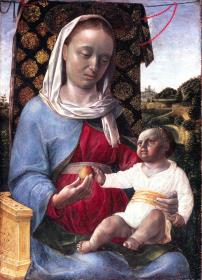
Maria mit dem schlafenden Kind

Ident. Nr.: S.5

ObjID: obj:868165

Details (Expert)

Beteiligte
Ausführung: Andrea Mantegna (um 1431-1506),
Maler*in
Datierung
Ausführung: 1455 - 1460
Weitere Titel
Sammlungstitel: Maria mit dem schlafenden Kind
Übersetzung: Mary with the sleeping child
Geografische Bezüge
Italien,
Land
Material / Technik
Leinwand
Abmessungen
Bildmaß: 48,4 x 32,2 cm

Objektbeschreibung

Andrea Mantegna wurde aufgrund seines Talents schon früh in die Malerschule seines Adoptivvaters Francesco Squarcione (1397–1468) in Padua aufgenommen. Squarcione besaß eine Sammlung von Gipsabgüssen antiker Kunstwerke und von Zeichnungen verschiedener Künstler der Renaissance, durch die Mantegnas Interesse für die Antike sowie für das künstlerische und humanistische Umfeld schon früh geweckt wurde. Zudem spielte Donatello, der von 1443 bis 1453 in Padua arbeitete,
eine Schlüsselrolle für Mantegnas Schaffen. Durch seine Hochzeit mit Nicolosia Bellini im Jahr 1453 schließlich verband sich Mantegna zeitlebens mit Giovanni (Nicolosias Bruder) und der venezianischen Bellini-Familie. Zusammen mit seinem Schwager zählt er bis heute zu den einflussreichsten Malern der oberitalienischen Renaissance.
Als Mantegna die Berliner Madonna malte, hielt er sich vermutlich als Hofmaler der Gonzaga in Mantua auf und war gerade dabei, die Camera Picta mit seinen Fresken auszustatten. Der Renaissance-Experte Keith Christiansen vermutet sogar, dass Mantegna zur selben Zeit die Wand mit den Darstellungen der Familie des Markgrafen Ludovico Gonzaga und seiner Frau Barbara von Brandenburg gestaltete.

In dem kleinformatigen Andachtsbild sehen wir zunächst eine Mutter, die ihr schlafendes Neugeborenes in den Händen hält, sein Köpfchen stützt und es liebevoll an sich schmiegt. Die Darstellung zeigt keine idealisierte heilige Maria sondern eine lebensnahe Figur, dies wird durch fehlende Attribute wie Heiligenscheine unterstrichen. Der Umhang Marias umfängt die beiden Figuren und symbolisiert die Geborgenheit, die eine Mutter ihrem Kind gibt. Der schlafende Säugling ist fest in weiße Windeln eingebunden, nur die kleinen Hände schauen aus der Umwicklung
hervor. Es ließe sich deuten, dass der Schlaf auf den Tod Christi verweist und Maria aufgrund ihrer durch Gott gegebenen Kenntnis über das bevorstehende Schicksal ihres Kindes melancholische Züge trägt. Mantegnas Komposition ist angeregt durch Donatellos bekannte Madonnenreliefs: Die Pazzi-Madonna (um 1420) der Skulpturensammlung im Bode-Museum ist ein Beispiel für die konzentrierte und emotionale Darstellung von Madonna und Kind.

Der Maler hat die Farbschichten auf die ungrundierte Leinwand aufgetragen – ein Verfahren, das Mantegna häufig anwandte –, sodass die Struktur des Malgrunds sichtbar blieb. Der Eindruck, den wir heute von dem Gemälde bekommen, sollte nicht darüber hinwegtäuschen, dass es ursprünglich mit kräftigen und kostbaren Farben versehen war. Neue kunsttechnologische Untersuchungen zeigen, dass Marias Kleid Pigmente von kostbarem Blau (Lapis) enthält, und dass der Umhang mit
einem deutlichen Muster versehen war, von dem die rote Farbe nahezu abgerieben ist. An den Rändern des Bildes lässt sich erkennen, dass der dunkle Hintergrund in späteren Zeiten übermalt wurde.

Im Jahr 1904 kam das Gemälde als Teil der großzügigen Schenkung des Berliner Mäzens James Simon 1904 in die Sammlung der Gemäldegalerie und hing in dem nach ihm benannten Kabinett im Kaiser-Friedrich-Museum (heute Bode-Museum). Seit 2019 wird das Kabinett wieder eingerichtet. Katharina Weick-Joch | 200 Meisterwerke der europäischen Malerei - Gemäldegalerie Berlin, 2019
_______________________________________

In consequence of his talent, Andrea Mantegna was admitted at an early age to the school of painting in Padua of Francesco Squarcione (1397–1468) and was adopted as Squarcione’s son. Squarcione possessed a collection of plaster casts of ancient works of art and drawings by various Renaissance artists, which awakened Mantegna’s interest in antiquity and in his artistic and humanist surroundings while he was still young. Donatello, who worked in Padua from 1443 to 1453, also played
a crucial role in Mantegna’s work. Through his marriage to Nicolosia Bellini in 1453, finally,
Mantegna formed a lifelong connection with Giovanni Bellini (Nicolosia’s brother) and the Venetian Bellini family. Today he is regarded, with his brother-in-law, as one of the most influential painters of the north Italian Renaissance. When Mantegna painted the Berlin Madonna, he was probably court painter to the Gonzagas in Mantua and was engaged there in executing his frescoes in the Camera Picta. The Renaissance expert Keith Christiansen even dates the present work at the same time Mantegna painted his frescoes with depictions of the family of Marquis Ludovico Gonzaga and his wife Barbara of Brandenburg.

In this small-format devotional work, we first see a mother holding in her hand her sleeping newborn child, supporting his little head and lovingly pressing the infant to her. This is not a portrayal of an idealised saint Mary, but a figure taken from life, as the absence of attributes such as haloes emphasises. Mary’s cloak encloses the two figures and symbolises the shelter that a mother gives to her child. The sleeping infant is firmly wrapped in swaddling clothes, from which only his tiny hands peep out. A possible interpretation is that this sleep prefigures the death of Christ and that Mary’s melancholy air results from her God-given knowledge of the coming fate of her child. Mantegna’s composition was inspired by Donatello’s well-known reliefs of the Madonna: the Pazzi Madonna (circa 1420) in the sculpture collection of the Bode-Museum is an example of a concentrated and emotional representation of the Madonna and Child.

The artist applied the layers of paint to canvas that had not been primed – a procedure that Mantegna often used – so that the structure of the ground remained visible. The impression of the work that we have today should not deceive us: originally, it was painted with intense colours and costly materials. Recent technical investigations have shown that Mary’s dress contains pigments of precious blue (lapis lazuli), and that the cloak bore a clear pattern, from which the red has almost been rubbed off. At the edges of the picture, it can be perceived that the dark background was overpainted at a later moment.

In 1904, the work came to the collection of the Gemäldegalerie as part of a generous donation by the Berlin patron James Simon and was hung in the small room named after him in the Kaiser-Friedrich-Museum (today the Bode-Museum). This room has been recently rehung with the Mantegna Virgin at the place of honour. Katharina Weick-Joch | 200 Masterpieces of European Painting - Gemäldegalerie Berlin, 2019

Letzte Aktualisierung: 03.07.2026

Kontakt

Einrichtung:

Gemäldegalerie

Weitere Objekte aus den Sammlungen

Die Auferstehung Christi

Die Auferstehung Christi

»Nun, da ich die Methoden dieser Kunst zu verstehen beginne, grämt es mich, dass sie mir nicht den Auftrag erteilen, das gesamte Rund der Stadtmauern von Florenz mit Geschichten zu bemalen.« Diese Aussage soll Domenico Ghirlandaio gegenüber seinem Bruder Davide geäußert haben, nachdem er den Chor der Dominikanerkirche S. Maria Novella ausgeschmückt hatte. Die Fresken sind heute nochzu sehen und gehören zu den künstlerischen Höhepunkten eines Florenzbesuchs. Doch Ghirlandaio war nicht nur ein bemerkenswerter Freskant, er ist auch für die Gemälde des Hochaltars verantwortlich, die Anfang des 19. Jahrhunderts veräußert wurden. Die Mitteltafel der Vorderseite, Maria mit dem Kinde und Heiligen, befindet sich heute in der Alten Pinakothek in München; die heute in der Gemäldegalerie in Berlin aufbewahrte Auferstehung nahm die Rückseite des Altarbilds ein, die nur für die Priester sichtbar war. Um die Mitteltafel und an den Seiten waren drei Heiligenpaare angeordnet. Zwei dieser Heiligen befanden sich einst in der Gemäldegalerie und wurden vermutlich im Mai 1945 in den letzten Tagen des Zweiten Weltkriegs zerstört (Abb. links).Die Auferstehung zeigt Jesus Christus am Ostermorgen, wie er dem Grab entsteigt und die vier römischen Soldaten, die es bewachen, in Schrecken versetzt. Ghirlandaio wich hier stark vom Inhalt der Heiligen Schrift ab: Das Grab Christi befand sich in einer Höhle und nicht unter freiem Himmel und keinesfalls wies es die Inschrift INRI auf (Jesus von Nazareth, König der Juden), die oben an seinem Kreuz angebracht gewesen sein soll. Auch der Pelikan, der seine Jungen mit demeigenen Blut nährt, entwickelte sich erst viel später zu einem Symbol Christi. Der Maler wollte hier die Theatralik der Szene betonen: Jesus scheint beinahe von einer unsichtbaren Maschinerie in die Luft gehoben, während die Soldaten ihre Überraschung und Angst zu überspielen suchen. Während des 19. Jahrhunderts erfuhr Ghirlandaio für seinen Sentimentalismus große Bewunderung, wurde von einigen Ästheten genau aus diesem Grund jedoch auch stark kritisiert. Der Landschaft in diesem Gemälde gebührt die gleiche Beachtung wie der bemerkenswerten Szene im Vordergrund. Auf der linken Seite nähern sich die drei Marien, die gleich das leere Grab Christi entdecken werden (ihre Namen variieren je nach Evangelium). Dahinter erkennt man im blauen Dunstschleier eine Stadt imflämischen Stil, mit einer besonderen Nähe zur Malweise des Hugo van der Goes. Am 28. Mai 1483 traf Van der Goes’ Bild für den Hochalter von S.’Egidio in Florenz ein (jetzt in den Uffizien), Domenico Ghirlandaio änderte daraufhin seine Vorstellung von Tafelmalerei.Ghirlandaio vollendete weder das Altarbild für S. Maria Novella, noch war es ihm vergönnt, die Stadtmauern von Florenz zu bemalen, wie er gehofft hatte: 1494 starb er im Alter von 45 Jahren an der Pest. Es hat etwas Bewegendes, stellt man sich vor, dass der Tod den Maler während der Arbeit an dieser Auferstehung ereilte, deren Botschaft die Hoffnung auf ein Leben nach dem Tod enthielt. Giorgio Vasari zufolge wurde dieser Teil des Bildes von Ghirlandaios Brüdern Davide undBenedetto fertiggestellt. Kritiker stimmen jedoch darin überein, dass die Landschaft von einem anderen Künstler stammen muss, in dem man Ghirlandaios Schüler Francesco Granacci sah, der heute als Pseudo Granacci bezeichnet wird. Trotz dessen Mitwirkens kann die Auferstehung als eines der letzten Meisterwerke von Domenico Ghirlandaio gelten. Neville Rowley | 200 Meisterwerke der europäischen Malerei - Gemäldegalerie Berlin, 2019________________________________________“Now that I have begun to understand the methods of this art, it grieves me that they will not commission me to paint the whole circuit of the walls of the city of Florence with stories.” This is what the painter Domenico Ghirlandaio is reputed to have said to his brother Davide, after having finished decorating the choir of the Dominican Church of Santa Maria Novella. The frescoes are still in place and are one of the highlights of any visitor who discovers Florence. But Ghirlandaio was not only a remarkable fresco painter: he was also responsible for the gigantic altarpiece adorning the chapel, dispersed at the beginning of the 19th century. The Virgin and Child in Glory among Saints which occupied the central compartment on the front side is now to be seen in Alte Pinakothek in Munich; as for the present Resurrection now in the Gemäldegalerie in Berlin, it was on the other side of the altarpiece, only visible to priests. Around the central panels and on the lateral sides of the altarpiece, three pairs of saints were displayed; two of these saints, once part of the collection of the Gemäldegalerie, were probably destroyed in May 1945 in the last days of the Second World War (fig. left).The Resurrection shows Jesus-Christ on Easter morning, coming out of his tomb, to the complete astonishment of the four Roman soldiers charged to guard his sepulture. Ghirlandaio freed himself largely from the Holy Scriptures: Christ’s tomb was set in a cave and not in the open air; and it was certainly not inscribed with the acronym “I.N.R.I.” (Jesus Christ King of Nazareth), placed instead on top of his cross, nor with the Pelican who fed his children with his blood, a symbol of Christ adopted much later (it is true that the inscription appears to have been painted over a former one). What mattered for the painter was to accentuate the theatrical character of the scene: Jesus seems to be pulled into the air by some backstage machinery, while the soldiers over-play their surprise and their fear. During the 19th century, Ghirlandaio was greatly admired for his sentimentalism; and also despised by a few aesthetes for this very reason.The landscape of this painting is to be admired on the same level as the ostentatious foreground. On the left side, we see the three Mary who, soon, will discover the empty tomb of Christ (their identities vary according to the gospels). Further on, one distinguishes a city in a blue mist, painted like in a Flemish style, and close in particular to Hugo van der Goes. On 28 May 1483, the high altarpiece of the church of Sant’Egidio, painted by Van der Goes, had arrived in Florence (it is now in the Uffizi); from that moment on, Domenico Ghirlandaio changed his conception of panel painting.Ghirlandaio did not have time to finish the Santa Maria Novella altarpiece, nor to fresco the whole circuit of the walls of Florence, as he had hoped: he died from the plague in 1494, only aged 45. There is something moving about imagining the painter agonizing while trying to complete this Resurrection, whose religious message is to give hope in a life after death. According to Vasari, this part of the altarpiece was completed by the painter’s brothers, Davide and Benedetto; but critics nowagree that the landscape is due to another artist, long confused with the pupil of Ghirlandaio Francesco Granacci and now known as the “Pseudo Granacci”. Despite the latter’s intervention, one can fully consider the Resurrection as one of the last masterpieces by Domenico Ghirlandaio. Neville Rowley | 200 Masterpieces of European Painting - Gemäldegalerie Berlin, 2019