
Logo

Bildnis eines jungen Mannes

Ident. Nr.: 12A

ObjID: obj:869143

Details (Expert)

Beteiligte
Ausführung: Giorgione (1477/78 - 1510),
Maler*in
Weitere Titel
Sammlungstitel: Bildnis eines jungen Mannes
Übersetzung: Portrait of a Young Man
Geografische Bezüge
Italien,
Land
Material / Technik
Leinwand
Abmessungen
Bildmaß: 59,2 x 47 cm

Objektbeschreibung

Das Bildnis eines jungen Mannes befand sich bis 1884 in der Sammlung Giustiniani in Padua und wird deshalb auch Bildnis Giustiniani genannt. 1884 bis 1891 gehörte es dem Kunsthistoriker Jean Paul Richter, der es Giorgione zuschrieb und von dem Bode es 1891 kaufte. Es gehört nicht zu den durch Inschriften, Quellen oder Dokumente beglaubigten Werken Giorgiones, aber doch zu dem kleinen Kernbestand, der von fast ausnahmslos allen Forschern als eigenhändig anerkannt wird. Unter diesen Werken sind nur ganz wenige Porträts, die Laura in Wien (Kunsthistorisches Museum; Inschrift mit Datum 1506 auf der Rückseite), das Bildnis einer alten Frau in Venedig (Akademie), das Bildnis Giustiniani und das etwas weniger prominente männliche Porträt Terris in San Diego (Fine Arts Gallery; Inschrift mit Datum 15[1]0 auf der Rückseite). Der in Halbfigur Dargestellte erscheint vor dunklem Grund hinter einer Steinbrüstung, auf die er seine rechte Hand gelegt hat. Die Haltung des Oberkörpers ist fast unmerklich aus der Frontalität verschoben, das Gesicht ist in Dreiviertelansicht gegeben. Der Blick trifft den Betrachter. Der Dargestellte trägt ein blaßviolettes, gestepptes Gewand, das vorn mit Schleifen geschlossen ist. Die oberste hat sich gelöst und läßt das weiße Hemd hervorschauen. Der selbstbewußte Ausdruck, der kühle Blick aus den Augenwinkeln, die ebenmäßig klassischen Formen und der leicht verhangen-melancholische Zug, der über dem Bild liegt, heben das Werk von den vorhergehenden Porträts des späten 15. Jahrhunderts (Antonello da Messina, Giovanni Bellini) ab. Das Motiv der auf der Brüstung ruhenden Hand ist unvenezianisch und könnte von niederländischen Vorbildern abgeleitet sein, etwa von Porträts von Memling, die Giorgione in venezianischen Sammlungen gesehen haben könnte. Es mag aber auch von Leonardo angeregt worden sein. Giorgione hat hier den Schritt zur Hochrenaissance vollzogen. In seiner klassischen Harmonie ist das Bild Werken Raffaels vergleichbar. Dieser Porträttypus wurde bestimmend für den jungen Tizian und für Künstler der Giorgione-Nachfolge wie Cariani. Die Inschrift »V V« auf der Steinbrüstung ist zwar nachgezogen, geht aber wohl auf einen originalen Befund zurück. Sie hat zahlreiche Interpretationen gefunden, zuletzt als »Virtus Vincit« und als »Vivo Vivus«, letztere in Analogie zu Inschriften auf römischen Porträts und Grabmonumenten. Diese Deutung hat zum Teil Anklang gefunden, sie ist aber auch in Frage gestellt worden. Die Datierung ist umstritten. Pignatti (1978), Pallucchini (1981) und andere datieren das Bild um 1506, in die Nähe der Laura. C. Hornig (1976) datierte es um 1500/01, A. Ballarin (1978/79) sogar um 1497/98. D. Rosand (1978) schrieb das Bild zu Unrecht dem jungen Tizian zu. [Gleiche Meinung seitens Joannides 2001]. Erich Schleier | 200 Meisterwerke der europäischen Malerei - Gemäldegalerie Berlin, 2019

SIGNATUR / INSCHRIFT: V V
_____________________________

Until 1884, the Portrait of a Young Man was found in the Giustiniani Collection in Padua, and was known for this reason as the Giustiniani Portrait. From 1884 until 1891, it was owned by the art historian Jean Paul Richter, who attributed it to Giorgione, and who sold it to Wilhelm von Bode in 1891. It is not among those works by Giorgione that can be authenticated on the basis of inscriptions, source materials, or documentation, but nonetheless belongs to the small core of works that are accepted by scholars, virtually without exception, as coming from the artist’s own hand. Very few portraits are found among this group of works: the Laura in Vienna (Kunsthistorisches Museum; inscription on the reverse with the date 1506), the Portrait of an Old Woman in Venice (Galleria dell’Accademia), the Giustiniani Portrait, and the somewhat less prominent male Terris Portrait in San Diego (Fine Arts Gallery; inscription on the reverse the date 15[1]0).

The sitter, depicted as a half-figure, appears against a dark background and behind a stone balustrade, on which he rests his right hand. The upper body is rotated almost imperceptibly away from a frontal position, and the face is shown in a three-quarters view. His gaze is directed toward the viewer. The young man wears a pale violet, quilted garment that closes with bows in the front. The uppermost bow has come undone, allowing the white shirt to show. His self-assured expression, the cool gaze that confronts the viewer from the corners of the sitter’s eyes, the well-proportioned classical forms, and the gently overcast, melancholic atmosphere that suffuses the image distinguishes it from slightly earlier portraits from the late 15th century by artists such as Antonello da Messina and Giovanni Bellini. The motif of the hand resting on balustrade is not Venetian, and could have been derived
from Netherlandish models, for example the portraits by Memling which Giorgione may well have seen in Venetian collections. It may instead have been inspired by Leonardo’s works. In this work, Giorgione has accomplished the transition toward the High Renaissance. In its classical harmony, it is comparable to works by Raphael. This portrait type would become decisive for the young Titian, and for artists who emulated Giorgione, such as Cariani.

The inscription “V V” on the stone balustrade was actually added later, but very likely reproduces the original initials. It has been interpreted variously, most recently as “Virtus Vincit”, but also as “Vivo Vivus”, the latter by analogy with inscriptions on Roman portraits and tomb monuments. This explanation has met with some acceptance, but has also been called into question. The dating of this work is controversial. Pignatti (1978), Pallucchini (1981), and others have dated it to circa 1506, and hence roughly contemporary with the Laura. C. Hornig (1976) dates it to 1500/01, and A. Ballarin (1978/79) has even proposed a date of 1497/98. D. Rosand (1978) regarded this picture, wrongly, to be by the young Titian(this view is shared by Joannides 2001). Erich Schleier | 200 Masterpieces of European Painting - Gemäldegalerie Berlin, 2019

Letzte Aktualisierung: 03.07.2026

Kontakt

Einrichtung:

Gemäldegalerie

Weitere Objekte aus den Sammlungen

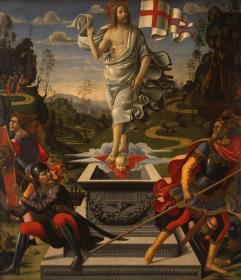
Die Auferstehung Christi

Die Auferstehung Christi

»Nun, da ich die Methoden dieser Kunst zu verstehen beginne, grämt es mich, dass sie mir nicht den Auftrag erteilen, das gesamte Rund der Stadtmauern von Florenz mit Geschichten zu bemalen.« Diese Aussage soll Domenico Ghirlandaio gegenüber seinem Bruder Davide geäußert haben, nachdem er den Chor der Dominikanerkirche S. Maria Novella ausgeschmückt hatte. Die Fresken sind heute nochzu sehen und gehören zu den künstlerischen Höhepunkten eines Florenzbesuchs. Doch Ghirlandaio war nicht nur ein bemerkenswerter Freskant, er ist auch für die Gemälde des Hochaltars verantwortlich, die Anfang des 19. Jahrhunderts veräußert wurden. Die Mitteltafel der Vorderseite, Maria mit dem Kinde und Heiligen, befindet sich heute in der Alten Pinakothek in München; die heute in der Gemäldegalerie in Berlin aufbewahrte Auferstehung nahm die Rückseite des Altarbilds ein, die nur für die Priester sichtbar war. Um die Mitteltafel und an den Seiten waren drei Heiligenpaare angeordnet. Zwei dieser Heiligen befanden sich einst in der Gemäldegalerie und wurden vermutlich im Mai 1945 in den letzten Tagen des Zweiten Weltkriegs zerstört (Abb. links).Die Auferstehung zeigt Jesus Christus am Ostermorgen, wie er dem Grab entsteigt und die vier römischen Soldaten, die es bewachen, in Schrecken versetzt. Ghirlandaio wich hier stark vom Inhalt der Heiligen Schrift ab: Das Grab Christi befand sich in einer Höhle und nicht unter freiem Himmel und keinesfalls wies es die Inschrift INRI auf (Jesus von Nazareth, König der Juden), die oben an seinem Kreuz angebracht gewesen sein soll. Auch der Pelikan, der seine Jungen mit demeigenen Blut nährt, entwickelte sich erst viel später zu einem Symbol Christi. Der Maler wollte hier die Theatralik der Szene betonen: Jesus scheint beinahe von einer unsichtbaren Maschinerie in die Luft gehoben, während die Soldaten ihre Überraschung und Angst zu überspielen suchen. Während des 19. Jahrhunderts erfuhr Ghirlandaio für seinen Sentimentalismus große Bewunderung, wurde von einigen Ästheten genau aus diesem Grund jedoch auch stark kritisiert. Der Landschaft in diesem Gemälde gebührt die gleiche Beachtung wie der bemerkenswerten Szene im Vordergrund. Auf der linken Seite nähern sich die drei Marien, die gleich das leere Grab Christi entdecken werden (ihre Namen variieren je nach Evangelium). Dahinter erkennt man im blauen Dunstschleier eine Stadt imflämischen Stil, mit einer besonderen Nähe zur Malweise des Hugo van der Goes. Am 28. Mai 1483 traf Van der Goes’ Bild für den Hochalter von S.’Egidio in Florenz ein (jetzt in den Uffizien), Domenico Ghirlandaio änderte daraufhin seine Vorstellung von Tafelmalerei.Ghirlandaio vollendete weder das Altarbild für S. Maria Novella, noch war es ihm vergönnt, die Stadtmauern von Florenz zu bemalen, wie er gehofft hatte: 1494 starb er im Alter von 45 Jahren an der Pest. Es hat etwas Bewegendes, stellt man sich vor, dass der Tod den Maler während der Arbeit an dieser Auferstehung ereilte, deren Botschaft die Hoffnung auf ein Leben nach dem Tod enthielt. Giorgio Vasari zufolge wurde dieser Teil des Bildes von Ghirlandaios Brüdern Davide undBenedetto fertiggestellt. Kritiker stimmen jedoch darin überein, dass die Landschaft von einem anderen Künstler stammen muss, in dem man Ghirlandaios Schüler Francesco Granacci sah, der heute als Pseudo Granacci bezeichnet wird. Trotz dessen Mitwirkens kann die Auferstehung als eines der letzten Meisterwerke von Domenico Ghirlandaio gelten. Neville Rowley | 200 Meisterwerke der europäischen Malerei - Gemäldegalerie Berlin, 2019________________________________________“Now that I have begun to understand the methods of this art, it grieves me that they will not commission me to paint the whole circuit of the walls of the city of Florence with stories.” This is what the painter Domenico Ghirlandaio is reputed to have said to his brother Davide, after having finished decorating the choir of the Dominican Church of Santa Maria Novella. The frescoes are still in place and are one of the highlights of any visitor who discovers Florence. But Ghirlandaio was not only a remarkable fresco painter: he was also responsible for the gigantic altarpiece adorning the chapel, dispersed at the beginning of the 19th century. The Virgin and Child in Glory among Saints which occupied the central compartment on the front side is now to be seen in Alte Pinakothek in Munich; as for the present Resurrection now in the Gemäldegalerie in Berlin, it was on the other side of the altarpiece, only visible to priests. Around the central panels and on the lateral sides of the altarpiece, three pairs of saints were displayed; two of these saints, once part of the collection of the Gemäldegalerie, were probably destroyed in May 1945 in the last days of the Second World War (fig. left).The Resurrection shows Jesus-Christ on Easter morning, coming out of his tomb, to the complete astonishment of the four Roman soldiers charged to guard his sepulture. Ghirlandaio freed himself largely from the Holy Scriptures: Christ’s tomb was set in a cave and not in the open air; and it was certainly not inscribed with the acronym “I.N.R.I.” (Jesus Christ King of Nazareth), placed instead on top of his cross, nor with the Pelican who fed his children with his blood, a symbol of Christ adopted much later (it is true that the inscription appears to have been painted over a former one). What mattered for the painter was to accentuate the theatrical character of the scene: Jesus seems to be pulled into the air by some backstage machinery, while the soldiers over-play their surprise and their fear. During the 19th century, Ghirlandaio was greatly admired for his sentimentalism; and also despised by a few aesthetes for this very reason.The landscape of this painting is to be admired on the same level as the ostentatious foreground. On the left side, we see the three Mary who, soon, will discover the empty tomb of Christ (their identities vary according to the gospels). Further on, one distinguishes a city in a blue mist, painted like in a Flemish style, and close in particular to Hugo van der Goes. On 28 May 1483, the high altarpiece of the church of Sant’Egidio, painted by Van der Goes, had arrived in Florence (it is now in the Uffizi); from that moment on, Domenico Ghirlandaio changed his conception of panel painting.Ghirlandaio did not have time to finish the Santa Maria Novella altarpiece, nor to fresco the whole circuit of the walls of Florence, as he had hoped: he died from the plague in 1494, only aged 45. There is something moving about imagining the painter agonizing while trying to complete this Resurrection, whose religious message is to give hope in a life after death. According to Vasari, this part of the altarpiece was completed by the painter’s brothers, Davide and Benedetto; but critics nowagree that the landscape is due to another artist, long confused with the pupil of Ghirlandaio Francesco Granacci and now known as the “Pseudo Granacci”. Despite the latter’s intervention, one can fully consider the Resurrection as one of the last masterpieces by Domenico Ghirlandaio. Neville Rowley | 200 Masterpieces of European Painting - Gemäldegalerie Berlin, 2019