
Logo

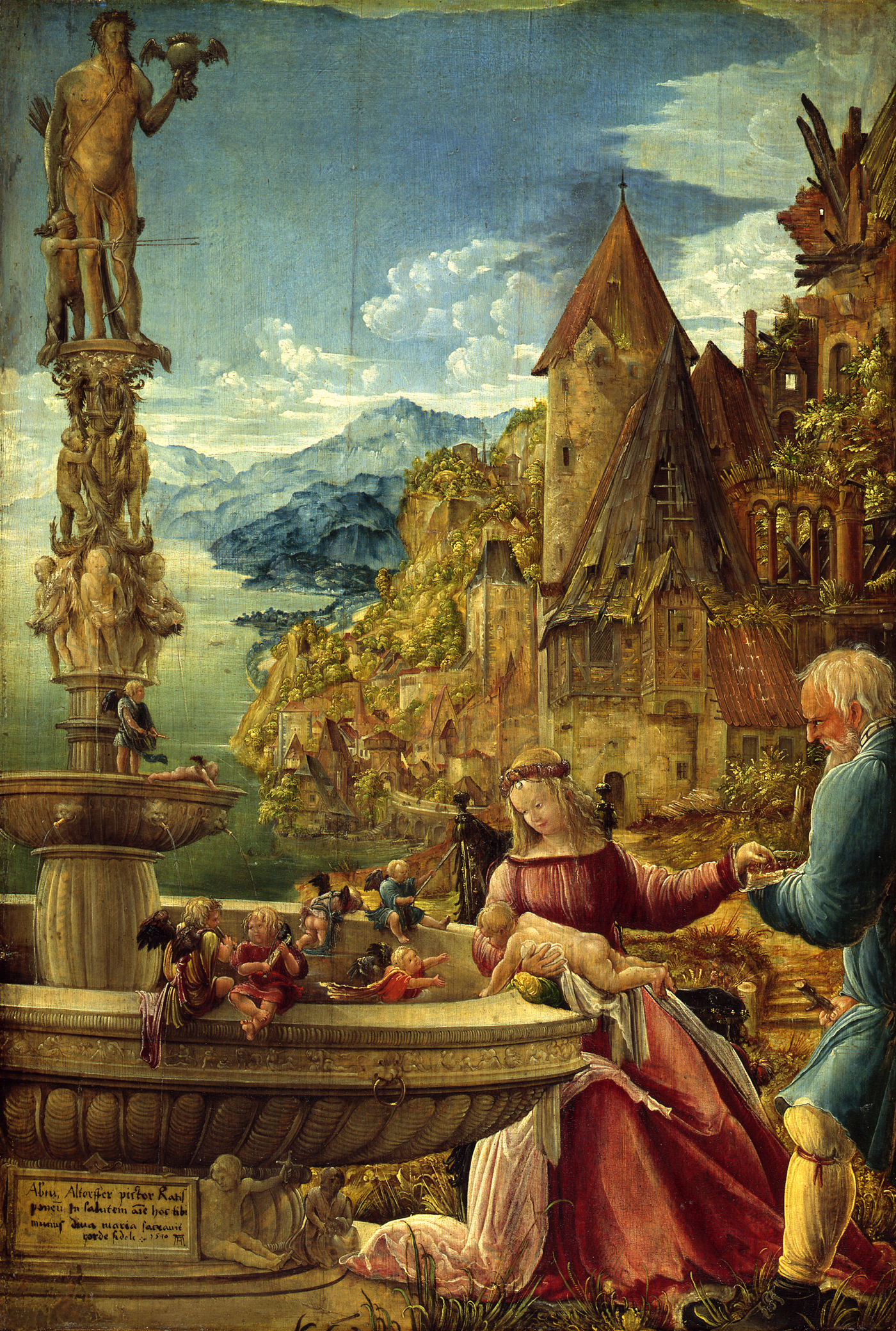
Ruhe auf der Flucht nach Ägypten

Ident. Nr.: 638B

ObjID: obj:870405

Details (Expert)

Beteiligte
Ausführung: Albrecht Altdorfer (ca. 1480 - 1538),
Maler*in
Datierung
Ausführung: 1510
Weitere Titel
Sammlungstitel: Ruhe auf der Flucht nach Ägypten
Übersetzung: Rest on the Flight to Egypt
Geografische Bezüge
Material / Technik
Lindenholz
Abmessungen
Bildmaß: 58,2 x 39,3 cm

Objektbeschreibung

Ein großer Brunnen mit einem schalenförmigen Becken und einem mit zahlreichen Figuren geschmückten Brunnenstock beherrscht den Vordergrund des Bildes. Neben dem Becken sitzt Maria auf einem thronähnlichen Sessel. Der Christusknabe auf ihrem Arm beugt sich dem Wasser und den dort spielenden Engelputten zu. Von rechts tritt Joseph mit einer Handvoll Kirschen heran und bietet sie Maria dar. Die Darstellung der Ruhe der Heiligen Familie auf der Flucht nach Ägypten ist ungewöhnlich und sehr persönlich bestimmt. Sie ist mit legendären Zügen ausgeschmückt und mit vielen symbolischen Anspielungen bereichert. Der Brunnen selbst erinnert an die Quelle, die nach der Legende am Rastplatz entsprang, um die Reisenden zu erquicken. Und die Kirschen, die Joseph herbeibringt, sind eine Reminiszenz an den Palmbaum, der sich neigte, um mit seinen Früchten die Ruhenden zu erfrischen. Beim Einzug des Christusknaben in die Stadt Sotinen, so heißt es, seien die Götzenstandbilder und Tempel eingestürzt. Die Ruinen alter Kirchen mit romanischen Bauformen, die den Zeitgenossen für das Vergangene schlechthin und für den Alten Bund und das Judentum im besonderen standen, und zerbrochene Standbilder spielen auf dieses Ereignis an. Zu den Götzensäulen sind wohl auch die Figuren des Brunnenstocks zu rechnen, ein Amor mit Bogen und zwei Pfeilen und eine bärtige Gestalt mit einem Köcher und einem geflügelten Gegenstand in der Linken. Was dieses Objekt und wer diese Gestalt sein sollen, ist nicht mit Gewißheit zu bestimmen. Sinnfällig ist, wie die steinerne, tote Fahlheit dieser Gestalten sich gegen das Wasser und gegen den Christusknaben hin wandelt und sich mit farbigem, blutvollem Leben erfüllt. Maria und Christus erscheinen so als der »Brunnen des lebendigen Wassers«, als der »Quell des Lebens« (Hohelied 4, 15; Psalm 36, 10). Hinter den Ruinen der Stadt am rechten Bildrand zieht sich eine weite zerklüftete Berglandschaft längs eines Sees hin bis zum Horizont. Eine ähnliche Landschaft hat Altdorfer noch einmal in einem anderen Gemälde, der Kreuzigung in Kassel, verwendet. Man hat dabei an reale Vorbilder gedacht. Eine Szenerie bei Wörth an der Donau soll Altdorfer zu dieser Darstellung angeregt haben. Wie dem auch sei, Altdorfer hat die Landschaft im Bild in seinem Sinne umgebildet. Die sanften Berge entlang der Donau sind zu steil aufragenden schroffen Felsen und zu schier unüberwindlichen Gebirgsketten hochgetürmt. Die dramatische Berglandschaft, die die Mühsal des Wegs der Fliehenden veranschaulicht, wird zum Kontrapunkt der Idylle am Brunnen. Vor den runden Sockel des Brunnenbeckens hat Altdorfer eine Widmungsinschrift gemalt. Darin weiht er dieses Bild frommen Herzens Maria. Es handelt sich also um ein ganz persönliches, bekenntnishaftes Werk des Malers. Wilhelm H. Köhler | 200 Meisterwerke der europäischen Malerei – Gemäldegalerie Berlin, 2019

SIGNATUR / INSCHRIFT: Bez. links unten über dem Fuß des Brunnens auf einer Tafel: A[l]b[er]tu[s] Altorffer pictor Ratis / ponen[sis] In salutem a[n]i[ma]e hoc tibi / munus diua maria sacrauit / corde fideli 1510. AA (verbunden)
__________________________________________________________________________

A large fountain with a bowl-shaped basin and a fountain column decorated with many figures dominates the foreground. Mary is sitting beside the pool on a thronelike seat. The Christ child on her arm is leaning over the water towards the angel cherubs playing in it. Joseph approaches from the right with a handful of cherries and offers them to Mary.

The depiction of the Holy Family resting on the flight into Egypt is unusual and very personal. It is elaborated with many legendary features and many symbolic allusions. The fountain itself recalls a spring, which according to legend rose at the resting place to quench travellers’ thirst, while the cherries that Joseph is bringing are a reference to the palm tree that leans over to offer its fruits as a refreshment for the resting travellers. It is said that when the Christ child entered the city of
Sotinen, the images of false gods and the temple collapsed. For contemporaries, the ruins of old Romanesque churches were the quintessential symbol of the past and the Old Covenant and of Judaism in particular; the broken statues are an allusion to this. The false gods probably also include the figures embellishing the fountain column: Cupid with a bow, and two arrows and a bearded figure with a quiver and a winged object in his left hand. It is difficult to say for certain what these objects
represent or who the figure is supposed to be. What is evident is how these figures with their stone, dead pallor become filled with colourful, full-blooded life as they turn towards the water and the Christ child. Mary and Christ thus appear to be the “fountain of the water of life”, the “source of life” (Song of Songs 4:15; Psalm 36:10).

Beyond the ruins of the city on the right of the picture, a broad craggy mountain landscape stretches along a lake all the way to the horizon. Altdorfer painted a similar landscape in another painting, the Crucifixion in Kassel. The models for these landscapes are thought to be real, and Altdorfer probably derived his inspiration for this depiction from the scenery near Wörth on the Danube. The gentle hills along the Danube tower up here to steep, craggy rocks and insurmountable mountain ranges. The dramatic mountain landscape, which illustrates the hardship of the journey for the fleeing family, forms a contrast to the idyll by the fountain.

In front of the round base of the fountain basin, Altdorfer has painted an inscription, piously dedicating the painting to Mary. Thus, for the painter this is a highly personal, confessional work. Wilhelm H. Köhler | 200 Masterpieces of European Painting – Gemäldegalerie Berlin, 2019

Letzte Aktualisierung: 03.07.2026

Kontakt

Einrichtung:

Gemäldegalerie

Weitere Objekte aus den Sammlungen

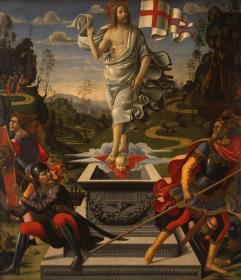
Die Auferstehung Christi

Die Auferstehung Christi

»Nun, da ich die Methoden dieser Kunst zu verstehen beginne, grämt es mich, dass sie mir nicht den Auftrag erteilen, das gesamte Rund der Stadtmauern von Florenz mit Geschichten zu bemalen.« Diese Aussage soll Domenico Ghirlandaio gegenüber seinem Bruder Davide geäußert haben, nachdem er den Chor der Dominikanerkirche S. Maria Novella ausgeschmückt hatte. Die Fresken sind heute nochzu sehen und gehören zu den künstlerischen Höhepunkten eines Florenzbesuchs. Doch Ghirlandaio war nicht nur ein bemerkenswerter Freskant, er ist auch für die Gemälde des Hochaltars verantwortlich, die Anfang des 19. Jahrhunderts veräußert wurden. Die Mitteltafel der Vorderseite, Maria mit dem Kinde und Heiligen, befindet sich heute in der Alten Pinakothek in München; die heute in der Gemäldegalerie in Berlin aufbewahrte Auferstehung nahm die Rückseite des Altarbilds ein, die nur für die Priester sichtbar war. Um die Mitteltafel und an den Seiten waren drei Heiligenpaare angeordnet. Zwei dieser Heiligen befanden sich einst in der Gemäldegalerie und wurden vermutlich im Mai 1945 in den letzten Tagen des Zweiten Weltkriegs zerstört (Abb. links).Die Auferstehung zeigt Jesus Christus am Ostermorgen, wie er dem Grab entsteigt und die vier römischen Soldaten, die es bewachen, in Schrecken versetzt. Ghirlandaio wich hier stark vom Inhalt der Heiligen Schrift ab: Das Grab Christi befand sich in einer Höhle und nicht unter freiem Himmel und keinesfalls wies es die Inschrift INRI auf (Jesus von Nazareth, König der Juden), die oben an seinem Kreuz angebracht gewesen sein soll. Auch der Pelikan, der seine Jungen mit demeigenen Blut nährt, entwickelte sich erst viel später zu einem Symbol Christi. Der Maler wollte hier die Theatralik der Szene betonen: Jesus scheint beinahe von einer unsichtbaren Maschinerie in die Luft gehoben, während die Soldaten ihre Überraschung und Angst zu überspielen suchen. Während des 19. Jahrhunderts erfuhr Ghirlandaio für seinen Sentimentalismus große Bewunderung, wurde von einigen Ästheten genau aus diesem Grund jedoch auch stark kritisiert. Der Landschaft in diesem Gemälde gebührt die gleiche Beachtung wie der bemerkenswerten Szene im Vordergrund. Auf der linken Seite nähern sich die drei Marien, die gleich das leere Grab Christi entdecken werden (ihre Namen variieren je nach Evangelium). Dahinter erkennt man im blauen Dunstschleier eine Stadt imflämischen Stil, mit einer besonderen Nähe zur Malweise des Hugo van der Goes. Am 28. Mai 1483 traf Van der Goes’ Bild für den Hochalter von S.’Egidio in Florenz ein (jetzt in den Uffizien), Domenico Ghirlandaio änderte daraufhin seine Vorstellung von Tafelmalerei.Ghirlandaio vollendete weder das Altarbild für S. Maria Novella, noch war es ihm vergönnt, die Stadtmauern von Florenz zu bemalen, wie er gehofft hatte: 1494 starb er im Alter von 45 Jahren an der Pest. Es hat etwas Bewegendes, stellt man sich vor, dass der Tod den Maler während der Arbeit an dieser Auferstehung ereilte, deren Botschaft die Hoffnung auf ein Leben nach dem Tod enthielt. Giorgio Vasari zufolge wurde dieser Teil des Bildes von Ghirlandaios Brüdern Davide undBenedetto fertiggestellt. Kritiker stimmen jedoch darin überein, dass die Landschaft von einem anderen Künstler stammen muss, in dem man Ghirlandaios Schüler Francesco Granacci sah, der heute als Pseudo Granacci bezeichnet wird. Trotz dessen Mitwirkens kann die Auferstehung als eines der letzten Meisterwerke von Domenico Ghirlandaio gelten. Neville Rowley | 200 Meisterwerke der europäischen Malerei - Gemäldegalerie Berlin, 2019________________________________________“Now that I have begun to understand the methods of this art, it grieves me that they will not commission me to paint the whole circuit of the walls of the city of Florence with stories.” This is what the painter Domenico Ghirlandaio is reputed to have said to his brother Davide, after having finished decorating the choir of the Dominican Church of Santa Maria Novella. The frescoes are still in place and are one of the highlights of any visitor who discovers Florence. But Ghirlandaio was not only a remarkable fresco painter: he was also responsible for the gigantic altarpiece adorning the chapel, dispersed at the beginning of the 19th century. The Virgin and Child in Glory among Saints which occupied the central compartment on the front side is now to be seen in Alte Pinakothek in Munich; as for the present Resurrection now in the Gemäldegalerie in Berlin, it was on the other side of the altarpiece, only visible to priests. Around the central panels and on the lateral sides of the altarpiece, three pairs of saints were displayed; two of these saints, once part of the collection of the Gemäldegalerie, were probably destroyed in May 1945 in the last days of the Second World War (fig. left).The Resurrection shows Jesus-Christ on Easter morning, coming out of his tomb, to the complete astonishment of the four Roman soldiers charged to guard his sepulture. Ghirlandaio freed himself largely from the Holy Scriptures: Christ’s tomb was set in a cave and not in the open air; and it was certainly not inscribed with the acronym “I.N.R.I.” (Jesus Christ King of Nazareth), placed instead on top of his cross, nor with the Pelican who fed his children with his blood, a symbol of Christ adopted much later (it is true that the inscription appears to have been painted over a former one). What mattered for the painter was to accentuate the theatrical character of the scene: Jesus seems to be pulled into the air by some backstage machinery, while the soldiers over-play their surprise and their fear. During the 19th century, Ghirlandaio was greatly admired for his sentimentalism; and also despised by a few aesthetes for this very reason.The landscape of this painting is to be admired on the same level as the ostentatious foreground. On the left side, we see the three Mary who, soon, will discover the empty tomb of Christ (their identities vary according to the gospels). Further on, one distinguishes a city in a blue mist, painted like in a Flemish style, and close in particular to Hugo van der Goes. On 28 May 1483, the high altarpiece of the church of Sant’Egidio, painted by Van der Goes, had arrived in Florence (it is now in the Uffizi); from that moment on, Domenico Ghirlandaio changed his conception of panel painting.Ghirlandaio did not have time to finish the Santa Maria Novella altarpiece, nor to fresco the whole circuit of the walls of Florence, as he had hoped: he died from the plague in 1494, only aged 45. There is something moving about imagining the painter agonizing while trying to complete this Resurrection, whose religious message is to give hope in a life after death. According to Vasari, this part of the altarpiece was completed by the painter’s brothers, Davide and Benedetto; but critics nowagree that the landscape is due to another artist, long confused with the pupil of Ghirlandaio Francesco Granacci and now known as the “Pseudo Granacci”. Despite the latter’s intervention, one can fully consider the Resurrection as one of the last masterpieces by Domenico Ghirlandaio. Neville Rowley | 200 Masterpieces of European Painting - Gemäldegalerie Berlin, 2019