
Spielende Amoretten
Ident. Nr.: 1024
ObjID: obj:870617
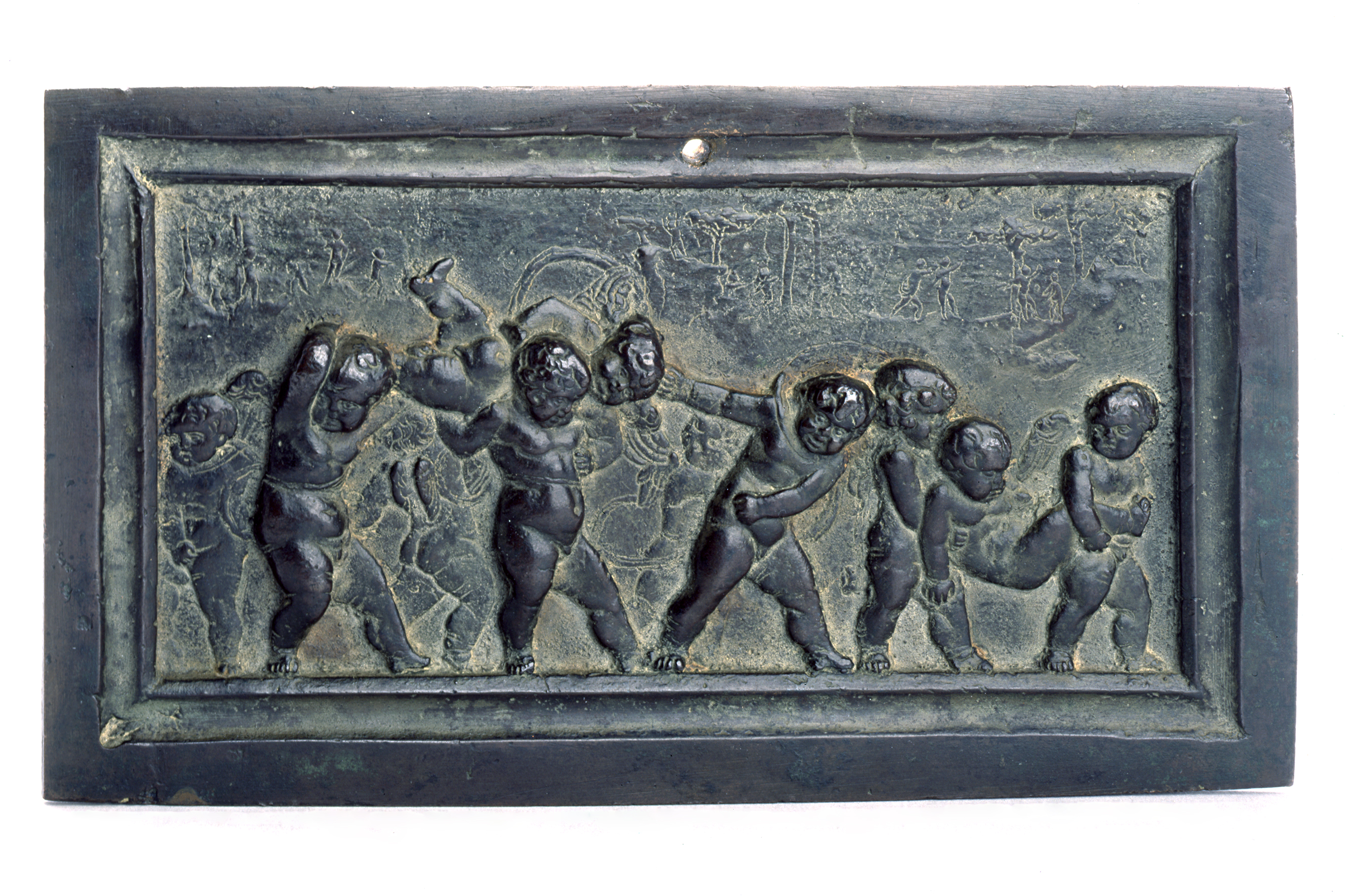
Fotonachweis: Staatliche Museen zu Berlin, Skulpturensammlung und Museum für Byzantinische Kunst / Antje Voigt Public Domain Mark 1.0
Details (Expert)
- Datierung
- Datierung: 3. Viertel 15. Jahrhundert
- Systematik/Art
- Weitere Titel
- Sammlungstitel: Spielende AmorettenPlaying Putti
- Material / Technik
- Bronze
- Abmessungen
- Höhe x Breite x Tiefe: 12,5 x 22,3 x 1,3 cmGewicht: 1,43 kg
- Permalink
- https://id.smb.museum/object/870617
Objektbeschreibung
Das Relief entstand in Auseinandersetzung mit zwei in der Renaissance hochberühmten antiken Bildwerken, Teilen vom sogenannten Thron Saturns, eines größeren Ensembles von Marmorreliefs mit Amoretten (Venedig, Museo Archeologico). Dort tragen die nackten Kindergestalten eine Sense, das Attribut Saturns, auf ihren Schultern und schleppen dessen Zepter fort. In der ersten Hälfte des 15. Jahrhunderts sind diese Reliefs in Venedig nachweisbar, wo sie zahlreichen Künstlern als Studienobjekte dienten. Goethe berichtet über die Engel in der "Italienischen Reise": "Es sind Genien, welche sich mit den Attributen der Götter schleppen, freilich so schön, das es allen Begriff übersteigt."
English catalogue entry
Northern Italian (Venice or Padua?)
Playing Putti
ca. 1450-80
Bronze plaquette
12.4 x 22.1 cm.
Berlin, Staatliche Museen, Skulpturensammlung, Inv. SKS 1024.
Bode-Museum, on view.
Provenance
Geneva, Mylius collection; Florence, Stefano Bardini (1880); Berlin, Skulpturensammlung/Altes Museum (1880-1896); Berlin, Berlin, Skulpturensammlung/Neues Museum (1896-1904); Berlin, Skulpturensammlung/Kaiser-Friedrich-Museum (1904-1939); Berlin, storage (1939-1945); Merkers, storage (1945); Wiesbaden, Central Collecting Point (1945-1956); West Berlin, Skulpturensammlung/Museum Dahlem (1956-1990); Berlin, Skulpturensammlung/Museum Dahlem (1990-1997); Berlin, storage (1997-2006); Berlin, Skulpturensammlung/Bode-Museum (since 2006).
Acquisition
Acquired in Florence from Stefano Bardini in 1880.
Bibliography
Bode 1884
Wilhelm Bode, “Die italienischen Skulpturen der Renaissance in den Königlichen Museen zu Berlin. III. Bildwerke des Donatello und seiner Schule”, Jahrbuch der Königlich preußischen Kunstsammlungen, V, 1884, pp. 30, 42 note 1: Donatello.
Molinier 1886
Émile Molinier, Les Bronzes de la Renaissance. Les plaquettes. Catalogue raisonné, Paris, Jules Rouam, 1886, I, pp. 45-46 cat. 77: school of Donatello.
Bode 1894
Wilhelm Bode, Denkmäler der Renaissance-Sculptur Toscanas, Munich, F. Bruckmann, 1894, II, pl. 92: Donatello.
Bode 1902
Wilhelm Bode, Florentiner Bildhauer der Renaissance, Berlin, Bruno Cassirer, 1902, pp. 259, 261 note 112: Donatello.
Bode 1904
Wilhelm Bode, Die italienischen Bronzen, 2nd edition, Berlin, Reimer, 1904, p. 50 n. 635, pl. XLIII. (reference to be checked)
Schubring 1907
Paul Schubring, Donatello. Des Meisters Werke in 277 Abbildungen, Stuttgart and Leipzig, Deutsche Verlags-Anstalt, 1907, p. 94: Donatello, ca. 1440.
Sirén 1909
Osvald Sirén, Florentinsk Renässansskultur och andra Konsthistoriska ämnen, Stockholm, Wahlström & Widstrand, 1909, p. 132: Donatello.
Bode 1921
Wilhelm Bode, Florentiner Bildhauer der Renaissance, Berlin, Bruno Cassirer, 1921, p. 234 fig. 141: Donatello.
Planiscig 1921
Leo Planiscig, Venezianische Bildhauer der Renaissance, Vienna, Anton Schroll, 1921, pp. 327-328: studies the motif, comparisons with works in Venice (San Marco), Vienna (Estense Gallery), Paris (Louvre), Florence (Bargello).
Bange 1922
E. F. Bange, Die Italienischen Bronzen der Renaissance und des Barock, Zweiter Teil: Reliefs und Plaketten, Berlin and Leipzig, Walter de Gruyter, 1922, pp. 39-40 cat. 296: Donatello, copy after the antique Throne of Saturn.
Colasanti 1931
Arduino Colasanti, Donatello, Franch trans., Paris, Crès, 1931, pl. CLVIII: Donatello.
Chastel 1954 ed. 1978
André Chastel, “Di mano dell’antico Prassitele”, Mélanges Lucien Febvre, II, Paris, 1954 now in: idem, Fables, forms, figures, Paris, Flammarion, 1978 II, p. 14: about the genealogy of the motif.
Goldscheider 1947
L. Goldscheider, Donatello, Paris, Phaidon, 1947, p. 35 fig. 95, p. 38: Donatello.
Pope-Hennessy 1965
John Pope-Hennessy, Renaissance Bronzes from the Samuel H. Kress Collection, London, Phaidon Press, 1965, p. 95: Venetian, late 15th-early 16th century; same workshop as the type also represented in the Berlin Collection, Inv. SKS 2121.
Metz 1966
Peter Metz, Bildwerke der christlichen Epochen von der Spätantike bis zum Klassizismus aus den Beständen der Skulpturenabteilung der Staatliche Museen, Stiftung Preußischer Kulturbesitz, Berlin-Dahlem, Munich, Prestel, 1966, p. 90 cat. 503: circle of Donatello.
Beschi 1985
Luigi Beschi, “I rilievi ravennati dei ‘troni’”, Felix Ravenna, CXXVII-CXXX, 1984-85, p. 44.
Trudzinski 1986
Meinholf Trudzinski, Beobachtungen zu Donatellos Antikenrezeption, Berlin, Richard Seitz & Co., 1986, p. 84 note 204, fig. 50: school of Donatello.
Pfisterer 2002
Ulrich Pfisterer, Donatello und die Entdeckung der Stile 1430-1445, Munich, Hirmer Verlag, 2002, pp. 207-214: follower of Donatello.
Krahn 2003
Volker Krahn in idem, Bronzetti veneziani. Die venezianischen Kleinbronzen der Renaissance aus dem Bode-Museum Berlin, Cologne, Dumont, 2003, pp. 32-35 cat. 1: Northern Italian, Venice?, 3rd quarter of the 15th century.
Comment
This plaquette represents numerous putti playing in a landscape. Arranged like a frieze, ten putti occupy the foreground: two are carried by others, the first one wiggling and the second one unconscious and most probably drunk. In the background, among the hills and trees, at least eleven other silhouettes can be seen. Such iconography is to be connected with the bacchanals represented on Antique sarcophagi, which Renaissance artists increasingly studied during the 15th century and reinterpreted for their own works. The main source of the present plaquette is a marble relief documented since 1335 in the Church of San Vitale, Ravenna, two fragments of which have been in the public sculpture collection of Venice (now the Museo Archeologico Nazionale) since 1808-09. This structure is known as the Throne of Saturn, each pair of putti flanking an empty throne – absent in the Venetian fragments – symbolizing a divinity.
The motif of the putto raising his arm behind his head, on the left foreground, was especially successful in the Veneto during the Renaissance: one can see it in a wall fountain once in the sacristy of Santa Maria dei Servi, Venice, and now in the Basilica of the Bode-Museum, Berlin (see Inv. SKS 294; and Planiscig 1921 for further comparisons). A Virgin and Child now in the Louvre (Inv. RF 1629), generally ascribed to the school of Donatello, uses the same motif (see Francesco Caglioti, “Una conferma per Andrea dell’Aquila scultore: la ‘Madonna’ di casa Caffarelli”, Prospettiva, 69, January 1993, p. 13), as does another plaquette formerly in the Berlin Sculpture Collection, lost since May 1945 and previously attributed to Donatello (see Inv. SKS 2121).
This plaquette has first been directly attributed to Donatello by Bode 1884, for typological and iconographic reasons: not only was the artist’s fascination for putti well known, but Donatello was also one of the first in the Renaissance to produce bronze plaquettes. However, no stylistic comparison can confirm this attribution; even if some scholars still locate this work among the “school of Donatello” (Pfisterer 2002), it is safer to detach it from the Florentine artist and to qualify it as by a Northern Italian artist from the third quarter of the 15th century (Krahn 2003).
Neville Rowley (24 February 2016)
Letzte Aktualisierung: 29.07.2026
Kontakt
Einrichtung:
Skulpturensammlung und Museum für Byzantinische Kunst
E-Mail:
sbm@smb.spk-berlin.de