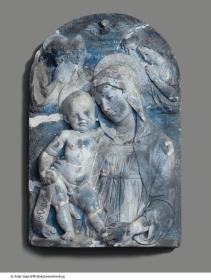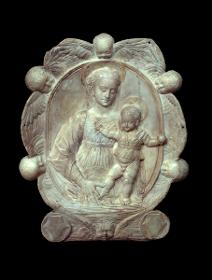

Madonna mit Kind mit zwei Cherubinen
Ident. Nr.: 57
ObjID: obj:870738

Fotonachweis: Staatliche Museen zu Berlin, Skulpturensammlung und Museum für Byzantinische Kunst / Antje Voigt CC BY-SA 4.0
Details (Expert)
- Beteiligte
- Datierung
- Datierung: 1440-60
- Weitere Titel
- Sammlungstitel: Madonna mit Kind mit zwei CherubinenThe Virgin and Child with two Cherubs
- Material / Technik
- Marmor
- Abmessungen
- Höhe x Breite x Tiefe: 44,5 x 33 x 9 cm
- Permalink
- https://id.smb.museum/object/870738
Objektbeschreibung
Dieses äußerst fein gearbeitete Relief wurde von einem Künstler ausgeführt, der mit Donatello eng zusammenarbeitete und die Marmordekorationen für den Hof des Medici-Palastes in Florenz ausgeführt hat. Das Relief war wahrscheinlich über der Augenhöhe angebracht: Christus schaut nach unten und segnet mit seiner rechten Hand den fiktiven Betrachter dieser Szene. Der Cherub auf der rechten Seite ist eine moderne Ergänzung.
Erworben 1842
This extremely refined relief was made by a close collaborator of Donatello, who was also the author of the marble courtyard decorations for the Medici Palace in Florence. The relief was probably placed above eye level: Christ is looking downward, blessing with his right hand the fictive viewer of this scene. The cherub on the right side is a modern addition.
--
Follower of Donatello
Madonna and Child with two Cherubs
ca. 1440-60
Marble
44 x 32.5 x 8.5 cm
Berlin, Staatliche Museen, Skulpturensammlung, Inv. SKS 57.
Bode-Museum, storage.
Provenance
Florence (before 1842); Berlin, Skulpturensammlung/Altes Museum (1842-1904); Berlin, Skulpturensammlung/Kaiser-Friedrich-Museum (1904-1939); Berlin, storage (1939-1945); Merkers, storage (1945); Wiesbaden, Central Collecting Point (1945-1956); West Berlin, Skulpturensammlung/Museum Dahlem (1956-1997); Berlin, storage (1997-2006); Berlin, Skulpturensammlung/Bode-Museum (since 2006).
Acquisition
Bought in Florence in 1842.
Exhibitions
Botticelli. Bildnis, Mythos, Andacht, Frankfurt am Main, Städel Museum, 13 November 2009-28 February 2010.
From Renaissance to Rococo. Four Centuries of European Drawing, Painting and Sculpture, Tokyo, The National Museum of Western Art, 13 June-17 September 2012 and Kyushu, Kyushu National Museum, 9 October-12 December 2012, cat. 1.
Bibliography
Tieck 1844
Frédéric Tieck, Musées Royaux. Notice des sculptures antiques, Berlin, Moeser and Kühn, 1844, p. 61 cat. 688a: school of Sansovino.
Kunstblatt, 1846
Kunstblatt, 1846, p. 245. (reference to be checked)
Bode 1884
Wilhelm Bode, “Die italienischen Skulpturen der Renaissance in den Königlichen Museen zu Berlin. III”, Jahrbuch der Königlich preußischen Kunstsammlungen, V, 1884, pp. 33-34: school of Donatello; same sculptor of the Lombardi monument in the Medici chapel of Santa Croce, Florence.
Bode 1887
Wilhelm Bode, Italienische Bildhauer der Renaissance. Studien zur Geschichte der italienischen Plastik und Malerei auf Grund der Bildwerke und Gemälde in den Königl. Museen zu Berlin, Berlin, W. Speemann, 1887, pp. 36-38: school of Donatello.
Tschudi 1887
Hugo von Tschudi, Donatello e la critica moderna, Turin et al., Fratelli Bocca, 1887 (1st ed.: Rivista storica Italiana, IV, n° 2, 1887), p. 33.
Bode and Tschudi 1888
Wilhelm Bode and Hugo von Tschudi, Beschreibung der Bildwerke der christlichen Epoche, Berlin, W. Spemann, 1888, p. 17 cat 44, pl. IV: school of Donatello, probably a pupil from Padua; same hand of the Lombardi relief in the Medici chapel in Santa Croce, Florence; of a Virgin and Child with five Angels in the Victoria and Albert Museum, London (Inv. 7624-1861); of a relief in the Jacquemart-André collection (Inv. 1810) and in the Bardini collection (stucco); of a round plaquette in the Musée du Louvre, Paris, and in the Hainauer collection, Berlin now in the Bode-Museum, see Inv. SKS 2847.
Semrau 1891
Max Semrau, Donatellos Kanzeln in S. Lorenzo. Ein Beitrag zur Geschichte der italienieschen Plastik im XV. Jahrhundert, Breslau, Schottlaender, 1891, p. 87 note 2: Giovanni da Pisa.
Bode 1902
Wilhelm Bode, Florentiner Bildhauer der Renaissance, Berlin, Bruno Cassirer, 1902, pp. 106, 107 fig. 107: follower of Donatello, close to the Judith in the Palazzo Vecchio, Florence, and to the pulpits of San Lorenzo, Florence.
Meyer 1903
Alfred Gotthold Meyer, Donatello, Bielefeld and Leipzig, Delhagen and Klafing, 1903, p. 118: Donatello.
Schubring 1907
Paul Schubring, Donatello. Des Meisters Werke in 277 Abbildungen, Stuttgart and Leipzig, Deutsche Verlags-Anstalt, 1907, pp. 157,162: school of Donatello.
Venturi 1908
Adolfo Venturi, Storia dell’arte italiana. VI. La scultura del Quattrocento, Milan, Ulrico Hoepli, 1908, pp. 455, 459 fig. 301: school of Donatello.
Schottmüller 1913
Frida Schottmüller, Die italienischen und spanischen Bildwerke der Renaissance und des Barocks in Marmor, Ton, Holz und Stuck, Berlin, Georg Reimer, 1913, p. 17 cat. 34: a section of the background on the right has been replaced in plaster in modern time; ancient frame, but not from the same period as the relief; characteristic of the studio of Donatello ca. 1435; related to two works mentioned by Schubring 1907, pp. 162, 166.
Bode 1921
Wilhelm Bode, Florentiner Bildhauer der Renaissance, Berlin, Bruno Cassirer, 1921, p. 101 fig. 56: workshop of Donatello.
Wulff 1922
Oskar Wulff, Donatello, Leipzig, E. A. Seemann, 1922, p. 14, fig. 31: pupil of Donatello.
Schottmüller 1933
Frida Schottmüller, Die italienischen und spanischen Bildwerke der Renaissance und des Barock. Erster Band. Die Bildwerke in Stein, Holz, Ton und Wachs, Zweite Auflage, Berlin and Leipzig, Walter de Gruyter & Co., 1933, p. 13: workshop of Donatello, ca. 1435; after a composition by Donatello; close to a Virgin and Child in a private collection, Paris, and to the Madona del Perdono in the Museo dell’Opera metropolitana, Siena.
Nicco Fasola 1956
Giusta Nicco Fasola, “Bassorilievi donatelleschi nel museo Calvet”, Critica d’arte, III (new series), n° 18, 1956, p. 559 and fig. 292: workshop of Donatello.
Neri Lusanna 1986
Enrica Neri Lusanna in eadem and Lucia Faedo (eds.), Il museo Bardini a Firenze. Volume secondo: le sculture, Milan, Electa, 1986, p. 254: perhaps the same pupil of Donatello as the author of the Madonna dei Cordai in the Museo Bardini, Florence.
Gentilini 1993
Giancarlo Gentilini in Luciano Bellosi (ed.), Francesco di Giorgio e il Rinascimento a Siena 1450-1500, exh. cat. (Siena, Chiesa di Sant’Agostino, 25 April-31 July 1993), Milan, Electa, 1993, p. 177 fig. 2, p. 181: collaborator of Donatello, author of one part of the Madonna del Perdono, of the tondi of the courtyard of the Medici palace, Florence, of the Madonna Lombardi in the Medici Chapel of Santa Croce, Florence, and the Madonna and Child with Angels in the Victoria and Albert Museum (deriving from Inv. SKS M 88); possibly Andrea dell’Aquila.
Jolly 1998
Anna Jolly, Madonnas by Donatello and his Circle, Frankfurt am Main et al., Peter Lang, 1998, p. 156: Paduan follower of Donatello, late 15th century; motif of the base similar to the plaquette of the Madonna with Candelabra in the National Gallery of Art, Washington DC.
Katalog der Originalabgüsse… 2000
Katalog der Originalabgüsse. Heft 6. Christliche Epochen. Spätantike. Byzanz. Italien. Freiplastik. Reliefs. Bronzestatuetten, Berlin, Staatliche Museen zu Berlin, 2000, cat. 2655: workshop of Donatello.
Eclercy 2009
Bastian Eclercy in Andreas Schumacher (ed.), Botticelli. Bildnis. Mythos. Andacht, exh. cat. (Frankfurt am Main, Städel Museum, 13 November 2009-28 February 2010), Frankfurt am Main, Städel Museum, 2009, pp. 266-267 cat. 44: workshop of Donatello; the closed eyes of the Child are a premonition of his death; spatial ambiguity of the left hand and the veil of the Virgin.
Weppelmann 2012
Stefan Weppelmann in From Renaissance to Rococo. Four Centuries of European Drawing, Painting and Sculpture, exh. cat. (Tokyo, The National Museum of Western Art, 13 June-17 September 2012 and Kyushu, Kyushu National Museum, 9 October-12 December 2012), Tokyo, National Museum of Western Art, 2012, pp. 46-47 cat. 1: workshop of Donatello, ca. 1460.
Comment
The Virgin is holding her baby by the chest, with her eyes raised to heaven – indicating her awareness of Jesus’ future death on the Cross. He is seated on his mother’s thighs; he caresses with his left hand the wrist of the Virgin, while blessing with his right hand a beholder who was probably intended to view the work from below (the lowered eyelids of the Christ Child are not a sign of sleep, as argued by Eclercy 2009). The figures are set in an ornamented base, finely carved with heads of putti and decorative, palm-trees motifs; the background is also decorated with two cherubs (the right one is a modern addition after the one on the left, which is very abraded, as is the case with the Virgin’s right hand, and Christ’s nose and legs). Jesus is wrapped in swaddling clothes, but his legs and left shoulder are left naked.
The relief was bought for the Berlin Museums by Gustav Waagen in 1842. First attributed to the school of Sansovino – a most implausible judgement – it was connected to the school of Donatello by Bode 1884, an attribution that is still valid today. The relationship with the works of Donatello is indeed very strong; from the pose of the Virgin, reminiscent of a composition present in Berlin, in a terracotta and a plaquette (see Inv. SKS 56 and Inv. SKS 1028), to her complicated headdress (similar to the Virgin and Child in the Musée du Louvre, Paris, Inv. RF 353; but also to Holophernes in the Judith and Holophernes in the Palazzo Vecchio, Florence) or to the Blessing Christ (see for instance the Virgin and Child with four Cherubs in Berlin, Inv. SKS 54). However, the handling of the marble has always prevented critics from seeing an original work by Donatello, whose conception of space is always more mastered and whose handling of the faces less caricatural.
The work has been most often compared to the relief known as the Madonna del Perdono, now in the Museo dell’Opera metropolitana in Siena but coming from the Sienese Cathedral: besides the composition, there are close similarities between the reliefs, such as the posture of the right arm of the Virgin, the background with cherubs or the intended view from below. If the Madonna del Perdono is accepted as an autograph work by Donatello, some parts of the relief have probably been carved by an assistant. This is why art historians have sometimes thought that this assistant may be the autor of the Berlin Madonna (see especially Gentilini 1993). Bode and Tschudi 1888 had also suggested a common paternity with a Virgin and Child in the Lombardi monument in the sacristy of Santa Croce, Florence and with a Virgin and Child with five Angels in the Victoria and Albert Museum (inv. 7624-1861). Gentilini 1993 added to this group the tondi of the courtyard of the Medici palace in Florence, and the decoration of the organ tribune of the church of San Lorenzo, Florence (oral communication); he suggested that their author might have been Andrea dell’Aquila, who was a pupil of Donatello between 1435 and 1443.
Neville Rowley (18 February 2016)
Letzte Aktualisierung: 19.03.2026
Kontakt
Einrichtung:
Skulpturensammlung und Museum für Byzantinische Kunst
E-Mail:
sbm@smb.spk-berlin.de