
Heilige Familie
Ident. Nr.: 60
ObjID: obj:871151
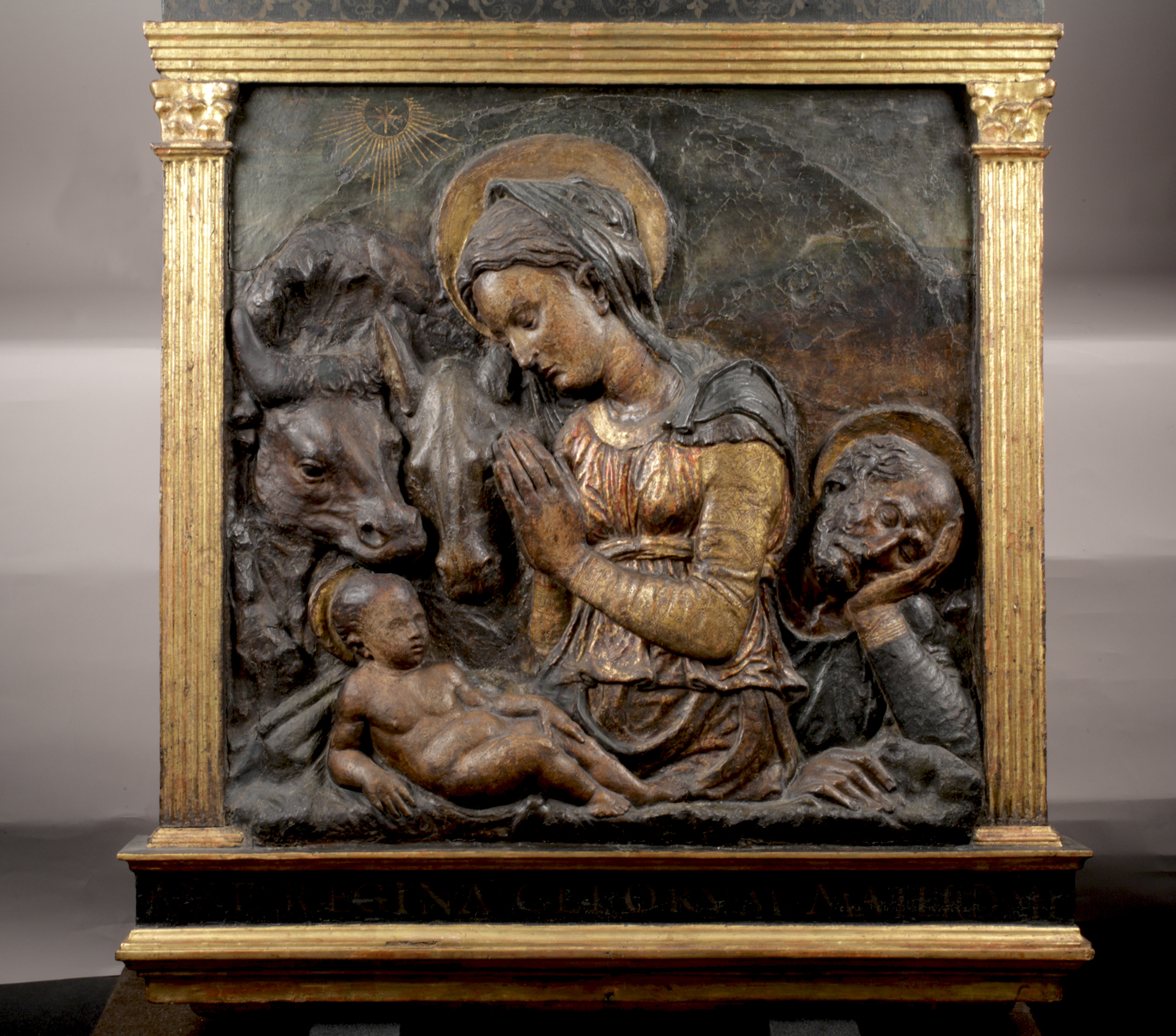
Fotonachweis: Staatliche Museen zu Berlin, Skulpturensammlung und Museum für Byzantinische Kunst / Helgard Weber
Details (Expert)
- Beteiligte
- Datierung
- ca. 1450-1470
- Systematik/Art
- Weitere Titel
- Sammlungstitel: Heilige FamilieThe Holy Family
- Abmessungen
- Höhe x Breite x Tiefe: 77 x 77 x 10 cm (Relief)Höhe x Breite x Tiefe: 116 x 101 x 12 cm (Rahmen)Gewicht: 60 kg
- Permalink
- https://id.smb.museum/object/871151
Objektbeschreibung
Maria in halber Figur, stehend und nach links gewendet; die Hände in Anbetung des links vor ihr auf dem Rasen liegenden nackten Kindes gefaltet. Ueber dem Kinde sehen Ochs und Esel hervor. Etwas zurück rechts Joseph, welcher auf die linke Hand gestützt schläft.
English catalogue entry
Follower of Donatello
The Holy Family
ca. 1450-70
Painted stucco
77 x 75 cm
Frame not contemporary with the relief. Inscription on the bottom: AVE REGINA CELORUM MATER DMI.
Berlin, Staatliche Museen, Skulpturensammlung, Inv. SKS 60.
Bode-Museum, storage.
Provenance
Stefano Bardini, Florence (1887); Berlin, Skulpturensammlung/Altes Museum (1887-1904); Berlin, Skulpturensammlung/Kaiser-Friedrich-Museum (1904-1939); Berlin, storage (1939-1945); Soviet Union, secret storage (1945/46-1958); East Berlin, Skulpturensammlung/Bode-Museum (1958-1990); Berlin, Skulpturensammlung/Bode-Museum (1990-present).
Acquisition
Bought from the dealer Stefano Bardini in Florence in 1887, as “school of Donatello”. Alleged provenance from the outskirts of Arezzo.
The acquisition file (1143/89) is missing from the Zentralarchiv der Staatlichen Museen zu Berlin.
Other versions
• Bologna, church of the Servi.
• Bologna, Fornaro Gaggioli collection.
• Chicago, Art Institute.
• Florence, Museo Bardini, Inv. 1201. Painted stucco, 105 x 85 cm.
Bibliography
Bode and Tschudi 1888
Wilhelm Bode and Hugo von Tschudi, Königliche Museen zu Berlin. Beschreibung der Bildwerke der Christlichen Epoche, Berlin, W. Spemann, 1888, p. 18 cat. 47: school of Donatello.
Bode 1902
Wilhelm Bode, Florentiner Bildhauer der Renaissance, Berlin, Bruno Cassirer, 1902, pp. 117-118, fig. 51: after Donatello.
Bode 1892-1905
Wilhelm Bode, Denkmäler der Renaissance-Sculptur Toscanas, Munich, Brückmann, 1892-1905, p. 52, pl. 183: after a lost work or a sketch by Donatello.
Schubring 1907
Paul Schubring, Donatello. Des Meisters Werke in 277 Abbildungen, Stuttgart and Leipzig, Deutsche Verlags-Anstalt, 1907, pp. 168, 201: maybe Giovanni da Pisa.
Schottmüller 1913
Frida Schottmüller, Die italienischen und spanischen Bildwerke der Renaissance und des Barocks in Marmor, Ton, Holz und Stuck, Berlin, Georg Reimer, 1913, p. 23 cat. 48: by the same pupil of Donatello who did the (reversed) composition in the Musée Jacquemart-André, Paris (Inv. 1850) and the Piot Madonna in the Musée du Louvre, Paris (Inv. RF 3967). The awkward rendering of space speaks against Donatello.
Bode 1921
Wilhelm Bode, Florentiner Bildhauer der Renaissance, Berlin, Bruno Cassirer, 1921, p. 112 fig. 68: Donatello.
Schottmüller 1933
Frida Schottmüller, Die italienischen und spanischen Bildwerke der Renaissance und des Barock. Erster Band. Die Bildwerke in Stein, Holz, Ton und Wachs, Zweite Auflage, Berlin and Leipzig, Walter de Gruyter & Co., 1933, p. 12: workshop of Donatello; same author as the reverse composition in Berlin (Inv SKS 2387, now lost), the version in the Musée Jacquemart-André and the Piot Madonna in the Louvre (Inv. RF 3967).
Pope-Hennessy 1959
John Pope-Hennessy, “Some Donatello Problems”, in Studies in the History of Art Dedicated to William E. Suida on His Eightieth Birthday, London, Phaidon Press, 1959, pp. 61-62 now in idem, Essays on Italian Sculpture, London and New York, Phaidon, 1968, p. 60: after Urbano da Cortona; the Berlin version is described as once in the Kaiser-Friedrich-Museum.
Pope-Hennessy 1964
John Pope-Hennessy, Catalogue of Italian Sculpture in the Victoria and Albert Museum, London, Her Majesty’s Stationary Office, 1964, I, p. 260: after Urbano da Cortona.
Negri Arnoldi 1970
Francesco Negri Arnoldi, “Scultura italiana al Victoria and Albert Museum. II”, Commentari, XXI, 1970, pp. 206-207: forgery.
La Moureyre-Gavoty 1975
Françoise de La Moureyre-Gavoty, Inventaire des collections publiques françaises. 19. Institut de France. Paris – Musée Jacquemart-André, Paris, Édition des Musées Nationaux, 1975, cat. 69: after Urbano da Cortona.
Herzner 1985
Volker Herzner in Italian Renaissance Sculpture in the Time of Donatello, exh. cat. (Detroit, The Detroit Institute of Arts, 23 October 1985-5 January 1986), Detroit, The Detroit Institute of Arts, 1985, p. 173: circle of Donatello; Bartolomeo Bellano?
Darr and Bonsanti 1986
Alan Phipps Darr and Giorgio Bonsanti (eds.), Donatello e i suoi, exh. cat. (Florence, Forte del Belvedere, 15 June-7 September 1986), Detroit and Florence, The Detroit Institute of Arts, La Casa Usher and Arnaldo Mondadori Editore, 1986, p. 158: circle of Donatello; Bartolomeo Bellano?
Neri Lusanna 1986
Enrica Neri Lusanna in eadem and Lucia Faedo (eds.), Il museo Bardini a Firenze. Volume secondo: le sculture, Milan, Electa, 1986, p. 256.
Gentilini 1993
Giancarlo Gentilini in Luciano Bellosi (ed.), Francesco di Giorgio e il Rinascimento a Siena 1450-1500, exh. cat. (Siena, Chiesa di Sant’Agostino, 25 April-31 July 1993), Milan, Electa, 1993, pp. 182-185: from a model by Francesco del Valente?
Katalog der Originalabgüsse… 2000
Katalog der Originalabgüsse. Heft 6. Christliche Epochen. Spätantike. Byzanz. Italien. Freiplastik. Reliefs. Bronzestatuetten, Berlin, Staatliche Museen zu Berlin, 2000, cat. 2680: workshop of Donatello.
Sarchi 2005
Alessandra Sarchi in Rosalia Fornaro und Giuliano Gaggioli (eds.), Sculptores. Opere scelte della collezione Fornaro Gaggioli. Secoli XIV-XVII, exh. cat. (Bologna, Antichità all’Oratorio, 26 November-24 December 2005), Bologna, Antichità all’Oratorio, 2005, p. 29 note 3: Bartolomeo Bellano; compared to the Virgin and Child in the Museum of Fine Arts, Boston (Inv. 17.1462) and the David with the Head of Goliath in the Metropolitan Museum of Art, New York (Inv. 64.304.1), both by Bellano.
Sarchi 2006
Alessandra Sarchi in Vittorio Sgarbi (ed.), La scultura al tempo di Andrea Mantegna tra classicismo e naturalismo, exh. cat. (Mantua, Castello di San Giorgio, 16 September 2006-14 January 2007), Milan, Electa, 2006, p. 78: Bellano (after Donatello?).
Gentilini 2007
Giancarlo Gentilini, “La ‘Madonna del Presepe’ ed altre immagini mariane tra Donatello e compagni”, in Giuseppe Adani, Giancarlo Gentilini and Cristina Grimaldi Fava (eds.), La Madonna del Presepe da Donatello a Guercino. Una devozione antica e nuova nella terra di Cento, exh. cat. (Cento, Pinacoteca Civica, 2 December 2007-13 April 2008), Bologna, Minerva Edizioni, 2007, pp. 109-110, 124, 132-133 note 11: collaborator of Donatello.
Comment
This relief represents the Nativity of Christ: the naked child is lying on a parapet, adored by his mother with her hands joined in prayer; above Christ, an ass and an ox emerge from a cave and pay homage to the Son of God, who rests in a pose inspired by Antique River Gods; while on the right side is Joseph, eyes closed and head on his arm – not so much asleep as melancholy about not being the ‘actual’ father of Jesus. The relief is rectangular, yet the shape of a lunette is clearly visible in the upper part of the representation: it certainly betrays the original structure of the work. As a consequence, the painted surface of the background is not original.
This work is one of the many known versions of a composition that has almost invariably been ascribed to the circle of Donatello. The physiognomy of the Virgin, the drapery style and the motif of her joined hands are indeed typical of the master (see for instance, only in the Berlin Museums, the two compositions Inv. SKS 60 and Inv. SKS 67). The work has almost never been given to Donatello himself: the anatomy and general modeling do not have the quality of the sculptor’s accepted oeuvre, while the composition lacks some coherence (it seems to be a collage of unrelated figures). It may have been made by a follower of Donatello after a sketch by the master (for a comparison, see the relationship of the probably autograph terracotta sketch Inv. KFM M 88 to its stucco version Inv. SKS 58). Various pupils of Donatello have been proposed as the authors of this relief, constantly paired with a similar, inverted composition (see another Holy Family, also in Berlin: Inv. SKS 2387): Giovanni da Pisa (Schubring 1907), Urbano da Cortona (Pope-Hennessy 1959) or Bartolomeo Bellano (Sarchi 2005 and Sarchi 2006).
Neville Rowley (18 February 2016)
Letzte Aktualisierung: 29.07.2026
Kontakt
Einrichtung:
Skulpturensammlung und Museum für Byzantinische Kunst
E-Mail:
sbm@smb.spk-berlin.de