
Fotonachweis: Staatliche Museen zu Berlin, Gemäldegalerie / Jörg P. Anders Public Domain Mark 1.0
Details (Expert)
- Beteiligte
- Datierung
- Ausführung: um 1480
- Weitere Titel
- Sammlungstitel: Die Fußwaschung der ApostelÜbersetzung: The washing of the apostles feet
- Geografische Bezüge
- Material / Technik
- Nadelholz
- Abmessungen
- Bildmaß: 132 x 75,6 cm
- Permalink
- https://id.smb.museum/object/871698
Objektbeschreibung
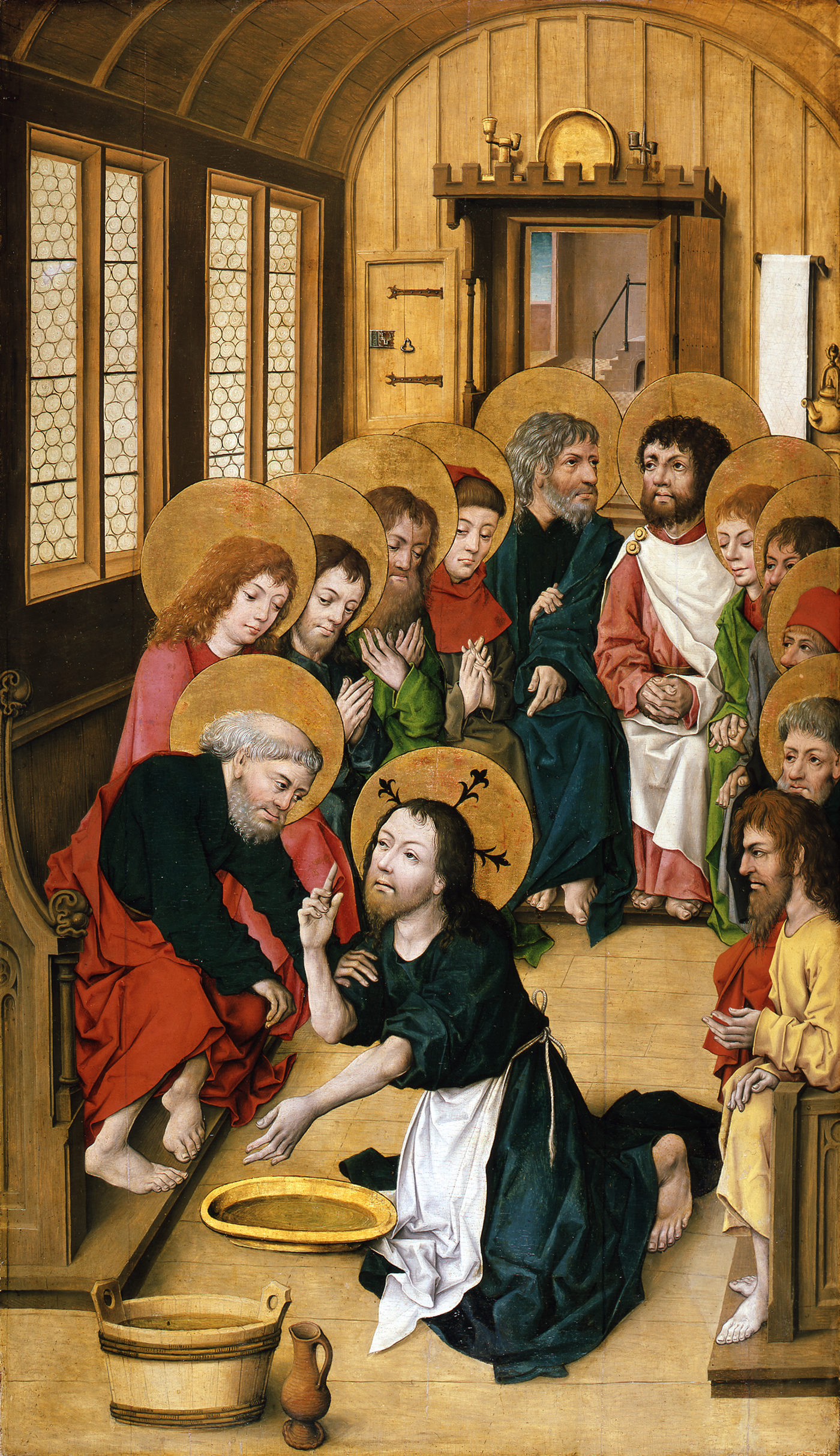
Seit dem 19. Jahrhundert wird der sogenannte Speyerer Altar als Hauptwerk des Hausbuchmeisters angesehen. Sein Notname leitet sich von dem im Besitz der Fürsten Waldburg auf Schloß Wolfegg in Schwaben bewahrten »Hausbuch« ab, einer Sammlung von Zeichnungen allerhöchster Qualität, von denen die subtilsten Arbeiten unserem Meister zugeschrieben werden. Der Speyerer Altar, dessen Teile über Museen in Freiburg im Breisgau, Frankfurt am Main und Berlin verstreut sind, verdankt seinen Namen dem Umstand, daß die Mitteltafel im 19. Jahrhundert vom damaligen Besitzer in Speyer erworben wurde. Über die tatsächliche Herkunft und ursprüngliche Bestimmung des Altares ist jedoch nichts bekannt. An Fest- und Feiertagen zeigte der geöffnete Altar im Zentrum die Darstellung des volkreichen Kalvarienberges, flankiert vom Ecce Homo und der Auferstehung Christi. Auf den Außenseiten der Flügel sah man die Fußwaschung Christi, das Abendmahl und das Verhör Christi durch Kaiphas. Die Reihe begann vermutlich mit dem nicht mehr erhaltenen Einzug Christi in Jerusalem. Mit der Szene der Fußwaschung, von der das Johannes-Evangelium (13, 1-15) berichtet, beginnt die eigentliche Passion. In einem holzgetäfelten Raum haben sich die Jünger vor dem Passahfest um Christus versammelt. Die zwölf Apostel sitzen dicht nebeneinander auf Bänken, die an den Längsseiten und am Ende des schmalen Raumes aufgestellt sind. Nachdenklich, aber auch von stiller Dankbarkeit erfüllt, blicken sie mit andächtig gefalteten Händen auf den in ihrer Mitte am Boden knienden Erlöser. Er hat die Ärmel aufgekrempelt, ein weißes Tuch wie eine Schürze umgebunden und Wasser aus einem hölzernen Bottich in eine vor ihm stehende Messingschale gegossen. Nachdem er den Jüngern die Füße gewaschen und mit dem Tuch getrocknet hat, kommt er zu Petrus, den er eindringlich auf die Notwendigkeit hinweist, auch an ihm die Waschung zu vollziehen. Dieser lehnt es ab, sich von seinem Herrn bedienen zu lassen, fällt ihm in den Arm und sucht die Füße seinem Zugriff zu entziehen. Als Christus jedoch die für Petrus zunächst unverständliche Handlung mit den Worten deutet: »Werde ich dich nicht waschen, so hast du keinen Teil an mir« (Johannes 13, 8), bittet Petrus den Herrn, ihm doch auch Hände und Haupt zu waschen. Der Akt der Fuß - waschung symbolisiert das ganze Wirken Christi. Er ist ein Sinnbild der Liebe und Demut, aber auch ein Beispiel dafür, wie die Jünger untereinander handeln sollen. Rainald Grosshans | 200 Meisterwerke der europäischen Malerei – Gemäldegalerie Berlin, 2019
____________________________________________________________________________________
The so-called Speyer Altarpiece has been regarded as the chief work of the Master of the House Book since the 19th century. His “notname” is derived from the “house book” owned by the Princes Waldburg and kept at Schloss Wolfegg in Swabia, a collection of drawings of exquisite quality of which the subtlest works have been attributed to this master. The Speyer Altarpiece, sections of which have been dispersed among the museums of Freiburg im Breisgau, Frankfurt am Main and Berlin, takes its name from the acquisition of the middle panel (fig. left) in the 19th century by its then owner in Speyer. Nothing is known, however, about the actual origin of the altarpiece or where it was intended for. On feast days and holidays, the opened altarpiece displayed in its centre the populous Calvary, flanked by the Ecce Homo and the Resurrection of Christ. The Washing of the Feet, the
Last Supper and the Interrogation by Caiaphas were depicted on the outer sides of the wings. The series probably originally began with Christ’s Entry into Jerusalem which is no longer extant.
The Washing of the Feet, as told by the Gospel according to Saint John (13:1–15) can be regarded as the actual beginning of the Passion of the Christ. The disciples have assembled around Christ in a wood-panelled room before the Feast of Passover. The twelve apostles are sitting close to one another on benches positioned against the long sides and at the end of the narrow room. Lost in thought but full of quiet gratitude, they are gazing with reverently folded hands at the saviour kneeling on the floor in their midst. He has rolled up his sleeves, tied a white cloth round his waist as an apron and poured water from a wooden tub into a bronze bowl standing in front of him. After he has washed the disciples’ feet and dried them with a towel, he turns to Peter and insists on washing his feet too. Peter, however, refuses to be served by his Lord. Emphatically pushing away his arm, he tries to stop Christ
touching his feet. When, however, Christ explains this for Peter initially incomprehensible act with the words: “If I do not wash you, you have no part of me” (John 13:8), Peter consents. The act of washing feet symbolically encompasses the whole of Christ’s ministry. It is a symbol of love and humility and also an example of how the disciples should treat one another. On the right at the front among the disciples is Judas, whom Christ has recognised as his betrayer. Judas is wearing a yellow robe and is the only one of the disciples to be depicted without a halo.
The following picture shows the Last Supper, at which the Lord bids farewell to his disciples on the evening before his crucifixion. He identifies the betrayer and tells the disciples of his forthcoming death. Christ sits in the middle of the room behind the table. His favourite disciple John is asleep on his breast. The scene depicts the moment immediately before events reach their dramatic climax, when Christ tells his disciples that one of them will betray him and that it is the person to whom he will pass the morsel that he has dipped. We see how Christ reaches into the bowl with the Easter lamb in order to give the morsel to Judas. Judas, in a yellow robe and without a halo, is sitting somewhat isolated at the front of the table trying to conceal the bag with the silver coins. The disciple sitting at front left is staring so intensely at Judas that it is obvious who the betrayer is. The fly on the lid of the woven
basket in the foreground is considered an impure animal and hence symbolises the devil who will take possession of Judas after he has taken the morsel. The chalice of wine on the table in front of Christ emphasises the sacramental character of the scene and its link to the Holy Communion.
The mood of these dramatic events is impressively captured in the reactions of the disciples and their highly individual facial expressions. The rendering of the red and yellow twilight of the evening sky with the clouds lit up by the last rays of the setting sun reveals the artist’s precise observation of nature. Rainald Grosshans | 200 Masterpieces of European Painting – Gemäldegalerie Berlin, 2019
Letzte Aktualisierung: 15.12.2025
Kontakt
Einrichtung:
Gemäldegalerie
E-Mail:
gg@smb.spk-berlin.de