
Fotonachweis: Staatliche Museen zu Berlin, Gemäldegalerie / Jörg P. Anders Public Domain Mark 1.0
Details (Expert)
- Beteiligte
- Datierung
- Ausführung: 1511
- Systematik/Art
- Weitere Titel
- Sammlungstitel: Die Anbetung der KönigeÜbersetzung: The Adoration of the Kings
- Geografische Bezüge
- Material / Technik
- Lindenholz
- Abmessungen
- Tafelmaß: 158,9 x 112,8 cm
- Erwerbung
- 1876 Ankauf aus der Sammlung Friedrich Lippmann, Wien/Berlin
- Permalink
- https://id.smb.museum/object/871896
Objektbeschreibung
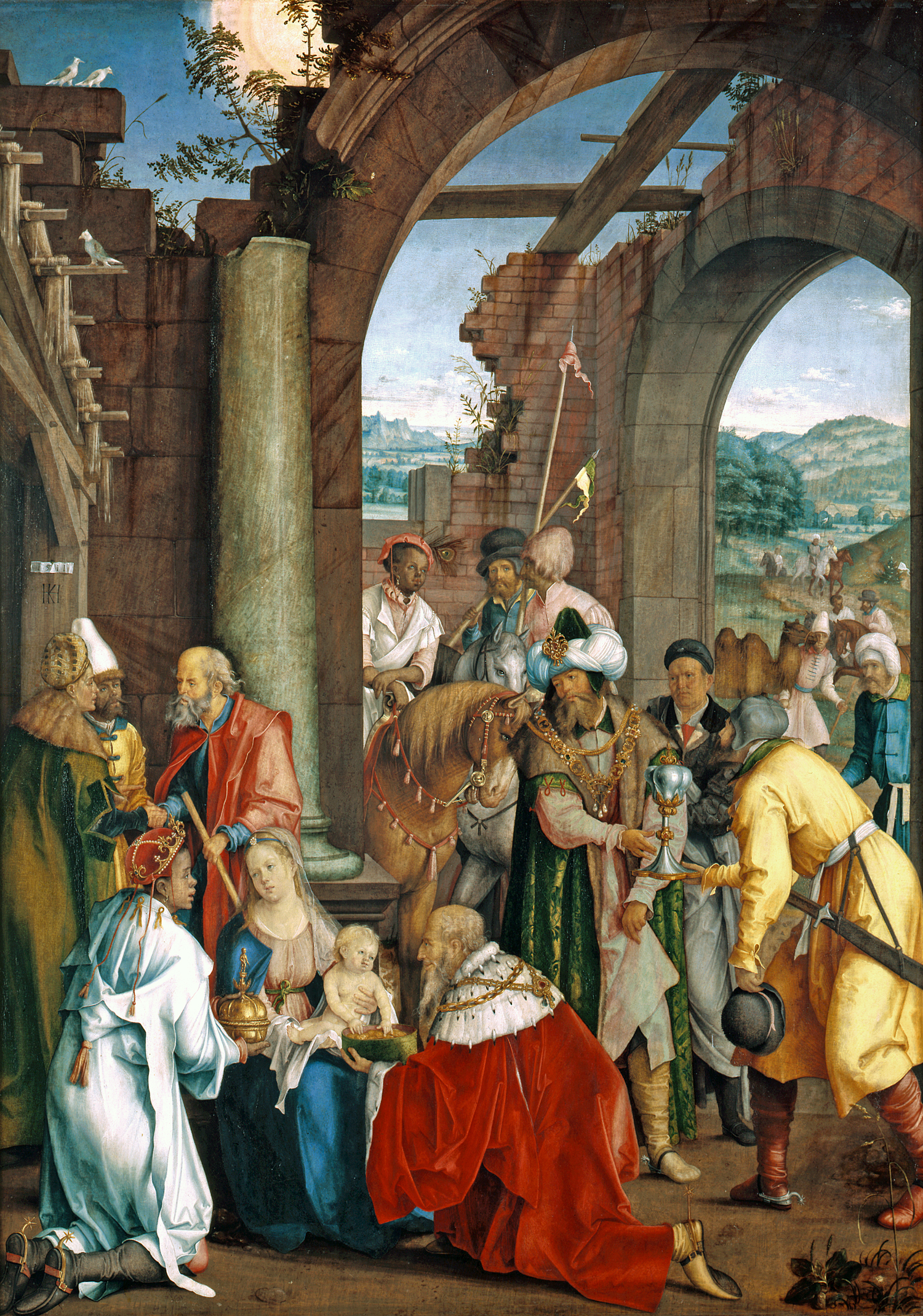
In der Ruine eines antiken Palastes, vor einer grünlichen Marmorsäule, sitzt Maria mit dem Kind im Schoß. Ihr nähern sich die Drei Weisen aus dem Morgenland mit ihrem Gefolge, die dem Stern nachgezogen sind bis Bethlehem, um dem neuen König, Christus, zu huldigen. Zwei von den Königen knien vor dem Christuskind und bieten ihm Geschenke dar. Ein jugendlicher Schwarzer König, links, bringt eine getriebene goldene Deckeldose. Vor Maria beugt ein greisenhafter König in rotem Mantel mit Hermelinkragen das Knie. Er bietet ein Gefäß mit Goldmünzen dar, in das das Kind mit beiden Händen hineingreift. Ein dritter, überaus prächtig gekleideter orientalischer König mit einem Turban nähert sich mit seinem Gefolge durch die Ruine. Er wendet den Blick schon auf das Kind und lässt sich einen getriebenen Birnenpokal als Geschenk reichen. Durch einen Torbogen blickt man in eine weite Landschaft, durch die Reiter auf Pferden und Kamelen herbeiziehen. Einige darunter tragen polnische Trachten.
Links am Bildrand erkennt man die in die Ruine eingebaute Geburtshütte. An einen ihrer Stützbalken hat Kulmbach einen Zettel mit der Jahreszahl 1511 gemalt. Darunter hat er sein verbundenes Monogramm HK gesetzt. Hinter Maria links steht Joseph im Gespräch mit zwei vornehmen Begleitern der drei Weisen. Über der Ruine wölbt sich ein nächtlicher Himmel. Eine Lichterscheinung, der Stern von Bethlehem, glänzt über den Mauern. Weiter in der Ebene aber scheint heller Tag über Wiesen und Bäumen. Die antike Ruine, in der Christus geboren wurde, ist nach der Legende der Überrest des Palastes König Davids. Sie versinnbildlicht die Herkunft Christi aus dem Stamm Davids. Sie macht auch anschaulich, dass dessen Zeit, die Zeit des Alten Bundes, vergangen ist. Mit der Menschwerdung Christi hat Gott einen Neuen Bund geschlossen. Die Säule hinter der Gruppe erinnert an die Geißelsäule und deutet so auf das Geschick des Kindes, auf die kommende Passion hin.
Die drei Könige sind zwiefach unterschieden. Der Schwarze König ist jugendlich, der in orientalischem Gewandt ist mittleren Alters und der dritte, nach seiner Tracht wohl ein Europäer, ist ein Greis. Die Altersstufen verdeutlichen, dass alle Generationen dem neugeborenen König ihre Huldigung darbringen. Die drei Könige zeigen zugleich, dass die ganze (damals bekannte) Welt, die drei Erdteile Afrika, Asien und Europa, herbeigeeilt sind zu diesem Ereignis. Unter dem Gefolge fällt ein Mann mit einer schwarzen Mütze durch seine individuellen Züge auf. Er steht im Torbogen. Man hat in ihm den Stifter vermutet. Die Anbetung der Könige ist die Mitteltafel eines auseinandergetrennten Klappaltars. Zwei weitere Teile, die Darbringung Christi im Tempel und die Flucht der Heiligen Familie nach Ägypten, befinden sich noch in dem Kloster na Skałce in Krakau. Eine Kopie nach der Anbetung befindet sich ebenfalls in Krakau. Es ist daher zu vermuten, dass dieser Marienaltar für eine Krakauer Kirche angefertigt wurde. Möglicherweise war es die Kirche des Klosters na Skalce. Für die Köpfe Mariens und Josephs existieren zwei vorbereitende Zeichnungen in Erlangen. Wilhelm H.Köhler | 200 Meisterwerke der europäischen Malerei – Gemäldegalerie Berlin, 2019
__________________________________________________________________
In the ruins of an ancient palace, the Virgin Mary sits with the child in her lap in front of a greenish marble column. The three kings from the East have arrived with their entourage, following the star to Bethlehem to pay homage to the king, Jesus Christ. Two of the kings are kneeling before the child offering their gifts. The young Black king on the left has brought a receptacle with a lid in chased gold. An elderly king in a red mantle with an ermine collar is approaching Maria on bent knee. He offers a receptacle full of gold coins into which the child is reaching with both hands. A third, magnificently dressed oriental king with a turban is approaching through the ruined palace with his entourage. He has already turned his gaze towards the child and is having his gift, a chased, pear-shaped goblet, handed to him. Through the arch behind him, a broad landscape can be seen with riders passing on horses and camels. Some of them are wearing Polish national dresses.
On the left edge of the painting, one can see the hut where Christ was born among the ruins. On one of its supporting beams, there is a note on which von Kulmbach has written the year, “1511”. Below this, the artist has inscribed his monogram “HK” in ligature. On the left, behind Mary, Joseph stands talking to two nobles who are accompanying the three kings. Above the ruins is the night sky. The star of Bethlehem shines above the walls. Further away, the meadows and trees on the plain stand in daylight. According to legend, the ancient ruins in which Christ was born are the remains of the palace of King David. They symbolise Christ’s origin from the lineage of David and also that David’s time, the time of the Old Covenant, has passed. With Christ becoming man, God has concluded a New Covenant. The pillar behind the group recalls the flagellation column and thus alludes to the fate of the child and to the coming Passion.
The three kings are differentiated in two ways. The Black king is young, the Oriental king is middle-aged and the third king, probably a European to judge by his dress, is elderly. Their different ages are intended to illustrate that all generations are paying homage to the newborn king. The depiction of the kings as an African, an Oriental and a European at the same time shows that people from the three continents, Africa, Asia and Europe (all of the world that was known at the time), have come hurrying to witness this event. Among the kings’ entourage a man with a black hat has strikingly individual features. He is standing in the archway, suggesting that he may be the donor. The Adoration of the Magi is the middle section of a foldable altarpiece. Two other sections, the Presentation of Jesus
in the Temple and the Flight of the Holy Family to Egypt, are still held at the Pauline Skałka monastery in Cracow. A copy of the Adoration of the Magi is also in Cracow. It therefore appears probable that this Marian altarpiece was made for a Cracow church, perhaps even the Skałka church. Two preliminary drawings for the heads of Mary and Joseph exist in Erlangen. Wilhelm H.Köhler | 200 Masterpieces of European Painting – Gemäldegalerie Berlin, 2019
Letzte Aktualisierung: 03.07.2026
Kontakt
Einrichtung:
Gemäldegalerie
E-Mail:
gg@smb.spk-berlin.de