
Logo

Madonna und Kind (Die Orlandini Madonna)

Ident. Nr.: 55

ObjID: obj:1816762

Details (Expert)

Beteiligte
zugeschrieben: Michelozzo di Bartolommeo (1396),
Bildhauer*in
Datierung
Datierung: um 1426
Systematik/Art
Weitere Titel
Madonna und Kind (Die Orlandini Madonna)
Virgin and Child (called the Orlandini Madonna)
Material / Technik
Marmor
Abmessungen
Höhe x Breite x Tiefe: 82,1 x 70 x 10,5 cm

Objektbeschreibung

Das Marmorrelief steht in direkter Verbindung mit Donatellos Pazzi Madonna; es wurde vermutlich von seinem engen Mitarbeiter Michelozzo gefertigt. Die Details sind außerordentlich genau verarbeitet, was man insbesondere an den Händen der Jungfrau sieht. Der Rahmen zeigt eine Vorliebe für antike Architektur, die sich in der florentinischen Kunst außerordentlich früh entwickelt hat und Michelozzos Karriere als Architekt möglicherweise vorwegnimmt.

This marble relief is directly related to Donatello’s Pazzi Madonna; it was probably carved by his close collaborator during the 1420s and 1430s, Michelozzo. The refined treatment of details is particularly apparent in the hands of the Virgin. The frame shows a taste for Antique architecture that was quite precocious in Florentine art and may anticipate Michelozzo’s career as an architect.

--

Attributed to Michelozzo di Bartolomeo
Michelozzo di Bartolomeo Michelozzi
Florence 1396-1472

Virgin and Child (called the Orlandini Madonna)
ca. 1426

Marble
80 x 69 cm

Berlin, Staatliche Museen, Skulpturensammlung, Inv. SKS 55.
Bode-Museum, on view.


Provenance
Florence, palazzo Orlandini (until 1842); Berlin, Skulpturensammlung/Altes Museum (1842-1904); Berlin, Skulpturensammlung/Kaiser-Friedrich-Museum (1904-1939); Berlin, storage (1939-1945); Soviet Union, secret storage (1945/46-1958); East Berlin, Skulpturensammlung/Bode-Museum (1958-1990); Berlin, Skulpturensammlung/Bode-Museum (1990-present).

Acquisition
Bought from the Orlandini family in Florence in 1842.

Restorations
1958; 1973; 2014.

Exhibitions
Das verschwundene Museum. Die Berliner Skulpturen- und Gemäldesammlungen 70 Jahre nach Kriegsende, Berlin, Bode-Museum, 19 March-27 September 2015.

Other versions
• Berlin, Staatliche Museen, Skulpturensammlung, Inv. SKS 1565. Painted stucco, 65.5 x 43.5 cm. Bought from Stefano Bardini in 1889. Now in the Bode-Museum, storage (mistakenly described as lost during WWII in Lothar Lambacher ed., Staatliche Museen zu Berlin. Dokumentation der Verluste. Skulpturensammlung. Band VII. Skulpturen. Möbel, Berlin, Staatliche Museen zu Berlin-Preußischer Kulturbesitz, 2006, p. 159).
• Florence, Museo Horne. Painted stucco, 61 x 46.5 cm. Provenance: Siena, Via dei Maestri.
• Florence, Palazzo Vecchio, Charles Loeser Collection, Inv. MCF-LOE 1933-5. Terracotta, 78 x 66 cm.
• Formerly Art Market. Photo Kunsthistorisches Institut Florenz: n° 222692.

Bibliography
Tieck 1844
Frédéric Tieck, Musées Royaux. Notice des sculptures antiques, Berlin, Moeser and Kühn, 1844, p. 51 cat. 610: Donatello.
Kunstblatt, 1846
Kunstblatt, 1846, p. 245. (reference to be checked)
Bode 1884
Wilhelm Bode, “Die italienischen Skulpturen der Renaissance in den Königlichen Museen zu Berlin. III”, Jahrbuch der Königlich preußischen Kunstsammlungen, V, 1884, pp. 38-39: close circle of Donatello; pilasters similar to the ones of the Madonna in the Old Sacristy in San Lorenzo, Florence.
Bode 1886
Wilhelm Bode, “Neue Erwerbungen für die Abteilung der christlichen Plastik in den königlichen Museen”, Jahrbuch der Königlich preußischen Kunstsammlungen, VII, 1886, pp. 205-206: by a pupil of Donatello; the Orlandini provenance indicats that the work probably belonged to the Medici; weaker in quality than the Pazzi Madonna (Inv. SKS 51) which is certainly by Donatello.
Bode 1887
Wilhelm Bode, Italienische Bildhauer der Renaissance. Studien zur Geschichte der italienischen Plastik und Malerei auf Grund der Bildwerke und Gemälde in den Königl. Museen zu Berlin, Berlin, W. Speemann, 1887, pp. 9, 49-50.
Tschudi 1887
Hugo von Tschudi, Donatello e la critica moderna, Turin et al., Fratelli Bocca, 1887 (1st ed.: Rivista storica Italiana, IV, n° 2, 1887), p. 33: Donatello, ca. 1430; much inferior to the “Pazzi Madonna”.
Bode and Tschudi 1888
Wilhelm Bode and Hugo von Tschudi, Königliche Museen zu Berlin. Beschreibung der Bildwerke der Christlichen Epoche, Berlin, W. Spemann, 1888, p. 17 cat. 42: school of Donatello.
Bode 1894
Wilhelm Bode, Denkmäler der Renaissance-Sculptur Toscanas, Munich, F. Bruckmann, 1894, II, pl. 68: Donatello (caption of the plate).
Bode 1902
Wilhelm Bode, Florentiner Bildhauer der Renaissance, Berlin, Bruno Cassirer, 1902, pp. 99-100, 100 fig. 35: workshop of Donatello, ca. 1425 or slightly later.
Balcarres 1903
Lord Balcarres, Donatello, London and New York, Duckworth & Co. and Charles Scribner’s Sons, 1903, pp. 181-182: after Donatello; another version is in the Bardini collection.
Meyer 1903
Alfred Gotthold Meyer, Donatello, Bielefeld and Leipzig, Delhagen and Klafing, 1903, pp. 60, 115: Donatello.
Schottmüller 1904
Frida Schottmüller, Donatello. Ein Beitrag zum Verständnis seiner künstlerischen Tat, Munich, F. Bruckmann, 1904, p. 36 note 4.
Schubring 1905
Paul Schubring, “Italienische Plastik”, Zeitschrift für bildende Kunst, new series, XVI, 1905, p. 56.
Schubring 1907
Paul Schubring, Donatello. Des Meisters Werke in 277 Abbildungen, Stuttgart and Leipzig, Deutsche Verlags-Anstalt, 1907, pp. 173, 201-202: maybe by Buggiano; close to the relief on the altar of the sacristy of San Lorenzo, Florence.
Bode 1908
Wilhelm Bode, “Ein Blick in Donatellos Werkstatt”, Monatshefte für Kunstwissenschaft, I, n° 1-2, January-February 1908, p. 10: after an idea by Donatello.
Venturi 1908
Adolfo Venturi, Storia dell’arte italiana. VI. La scultura del Quattrocento, Milan, Ulrico Hoepli, 1908, p. 266 note 3: not Donatello.
Sirén 1909
Osvald Sirén, Florentinsk Renässansskultur och andra Konsthistoriska ämnen, Stockholm, Wahlström & Widstrand, 1909, p. 55 note 1: follower of Donatello.
Cruttwell 1911
Maud Cruttwell, Donatello, London, Methuen, 1911, pp. 134-135: “imitation of the ‘Pazzi Madonna’”.
Schottmüller 1913
Frida Schottmüller, Die italienischen und spanischen Bildwerke der Renaissance und des Barocks in Marmor, Ton, Holz und Stuck, Berlin, Georg Reimer, 1913, p. 16 cat. 31: young assistant of Donatello; comes from the Orlandini palace, so possibly inherited from the Medici; the capitals are in the style of Brunelleschi.
Bode 1921
Wilhelm Bode, Florentiner Bildhauer der Renaissance, Berlin, Bruno Cassirer, 1921, p. 96 fig. 51: workshop of Donatello.
Deri 1926
Max Deri, Das Bildwerk, Berlin, Deutsche Buch-Gemeinschaft, 1926, pp. 104-113: compared to the Pazzi Madonna, which is given to Donatello, whereas this one is attributed to his school.
Colasanti 1931
Arduino Colasanti, Donatello, Rome, Valori Plastici, n. d., pl. CCXL, French trans., Paris, Crès, 1931, p. 89, pl. CCXL: workshop of Donatello.
Schottmüller 1933
Frida Schottmüller, Die italienischen und spanischen Bildwerke der Renaissance und des Barock. Erster Band. Die Bildwerke in Stein, Holz, Ton und Wachs, Zweite Auflage, Berlin and Leipzig, Walter de Gruyter & Co., 1933, pp. 19-20: Andrea Guardi; the artist worked on the same bozzetto by Donatello as did Buggiano in his Virgin and Child in the Old Sacristy, San Lorenzo, Florence; p. 88: related to a Madonna and Child attributed to a Sienese artist ca. 1460 (Inv. SKS 1744).
Lensi 1934
Alfredo Lensi, La donazione Loeser in Palazzo Vecchio, Florence, Comune di Firenze, 1934, pp. 27-29, pl. XII: Charles Loeser thought that his own version of the composition now in the Palazzo Vecchio, Florence was by Donatello, and that the Inv. SKS 55 was a replica from the 19th century; the author thinks that the Berlin work is of lesser importance than the other, and is not worthy of Donatello himself. (reference to be checked)
Middeldorf 1933
Ulrich Middeldorf, review of Schottmüller 1933, Rivista d’arte, XX, 1938 now in: idem, Raccolta di scritti that is Collected Writings. I. 1924-1938, Florence, SPES, 1979-80, p. 379: too fine to be by Andrea Guardi (as stated by Schottmüller 1933); the frame is similar to the creations of Brunelleschi.
Buscaroli 1942
Rezio Buscaroli, L’arte di Donatello, Florence, Monsalvato, 1942, p. 149 cat. 96: by the same artist who made the Lombardi monument in Santa Croce, Florence.
Goldscheider 1947
L. Goldscheider, Donatello, Paris, Phaidon, 1947, p. 39 fig. 112: Andrea Guardi.
Verzeichnis 1953
“Verzeichnis der im Flakturm Friedrichshain verlorengangenen Bildwerke der Skulpturen-Abteilung”, Berliner Museen, new series, III, n° 1-2, 1953, p. 12: burnt in Berlin between 5 and 10 May 1945.
Janson 1957
H. W. Janson, The Sculpture of Donatello, Princeton, Princeton University Press, 1957, II, p. 44: “a much inferior marble variant of the Pazzi Madonna dating from the middle years of the Quattrocento”.
Grohn 1959
Hans Werner Grohn, “Report on the Return of Works of Art from the Soviet Union to Germany”, The Burlington Magazine, CI, n° 670, January 1959, p. 61: Andrea Guardi, “broken into three parts and the surface was disfigured by black burns at the time of the salvaging; the parts have been carefully and skillfully joined together again”. “It must be stressed that in no case were there any additions made in the process of restoration, but permanent losses of material were substituted by some neutral ingredient.”
Beck 1971
James H. Beck, “Masaccio’s Early Career as a Sculptor”, The Art Bulletin, LIII, n° 2, June 1971, pp. 178, 181 fig. 3: after Donatello, ca. 1450. The Christ with his fingers in his mouth is an invention of Donatello ca. 1420 that was copied here, and in Masaccio’s San Giovenale Triptych.
Fründt 1973
Edith Fründt, “Skulpturen-Sammlung”, Staatliche Museen zu Berlin. Forschungen und Berichte, 15 (Kunsthistorische und Volkskundliche Beiträge), 1973, p. 253: the work has just been restored.
Pope-Hennessy 1976, ed. 1980
John Pope-Hennessy, “The Madonna Reliefs of Donatello”, Apollo, CIII, n° 169, March 1976 now in: idem, The Study and Criticism of Italian Sculpture, New York and Princeton, The Metropolitan Museum of Art and Princeton University Press, 1980, pp. 74-75, 103 note 7: unidentified imitator of Donatello, after the “Pazzi Madonna”.
Knuth 1982
Michael Knuth, Skulpturen der italienischen Frührenaissance, East Berlin, Staatliche Museen zu Berlin, 1982, pp. 34, 36: Andrea Guardi. (reference to be checked)
Sachs 1984
Hannelore Sachs, Donatello, East Berlin, Henschelverlag, 1984, chap. 6: Donatello; reproduced together with the Pazzi Madonna, then in West Berlin.
Gentilini 1985
Giancarlo Gentilini in Paola Barocchi et al. (eds.), Omaggio a Donatello. 1386-1986. Donatello e la storia del Museo, exh. cat. (Florence, Museo Nazionale del Bargello, 19 December 1985-30 May 1986), Florence, SPES, 1985, p. 272: donatellesque; “modest creation”.
Neri Lusanna 1986
Enrica Neri Lusanna in eadem and Lucia Faedo (eds.), Il museo Bardini a Firenze. Volume secondo: le sculture, Milan, Electa, 1986, p. 249: repeats the comparison with Inv. SKS 57 made by Schottmüller 1933.
de Winter 1986
Patrick M. de Winter, “Recent Acquisitions of Italian Renaissance Decorative Arts. Part I: Incorporating Notes on the Sculptor Severo da Ravenna”, The Bulletin of the Cleveland Museum of Art, LXXIII, 3, March 1986, p. 76: style of Donatello.
Joannides 1987
Paul Joannides, “Masaccio, Masolino and ‘Minor’ Sculpture”, Paragone. Arte, XXXVIII, new series, n° 5 (451), September 1987, pp. 5-6: not Donatello but workshop; mentions the painted copy by Giovanni Toscani; the pose of the Child is the source of the Fortnum Madonna by Luca della Robbia in the Ashmolean Museum, Oxford (see Inv. SKS 2303); Masaccio’s St Giovenale Triptych in Cascia di Reggello derives from the Orlandini Madonna; p. 21 note 18: influenced the pose of the Child in the Medici Madonna in the Old Sacristy, San Lorenzo, Florence.
Avery 1989
Charles Avery, “Donatello’s Madonnas Revisited”, in Donatello Studien, Munich, Brückmann, 1989, pp. 221-222, fig. 3: Andrea Guardi, after 1430; after a prototype by Donatello around 1429, which influenced also the Fortnum Madonna in the Ashmolean Museum, Oxford (dated 1429), a painting of a Virgin and Child by Giovanni Toscani (mid-1420s), and the Medici Madonna by Buggiano in the Old Sacristy of San Lorenzo, Florence (1432).
Gentilini 1992
Giancarlo Gentilini, I della Robbia. La scultura invetriata nel Rinascimento, Florence, Cantini, 1992, I, p. 157 note 74: a less important artist than Donatello, possibly Andrea Guardi.
Jolly 1998
Anna Jolly, Madonnas by Donatello and his Circle, Frankfurt am Main et al., Peter Lang, 1998, pp. 107-108 cat. 19.1: Andrea Guardi at an early stage of his career, after Donatello, ca. mid-1420s; p. 186: compared to the Loeser Madonna in the Palazzo Vecchio, Florence, said to have been attributed to Michelozzo by Lensi 1934 but see Lensi 1934.
Katalog der Originalabgüsse 2000
Katalog der Originalabgüsse. Heft 6. Christliche Epochen. Spätantike. Byzanz. Italien. Freiplastik. Reliefs. Bronzestatuetten, Berlin, Staatliche Museen zu Berlin, 2000, cat. 2632: attributed to Andrea Guardi.
Sorce 2003
Francesco Sorce, “Guardi, Andrea”, in Dizionario biografico degli italiani, 60, Rome, Istituto della Enciclopedia Italiana, 2003, pp. 286-287: follows the attribution to Andrea Guardi recently made by Avery, and the dating before 1432.
Boskovits 2007
Miklós Boskovits, “Wilhelm von Bode als Kunstkenner”, in Stefan Weppelmann (ed.), Zeremoniell und Raum in der frühen italienischen Malerei, Petersberg, Michael Imhof Verlag, 2007, p. 19: follower of Donatello.
Warren 2014
Jeremy Warren, Medieval and Renaissance Sculpture. A Catalogue of the Collection in the Ashmolean Museum, Oxford. Volume 2. Sculptures in Stone, Clay, Ivory, Bone and Wood, Oxford, Ashmolean Museum Publications, 2014, p. 387: after 1430; Christ sucking his fingers derives from Masaccio and influenced Buggiano in the Medici Madonna (1432) in the Old Sacristy of San Lorenzo, Florence.
Chapuis and Kemperdick 2015
Julien Chapuis and Stephan Kemperdick (eds.), The Lost Museum. The Berlin Painting and Sculpture Collections 70 Years after Wold War II, exh. cat. (Berlin, Bode-Museum, 19 March-27 September 2015), Berlin and Petersberg, Staatliche Museen zu Berlin and Michael Imhof Verlag, 2015, pp. 122-123: attributed to Michelozzo; on the damages of WWII on the relief, and its restoration in 2014.

Rowley 2015
Neville Rowley, “Wie man ein Denkmal wird. Wilhelm Bode und die Berliner Museen 1883/84”, in Nikolaus Bernau, Hans-Dieter Nägelke and Bénédicte Savoy (eds.), Museumsvisionen. Der Wettbewerb zur Erweiterung der Berliner Museumsinsel 1883/84, exh. cat. (Berlin, Bauakademie, 16 September–11 October 2015), Kiel, Ludwig, 2015, p. 80: attributed to Michelozzo.


Comment
The Virgin holds the naked Christ against her face and body; Jesus is biting his right hand, while holding with the left one a coral branch attached to his neck. He looks at the viewer, while his left foot rests on the edge of the relief frame. The ground around the figures is neutral, while the frame, made of the same marble block, is an Antique-style niche with fluted pilasters and Corinthian capitals.
This relief was acquired for the Berlin Museums by Gustav Waagen in Florence in 1842, as a work by Donatello. It was said to come from the Orlandini palace in Florence, and was by then frequently named the Orlandini Madonna. In 1884, Wilhelm Bode published an engraving of the work, describing it as from the very close circle of Donatello, the pilasters of the frame reminding him of the Old Sacristy of San Lorenzo in Florence, built by Filippo Brunelleschi and partly decorated by Donatello (Bode 1884). In 1886, Bode changed his mind: the work was described as much weaker than a genuine production of Donatello, the Pazzi Madonna (Inv. SKS 51), that Bode had just acquired for the Berlin Museums (Bode 1886; see Rowley, 2015).
A few artists have been proposed as authors of the relief. Schubring 1907 had thought of Buggiano, the adoptive son of Filippo Brunelleschi and author of a Virgin and Child in the Old Sacristy of San Lorenzo, Florence (often called the Medici Madonna), dated 1432, as the composition and the gesture of the Christ biting his hand are close to our work; while Schottmüller 1933 attributed the Orlandini Madonna to a follower of Donatello in Pisa, Andrea Guardi (Schottmüller 1933). Both scholars clearly considered the relief a minor work, and their opinions should be seen in conjunction with each other, as Frida Schottmüller refused to acknowledge the body of works reunited by Schubring under the name of Andrea Guardi (for this point, see the entry about a Virgin and Child after Guardi, Inv. SKS 2012). Even if Schottmüller’s attribution was immediately refuted by Middeldorf 1938, who thought the relief too fine to be by Guardi and its frame could have been conceinved by Brunelleschi, the name of Andrea Guardi remained connected to the relief for decades (see Goldscheider 1947; Knuth 1982; Avery 1989; Gentilini 1992; Sorce 2003).
After WWII, the state of the sculpture did not help any reconsideration: damaged in the Flakbunker Friedrichshain fires in May 1945, and secretly transferred to Moscow in 1946, it came back in a restored state that showed the damages of fire (the transfer to the Soviet Union is documented in Konstantin Akinscha, Grigori Koslow and Clemens Toussaint, Operation Beutekunst. Die Verlagerung deutscher Kulturgüter in die Sowjetunion nach 1945, Nuremberg, Verlag des Germanischen Nationalmuseums, 1995, p. 29: in July 1946, the described “half-length figure of the Virgin and Child by Donatello. Broken into many pieces. The marble is burned at the surface. The right elbow of the Virgin is covered with soot (Ein Relief rechteckiger Form aus Marmor. Halbfigur der Jungfrau mit Kind von Donatello. In viele Stücke zerbrochen. Der Marmor ist an der Oberfläche verbrannt. Der rechte Ellenbogen der Jungfrau ist mit Ruß bedeckt)” can only be the Orlandini Madonna, which is furthermore matched by the photographs of the work taken in the Soviet Union before its restoration.
In 2014, a restoration conducted by Paul Hofmann and Bodo Buczynski allowed the relief to be seen in a new light. Many details of the work appeared to be of the highest quality when seen at close range. This is especially the case of the fingers of the figures: the right hand of the Virgin (with delicately carved wrinkles in the joints) holds the Child’s leg with great spatial effect, the upper part of the fingers seemingly sinking into the relief, while the index finger of the left hand is in extremely shallow relief; the Christ is forcefully holdling onto a coral (an apotropaic organism often associated with healing, visible for instance in Piero della Francesca’s Montefeltro Altarpiece in the Pinacoteca di Brera, Milan) and biting his right hand, in a naturalistic gesture. Other details, such as the Virgin’s hair, her diadem, or the draperies, call to mind Donatello’s work.
The general conception of the relief is, however, somewhat different from the ascertained works by Donatello. The space around the figures is not worked as in Donatellesque reliefs (such as the Pazzi Madonna Inv. SKS 51 with its perspective niche, but also, more evidently, the Assumption of the Virgin in the Museum of Fine Arts, Boston, where no flat surface is left). Furthermore, the Virgin’s anatomy is not entirely convincing, especially the junction of the breast with the rest of the bust. For these reasons, one can assume that the Orlandini Madonna is by an artist very gifted and close to Donatello. This artist cannot be Andrea Guardi, whose style is too characteristic (and too weak) for such a work (in Spring 2015, this was also the opinion of Gabriele Donati, the author of a forthcoming monograph on Guardi). The closest parallel to the Orlandini Madonna appears to be the virtues at the base of the tomb of Cardinal Rinaldo Brancacci in Sant’Angelo a Nilo, Naples, which have almost unanimously been attributed to Donatello’s collaborator at the time, Michelozzo di Bartolomeo. The Orlandini Madonna is then very likely by Michelozzo, even if the authorship of another pupil of Donatello’s in this period (such as Pagno di Lapo Portinari, also documented for the Neapolitan tomb) cannot be absolutely ruled out.
As the Brancacci Tomb in Naples dates to 1426-28, these years are the likely dating of our relief, which was certainly made before the end of the decade, as a painting by Giovanni Toscani (died 1430) directly echoes the work (see Joannides 1987). The iconographical detail of Christ putting his fingers in his mouth is visible is Masaccio’s Pisa Altarpiece, also made in Pisa in 1426 – it is tempting to think that Michelozzo took this motif from Masaccio in Pisa (the painter already used it in his St Giovenale Triptych in Cascia di Reggello, dated 1422). A few derivations in stucco from the Orlandini Madonna exist (notably in Berlin, see Inv. SKS 1565); the one in the Museo Horne comes from Siena, like a more indirect and later version once in the Berlin Museums and lost during WWII (Inv. SKS 1744). To have further indication about the original provenance of the relief, it is necessary to investigate on the Orlandini provenance in Florence.

Neville Rowley (15 February 2016)

Letzte Aktualisierung: 29.07.2026

Kontakt

Einrichtung:

Skulpturensammlung und Museum für Byzantinische Kunst

Weitere Objekte aus den Sammlungen

Kreuzigung Christi / The Crucifixion

Kreuzigung Christi / The Crucifixion

Inscription on the bottom of the frame: AVE MARIA GRATIE PLENA DOMINUS TEC[UM]; at the base of the frame are two coats of arms: of the Barbarori family on the right side; the one on the left hand side is unidentified.ProvenanceSanta Maria in Monteluce, Perugia (before 1903); Berlin, Skulpturensammlung/Kaiser-Friedrich-Museum (1904-1939); Berlin, storage (1939-1945); Soviet Union, secret storage (1945/46-1958); East Berlin, Skulpturensammlung/Bode-Museum (1958-1990); Berlin, Skulpturensammlung/Bode-Museum (1990-present).AcquisitionBought in 1903 (through the gift of James Simon) as by a Florentine Master, ca. 1450, together with a David by Antonio di Banco (Inv. SKS 2794), for 8,540 Mark. Acquisition file n°I. 3789/03 (Zentralarchiv der Staatlichen Museen zu Berlin).Restorationca. 2000.ExhibitionSchätze der Weltkultur von der Sowjetunion gerettet, East Berlin, National-Galerie and Pergamonmuseum, 1958, cat. D 76.Curatorial files in the Bode-Museum• Correspondence between Luciano Bellosi and Michael Knuth (1997-2007); see comment.• Michael Knuth (April 1996) attribution to Dello Delli (on the basis of a Crucifixion from Careggi published in B. Borngässer, “Die Apsisdekoration der alten Kathedrale zu Salamanca”, Mitteilungen des Kunsthistorisches Institutes in Florenz, XXXI, 1987, p. 273 fig. 30).CommentThis work is a pathetic yet beautiful vision of the moment of the Crucifixion of Jesus Christ: aspects of pure drama (such as the fainting Virgin Mary on the left foreground, surrounded by the Magdalene, St John and another Mary; or the suffering of the bad thief on the right-hand cross) are presented next to careful anatomical studies (such as Christ or the Roman soldier in the right foreground). The main interest of this work lies in the eclectic capacity of its author to switch from the “high” culture of the Renaissance, with foreshortening based on perspectival and anatomical studies (the two thieves and their crosses), to “low” culture related to popular devotion, sometimes at the limits of caricature (the standing Roman soldiers at the feet of the Cross).The plinth of the relief’s frame bears the inscription “Ave Maria Gratia Plena, Dominus Tecum”, which has led to the assumption that it did not originally belong with the relief, as the salutation to the Virgin is better suited to an Annunciation or a Virgin and Child (see Schottmüller 1913 and 1933); however the frame appears to be original to the relief. The armorial shield at the bottom-right of the frame is that of the Barbadori family; the one on the left is unidentified, even though it is close to that of the Florentine Ricasoli family – it is possibly the shield of a family from Perugia, where the relief comes from (it is said to come from the church of Santa Maria in Monteluce in Perugia, which was rebuilt during the 16th century). Schottmüller 1913 saw affinities with the works of Sienese sculptors of the second half of the 15th century: Neroccio de’ Landi, Vecchietta, Francesco di Giorgio Martini and Giacomo Cozzarelli. The latter artist was suggested as the author of the work by Bode 1916, followed by Bange 1933 and Schottmüller 1933, while Meller 1963 thought of the eccentric Florentine artist who went to Spain, Dello Delli. Another Florentine artist who went to Spain has been the most cited author of the relief: Giuliano di Nofri, also called Giuliano Fiorentino. This proposition of Schubring 1919 (see also Schubring 1921) was recently reassessed by Franci 2001 and has been endorsed by Gentilini 2007: the affinities of the Berlin relief with the marble decoration of the Cathedral of Valencia, especially the reliefs of the Crucifixion and Samson Breaking the Doors of Gaza, are indeed quite compelling. Giancarlo Gentilini (oral communication, May 2014) made an interesting confrontation with another Crucifixion in the Szépmüvészeti Múzeum in Budapest, which may be by the same artist (cartapesta with gilt background, 70 x 42 cm, Inv. 51.929; see Mária G. Aggházy, Italian and Spanish Sculpture, Budapest, Kossuth Printing House, 1977, cat. 15).Before attributing the relief to Giuliano Fiorentino, Schubring had stated that that it reminded him of Donatello’s style, especially as seen in the bronze pulpits of San Lorenzo – one of the master’s last works. This relationship to Donatello, which must have been more compelling when the relief was covered with a bronze patina (removed in a restoration during the 2000s), had almost convinced one of the greatest specialists on Donatello, Luciano Bellosi, to attribute the work to the artist. Between 1997 and 2007, Bellosi repeatedly wrote to Michael Knuth, curator of the Berlin Skulpturensammlung, to share his opinion; a passage from one of Bellosi’s articles dedicated to the early activity of Donatello for the Florentine Cathedral also argues in favor of this attribution; Bellosi never published the text (see the article in Margaret Haines (ed.), Santa Maria del Fiore. The Cathedral and its Sculpture, Fiesole, Cadmo, 2001), which is preserved in the archive of the Bode-Museum.LiteratureSchubring 1907Paul Schubring, “Gli acquisti del museo ‘Kaiser Friedrich’”, L’Arte, X, 1907, p. 451: recalls Donatello, especially the pulpits of San Lorenzo in Florence.Schottmüller 1913Frida Schottmüller, Die italienischen und spanischen Bildwerke der Renaissance und des Barocks in Marmor, Ton, Holz und Stuck, Berlin, Georg Reimer, 1913, pp. 104-105 cat. 257: Sienese, ca. 1450-70; the inscription means that the frame is probably not original; mixture of Sienese (Jacopo della Quercia) and Donatellesque elements; close to Vecchietta; the figures around the fainting Virgin recall the group in the Osservanza, Siena; maybe a Sienese artist active in Umbria and in the Marche, not necessarily Francesco di Giorgio Martini or Giacomo Cozzarelli.Bode 1916Wilhelm von Bode, “Die Sammlung der Sienesischen Bildwerke des Quattrocento im Kaiser-Friedrich-Museum”, Amtliche Berichte aus der Königl. Kunstsammlungen, XXXVII, n°9, June 1916, col. 176-79: Giacomo Cozzarelli?Scgubring 1919Paul Schubring, Die italienische Plastik des Quattrocento, Berlin, Akademische Verlagsgesellschaft Athenaion, 1919, pp. 26, 193: Giuliano Fiorentino, before 1450.Bode 1921Wilhelm von Bode, Bollettino d’arte, 2nd series, I, 1921, p. 347. (reference to be checked)Mayer 1922-23August L. Mayer, “Giuliano Fiorentino”, Bollettino d’arte, II, 1922-23, p. 337 or 341: not Giuliano Fiorentino? (reference to be checked)Bange 1933E. F. Bange, Italienische Skulpturen im Kaiser Friedrich Museum, Berlin, Staatliche Museen in Berlin, 1933, pl. 47: Giacomo Cozzarelli?Schottmüller 1933Frida Schottmüller, Die italienischen und spanischen Bildwerke der Renaissance und des Barock. Erster Band. Die Bildwerke in Stein, Holz, Ton und Wachs, Zweite Auflage, Berlin and Leipzig, Walter de Gruyter & Co., 1933, p. 94: Giacomo Cozzarelli? The base with the inscription comes from a tabernacle of the Virgin and Child or an Annunciation. Derives from Jacopo della Quercia and Vecchietta.Middeldorf 1938Ulrich Middeldorf, review of Schottmüller 1933, Rivista d’arte, XX, 1938 now in: idem, Raccolta di scritti that is Collected Writings. I. 1924-1938, Florence, SPES, 1979-80, p. 382: better and earlier than Cozzarelli. Magnificent.Schätze der Weltkultur… 1958Schätze der Weltkultur von der Sowjetunion gerettet, exh. cat. (East Berlin, National-Galerie and Pergamonmuseum, 1958), East Berlin, Staatliche Museen zu Berlin, 1958, cat. D 76: Giacomo Cozzarelli?Franci 2001Andrea Franci, “Giuliano di Nofri scultore fiorentino”, Mitteilungen des Kunsthistorischen Institutes in Florenz, XLV, n°3, 2001, pp. 439-440, 457 notes 30-31: Giuliano di Nofri, ca. 1430; compared to a Crucifixion and a Samson breaking the doors of Gaza in the Cathedral of Valencia; an 1872 guide by Guardabassi mentions a wooden Crucifixion in the church of Santa Maria in Monteluce.Bellandi 2005A. Bellandi in Botticelli, Via Maggio, Florence, 2005, n. p. (reference to be checked)Franci 2007Andrea Franci, “Giuliano di Nofri”, in Saur Allgemeines Künstlerlexikon, Munich and Leipzig, Saur, 55, 2007, p. 425: Giuliano di Nofri, said to be formerly in Berlin (sic).Gentilini 2007Giancarlo Gentilini, Donatello e Nanni di Bartolo. Una inedita Madonna in terracotta, Milan, Cesati e Cesati, 2007, p. 37 note 17: accepts the attribution to Giuliano di Nofri of this work and of the tabernacle of the Virgin and Child in the Museo Civico, Prato, but not the rest of the reconstruction in Franci 2001.Neville Rowley (24 May 2016)

Wandkonsole mit reichem Blattbesatz

Wandkonsole mit reichem Blattbesatz

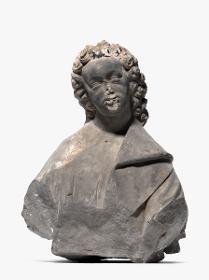
Die Konsole hat eine kelchförmige Gestalt mit Blattornamenten und rechteckiger Deckplatte. Die Deckplatte zeigt ein halbiertes Sechseck und ist wohl dadurch zu erklären, dass sie im schrägen Gewände des Portals gestanden haben wird. Der vegetabile Schmuck besteht aus einer Reihe von Blättern, die dem Kelch aufgelegt sind und zur eckigen Form der Deckplatte vermitteln. Dadurch wird die tektonische Strenge überspielt, ohne gegen die Konventionen des Aufbaus einer gotischen Konsole zu verstoßen.Die Kirche des in den 1030er-Jahren am linken Aaufer gegründeten Damenstifts Liebfrauen war von Beginn an zugleich Pfarrkirche der Bürger der Münsteraner Vorstadt Überwasser. Diese Doppelfunktion, die sich auch in der Finanzierung und Nutzung des 1340 begonnenen Neubaus spiegelt, dürfte für die Konzeption des Westportals von Bedeutung gewesen sein. Mit der Errichtung des Turms wurde, wie man aus einem Bauvertrag weiß, 1363/64 begonnen. 1374 ließ Fürstbischof Florenz von Wevelinghoven (amt. 1364–78) mehrere Reliquien in der rechten Schulter des Marienbildes am Portal einschließen und man hat zu Recht angenommen, dass zu diesem Zeitpunkt das Portal mit seinem Figurenschmuck vollendet war, vielleicht auch schon bereits seit mehreren Jahren. Die Funktion der Konsolen ist die Vermittlung zwischen der streng geometrischen Architektursprache des kunstvollen Portalgebildes und der menschlichen Figur. Daher wurden auch die einzelnen Glieder (Halsring und Kelch) in fantasievolle pflanzliche Gebilde aufgelöst, deren wohl kalkulierter Verismus nicht auf effektvolle Überraschung abzielt, sondern der Wirkungs- und Bedeutungseinheit von Architektur und Skulptur dient.Die Konsolen des Westportals der Liebfrauenkirche passen gut in die Genese gotischer Laubwerkgestaltung, bei der um 1350 eine Tendenz zur stärkeren Bewegung und einem Verwischen der Grenzen zwischen Wand und Ornament festzustellen ist. Die Werkstatt hat, wie die geringere Qualität der späteren Konsolen in Münster zeigt, die Stadt wieder verlassen, möglicherweise, um in Utrecht zu arbeiten, wo sich am Dom um 1380 vergleichbare figürliche Darstellungen finden. Der Steinmetz hat sich eindeutig an der Bauornamentik des Kölner Doms orientiert, wie eine Durchsicht der dortigen Kapitelle im Chor und Langhaus zeigt. (Auszug aus: Tobias Kunz, Bildwerke nördlich der Alpen. 1050 bis 1380. Kritischer Bestandskatalog der Berliner Skulpturensammlung, Petersberg, Michael Imhof Verlag 2014)

Kopffragment auf Büstenkopie: Bildnis einer Prinzessin von Neapel

Kopffragment auf Büstenkopie: Bildnis einer Prinzessin von Neapel

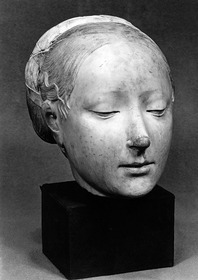
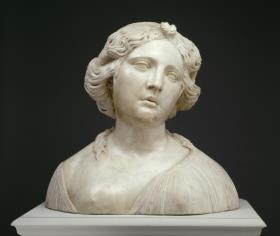
Francesco Laurana war einer der vielseitigsten Bildhauer der Renaissance und arbeitete für bedeutende Fürsten in Italien und Frankreich. Seine weiblichen Büsten sind für die damalige Zeit bemerkenswert, weil sie ihrem Modell einen überraschend modernen Abstraktionsgrad verleihen. Diese Büste stellt wahrscheinlich eine reich gekleidete Prinzessin des Königreichs Neapel dar, deren Brust einst mit einem Edelstein geschmückt war. Die Büste, die am Ende des Zweiten Weltkriegs durch Brände schwer beschädigt wurde, hatte ein einzigartiges Schicksal: Während der Kopf immer in Berlin geblieben ist, gelangte der untere Teil in die Sowjetunion und befindet sich heute im Puschkin-Museum in Moskau. Letzterer wird hier durch einen Abguss ersetzt.Francesco Laurana was one of the most eclectic sculptors of the Renaissance, working for important princes of Italy and France. His female busts are remarkable for the time because they give their model a surprisingly modern degree of abstraction. The present bust probably represents a princess of the Kingdom of Naples, richly dressed and whose chest was once adorned with a precious stone. The bust, which was badly damaged by fire at the end of the Second World War, had a singular fate: while the head has always remained in Berlin, the lower part was transferred to the Soviet Union and is now kept in the Pushkin Museum in Moscow. This lower part is replaced here by a plaster cast.

Maria mit dem Kind im Mantel

Maria mit dem Kind im Mantel

Zusammen mit den mandelförmigen Augen der Jungfrau zeigen die überlängten Proportionen der Figuren, dass das Werk in einer Zeit geschaffen wurde, als der junge Donatello noch von der Gotik beeinflusst war. Die Originalität des Künstlers ist jedoch bereits in der dynamischen Haltung des Kindes sichtbar, und in der Art, wie das Relief viel tiefer erscheint als es tatsächlich ist.Erworben 1892Together with the almond-shaped eyes of the Virgin, the elongated proportions of the figures indicate that the work was created at a time when the young Donatello was still under the influence of Gothic taste. Yet the originality of the artist is already visible in the dynamic pose of the Child, and in the way the relief appears much deeper than it actually is.--Attributed to DonatelloVirgin and Childca. 1410-15Terracotta, formerly painted90 x 67.5 cmBerlin, Staatliche Museen, Skulpturensammlung, Inv. SKS 1940.Bode-Museum, on view.ProvenanceFlorence (1892); Berlin, Skulpturensammlung/Altes Museum (1892-1904); Berlin, Skulpturensammlung/Kaiser-Friedrich-Museum (1904-1939); Berlin, storage (1939-1945); Soviet Union, secret storage (1945/46-1958); East Berlin, Skulpturensammlung/Bode-Museum (1958-1990); Berlin, Skulpturensammlung/Bode-Museum (1990-present).AcquisitionAcquired in Florence in 1892, gift of Oscar Huldschinsky.Restorations1958; 1977-78; 2009.ExhibitionsSchätze der Weltkultur von der Sowjetunion gerettet, East Berlin, National-Galerie and Pergamonmuseum, 1958, cat. D 47.Versions• Bologna, Palazzo Grassi (formerly Tribunale Militare).• Formerly Bologna, Caprara Orléans collection.CommentThis Virgin and Child is a masterpiece of Florentine sculpture from the beginnings of the 15th century – when terracotta was once again used in Italy after a long period of disinterest. The Virgin and the Child are not looking at each other, but at the beholder; however, they are closely linked: the standing Child (supported by the Virgin’s left hand) has flung his right arm around his mother’s neck, while his left arm is covered by her veil (this veil has often been seen as a mantle, hence the name of the composition proposed by Knuth 1990 and Jolly 1998). Tschudi 1892 notes ancient traces of color on the relief; in any case, the paint on the Virgin’s eyes visible in pre-WWII photographs is a modern addition. The current absence of color allows the modeling to be fully appreciated. The fringes of the folds are especially well rendered, as is the drapery in general, through which the anatomy of the figures remains visible – an aspect that was not frequent in early 15th-century Florence. The Virgin’s hair and hands, or the Child’s legs seems to indicate that the work was modeled and not cast from a mold (the deep hollows in the Virgin’s hair also support this judgement).The relief allegedly comes from a villa near Florence, where it was acquired by the Berlin Museums through the Florentine dealer Stefano Bardini with funds provided by Oskar Huldschinski (Bode 1899; the work is sometimes called the Huldschinski Madonna even if it was never part of the rich collection of the entrepreneur). This provenance may explain why the attribution of the work mostly focused on Tuscan artists, while another version of the Madonna, located in the Palazzo Grassi, Bologna, had made Bode 1891 think of Niccolò dell’Arca (see also Malaguzzi Valeri 1932-33, who published the third known version, then also in Bologna, and attributed it to the school of Niccolò dell’Arca). Bode 1899 first proposed that the work was by one of the many Tuscan masters active in Central and Southern Italy. Schottmüller 1913 grouped the work with the Crowning of the Virgin from Santa Maria Novella in Florence now attributed to Dello Delli. In a groundbreaking article, Bode 1914 grouped several Virgin and Child versions in terracotta, including this one, under thename of Lorenzo Ghiberti. Even if this attribution was generally followed, Schottmüller 1932-1933 preferred to see a work by Donatello. This dispute lasted for some decades; during the Cold War, as the sculpture was in the Bode-Museum in East Berlin, the publications of the East insisted more on Donatello, while (consciously or not) the West preferred to point towards Ghiberti.The influence of Ghiberti is indeed visible in the drapery, the elongated proportions and the almond-shaped eyes of the Virgin. However, the Donatellesque traits are much more pronounced: the dynamism of the Child’s pose and his play with his mother’s veil; the fringes of the mantle recurrent in many early works in Florence (from the marble David in the Museo Nazionale del Bargello to the St Peter carved for Orsanmichele); the foreshortening of the Virgin’s right arm, which appears almost superimposable with the arm of the cited David and of the St John the Evangelist made for the Cathedral of Florence and now in the Museo dell’Opera del Duomo (Middeldorf 1938 interestingly rejected the Donatello attribution, but paired the sculpture with the Virgin and Child in the church of San Martino, Pontorme, now widely ascribed to the young Donatello). As the David and the St John by Donatello are documented between 1408 and 1416, this Madonna should be dated to ca. 1410-15. The references to the art of Ghiberti are all the more understandable if the work is by Donatello, as the latter was a pupil of Ghiberti between 1403 and 1407.The Berlin Madonna was badly damaged by fire at the end of WWII. Transferred to the Soviet Union in 1946, the work was returned to East Berlin in 1958 (Grohn 1959). The sculture was restored beforehand; a photograph of the damaged state of the sculpture reveals which parts are original (see Schade 1985; and Kunth 1990). Such damage makes it difficult to ascertain if the work is an original creation by Donatello, rather than a replica. This uncertainty is compounded by the other version in Palazzo Grassi, Bologna, which seems very similar to the Berlin relief but is difficult to access (the version once in the Palazzo Caprara Orléans, now badly damaged, appears to be of much lower quality).LiteratureTschudi 1892Ugo von Tschudi, “Bildwerke der Christlichen Epoche”, Jahrbuch der Königlich Preußischen Kunstsammlungen, XIII, 1892, p. LXXII: Florentine, ca. 1425; style of Jacopo della Quercia. Traces of ancient color.Bode 1899Wilhelm Bode, “Le opere di Niccolò dell’Arca”, L’Arte, II, 1899, p. 499: Tuscan master, active in Central and Southern Italy; found in a villa in the outskirts of Florence; related to another version of the work in the Military Tribunal, Bologna, once published by the author as by Niccolò dell’Arca (Wilhelm Bode, Die italienische Plastik, Berlin, W. Spemann, 1891, pp. 126-127) but not discussed in the following editions of the same book.Schottmüller 1913Frida Schottmüller, Die italienischen und spanischen Bildwerke der Renaissance und des Barocks in Marmor, Ton, Holz und Stuck, Berlin, Georg Reimer, 1913, p. 6 cat. 7: Florentine, ca. 1425; perhaps circle of Bicci di Lorenzo, the author of the Coronation of the Virgin on the façade of Santa Maria Nuova, Florence.Bode 1914Wilhelm von Bode, “Lorenzo Ghiberti als Führender Meister unter den Florentiner Tonbildern der ersten Hälfte des Quattrocento”, Jahrbuch der königlich preußischen Kunstsammlungen, XXXV, 1914, pp. 81-82: Lorenzo Ghiberti.Bode 1921Wilhelm Bode, Florentiner Bildhauer der Renaissance, Berlin, Bruno Cassirer, 1921, p. 84 fig. 41: Ghiberti.Wulff 1922Oskar Wulff, “Ghibertis Entwicklung im Madonnenrelief”, Berliner Museen, XLIII, 9-10, September-October 1922, p. 100: Ghiberti.Malaguzzi Valeri 1932-33Francesco Malaguzzi Valeri, “Sculture del Rinascimento a Bologna”, Dedalo, III, 1932-33, pp. 356, 360: publishes the version in the Caprara Orléans collection, attributed to the school of Niccolò dell’Arca.Schottmüller 1932-33Frida Schottmüller, “Ein Jugendwerk Donatellos im Kaiser-Friedrich-Museum”, Zeitschrift für Kunstgeschichte, I, 1932-1933, pp. 336-340: Donatello.Bange 1933E. F. Bange, Italienische Skulpturen im Kaiser Friedrich Museum, Berlin, Staatliche Museen in Berlin, 1933, pl. 19: Florentine Master ca. 1525 (sic).Schottmüller 1933Frida Schottmüller, Die italienischen und spanischen Bildwerke der Renaissance und des Barock. Erster Band. Die Bildwerke in Stein, Holz, Ton und Wachs, Zweite Auflage, Berlin and Leipzig, Walter de Gruyter & Co., 1933, pp. 6-7: Donatello; cites an unpublished Virgin and Child in the Victoria and Albert Museum, London (Inv. 62-03), by the same hand as the Coronation of the Virgin in the façade of Santa Maria Nuova, Florence; but said to be by a different artist.Bange 1934E. F. Bange, Die Italienischen Bildwerke im Kaiser-Friedrich-Museum, Berlin, Verlag für Kunstwissenschaft, 1934, pp. 21-22: Donatello?Middeldorf 1938Ulrich Middeldorf, review of Schottmüller 1933, Rivista d’arte, XX, 1938, pp. 97-98 now in: idem, Raccolta di scritti that is Collected Writings. I. 1924-1938, Florence, SPES, 1979-80, p. 378: anonymous, same hand as the Virgin and Child in San Martino, Pontorme; the Singing Angels divided between the Kaiser-Friedrich-Museum, Berlin (Inv. SKS 1902) and the Musée du Louvre, Paris (Inv. RF 690); and the Virgin and Child in the Victoria and Albert Museum, London (Inv. 8378-1863).Valentiner 1940W. R. Valentiner, “Donatello and Ghiberti”, The Art Quarterly, III, 1940, pp. 210-213 now in: idem, Studies of Italian Renaissance Sculpture, London, Phaidon Press, 1950, pp. 63, 65: Lorenzo Ghiberti; compared to a Virgin and Child in the Detroit Institute of Arts (Inv. 40.19), also given to Ghiberti.Gnudi 1942Cesare Gnudi, Niccolò dell’Arca, Turin, Einaudi, 1942, p. 82: Tuscan.“Verzeichnis…” 1953“Verzeichnis der im Flakturm Friedrichshain verlorengangenen Bildwerke der Skulpturen-Abteilung”, Berliner Museen, new series, III, n°1-2, 1953, p. 11: burnt between 5 and 10 May 1945.Schätze der Weltkultur… 1958Schätze der Weltkultur von der Sowjetunion gerettet, exh. cat. (East Berlin, National-Galerie and Pergamonmuseum, 1958), East Berlin, Staatliche Museen zu Berlin, 1958, cat. D 47: Donatello.Feist 1959P. H. Feist, Florentinische Frührenaissance-Plastik in den Staatliche Museen zu Berlin, Leipzig, Seemann, 1959, p. 15: Donatello, ca. 1425.Grohn 1959Hans Werner Grohn, “Report on the Return of Works of Art from the Soviet Union to Germany”, The Burlington Magazine, CI, n°670, January 1959, p. 58 fig. 18-19, p. 61: the work, destroyed and in pieces in Berlin in 1945, was “completely assembled in the workshops of the Hermitage”. “It must be stressed that in no case were there any additions made in the process of restoration, but permanent losses of material were substituted by some neutral ingredient.”Malerei und Plastik… 1960Malerei und Plastik. Meisterwerke aus acht Jahrhunderten, East Berlin, Henschelverlag Kunst und Gesellschaft, 1960, pp. 104-105: Donatello?Fründt 1963Edith Fründt, Italienische Plastik des 15.-17. Jahrhunderts, East Berlin, Staatliche Museen zu Berlin, 1963, p. 12 cat. 3: Donatello?Pope-Hennessy 1964John Pope-Hennessy, Catalogue of Italian Sculpture in the Victoria and Albert Museum, London, Her Majesty’s Sationery Office, 1964, I, p. 372: follows Middeldorf 1938.Schulz 1966Sabine Schulz, Staaltiche Museen zu Berlin. Gesamtführer, East Berlin, Staatliche Museen zu Berlin, 1966, pp. 82, 162 (fig.): Florentine, ca. 1420; attributed to Donatello.Wundram 1969Manfred Wundram, Donatello und Nanni di Banco, West Berlin, De Gruyter, 1969, pp. 24, 60.Knuth 1982Michael Knuth, Skulpturen der italienischen Frührenaissance, East Berlin, Staatliche Museen zu Berlin, 1982, pp. 5-8: Donatello, ca. 1415.Rosenauer 1982Artur Rosenauer, “Zum Geremia vom Florentiner Campanile”, Münchner Jachbuch der bildenden Kunst, 3rd series, XXXIII, 1982, p. 70.Darr 1985Alan Phipps Darr in Italian Renaissance Sculpture in the Time of Donatello, exh. cat. (Detroit, The Detroit Institute of Arts, 23 October 1985-5 January 1986 and Fort Worth, Kimbell Museum of Art, 22 February-5 April 1986), Detroit, The Detroit Institute of Arts, 1985, p. 107: attributed to Donatello.Effenberger 1985Arne Effenberger, Führer durch das Bodemuseum, East Berlin, Staatliche Museen zu Berlin, 1985, p. 74: Donatello, ca. 1415.Schade 1985Günter Schade, “Zur Geschichte der Berliner Museumsinsel von Mai 1945 bis Oktober 1959”, in idem (ed.), Weltschätze der Kunst – der Menschheit bewahrt, exh. cat. (East Berlin, Altes Museum, 13 March-23 May 1985), East Berlin, Staatliche Museen zu Berlin, 1985, pp. 26-29: photograph of the work in pieces in the Soviet Union, and copy of the restoration file of 1958.Darr 1986Alan Phipps Darr in idem and Giorgio Bonsanti (eds.), Donatello e i suoi, exh. cat. (Florence, Forte del Belvedere, 15 June-7 September 1986), Detroit and Florence, The Detroit Institute of Arts, La Casa Usher and Arnaldo Mondadori Editore, 1986, p. 132: attributed to Donatello.Fründt 1987Edith Fründt, “Skulpturensammlung”, in Die Museumsinsel zu Berlin, East Berlin, Henschelverlag Kunst und Gesellschaft, 1987, p. 183 fig. 329: Donatello, ca. 1415.Filieri 1988Maria Teresa Filieri, “Edicole sacre nel XV secolo” in eadem (ed.), Immagini di devozione a Lucca, exh. cat. (Lucca, Complesso monumentale di San Micheletto, 18 September-20 October 1988), Lucca, Rugani officine grafiche lucchesi, 1988, p. 12: close to two groups of the Virgin and Child works recently rediscovered in Lucca, but also to a Virgin and Child once in the Vellutini collection, Florence.Kecks 1988Ronald G. Kecks, Madonna und Kind. Das häusliche Andachtsbild im Florenz des 15. Jahrhunderts, West Berlin, Gebr. Mann Verlag, 1988, pp. 56, 88 pl. XXVII fig. 57: circle of Ghiberti, ca. 1440.Forlani Tempesti 1989Anna Forlani Tempesti, “Restauri donatelliani dell’Opificio delle Pietre Dure”, in Donatello-Studien, Munich, Bruckmann, 1989, p. 101 note 9: attributed to Donatello.Gentilini 1989Giancarlo Gentilini in idem and Carlo Sisi (eds.), La scultura. Bozzetti in terracotta, piccoli marmi e altre sculture dal XIV al XX secolo, 1, Siena, Palazzo Chigi Saracini, 1989, p. 45 (Monte dei Paschi di Siena. Collezione Chigi Saracini 4): Donatello.Knuth 1990Michael Knuth, “Die Berliner ‘Maria mit dem Kind im Mantel’ – ein Frühwerk Donatellos?”, Forschungen und Berichte, 28, 1990, pp. 201-210: Donatello, ca. 1415.European Works of Art and Sculpture 1990European Works of Art and Sculpture, sale catalogue (London, Sotheby’s, 13 December 1990), p. 24: compared to a Virgin and Child in terracotta attributed to the circle of Donatello now in the Kimbell Museum of Art, Fort Worth.Gentilini 1992Giancarlo Gentilini, I della Robbia. La scultura invetriata nel Rinascimento, Florence, Cantini, 1992, I, p. 158 note 14: attributed to Donatello.Bellosi and Gentilini 1996Luciano Bellosi and Giancarlo Gentilini, “Una nuova Madonna in terracotta del giovane Donatello”, Pantheon, LIV, 1996, pp. 19-26 (now in: Una nuova Madonna in terracotta del giovane Donatello, exh. cat. Turin, Antichi maestri pittori, 4 April-30 Mai 1998¬¬, Turin, Antichi maestri pittori, pp. 20-21, 23, 33): Donatello.Castelnuovo 1998Enrico Castelnuovo, “Inedito e delicato Donatello”, Il Sole 24 Ore, 87, Sunday 29 March 1998, p. 23: Donatello, related to the Madonna published by Bellosi and Gentilini 1996.Jolly 1998Anna Jolly, Madonnas by Donatello and his Circle, Frankfurt am Main et al., Peter Lang, 1998, pp. 99-100 cat. 14.1: Donatello; late decade after 1400 or early 1410s; called the “Madonna with the cloak”.Cavazzini 2002Laura Cavazzini in Luciano Bellosi, Laura Cavazzini and Aldo Galli (eds.), Masaccio e le origini del Rinascimento, exh. cat. (San Giovanni Valdarno, Casa Masaccio, 20 September-21 December 2002), Geneva and Milan, Skira, 2002, p. 116: Donatello.Darr 2002Alan P. Darr in idem, Peter Barnet and Antonia Boström, Catalogue of Italian Sculpture in the Detroit Institute of Arts, Volume One. Eighth to Sixteenth Century, London and Turnhout, Harvey Miller Publishers and Detroit Institute of Arts, 2002, p. 91: attributed to Donatello; related to a Virgin and Child in the Detroit Institute of Arts (Inv. 40.19).Galli 2002Aldo Galli in Luciano Bellosi, Laura Cavazzini and Aldo Galli (eds.), Masaccio e le origini del Rinascimento, exh. cat. (San Giovanni Valdarno, Casa Masaccio, 20 September-21 December 2002), Geneva and Milan, Skira, 2002, p. 118: Donatello.Galli 2003Aldo Galli, “Calchi in stucco del primo Rinascimento: quattro ‘Madonne’ della Fondazione Giorgio Cini”, Saggi e memorie di storia dell’arte, 27, 2003, p. 161: Donatello.Casciaro 2005Raffaele Casciaro, “Variazione su tema ghibertiano: una ‘Madonna’ in terracotta del primo Quattrocento fiorentino”, Rassegna di studi e di notizie, vol. XXIX, anno XXXII, 2005, p. 87 fig. 18: Donatello.Grisko 2006 ed. 2007Michael Grisko, “Die Ausstellung: Einblicke in die vier Sammlungen”, in Carola Wedel (ed.), Das Bode-Museum. Schatzkammer der Könige, Berlin, Jaron Verlag, 2006 (2nd ed. 2007), p. 102 (Donatello); p. 110 (Benedetto da Maiano; sic).Knuth 2006Michaël Knuth in Skulpturensammlung im Bode-Museum, Munich et al., Prestel, 2006, pp. 125-126: Donatello.Rowley 2013Neville Rowley, Donatello. La renaissance de la sculpture, Garches, A Propos, 2013, pp. 10-11: attributed to Donatello.Gregory D’Apuzzo 2014Mark Gregory D’Apuzzo, “Francesco Malaguzzi Valeri e la scultura del Rinascimento a Bologna: precisazioni e il ‘caso’ della donatelliana ‘Madonna’ Grassi”, in Alessandro Rovetta and Gianni Carlo Sciolla (eds.), Francesco Malaguzzi Valeri (1867-1928). Tra storiografia artistica, museo e tutela, symposium papers (Milan, 19 October 2011 and Bologna, 20-21 October 2011), Milan, Scalpendi Editore, 2014, pp. 78-81: about the other versions.Curatorial Files (Berlin, Bode-Museum)Letter from Artur Rosenauer (21.8.1990): circle of Donatello?Letter from Francesco Caglioti (14.10.2005): Donatello.Neville Rowley (20 May 2016)